

A game can be creatively ready and still need work before release. The legal requirements for releasing a game depend on your target markets, what the game contains, and how players interact with it. Rights, privacy, player-facing information, and platform submission rules all need attention as you prepare to launch.
A global digital release can involve several overlapping workstreams. Start by defining where you plan to release and which players you intend to reach. Then separate statutory duties from platform policies and publishing agreements. This checklist helps you organise those reviews and identify which questions need qualified legal counsel. For jurisdiction-specific obligations, work with qualified legal counsel, and use current official platform guidance for submission details.
As you plan to bring your game to consoles, a structured publishing pipeline helps organise platform submissions and certification. Ocean Media brings over 20 years of gaming-industry experience to digital console publishing, supporting developers as they prepare to reach a global audience. When you’re ready to move forward, reserve your slot in our publishing pipeline and let's get started today!
Key Takeaways
- Map the markets, audience, game features, and distribution model that shape the legal requirements for releasing a game.
- Build a rights inventory for game assets and trace ownership through the agreements behind their creation.
- Document player-data practices and review public-facing game information so legal review can focus on the relevant questions.
- Separate legal duties from platform policies, certification checks, and commercial agreements before submission.
- Track each readiness task with an owner, evidence record, dependency, and status as you prepare to bring your game to consoles.
Which Legal Requirements Apply Before You Release a Game?
The legal requirements for releasing a game depend on the game, its audience, your target markets, and how you distribute it. A digital console launch can reach players in several countries, so your checklist may need to account for different jurisdictions. There is no universal rulebook. Define the release you’re planning, then have qualified legal counsel assess the questions that depend on your markets and project.
How do target markets shape a game’s legal checklist?
Before researching obligations, map your intended countries, languages, platforms, and player groups. These choices help focus legal review. For example, the audience you intend to reach and the features your game offers can shape what counsel needs to assess in each market. Ground your 2026 release plan in current, market-specific research rather than assumptions based on another game or launch.
Keep the market map current. If your planned countries, platforms, or audience change, revisit the research with counsel. That gives your team a reliable starting point for rights, privacy, and player-information reviews.
What counts as law, platform policy, or a contract?
Keep three categories distinct. Legal requirements arise from laws and other legal duties that may apply to your release. Their scope depends on the jurisdiction and the facts, so qualified counsel should assess them. For background on how rights issues can span different markets, see Intellectual property protection for video games.
Platform policies and certification checks are separate from legislation. They set platform-specific expectations for submission, review, and release. Meeting these expectations can be necessary for storefront readiness, but it does not replace legal review. Use current official platform guidance for submission details.
Publishing agreements are commercial contracts. Their negotiated terms can define responsibilities and working arrangements between parties. They are not the same as laws or platform rules, so review them alongside your release plan to clarify who owns each task.
Use this scope check to organise the work:
- List intended countries, languages, platforms, and player groups.
- Identify questions that need jurisdiction-specific legal review.
- Separate legal duties, platform submission criteria, and contract terms.
- Assign an owner to track each workstream and its supporting records.
A publishing partner can coordinate platform-facing submissions and certification, while qualified legal counsel assesses legal questions. As you plan to bring your game to consoles, our console publishing process provides a structured publishing pipeline for platform work.
Check Game Rights, Licences, and Agreements Before Release
Before platform submission, create a rights inventory for every creative and technical element in your game. Include code, artwork, music, writing, voice recordings, and other incorporated materials. For each item, record its origin, rights holder, supporting agreement or licence, permitted uses, and restrictions. This makes it easier to see what is cleared and which items need follow-up.
How can a studio document ownership of game content?
Trace each asset to the person or organisation that created or supplied it. Gather signed employment and contractor agreements, co-creator arrangements, commissioned-work records, and relevant studio agreements. Payment alone should not be treated as proof that ownership transferred. The effect depends on the governing agreement and applicable law, so ask qualified counsel to assess uncertainties.
A simple inventory can reveal gaps before release:
- Asset: identify the work or component and where it appears.
- Origin and rights holder: record who created or supplied it and who holds relevant rights.
- Permission: note the agreement or licence and its terms.
- Restrictions and evidence: capture conditions such as attribution, permitted platforms, territories, or commercial use, and keep the supporting records together.
Which third-party assets and agreements deserve a release check?
Review middleware, open-source components, stock assets, music, fonts, and any licensed intellectual property. Don’t assume a licence covers every intended platform, territory, or commercial use. Read the actual terms, including attribution requirements and other usage restrictions. The ESA’s perspective on intellectual property offers industry context. Counsel can assess how specific agreements and applicable laws affect your game.
Review agreements beyond individual assets, too. Publisher, platform, and collaboration agreements may set permissions, responsibilities, or approval steps that affect release readiness. Keep these documents with your rights inventory, and flag unclear ownership or licence terms for qualified legal review before submission. For an overview of how publishing fits into bringing your game to consoles, explore our console game publishing process.
Once your rights records are organised, we can coordinate platform-facing work within a structured publishing pipeline.
Review Privacy, Player-Facing Information, and Age Ratings
Include privacy, public-facing information, and age ratings in your release plan. These areas connect to the player experience, but they are not interchangeable. A rating does not settle privacy questions, and accurate store copy does not replace legal review. The legal requirements for releasing a game depend on your markets and the details of your game, so have qualified counsel assess jurisdiction-specific duties.
What should developers map about player data?
Start with an inventory of data handled by the game, connected services, analytics, and third-party tools. Record what is collected, why it is used, where it is stored, whether it is shared, and which parties are involved. This gives counsel a clearer picture to assess against your target markets. Don’t assume the same privacy rules apply identically across all territories.
Review player-facing material as well, including the game description, disclosures, support details, and purchase-related information. Check that each statement is accurate and consistent with the game’s features and data practices. Keep a record of the versions reviewed so your team can identify what was approved for release.
How do age ratings relate to legal readiness?
Age-rating processes and legal obligations are separate review tracks. Ratings communicate age suitability through the relevant rating process; they do not determine whether your data practices, agreements, or disclosures meet applicable legal duties. Coordinate the work so the game’s features, public descriptions, and submission materials stay consistent. For rating-process context, see the Global Console Game Age Rating Guide for Developers 2026.
For broader background on intellectual property considerations that can inform a separate rights review, WIPO’s Intellectual Property Rights for Game Developers offers a useful reference. Keep that work distinct from your player-data assessment.
Use this comparison to assign owners and organise evidence:
Legal obligations: Counsel assesses applicable duties by market. Keep the review notes and relevant decisions.
Age-rating processes: Your team coordinates the rating submission and records the outcome and supporting materials.
Storefront policies: The publishing team tracks current platform requirements and retains submission records.
Studio evidence: Your team maintains data inventories, approved disclosures, support information, and version records.
As you prepare to bring your game to consoles, we coordinate platform-facing requirements and certification within a structured publishing pipeline.
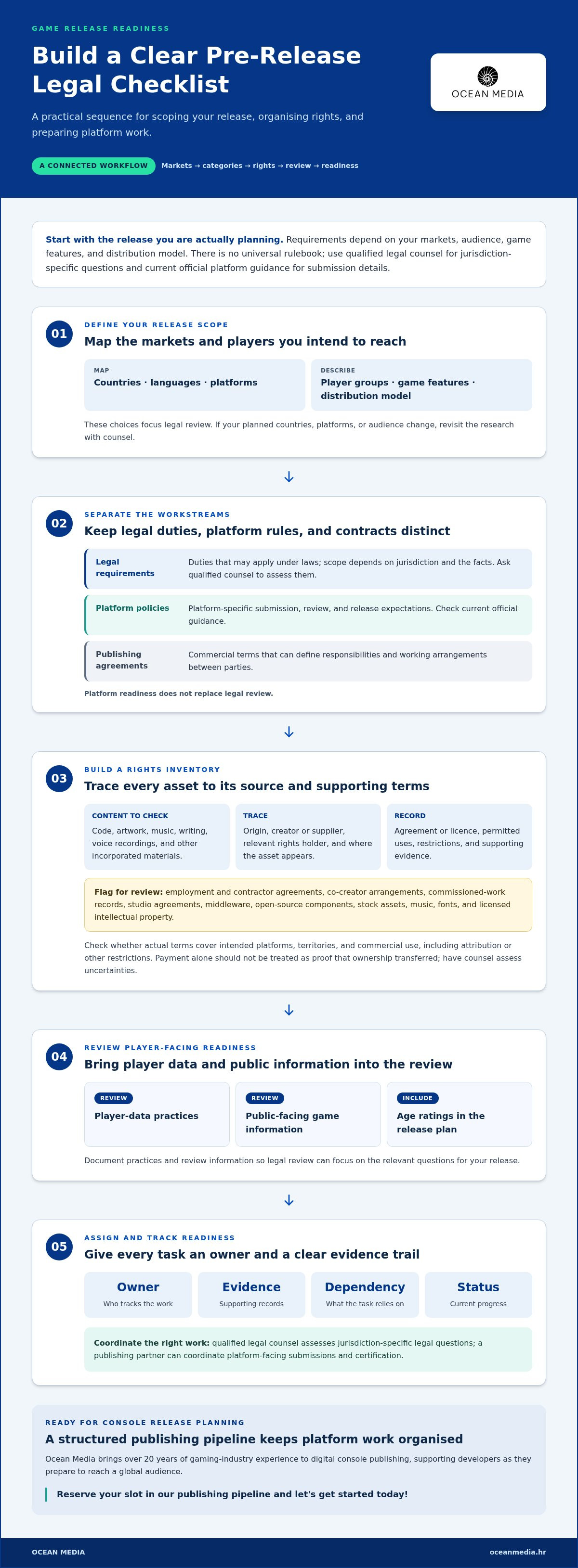
Pre-Release Checklist: Legal Duties vs Platform Rules
Turn your release scope into a workflow your team can track. The legal requirements for releasing a game vary with your markets and project details, so distinguish counsel-led legal decisions from studio records and platform submission work. For each task, name an owner, save evidence, note dependencies, and update the status. You can use “not started,” “in progress,” “blocked,” or “complete” without setting an unsupported deadline.
- 1. Map the release. Owner: release lead. Evidence: intended markets, languages, platforms, and player groups. Dependency: initial release plan. Status: record the current state and flag changes for review.
- 2. Inventory game rights. Owner: production or rights coordinator. Evidence: asset register, contributor agreements, licences, and usage restrictions. Dependency: access to project files and signed records. Status: flag gaps or unclear permissions for follow-up.
- 3. Map player data and public information. Owner: product or privacy lead. Evidence: data-flow inventory, relevant privacy materials, approved game descriptions, disclosures, support details, and purchase-related copy. Dependency: current feature and service information. Status: separate items ready for review from questions requiring counsel.
- 4. Escalate legal questions. Owner: studio lead coordinates; qualified counsel assesses jurisdiction-dependent issues. Evidence: written advice or decision records held by the studio. Dependency: market scope, game features, data practices, and relevant agreements. Status: keep each unresolved question open until the appropriate decision is recorded.
- 5. Prepare platform submissions. Owner: publishing or submission lead. Evidence: platform-specific forms, assets, and certification materials, kept separate from evidence of legal review. Dependency: current official platform documentation and submission criteria. Status: track each platform’s requirements and submission progress.
What should your team document before submission?
Keep a decision log for market scope, age-rating status, and open legal questions. Store rights records, agreement and licence details, privacy materials, and approved public-facing copy where the responsible team can find them. Maintain platform submission materials in a separate folder or tracker. This separation helps your team distinguish a legal review, a studio record, and a platform criterion.
How should you handle unresolved release questions?
Escalate questions involving jurisdiction, player age, data use, or contract interpretation to qualified counsel. Assign each open item an owner and note whether it blocks a decision, a submission, or release readiness. For platform policies and technical criteria, use current official documentation rather than relying on old submission notes.
For the wider console release roadmap, explore our guide to publishing a game on console. We coordinate platform-facing requirements and certification as you bring your game to consoles.
Bring Your Game to Consoles with a Structured Publishing Pipeline
Legal readiness is one workstream in the broader digital console publishing lifecycle. Rights, privacy, and market-specific questions need their own review, while platform preparation involves separate submission and certification tasks. Coordinating these workstreams helps your team see what is ready, what depends on another decision, and where specialist input is needed.
Where can a publishing partner support the release process?
A publishing partner can coordinate platform requirements, submission preparation, and tasks involved in a digital release. This includes organising platform-facing materials, tracking submission requirements, and supporting certification as your game moves through the publishing pipeline. These activities support your release plan, but they do not replace qualified legal advice or guarantee platform approval.
As you plan to bring your game to consoles, a structured process connects platform work with your studio’s wider release goals and helps prepare for a global digital audience. Explore our console publishing support to learn how we work with developers on platform-facing requirements and certification.
What is the next step for your studio?
Start with a clear snapshot of your project. Outline your game, target platforms, intended markets, and current release stage. Note which submission tasks are underway and which legal questions still need qualified counsel. With that context, your team and publishing partner can set a practical path through platform-facing work without confusing it with legal review.
Ocean Media brings over 20 years of gaming-industry experience to digital console publishing. We coordinate platform submissions and certification with developers, making the route from release planning to launch preparation more structured. The legal requirements for releasing a game remain a separate workstream for your studio and qualified legal counsel. Our role is to support the publishing process around your console release.
Ready to take the next step? reserve your slot in our publishing pipeline and let's get started today!
Move from Release Planning to Console Launch
A release-ready game needs more than a completed build. The legal requirements for releasing a game depend on your markets and project, so map your release scope and have qualified counsel review jurisdiction-specific questions. Organise rights, player data, and public-facing information, and distinguish legal decisions from platform policies, submission materials, and certification.
With those workstreams assigned, you can approach bringing your game to consoles with a structured plan. Ocean Media brings over 20 years of gaming-industry experience and expertise navigating console platform submissions and certification. We support digital publishing for developers reaching a global audience, coordinating platform-facing work as part of your publishing pipeline. This support complements legal review; it does not replace legal advice or guarantee approval.
Share your game, target platforms, intended markets, and current release stage to take the next step with our team. Your console release journey can begin with a clear plan and the right partners working alongside you.
Frequently Asked Questions
What legal requirements apply when releasing a video game?
The requirements depend on your target markets, audience, game features, and distribution model. Areas to assess may include ownership and licences for game content, player-data practices, public-facing information, and purchase-related details. The legal requirements for releasing a game are not identical across countries, so map your intended markets and ask qualified legal counsel to assess which duties apply to your release.
Do game developers need a lawyer before releasing a game?
Whether your studio must engage a lawyer depends on the applicable jurisdictions and the facts of your release. Qualified counsel can assess questions about rights, agreements, privacy, and player-facing obligations that platform guidance alone cannot resolve. Give counsel a clear picture of your game, target markets, player groups, and data practices. A publishing partner can coordinate platform-facing work, but does not provide legal representation.
Can I release a game worldwide with one privacy policy?
Don’t assume one privacy policy will address every market in the same way. Start by documenting what data the game, connected services, analytics, and third-party tools collect, why they use it, and who receives it. Then have qualified counsel assess the relevant jurisdictions and whether your player-facing materials accurately explain those practices. Revisit the review if your features, markets, or data use change.
What happens if a game uses third-party music, art, or software?
Identify the applicable licence or agreement and review its terms before release. Check who holds the relevant rights, what uses are permitted, and whether the terms cover your planned platforms, territories, commercial use, and attribution. This applies to music, artwork, fonts, middleware, and open-source components. If ownership or permission is unclear, flag it for qualified legal review before submission.
Are age ratings a legal requirement for every game platform?
There is no universal answer for every game, market, and platform. Age-rating processes are a distinct release workstream, and their requirements can differ from legal duties and between platform submission processes. Check current official platform and rating-system guidance for your intended release. A rating outcome does not replace legal review of rights, data practices, or player-facing information.
Do console platform rules count as legal requirements?
Platform rules and certification criteria are distinct from legislation, though both can affect release readiness. Platform requirements set conditions for submitting or releasing a game through that platform. Legal duties arise from applicable law and need jurisdiction-specific assessment. Meeting a platform’s submission criteria does not by itself resolve your legal obligations. Track the two workstreams separately and use current official platform documentation for submission details.
How early should a studio review legal requirements before launch?
Start while defining target markets, platforms, audiences, and game features, rather than waiting until submission preparation. Early review gives your studio time to identify rights or data questions and gather relevant records. Revisit the assessment when your release scope or game changes. There is no universal timeline for every project, so have qualified counsel assess jurisdiction-specific obligations and plan platform work against current official guidance.


