

What if age-rating work could become a planned part of your console release, rather than a last-minute publishing hurdle? If you’re managing global age ratings for a console game, it makes sense to consider territories, rating organizations, platform workflows, and submission details early. Inconsistent content descriptions or metadata can create avoidable friction while your team coordinates a complex launch.
A repeatable process starts with a territory-aware plan and a consistent source of truth for your game’s content. This guide explains how to map where ratings may apply, prepare clear submission information, and track rating tasks alongside your publishing pipeline. You’ll also find criteria for deciding whether your team can coordinate the work internally or would benefit from a publishing partner.
Ocean Media brings over 20 years of gaming-industry experience to digital console publishing, helping developers navigate platform-specific requirements and certification as they pursue global digital distribution. Rating preparation can be coordinated with the wider console publishing process. When you’re ready to discuss bringing your game to consoles, explore console publishing for developers.
Key Takeaways
- Build a territory-and-platform matrix before preparing submissions, and verify which rating routes apply instead of assuming they’re the same in every market.
- Managing global age ratings for a console game becomes more repeatable when each task has a clear owner, status, and source of content information.
- Compare in-house coordination with a publishing-partner approach based on your team’s experience, market scope, and available capacity.
- Bring rating planning into your wider publishing pipeline so it can be coordinated alongside platform submissions and digital launch planning.
- For help with bringing your game to consoles, discuss digital publishing support with Ocean Media.
Why managing global age ratings for a console game starts with release planning
Age-rating work is easier to coordinate when it’s part of your release plan from the start. Identify the intended markets and platforms, check which rating routes may apply, and keep the game’s content information consistent as submissions progress. Leaving this work until late in the schedule can force your team to check details while other launch tasks are already underway.
Global age-rating management is the coordinated planning and tracking of content assessment, rating submissions, market coverage, and related platform and store information for a game release. It isn’t one universal application: the relevant systems and processes can differ by market and platform. For an overview of the international landscape, see Video game content rating systems.
What does global age-rating management involve?
Separate the work into connected but distinct areas. Content assessment establishes what information about the game needs to be reviewed. Rating submissions follow the applicable route for each market. Platform requirements and store information belong in the same coordination plan, but they aren’t automatically part of a rating submission.
Age ratings communicate a game’s suitability for audiences under a rating system. Platform certification, by contrast, concerns a platform’s submission and approval process. Track these as separate workstreams, and verify the current terminology and workflow for each platform rather than assuming one process covers the other. The console age-rating systems guide offers system-by-system background. Confirm current applicability and submission details before acting on it.
Why can ratings affect a console launch plan?
Rating preparation connects to submission readiness because teams need reliable content details to coordinate rating work with platform submissions and digital launch planning. If the game’s content changes, or the same feature is described differently across materials, your team may need to review and reconcile those details before moving forward. That can create avoidable rework during a busy point in the release process.
Make the work trackable early. For each planned market and platform, record the rating route to verify, the owner of the next action, the status, and any information still needed. This gives your team a practical view of open decisions without assuming that one rating or process applies everywhere. A publishing partner may also help coordinate rating tasks within the broader publishing pipeline. Ocean Media brings over 20 years of gaming-industry experience in digital console publishing, including support with platform-specific requirements and certification.
Map markets and rating systems before preparing console submissions
Start with the markets you intend to reach and the console platforms you plan to support. Then check which rating route applies to each market-platform combination. This makes the work visible before you prepare submissions and helps prevent assumptions, such as treating one rating as automatically valid everywhere.
For broader launch planning, see our global console launch localization guide. Connect your intended storefront coverage with the rating research and platform workflows that still need confirmation.
How do you decide which territories to include?
List your intended storefront markets alongside each planned console platform. For every combination, record the rating body or route to verify, the information needed, the person responsible, and the current verification status. ESRB, PEGI, USK, and the Australian Classification Board are examples of systems relevant to major markets, but check their applicability and processes for your specific release.
Verify market coverage separately for each platform. A market’s presence in your release plan does not by itself confirm which rating route applies to a particular console.
What belongs in a territory-and-platform matrix?
Keep the matrix practical and easy to update. Include columns for market, platform, rating body or route, required inputs, submission status, responsible person, and verification notes. Mark uncertain or potentially changing details as “verify” until someone checks current official guidance.
- Market and platform: Where and on which console you intend to release.
- Rating route: The system or submission path to confirm for that combination.
- Inputs and owner: Information to prepare and the person accountable for the next action.
- Status and source: Progress, open questions, and the official guidance used to verify the route.
IARC may offer a streamlined route on participating digital storefronts, but don’t assume it applies to every market or console workflow. Check current platform and market procedures directly with the International Age Rating Coalition (IARC) and relevant platform guidance before listing it as the applicable route.
This matrix gives your team a shared reference for managing global age ratings for a console game, while keeping confirmed requirements distinct from open questions. To discuss how market planning fits into digital console publishing, explore our console publishing for developers.
Compare in-house and publishing-partner approaches to age-rating management
There’s no single ownership model that suits every studio. The right choice depends on your team’s experience, the markets and platforms in scope, available capacity, and how closely rating tasks need to connect with the wider console release. Managing global age ratings for a console game can remain with your internal team or be coordinated as part of a broader digital console publishing relationship.
When might a studio manage the process internally?
Internal ownership can work well when your team has the knowledge and capacity to track market-specific rating tasks alongside platform submissions. Assign a clear owner, define who reviews content information, and make decisions and status updates accessible to everyone involved. For example, a team planning a North American release can consult the official ESRB rating system guidance as part of its research, then verify other relevant routes separately.
Be realistic about workload. A small team may be able to manage a focused release plan, while broader market coverage can create more coordination points. In-house management isn’t automatically faster or less costly. Weigh the time needed to verify processes, prepare information, follow up, and keep platform work aligned.
What can a publishing partner contribute?
A publishing partner may help connect rating coordination with platform submissions and digital launch planning. Console publishing experience can help organize related administrative work and clarify where rating tasks sit within the overall publishing pipeline. A partner’s role depends on the relationship, so agree on responsibilities explicitly rather than assuming who will research markets, prepare or review information, track submissions, or communicate updates.
Use the console publishing roadmap for wider process context, then use these questions to guide your decision:
- Experience: Who can verify current rating-body and platform workflows?
- Scope: How many markets and platforms need coordination?
- Capacity: Can your team own follow-ups without pulling focus from other release tasks?
- Responsibilities: Which tasks belong to your studio, and which are included in the publishing relationship?
Ocean Media brings over 20 years of gaming-industry experience and helps developers navigate platform-specific requirements and certification throughout digital console publishing. If you’re assessing how a publishing partner could fit your release, explore our console publishing for developers.
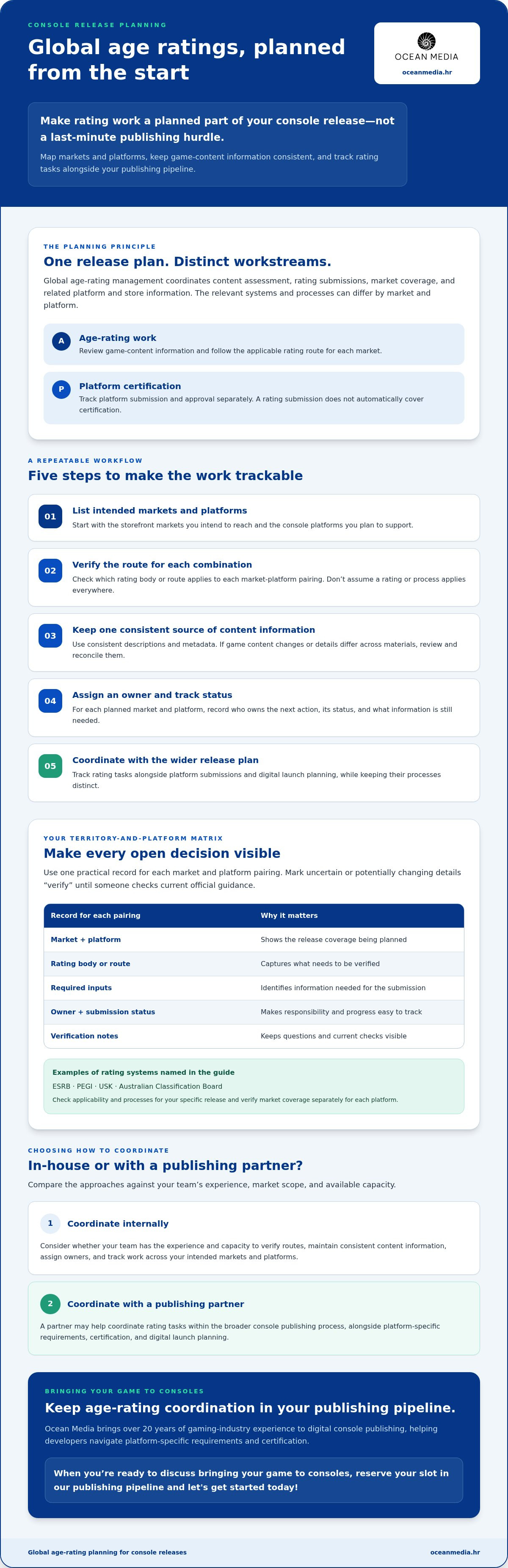
Follow a repeatable workflow for managing global console game age ratings
A shared tracker turns rating work into a set of clear actions. For every task, record a named owner and a current status, such as “not started,” “in progress,” “awaiting confirmation,” or “complete.” Adjust the labels to fit your team, and use the workflow below to move from release scope to ongoing review.
- Confirm markets and platforms. The release manager lists intended storefront markets and console platforms, then records the plan and status in the tracker.
- Verify rating routes. The ratings lead checks current official guidance for each market-platform combination, records the source and verification date, and flags anything uncertain for follow-up.
- Prepare content information. A designated content owner creates an accurate inventory of game content relevant to rating submissions. The ratings lead checks the current requested materials for each applicable route before anything is submitted.
- Maintain one source of truth. The project lead identifies the approved version of content descriptions and related submission information. Teams working on ratings, platform submissions, and storefront tasks should refer to that version and raise discrepancies with its owner.
- Track submissions and follow-ups. The submission owner logs each status, communication, next action, responsible person, and verified decision. Keep the record current so the team can see what is complete and what still needs attention.
- Review changes against the plan. The release manager checks whether changes to game content, markets, or platforms affect existing rating tasks. Assign any needed re-verification to an owner and keep it open until confirmed.
What information should teams prepare and review?
Build content descriptions from the game itself, then confirm that the information is accurate and consistent across submission and storefront work. Avoid separate, untracked versions that could describe the same feature differently. Requirements vary, so don’t assume one set of materials will fit every rating route. The owner should verify each rating body’s current requests before submission and note where that confirmation came from.
How should a team track submissions and changes?
Use a central log for decisions, submissions, follow-up actions, owners, and status updates. Rating tasks need ongoing tracking when project details change: review affected markets and platforms, verify whether existing information remains accurate, and document the outcome. This keeps the team’s release record aligned with the current game and launch plan.
For support that connects rating coordination with digital console publishing, explore publishing support.
Bring age-rating coordination into your console publishing pipeline
Age-rating planning works best as part of the wider release picture. Keep it connected to platform submissions and digital launch coordination, so teams can see how rating-related tasks fit alongside other publishing work. This doesn’t mean the same person or partner must own every task. It means responsibilities, open questions, and communication should be clear as your release moves forward.
For developers managing global age ratings for a console game, a publishing partner can be an option for coordinating this work within a broader digital console publishing relationship. Before agreeing on an approach, clarify what is included and how decisions or changes will be shared.
What should you discuss with a publishing partner?
Use an initial discussion to align on scope and ownership. Ask direct questions, then document the answers so your team and partner have the same expectations:
- Roles: Who tracks rating-related tasks, verifies applicable routes, and maintains the status record?
- Markets: Which intended digital markets are within the proposed publishing scope, and which details still need confirmation?
- Platforms: Which console platforms are included, and how will rating work connect with their submission workflows?
- Communication: Who shares updates, raises questions, and alerts the team if content or release plans change?
Then align the answers with your submission and launch plan. A clear division of responsibilities helps everyone understand what the studio must provide, what the partner is coordinating, and where current guidance still needs to be verified.
How can you get started with Ocean Media?
Bring your console-release goals and current preparation status to the conversation. Outline your intended platforms and digital markets, the rating research your team has completed, and any unclear ownership or next steps. That gives both sides a practical starting point for discussing how publishing work fits together, without assuming a rating route or outcome in advance.
Ocean Media is a digital console publisher with over 20 years of gaming-industry experience, helping developers navigate platform-specific requirements and certification throughout digital console publishing. To discuss bringing your game to consoles, explore console publishing support.
Make age-rating coordination part of your next release plan
Managing global age ratings for a console game works best as a coordinated publishing task, not a form left until launch. Start by mapping intended markets and platforms, then verify the rating routes that apply to each. Keep content information consistent, assign owners and statuses, and review the plan when release details change.
You can manage the work internally or discuss coordination with a publishing partner. The right approach depends on your team’s experience, capacity, release scope, and the responsibilities you agree together. Either way, connect rating preparation with platform submissions and digital launch planning.
Ocean Media brings over 20 years of gaming-industry experience, with expertise in digital console publishing and navigating platform submissions. To discuss how Ocean Media can support your console release, explore console publishing for developers.
Frequently Asked Questions
Do console games need a separate age rating for every country?
Not necessarily, but don’t assume one rating applies across every country. The rating route can depend on the intended market, console platform, and current procedures. Map your planned territories and platforms, then verify the relevant rating body or process for each combination. Some digital storefronts may use a shared rating process, but confirm that it applies to your specific release before relying on it.
Can one age rating be used across different console platforms?
Don’t assume a rating obtained through one platform or storefront automatically covers another. Applicability depends on the rating route and the platforms involved, so check current guidance for each planned release. Record what you’ve verified, where you verified it, and any open questions. Treat age-rating work and platform submission tasks as related but distinct parts of your console publishing plan.
How do developers identify which age-rating systems apply to their game?
Start with your intended digital markets and console platforms, then verify the applicable rating system and submission process for each. Systems such as ESRB, PEGI, USK, and the Australian Classification Board may be relevant depending on your release scope. Check current official guidance rather than relying on assumptions or a system’s name alone. Keep the route, source, owner, and verification status in a shared tracker.
What game content information should developers prepare for rating submissions?
Prepare an accurate inventory of the game’s content and maintain consistent descriptions for rating submissions and related storefront information. Assign an owner to keep the approved information up to date, so teams don’t work from conflicting versions. Before submitting, check the current materials requested by the relevant rating body or route. The exact information needed can vary, so verify it for each planned submission.
When should a studio begin managing global age ratings for a console game?
Begin during release planning, while you’re defining target markets and console platforms. Early planning gives your team time to verify which rating routes may apply and coordinate the work with platform submissions and digital launch tasks. You don’t need every detail resolved at once. Start a tracker, name an owner for each open question, and update the plan as your release scope develops.
Can a console game’s age rating change after submission?
It can depend on the rating process and whether the submitted game information changes or needs further review. Don’t assume an initial decision will remain applicable if the game’s content or release plans change. Track follow-up requests and confirmed decisions, and check with the relevant rating body or platform about the next steps. Keep a record of what changed and which markets may be affected.
What can a game publisher do to help manage global age ratings?
A publisher can help coordinate rating-related work within the broader digital console publishing process, including connecting it with platform submissions and launch planning. Agree explicitly on responsibilities, markets, platforms, updates, and any tasks that remain with your studio. Ocean Media is a digital console publisher with over 20 years of gaming-industry experience and expertise in platform submissions. To discuss bringing your game to consoles, explore console publishing for developers.


