

Bringing your game to consoles involves more than distribution. You may need technical and administrative support to navigate console platform requirements, while other release responsibilities remain with your team. Understanding these publishing roles can help you identify the support you need.
If you’re developing a game, it helps to understand how publishing support fits into bringing your game to consoles. Our team can help you navigate the technical and administrative steps and follow a structured path through the publishing pipeline.
Ocean Media supports developers with Console Game Publishing, including help navigating console platform submissions. Reserve your slot in our publishing pipeline and let's get started today!
Key Takeaways
- Prepare your game build and submission materials for each console platform.
- Plan for platform requirements, certification, and submission timelines in our publishing pipeline.
- Track submission feedback and address required updates to keep your release moving forward.
- Clarify which technical and logistical tasks you’ll handle and where our team can help.
- To bring your game to consoles, reserve your slot in our publishing pipeline and let's get started today!
Console publishing support
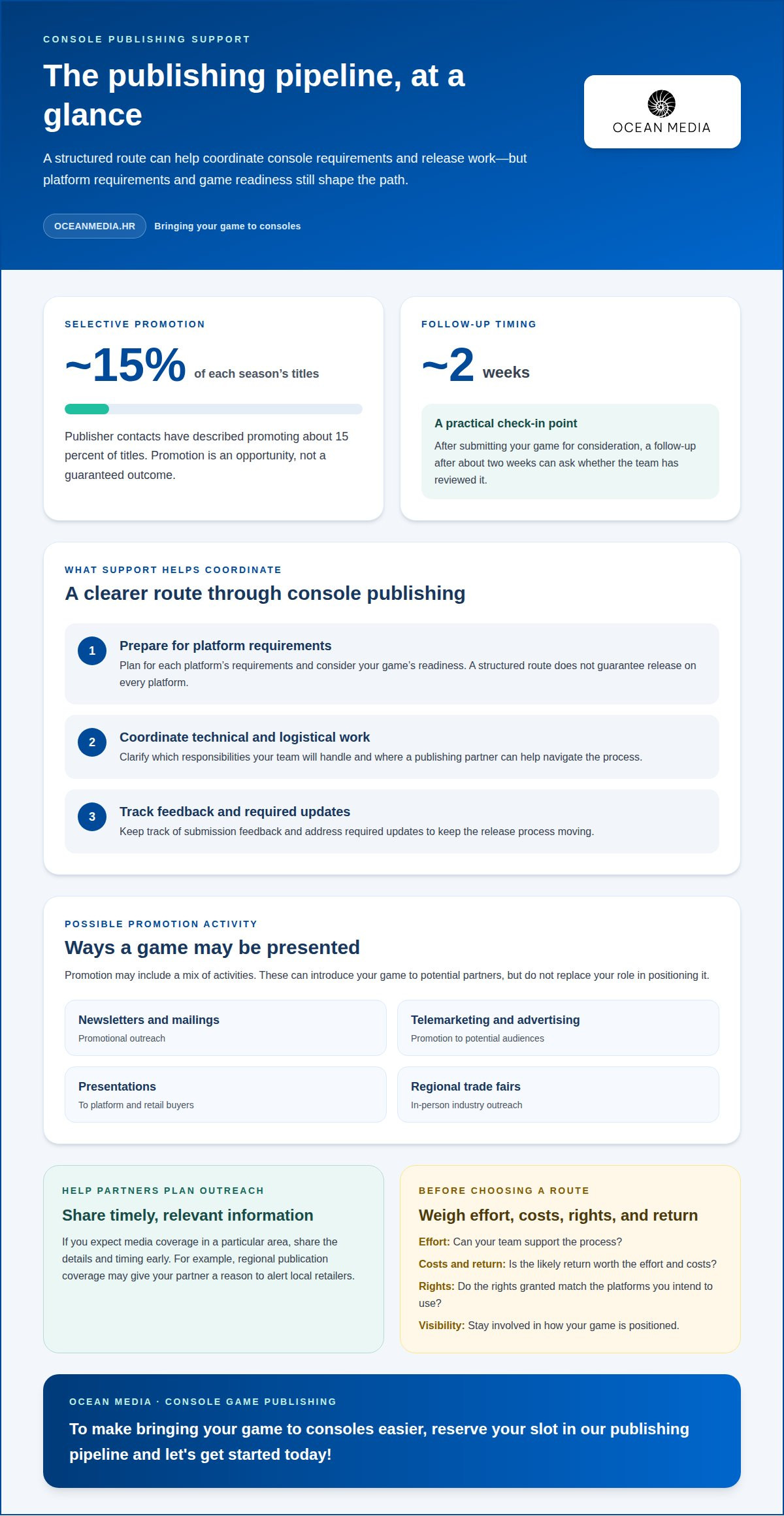
Bringing your game to consoles involves working with platform partners and navigating the publishing pipeline. Rather than managing every technical and logistical step alone, you can work with a partner who helps coordinate the process. A structured route can simplify planning, but it does not guarantee a release on every platform. Platform requirements and your game’s readiness still determine its path to release.
Publishing support can also create opportunities to present your game, though attention is selective. Publisher contacts have described promoting about 15 percent of each season’s titles. Promotion may include newsletters and mailings, telemarketing, advertising, presentations to platform and retail buyers, and regional trade fairs. These activities can introduce a game to potential partners, but they don’t replace your role in positioning it. Our team can help you prepare your game for the publishing pipeline while you remain involved in how it is presented.
Timely, relevant information can help your game reach the right partners. If you expect media coverage in a particular area, share the details and timing with your publishing partner early so they can plan outreach before interest peaks. For example, coverage in a regional publication may give your partner a reason to alert local retailers.
Bringing your game to consoles offers a route to new audiences, but each platform has its own requirements and process. Our support can help you plan the technical and logistical steps, while you focus on your game. Each platform’s terms also affect the share of sales retained.
Before choosing a route, compare the effort and costs with the likely return. A publishing partner may provide access to platform and retail networks and promotional activity, while you still contribute to your game’s positioning and visibility. Rights also matter: you must grant the publisher or platform the rights needed to release your game. If you submit your game for consideration, a follow-up after about two weeks can ask whether the team has reviewed it.
Platform partners often prefer working through an established publishing pipeline rather than coordinating with many individual developers. For a new studio, this support can offer a structured path to console releases without managing every step alone. These advantages do not remove the need to assess whether you can support the process and whether the likely return justifies the effort and costs.
Revenue terms also warrant close attention: Amazon Kindle and Apple take a royalty cut of 30% – 65% on ebook sales, depending on the distribution channel and distribution rights. Compare the terms alongside the work each route requires, rather than treating access to a platform as the only measure of its value. A route that makes a game available may still call for time and resources to support its position and visibility. Consider whether the expected return is proportionate before committing, and make sure the rights granted match the platforms you intend to use. To make bringing your game to consoles easier, reserve your slot in our publishing pipeline and let's get started today!
Trade discounts and distribution fees
Retail discounts determine how much of a book’s list price remains after a sale. In Canada, the standard bookstore discount is 40% of the retail price. A distributor may also receive a share for supplying retailers, leaving the publisher with less than the full list price. The exact division matters because printing, marketing, and other publishing expenses may still come out of the publisher’s share. For each title, assess the net amount per copy, not just the headline retail price.
Canadian distribution discounts can be higher than the bookstore discount alone. The average distribution discount in Canada is a minimum of 60% off the retail price. In the example behind that figure, the distributor’s gross margin is 20%, alongside the bookstore’s 40% discount. This illustrates how a combined channel discount can reduce the amount received by the publisher. It is an example of the split, not a universal contract term for every book, retailer, or distribution arrangement.
A broader estimate places book distribution costs between 15% and 55% of the retail price for each item sold. That range makes it important to understand what a quoted distribution charge covers. A percentage taken from the list price affects each sale differently from a charge calculated on the amount received after retailer discounts. Ask how the calculation works in the agreement, then map the result against expected book sales and production costs. The key step is tracing the money from list price to publisher proceeds.
Self-publishing can leave an author with a higher share of each book’s sale than working with a publisher, but that does not automatically mean higher profit. You may also take on more responsibility for reaching retailers, managing sales operations, and building an audience. A distribution arrangement can exchange part of the proceeds for channel access or support. Compare the share you retain with the work and costs you would otherwise handle yourself.
Run the calculation for different channels and titles before deciding where distribution fits. Include the retailer discount, distributor share, and costs that remain your responsibility. Then consider whether the channel can reach the audience most likely to buy that particular book. For developers evaluating a separate publishing path, console release publishing support involves a different product and pipeline from book distribution.
Availability versus distribution
A distribution-only publisher focuses on making books available through sales channels. A traditional publisher may also shape a book’s concept and presentation, and oversee design and production. Both routes can support distribution, but they differ in how much publishing work extends beyond channel access. That distinction affects creative control, production responsibilities, and the support surrounding a title.
Compared with self-publishing platforms, a distribution-only arrangement adds a distribution partner, while self-publishing lets you retain control over creative decisions. Online-store distribution may have no upfront distribution cost, with costs incurred only when a book sells. Compare the channel access and services provided with the tasks and decisions you keep.
Most importantly, distribution means a book can be ordered through a channel; it does not mean bookstores or libraries will order or stock it. A listing can make a title discoverable, but a retailer still decides whether it suits local customers, available shelf space, and expected demand. Availability through a supplier can support ordering without guaranteeing physical placement.
That distinction matters when planning printing and inventory. Physical-store distribution is more expensive than online distribution and involves high inventory costs and delays in availability. If you print a large quantity before retailer orders develop, you carry the stock while waiting for sales. Online availability can reduce the need to place inventory in stores, but it does not create bookstore demand by itself.
Think of distribution as distinct stages: first, a title becomes orderable; then a retailer decides whether to order it; finally, customers decide whether to buy it. Each stage has a different decision-maker. A distributor can provide access to its channels, but cannot make a particular store place an order. Authors still need to build awareness and position titles for their intended audience.
Traditional publishing can include work beyond distribution. James Gurney’s experience describes publishers helping shape concepts and presentation, improving design and production, and managing inventory, warehousing, and returns. These responsibilities can affect how smoothly books move from printing to retailers. A distribution-only arrangement is narrower: its value lies in channel access and distribution functions, not in assuming the publisher handles every part of a book’s development.
Use this distinction to set realistic expectations. If bookstore availability is your priority, separate the question of whether retailers can order your book from whether they will choose to stock it. If online access is the main goal, consider how the channel handles orders and whether your audience can find the title there. Matching the route to your goal clarifies what distribution can do and what remains outside its scope.
Console publishing infrastructure
Console publishing support can cover build preparation, submission management, certification coordination, metadata, invoicing, and publisher payments. Marketing support may be limited unless a title gains significant visibility; you remain responsible for positioning your game.
Publishing-Only Support Functions
A publishing-support partner connects the operational steps between preparing a game for console release and managing its publishing requirements. This can include coordinating builds, submissions, platform communications, and administrative tasks. The practical benefit is less day-to-day release work for you. The trade-off is that technical and administrative support does not automatically include broader marketing support.
Services and Marketing Support
Publishing services and marketing support are separate parts of a publishing relationship, so don’t mistake release coordination for a full marketing campaign. A partner may handle technical requirements and platform access, while you position your game and build visibility with players. Keeping these responsibilities distinct helps set expectations.
The workflow links several functions. A game build is prepared, submission materials are checked, and the build moves through platform review. The partner may then coordinate feedback, track release requirements, manage invoices, and handle publisher payments. Each handoff affects how smoothly your game moves through the publishing pipeline and how clearly its status is tracked.
Cash flow is another part of the infrastructure. A publishing cycle can require 60 days or more between paying for release work and receiving platform revenue. You may have to pay for development or release services 2–4 months before receiving a payment. That gap means release expenses can arise well before related revenue reaches you.
Structured build and submission processes can reduce operational demands. They help you avoid managing every release task on your own, including tracking requirements, preparing materials, and coordinating submissions. Instead of handling each step without support, you can follow a clear process. This can reduce hands-on administrative work, though the publishing process still depends on accurate game information and timely submissions.
Consider a simple example: you submit a game build, but its accompanying information is out of date. The submission may need extra handling before it can proceed. Accurate records connect build status, release requirements, and administration, so a publishing partner’s systems matter as much as its platform access. Ask what operational steps the arrangement covers, then distinguish those functions from marketing, positioning, and other publishing work.
Assess infrastructure as a sequence of tasks, not a single service. Build preparation, submission coordination, requirements tracking, invoicing, and publisher payments address different points in bringing your game to consoles. Marketing remains a distinct responsibility. Knowing who handles each task helps you identify the support you receive and the work you still need to plan. To make starting simple, reserve your slot in our publishing pipeline and let's get started today!
What does a distribution-only publisher do?
A distribution-only publisher focuses on moving a book through sales channels and handling related operations. The role can cover retailer orders, shipment, invoicing, inventory records, and payments to the publishing author. For example, when a bookstore orders copies, distribution functions connect that order with fulfilment. The arrangement centers on making a title distributable, rather than taking responsibility for every part of publishing.
The work may start before release because channels need time to prepare for a title. Authors are advised to arrange online-store distribution about one month before release. Physical-book distribution calls for an earlier start, six months before release. These timelines reflect different channel processes, so build the route into your release plan.
Once orders begin, distribution may involve order entry, packing, shipping, customer invoicing, and inventory control. It can also include debt collection and payments to client publishers. Each function covers a distinct handoff: inventory control records stock, while shipping moves a packed order toward its destination—a logistical step where companies shipping physical boxed goods often partner with protective specialists like Foam Packaging Direct. Together, these tasks support the commercial flow from retailer order to publisher payment.
Rights are another part of the relationship. Authors must grant a publisher or distributor the rights needed to distribute their book. Those rights allow the partner to make the title available through the agreed channels. The scope matters: a channel arrangement can cover how a book reaches stores, while editorial development, design, and broader marketing are separate publishing activities.
Physical distribution can involve inventory, warehousing, and returns. A publisher may manage these functions, while print-on-demand can spare an individual author from holding stock and handling orders, packing, and dispatch. The operational difference is clear: stocked copies require inventory management, while print-on-demand produces copies in response to orders. The channel and production model shape the work involved.
Use the arrangement’s defined scope to understand what happens after a book is ready. Separate channel access from order fulfilment, inventory handling, rights, and promotion, then identify who handles each responsibility. This gives you a practical picture of the publishing workload instead of assuming one distribution agreement covers every step from preparing a book to building demand.
Ocean Media
Ocean Media is a next step when your project is a game, not a book, and you need support bringing it to consoles. Its Console Game Publishing service helps developers navigate the technical and administrative complexities of console platform submissions. This focus can help you understand the publishing process and move your game through a structured pipeline, rather than applying book-distribution models to a different medium.
If you’re preparing a console release, contact Ocean Media to discuss your publishing needs. Reserve your slot in our publishing pipeline and let's get started today!
Choose the Right Publishing Path for Your Next Release
The benefits of publishing support depend on which work you want handled and which responsibilities you’re prepared to retain. For your game, use that distinction to guide your console release plans and focus on the technical and administrative path to bringing your game to consoles.
Ocean Media offers Console Game Publishing for developers preparing a console release. Discussing your project can help you consider how publishing support fits your goals and where to begin in the publishing pipeline.
Contact Ocean Media to discuss your options, reserve your slot in our publishing pipeline and let's get started today!
Frequently Asked Questions
Who actually owns the distribution?
Distribution rights are granted to a publisher or distributor for the agreed arrangement; that does not by itself determine who owns the book. The agreement defines which rights are granted and which channels they cover. For example, an author may authorize distribution through specified sales channels while retaining other rights. Read the rights and territory clauses together to understand who can distribute the title, where, and under what terms.
What are the benefits of using a distribution-only publisher?
A distribution-only publisher can give authors access to established sales channels and reduce the administrative work of reaching them individually. For example, a distributor can consolidate retailer orders across titles, while print-on-demand can avoid holding a large quantity of stock. This model may suit authors who want channel access but plan to manage other parts of publishing themselves. Its value depends on which tasks the arrangement actually covers.
What are the risks and drawbacks of distribution-only publishing?
The main drawback is that distribution access does not ensure sales, store placement, or broad promotional support. You may still need to position the book, build reader awareness, and manage responsibilities outside distribution. A title can be orderable by a retailer yet remain absent from its shelves. The financial trade-off matters too: retailer discounts and distribution charges reduce the proceeds available from each sale.


