

A publisher isn’t automatically the easier or more profitable route to a PlayStation release. The publisher vs. self-publishing on PlayStation decision comes down to the support you need, the control you want to retain, and the publishing responsibilities your team can manage.
For a solo developer or small team, self-publishing can be feasible, but your team will take on more of the work behind the release and its ongoing operations. A publisher may contribute funding, marketing, distribution expertise, or platform support in exchange for agreed rights and a share of revenue. The right fit depends on your project and the terms offered.
This comparison explains how publishing agreements and self-publishing differ in costs, revenue, marketing, distribution, platform access, and control. It also highlights the key considerations for a small team deciding how to bring a game to consoles.
Key Takeaways
- Compare the revenue share with the responsibilities and support included in the publishing agreement.
- Clarify how the contract handles intellectual property, publishing rights, territories, duration, and future content.
- Assess whether your team can manage marketing, release operations, and ongoing support independently.
- Weigh the creative control of self-publishing against the funding, audience access, and infrastructure a publisher may contribute.
- When you’re ready to bring your game to consoles, reserve your slot in our publishing pipeline and let's get started today!
Publisher revenue splits, advances, and contract terms
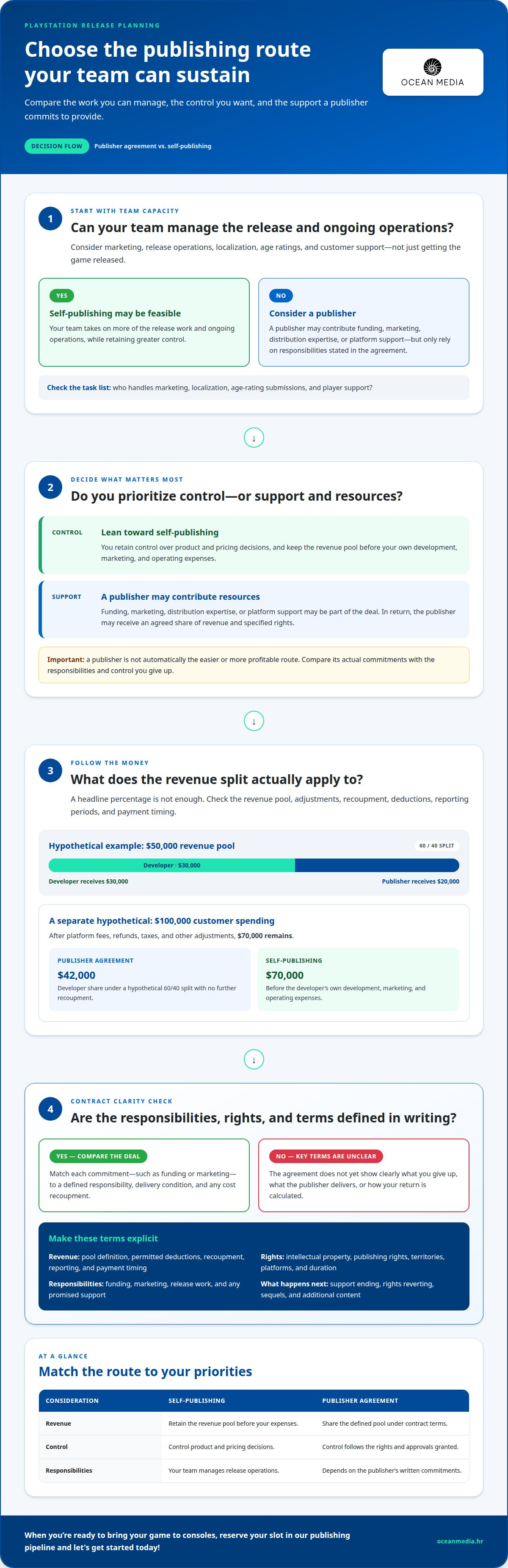
Choosing between a publisher and self-publishing on PlayStation means weighing the revenue you retain against the support and control you need. Self-publishing gives you greater control and a larger share of earnings, but your team handles the operational work. A publisher may contribute resources or manage parts of the release in exchange for agreed rights and revenue. The contract defines each side’s contributions, returns, and decision-making authority.
Start with the revenue pool, not just the headline percentage. In one hypothetical example, a $50,000 pool is split 60/40: the developer receives $30,000, and the publisher receives $20,000. The agreement must define which receipts enter that pool and which adjustments come first. A separate comparison assumes $100,000 in customer spending, with $70,000 remaining after platform fees, refunds, taxes, and other adjustments. Under a hypothetical 60/40 publisher agreement with no further recoupment, the developer receives $42,000. Self-publishing leaves the developer with that $70,000 before its own development, marketing, and operating expenses.
An advance also needs precise terms. The contract should state whether it is recoupable, which revenue will repay it, and when revenue shares begin. A percentage alone can obscure your actual return. Check how the agreement defines reporting periods, payment timing, permitted deductions, and access to sales statements. These details help you understand the financial impact before the release.
Creative control depends on the rights you grant. Self-publishing can preserve your control over the game, pricing, and customer relationships. A publisher agreement may assign decision-making authority over marketing, release plans, or other specified activities. Before signing, clarify who owns the game’s intellectual property, which publishing rights you grant, and which territories and platforms they cover. Define the agreement’s duration, what happens if the publisher stops supporting the game, and who controls sequels and additional content.
| Option | Revenue | Creative control | Responsibilities |
|---|---|---|---|
| Self-publishing | You retain the revenue pool before your expenses. | You control product and pricing decisions. | Your team manages release operations. |
| Publisher agreement | You share the defined pool under contract terms. | Control follows the rights and approvals granted. | Responsibilities depend on publisher commitments. |
Use the table as a starting point, then assess the agreement clause by clause. Match each publisher commitment, such as funding or marketing, to a defined responsibility and delivery condition. Confirm whether costs are recouped from game revenue and how that affects the split. If the publisher receives platform or territory rights, make sure they match your intended release scope. The contract should also explain how rights revert when its term ends.
Compare the value you receive with the revenue and decision-making authority you give up. A publisher’s percentage matters only in the context of its actual obligations, recoupment terms, and rights. Self-publishing may suit a team ready to make creative decisions and manage operational demands. Choose the arrangement whose written terms support your release goals, ownership priorities, and capacity.
Publisher-paid production and marketing expenses
Publisher funding can ease production and marketing demands, but what gets paid for depends on the agreement. The contract determines who handles marketing, localization, age ratings, and customer support on PlayStation. With self-publishing, your team coordinates those tasks or arranges support. A publisher handles them only if its commitments say so.
Production and marketing expenses
A publisher may fund agreed production work or marketing, while a self-publishing team plans and pays for its own campaign. Don’t assume “publisher-funded” means an unlimited budget. Define covered work, approval rights, timing, and reporting in writing. For example, a campaign plan can specify who creates promotional materials, who approves them, and how spending is tracked against the release plan.
Separate production support from promotion. If a publisher funds additional development work, specify the deliverables and how schedule changes will be handled. For marketing, identify whether the publisher commits to campaign planning, audience outreach, or creative assets. Your team can then compare the promised contribution with its own capacity, rather than assuming every expense or task transfers automatically.
Marketing and audience development
Marketing works best when you define an audience and a clear reason for players to choose your game. Research comparable titles, player communities, and the features that distinguish your experience, then use those findings to shape a concise value proposition. A publisher may contribute audience insight and campaign execution. Self-publishing gives you direct control, but your team must build and maintain those connections.
For community development, focus on the channels where your intended players already share feedback. A Discord community, developer website, creator outreach, or educational content can help players follow development and understand the game. Set a regular schedule for updates and feedback, then monitor responses and adjust the campaign. Treat engagement as an ongoing part of the release, not a one-off announcement.
Localization, ratings, and customer support
Assign these responsibilities individually rather than bundling them under a broad promise to “publish” the game. The agreement can specify who coordinates localization, prepares age-rating submissions, and responds to player support requests. With self-publishing, your team organizes each task directly or arranges support. A publisher’s role depends on the written scope.
Make the division practical. For localization, define who supplies source text and reviews language versions. For ratings, name the party responsible for preparing materials and managing submission steps. For customer support, specify who receives player issues and how feedback reaches the development team. A clear workflow helps you plan internal capacity and coordinate console publishing support around your release.
Distribution and platform access
Releasing on PlayStation requires platform access, release preparation, and approval, whether you publish independently or through a publisher. The main difference is who coordinates those steps and handles the related work.
Self-publishing requirements
For PS5 and PS4, self-publishing means arranging platform access and preparing your game for submission. Plan around the platform’s access process, development needs, and submission requirements; don’t assume the two console generations use identical processes. Self-publishing games have appeared on PSN, showing that independent release is a viable route for developers.
To apply to become a PlayStation partner, prepare information about your studio, game, and intended release, then submit it through PlayStation’s developer application route. A publisher can help coordinate platform access and distribution, while self-publishing leaves that relationship and its administration to your team. In either case, organize your project details before starting the application.
Build your budget around the work involved rather than assuming there is one fixed publishing cost. Developer kits, production preparation, and certification are separate considerations. The total depends on the equipment and services your project requires. A publisher may fund or coordinate agreed work, while an independent developer plans and pays for its own requirements.
Self-publishing has reached a meaningful scale on PSN: more than 500 self-published games and more than 160 studios were represented at the time described. Those figures illustrate access, not guaranteed visibility or sales. Your distribution plan still needs to account for how players will discover the game and how your team will support its release.
Certification and release approval
Certification is the approval stage between a prepared game and its release. Sony’s PS4 self-publishing approval process is a one-stage process. That gives developers a defined approval pathway, but it doesn’t remove the need to prepare the game and required submission materials carefully.
For PS5, treat certification as a separate release milestone and follow the applicable submission process for that platform. A publisher may coordinate preparation and communication as part of its agreed role; self-publishing means your team manages those activities. Keep ownership of the submission schedule clear, including who responds to requested changes.
There is no single reliable timeline from application to release for every game. The schedule depends on application progress, development readiness, submission preparation, and approval. Map these stages in order and allow the release plan to account for work that may need attention after submission. Align funding and distribution plans with that schedule instead of assuming approval and launch will happen immediately.
Feasibility for solo developers and small teams
Solo developers and small teams can self-publish on PlayStation, but feasibility depends on available time, skills, and operational capacity. The question isn’t simply whether you can submit a game. It’s whether your team can manage its lifecycle, from production and pricing to marketing, payments, security, and ongoing player support.
Map the work before choosing a route. For example, a solo developer might handle game production and store updates while arranging third-party support for worldwide sales operations. A small studio could assign release coordination to one team member, leaving others focused on development. Making responsibilities visible helps reveal gaps before they affect the release.
Self-publishing gives you direct control over product decisions, pricing, and customer relationships. That flexibility matters if your game serves a clearly defined niche or needs a distinct release strategy. It also means your team must make and carry out those decisions. Competition adds pressure: independent developers need a specific reason for players to notice their game among other PlayStation releases.
Start with scope. Define your audience, the features that distinguish the game, and the work required to support it after launch. Then set goals that match your team’s capacity. A small team targeting a focused niche can prioritize relevant communities and a manageable update plan instead of stretching its resources across every possible audience and channel.
Treat operational readiness as part of production. Payments, security, regulatory compliance, customer support, and updates all need an owner. For each responsibility, identify who handles it, what information they need, and how player feedback reaches the development team. If a task requires expertise your team lacks, third-party support can help preserve focus without transferring every creative decision.
A publisher may be a better fit when your plan depends on support your team cannot provide internally. Assess the specific work offered, such as funding, audience access, or release infrastructure, against the obligations and control granted in return. Don’t decide based on the publisher label alone. Compare your actual capacity with the agreement’s actual contribution.
Use this decision guide: choose self-publishing if your team can manage the release workload and wants direct control; consider a publisher if defined support fills important operational or audience gaps. If neither route covers every need, keep core creative work in-house and assign specific operational tasks to capable third parties. This helps you plan a feasible PlayStation release around your team’s strengths.
Traditional publishing compared with self-publishing
A PlayStation publisher may provide funding, audience access, and release infrastructure in exchange for a share of revenue and defined rights. With self-publishing, you retain more control but manage the game’s lifecycle and operations yourself.
Traditional publishing
A traditional publisher works with your team under an agreement that allocates responsibilities, rights, and revenue. For example, the publisher may fund agreed work or coordinate parts of the release, while your studio focuses on development. The value depends on specific commitments, not the publisher label. Review what support is promised alongside the rights and decision-making authority the contract grants.
This arrangement can help when your team needs funding, audience access, or publishing infrastructure. The trade-off is less independence and a smaller share of the defined revenue pool. A publisher should not ask you to pay for its work. If a proposal shifts payment responsibility to your studio, assess whether it is truly a publishing arrangement.
Self-publishing
Self-publishing puts product decisions and release management in your hands. You control pricing, marketing, and the customer relationship, but you also take on operational work, including payments, security, and regulatory compliance. For example, your team decides how to position an update and organizes the work needed to deliver it.
That independence can suit a developer with a clear audience and the capacity to manage the full lifecycle. It also means coordinating platform submissions and release work without a publisher managing those tasks. Platform requirements still apply: publishing independently does not remove PlayStation’s approval process.
The distinction is practical: traditional publishing trades some control and revenue for support, while self-publishing trades that support for greater autonomy. Neither route removes the need to build an audience. A self-publishing team can use social media to share development updates, invite feedback, and direct interested players to the game. A publisher may contribute audience access, but the agreement should define what that means in practice.
Compare each route with the work your studio can realistically handle. List core needs, such as financing, campaign planning, platform coordination, and player communication. Mark which responsibilities your team can manage and which need outside support. Then compare a publisher’s written commitments with those gaps instead of assuming broad promises of marketing or distribution guarantee specific activity.
For a small team, a mixed approach can preserve creative control while assigning specific operational tasks to third parties. For example, you might keep pricing and game updates in-house while arranging external support for worldwide sales operations. Define who owns each decision, how feedback reaches developers, and which rights remain with your studio. This can make release work more manageable without treating publishing as an all-or-nothing choice.
If you’re planning a console release, explore a structured path for bringing your game to consoles.
Ocean Media: Console Game Publishing
Ocean Media provides Console Game Publishing for developers bringing games to consoles. If platform submissions and release administration are taking focus away from your game, publishing support may be a practical next step. Ocean Media helps developers navigate the technical and administrative complexities of console submissions and digital distribution across console platforms.
That support can be relevant whether you’re a solo developer or a small studio planning a PlayStation release. You can focus on your project while working with a publishing partner on the path to a wider audience. Contact Ocean Media to discuss your game, reserve your slot in our publishing pipeline and let's get started today!
Turn your release plan into a clear next step
Your choice between a publisher and self-publishing on PlayStation should support how you want to grow your game, not just solve the immediate release challenge. The decision becomes more practical when you identify what your team wants to retain, what it can manage, and where experienced support could help focus the process.
Use those priorities to guide your next conversation. Clarify your release goals and the areas where you want support, then consider how console publishing fits your plans for the game. Ocean Media offers Console Game Publishing for developers bringing their games to consoles.
Explore Console Game Publishing with Ocean Media and take the next step toward a release plan that fits your team. Your game’s journey to consoles can start with a clear conversation about where you want to go.
Frequently Asked Questions
Is self-publishing a feasible path for individual developers or small teams?
Yes, if your team can handle release responsibilities alongside development. A solo creator might schedule store updates and player communications around production, while a small team can assign those duties to specific members. Before committing, map recurring work and decide who owns each task. If essential responsibilities have no clear owner, narrow the release plan or arrange targeted external support.
What are the key differences, advantages, and disadvantages compared to traditional publishing?
Traditional publishing involves an agreement with a publisher that may contribute resources or release support; self-publishing leaves the developer in charge. Compare your decision-making needs with the work your team can take on. For example, a studio that wants direct control over pricing may prefer independence, while one lacking release expertise may value defined publisher support. The trade-off is autonomy versus shared responsibilities and rights.
What revenue share and royalties do PlayStation publishers and self-publishers receive?
There is no single revenue share for every PlayStation publishing deal. Your contract establishes how revenue is calculated, which deductions apply, whether advances or expenses are recouped, and when royalties are paid. If self-publishing, track storefront receipts separately from refunds, taxes, and operating costs. A clear revenue statement should show each deduction and the remaining amount, allowing you to reconcile payments against sales reports.
What are the advantages and disadvantages of using a publisher versus self-publishing on PlayStation?
A publisher can contribute resources and expertise, while self-publishing gives you more direct control over decisions and player relationships. The best fit depends on your priorities and capacity. If your team can manage community channels and coordinate post-launch updates, independence may be workable. If those activities would displace core development, compare the publisher’s defined support with the rights and revenue share it requests.
What risks and contract terms should developers consider when signing with a PlayStation publisher?
Focus on terms that affect ownership, income, and what happens if the partnership ends. Check whether revenue recoupment could continue after support stops, and how unsold or unpaid amounts are handled. Confirm who controls sequel and additional-content decisions, and whether rights return automatically at the agreement’s end. For example, a sequel clause can affect a future game even after the original PlayStation release is complete.


