

The publisher vs. self-publishing decision on Nintendo Switch isn’t always an all-or-nothing choice. A publishing partner can bring funding, marketing support and experience with console submissions, while self-publishing gives you more direct control and responsibility for the work and costs. A hybrid approach may also be worth considering, depending on the agreement and what your game needs.
Creative freedom and revenue share matter, but compare who funds the release, handles marketing, and manages the publishing pipeline too. This guide covers those trade-offs, including platform submissions, costs, and crowdfunding, to help you decide which route fits your studio and project.
You’ll also see how a console publishing partner can help with the technical and administrative demands of bringing a game to consoles. The aim is to clarify what support you need and which responsibilities you’re ready to keep.
Key Takeaways
- Compare the creative control you want with the revenue share, recoupment terms, and responsibilities in a publisher agreement.
- Assess whether publisher funding and platform-specific support fit your release better than carrying more costs and decisions yourself.
- Marketing, press, and launch planning require time and resources; partnerships can divide that workload in different ways.
- A focused submission can help a publisher understand your game, while industry relationships may shape how it reaches the right people.
- If console publishing support fits your needs, reserve your slot in our publishing pipeline and let's get started today!
Creative control and freedom when self-publishing your game
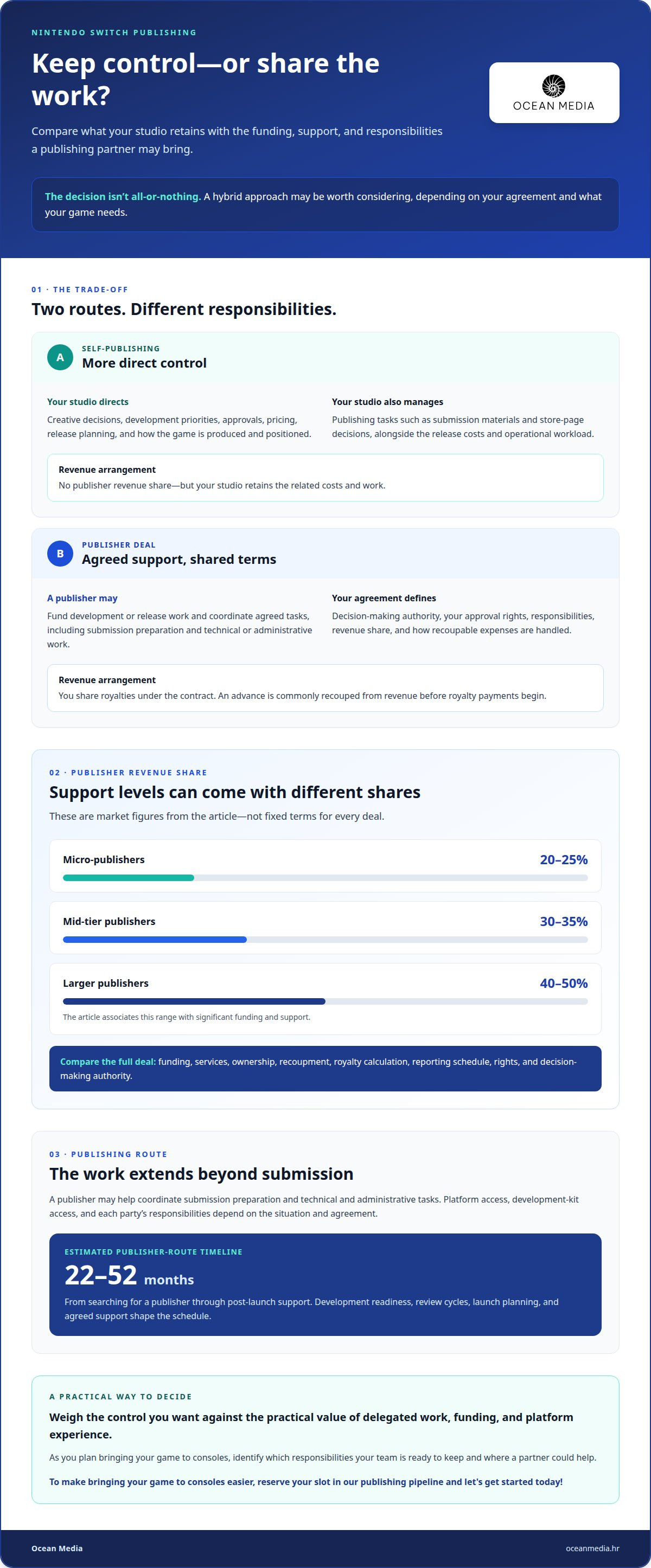
Self-publishing gives your studio direct control over creative decisions, pricing, release planning, and the publishing process. With a publisher, you share some decisions and royalties in return for agreed support. The publisher-versus-self-publishing choice for Nintendo Switch comes down to which responsibilities you want to retain and which you want a partner to manage.
With self-publishing, your studio sets development priorities, approves changes, and decides how to produce and position the game. You also manage release tasks, including submission materials and store-page decisions. A publisher may coordinate some of this work, but the agreement defines its authority and your approval rights. As you plan bringing your game to consoles, consider which tasks your team can manage and where a partner can help.
Revenue shares vary by publisher and the support included. Micro-publishers may take 20-25%, mid-tier publishers commonly take 30-35%, and larger publishers may take 40-50% when providing significant funding and support. Self-publishing avoids a publisher’s share, but your studio retains the related costs and workload.
An advance is not automatically income on top of royalties. Agreements commonly specify how an advance is recouped from revenue before royalty payments begin; exact terms depend on the contract. Before signing, review the recoupment terms, royalty calculation, reporting schedule, rights, and decision-making authority.
| Option | Creative control | Revenue arrangement | Publishing responsibilities |
|---|---|---|---|
| Self-publishing | Your studio directs decisions | No publisher revenue share | Your studio manages the process |
| Publisher deal | Shared or contract-defined | Share and recoupment terms vary | Publisher handles agreed tasks |
Choose by weighing control against the practical value of delegated work, funding, and platform experience. A clear publishing pipeline can help you understand the stages and responsibilities involved.
A publisher can coordinate the Nintendo Switch publishing process, including submission preparation and technical and administrative tasks. Publisher relationships may also provide access to Nintendo development kits and help a studio navigate platform requirements. The agreement should set out specific responsibilities and approvals.
For a publisher route, the estimated timeline is 22-52 months, from searching for a publisher through post-launch support. That period covers more than submission; development readiness, review cycles, launch planning, and agreed support shape the schedule. A console publishing process can help organize those stages around your game. To make bringing your game to consoles easier, reserve your slot in our publishing pipeline and let's get started today!
Funding differences between publisher deals and self-publishing
Funding affects who carries development expenses and how revenue is shared. The right scenario depends on the resources your game needs and the support you want to secure.
Publisher Deal Funding and Fees
A publisher may fund development and release work, then recoup agreed expenses from game revenue before royalties are paid. Mid-tier publishers commonly take a 30-35% revenue share; larger publishers may take 40-50% when they provide significant funding and support. These are market figures, not fixed terms for every deal.
A platform-specific publishing deal focuses on releasing a game for a particular console, rather than funding every platform. A proposed Nintendo indie model would let developers retain independence and own some or all of their intellectual property while receiving funding and creative guidance. Nintendo requirements include platform access and completing the game submission process; publishers may offer development-kit access through platform relationships.
Self-Publishing Requirements and Commissions
Self-publishing puts the funding burden on your studio, but leaves you in control of resource allocation and release timing. A successful release still requires completing Nintendo’s platform process, preparing a suitable game build, and handling the technical and administrative work. A publisher can coordinate those steps, while your studio provides the game and project information.
Literary agents represent a different kind of deal from game publishers. Domestic publishing deals typically involve a 15% commission; foreign rights deals typically involve 20%, often divided equally between a primary agent and subagent at 10% each. These are book-industry comparisons, not Nintendo game-publishing rates. For a Switch game, publisher shares and recoupment terms belong to the signed agreement.
There is no universal fee for publishing a Switch game through a publisher. The agreement defines any advance, revenue share, recoupable expenses, funding, and services, so compare the full terms rather than focusing on one percentage. Self-publishing avoids a publisher share, but your studio finances the release and handles the operational workload.
Before signing or committing your own budget, map funding against responsibilities. A publisher’s funding can help cover the planned release without putting every expense on your studio, while self-funding preserves direct control. Compare ownership, recoupment, platform support, and the costs your team must carry.
PR, marketing, and press responsibilities
A publisher deal can shift some launch marketing work, while self-publishing leaves your studio to coordinate promotion. The right fit depends on which campaign tasks you want supported.
Publisher Marketing Support
A publisher may fund and coordinate marketing, press outreach, and launch activity as part of its agreement. Clarify which tasks it handles, which require your approval, and whether campaign expenses are recouped from revenue. “Publisher support” can mean a full campaign or a narrower contribution to specific materials or activities.
Marketing-only partnerships separate promotion from other publishing responsibilities. A marketing partner can focus on campaign planning and press, while your studio retains other release duties. Porting partnerships are different: they focus on adapting a game for another platform and may have a scope separate from Nintendo Switch marketing. The agreement should spell out each partner’s responsibilities.
For example, if a publisher funds press outreach but your team supplies trailers and updates, assign task owners and approval steps before launch. A clear plan aligns campaign timing, messaging, and assets. Unless the contract assigns those tasks to the publisher, include them in your studio’s release plan.
Self-Promotion and Marketing Workload
With self-publishing, your studio plans and runs its own marketing or hires specialists. A campaign can include capsule art, key art, social promotion, press materials, and ongoing audience updates.
These costs sit alongside the time your team spends preparing assets, publishing updates, and coordinating press. Set priorities by assigning each task and estimating how much campaign work your development team can handle without disrupting production.
Store-page wishlists can help you assess audience interest. A modest, sustainable launch target is described as 5,000 wishlists. Estimates suggest 10-20% of store-page visitors may wishlist a game, while 10-15% of wishlists may convert to purchases during the first week after launch. Treat these measures as planning inputs, not a straight forecast of sales.
Choose a publisher, marketing-only arrangement, porting partner, or self-promotion based on the gap you need to fill. If your studio already has campaign capacity, focused support may suit the project. If not, broader publisher funding and coordination can reduce your team’s workload.
Finding publishers and submitting games
Finding a Nintendo Switch publisher takes more than sending a game build. A focused submission, clear project information, and relevant relationships help a publisher assess whether your game fits its plans.
Finding and signing a publisher takes an estimated 3-6 months. Publishers may release only a few games per year, so timing and portfolio fit can influence interest. Research each publisher’s released games and submission preferences, then tailor your pitch to explain what makes your project suitable.
Prepare a submission that gives the publisher a clear view of the game and its commercial direction. A practical package can include:
- A playable build: Choose a stable version that demonstrates the core experience.
- A concise pitch: Describe the genre, audience, development stage, and what makes the game distinctive.
- Project materials: Include a trailer or screenshots that accurately represent the current build.
- A clear request: State whether you’re seeking funding, publishing support, or a Nintendo Switch release partner.
Relationships can help your submission reach the right decision-makers. Introductions through industry contacts may add context to your pitch, but the build and project fit still need to speak for themselves. A publisher may also provide access to Nintendo development kits through platform relationships, supporting the technical path to a console release.
Common risks include submitting an unstable build, unclear project materials, or a game that needs more development before evaluation. These can lead to revision requests or delay a decision. A publisher’s release schedule and the time needed to address feedback can also affect timing.
After a publisher receives a game build, developers typically wait approximately 10-15 days to hear back. That response may guide the next discussion, but it isn’t the same as a signed agreement or a confirmed release plan. Keep the submission version clearly identified so feedback refers to the right build.
Before signing, review the scope, rights, funding, recoupment, and responsibilities in the proposed agreement. Don’t pay a publisher to publish your game. A game-by-game arrangement can let you choose which titles to submit while preserving flexibility for later releases across platforms.
Make the next step easy with a stable build, a focused pitch, and a specific publishing goal. These give a publisher a practical basis for evaluating your Nintendo Switch project.
Self-publishing costs and crowdfunding results
Self-publishing means your studio budgets directly for release expenses, while crowdfunding can help test audience demand and raise funds. Separate essential production costs from campaign spending before deciding how much funding your project needs.
Your budget also depends on which development, promotion, and release tasks your team handles internally or outsources. Estimate each category separately, then add a contingency for work still outstanding.
- Testing: Allocate for QA and testing based on the game’s scope and testing time.
- Marketing assets: Plan for the creative work and campaign support your release requires.
- Crowdfunding: Build a campaign around a clear funding goal, audience, and production plan.
Crowdfunding can bring in capital, but a campaign also takes preparation and a credible plan for delivering rewards. Its creator spent several thousand on expenses before the campaign. Consider campaign totals alongside preparation costs and fulfillment commitments, rather than treating the total raised as net funding.
Roll In One was a tabletop project, not a Nintendo Switch game, so its result illustrates crowdfunding mechanics rather than predicting results for console releases. Crowdfunding can demonstrate audience interest, but the amount raised depends on the project, campaign, and supporter response.
What costs should you expect when a publisher handles publishing your Switch game? The agreement determines which costs the publisher funds, which are recouped from revenue, and which remain your studio’s responsibility. Review cost categories, payment timing, and recoupment language together; the revenue share alone doesn’t show the full financial impact.
Compare the cash your studio must commit upfront with costs a publisher may cover and later recoup. Self-publishing can preserve direct control over spending, but your team carries the budget risk. Crowdfunding may contribute funds, but it requires campaign work and a realistic delivery plan. Traditional funding and community-backed funding serve different needs, so match the approach to your game’s remaining production and release requirements.
Ocean Media: Console Game Publishing
Ocean Media offers Console Game Publishing for developers preparing to bring a game to Nintendo Switch and other console platforms. Its publishing work supports digital distribution and helps developers reach a global audience, while addressing the technical and administrative complexity of platform submissions.
Consider this support when your studio wants an experienced publishing partner to help manage the console release process. Ocean Media has over 20 years of experience in the gaming industry, bringing knowledge of console publishing and the steps involved in moving a game toward release.
For a Nintendo Switch project, platform submission is one part of a wider publishing pipeline. Your team brings the game and its creative vision; a publishing partner can help navigate the technical and administrative requirements for submission and digital release. This can make the console publishing process clearer for your studio.
The right time to explore a publishing partnership depends on your project’s stage and the support you need. You might be preparing a game for console release, planning a digital launch, or weighing how to manage platform submissions alongside development. A focused discussion can clarify publishing responsibilities and the project information needed for next steps.
Keep the scope clear. Console Game Publishing is relevant when you need support bringing a game to consoles and navigating the publishing process. Funding, marketing, and other contract terms depend on the agreement, so distinguish those considerations from the technical and administrative publishing support you need.
As you move forward, align your team around the game’s current stage, intended platforms, and release goals. These details frame the publishing conversation and connect your needs with the relevant parts of the process. With a shared understanding of the project, you can plan the next steps toward a console release.
Ocean Media can be a natural next step when console publishing expertise and digital distribution support match your studio’s needs. Bring your project goals to the conversation, and let’s map a practical route through the publishing pipeline.
To discuss bringing your game to consoles, contact Ocean Media, reserve your slot in our publishing pipeline and let's get started today!
Frequently Asked Questions
Hybrid Models: The Best of Both Worlds?
Yes, a hybrid arrangement can combine publisher support with selected studio responsibilities. For example, you might partner for a Nintendo Switch release while retaining control over another platform or a future title. Marketing-only and porting partnerships can also address specific needs without transferring every publishing task. Define the scope for each game, platform, and activity so you know which decisions remain yours and which the agreement assigns to your partner.
What does a publisher do for a Nintendo Switch game?
A publisher can coordinate agreed parts of a game’s release, from publishing administration to digital distribution. The contract defines the exact role, which may include platform submission support, certification coordination, marketing, or funding. For example, if your team wants help with console submissions but plans its own campaign, specify that division before work begins. Ocean Media focuses on digital console publishing and platform-specific requirements.
Who handles porting, testing, age ratings, marketing, and customer support for Switch games?
The agreement should name the responsible party for each task, because these duties don’t automatically belong to one side. For a game requiring a port, clarify who manages the adaptation; assign testing, age-rating submissions, campaign work, and player support separately. Ocean Media handles digital releases and platform requirements, while the project agreement should define any additional responsibilities and deliverables for your release.
What are the pros and cons of self-publishing versus using a publisher on Nintendo Switch?
Self-publishing gives your studio direct authority over decisions, but also leaves your team to coordinate release work and funding. A publisher can contribute experience and manage agreed publishing tasks, though you share revenue and may share decision-making. A small studio with limited submission experience, for example, may value publishing support more than full control. A team with established release capacity may prefer to keep more responsibilities in-house.
What contract terms and intellectual property rights should Switch developers check before signing with a publisher?
Review ownership, exclusivity, platforms, territory, agreement length, and what happens to rights when the contract ends. Clarify how royalties are calculated, which costs are recouped, when statements arrive, and who approves changes to the game or marketing. For example, a Switch-only agreement should distinguish that title’s rights from your studio’s rights to later releases. Address sequel, downloadable content, and porting rights explicitly.


