

A strong game can be ready to play long before it’s ready to launch across consoles. Understanding how publishers handle multi-platform releases means looking beyond the build itself: each platform has its own technical requirements, submission process, and release considerations.
Reaching players on more platforms can create more opportunities for your game, but coordinating releases takes careful planning. Teams must protect quality, timing, and the experience players expect. This article explains the benefits and complexities of multi-platform publishing, how teams organize the publishing pipeline, and which strategic choices shape a release.
We’ll also look at where professional console publishing support fits, from navigating platform submissions to managing digital distribution. If you’re bringing your game to consoles, reserve your slot in our publishing pipeline and let's get started today!
Key Takeaways
- Adapt each release to the platform while keeping the game’s core identity and quality consistent.
- Use audience and engagement insights to understand which channels support your reach and publishing goals.
- A centralized workflow can help teams coordinate content, platform-specific requirements, and approvals.
- Choose channels and release priorities based on your audience, the experience you want to deliver, and the resources available.
- For support bringing your game to consoles, reserve your slot in our publishing pipeline and let's get started today!
Challenges of adapting content to different channels
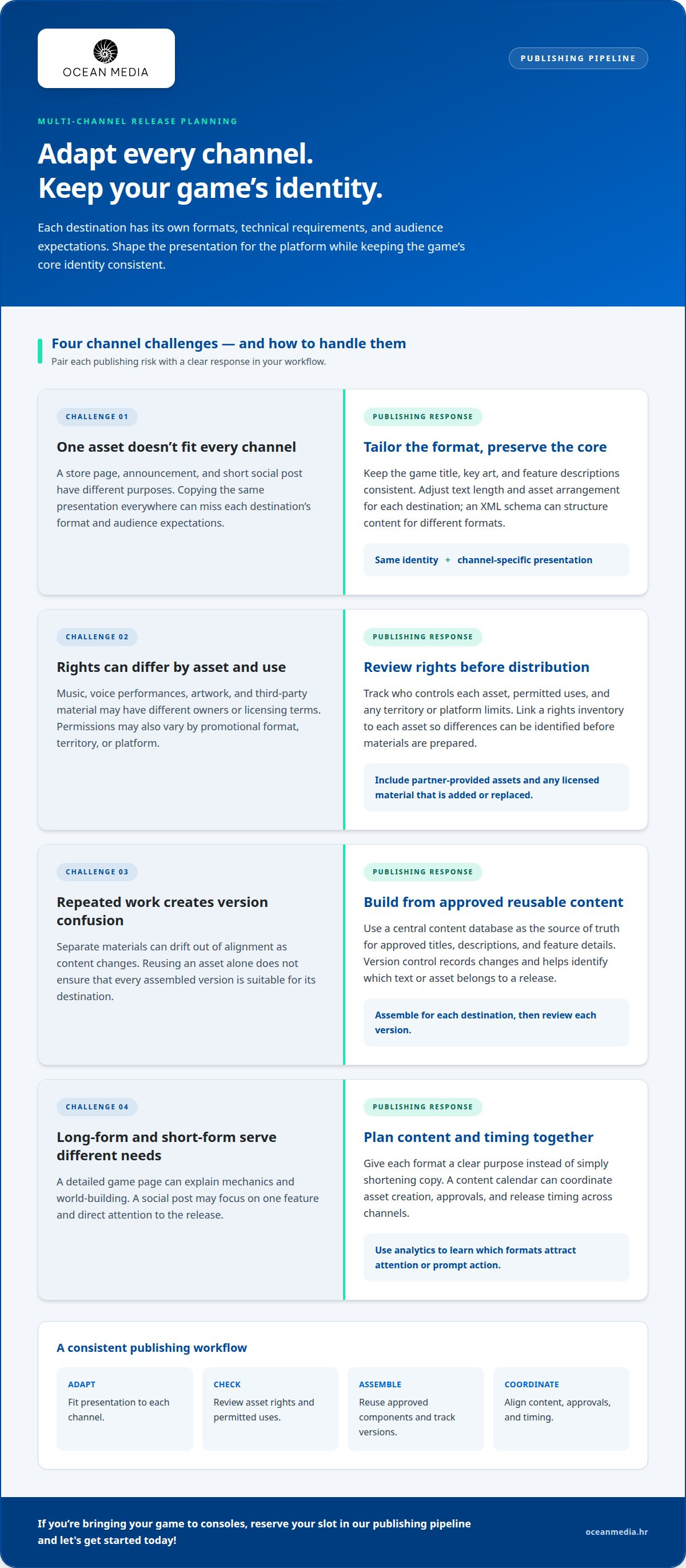
Each channel has its own formats, technical requirements, and audience expectations. During release planning, we adapt the presentation to suit each platform while keeping the game’s identity consistent.
Channel-Specific Formatting and Adaptation
Channel-specific adaptation means reshaping release materials to suit each platform’s format and presentation. It matters because a store page, announcement, and short social post serve different purposes. You may need a concise version of a game description for a limited display, while a longer page can explain its setting and features. Together, we can preserve the same core identity across those formats.
For example, we can keep your game title, key art, and feature descriptions consistent while adjusting text length and asset arrangement for each destination. An XML schema can structure content for different formats, while shared layout rules help limit unnecessary design variation. Rather than copy one asset everywhere, we tailor each adaptation to its channel while ensuring it represents your release.
Legal, Rights, and Licensing Risks
A rights and licensing review identifies who controls each asset and what permissions apply to its intended use. Music, voice performances, artwork, and third-party material may have different ownership or licensing terms. Before adapting a trailer or store description for another channel, we track the relevant rights, permitted uses, and any territory or platform limits recorded for those materials.
For example, a music license for one use may not cover every promotional format or release territory. We can link a rights inventory to each asset, helping our publishing team identify differences before preparing materials for distribution. Share details about partner-provided assets and any changes that replace or add licensed material so we can include them in the review.
Composable Content and Reuse
Composable architecture organizes content into reusable modules rather than treating each channel’s materials as one fixed package. A central content database can serve as the source of truth for approved titles, descriptions, and feature details. We can assemble those components differently for each destination, reducing repeated work while keeping core information aligned.
Version control records changes, making it easier to identify which text or asset belongs to a particular release. For example, we can update a revised feature description centrally, then adapt it for a long-form store page and a shorter announcement. Each assembled version still needs review, since reuse alone does not make every format suitable.
Long-Form and Short-Form Publishing
Long-form materials provide context; short-form materials prioritize immediate recognition. A detailed game page can describe mechanics and world-building, while a social post highlights one feature and points players toward the release. Planning both formats together helps us avoid simply shortening copy without considering its purpose or the information the audience needs.
A content calendar can coordinate asset creation, approvals, and release timing across channels. Analytics can show which formats attract attention or prompt action, helping us refine future adaptations. This feedback informs the next version without assuming every audience responds in the same way.
Audience reach, engagement, and monetization benefits
Releasing across platforms can connect a game with audiences who discover and play in different ways. Growth depends on choosing channels that fit the game and measuring their results.
Reaching Audiences Across Platforms
Multi-platform reach means making a game available through distinct channels so it can meet players where they already engage. Digital distribution can help independent developers reach a global audience, while each additional platform creates another path for discovery.
For example, a player might see a launch announcement on social media, then purchase the game through a console storefront. Consistent messaging links those moments, while platform-specific materials present the game in a familiar context. More channels can widen exposure, but each needs suitable support and a clear role.
Platform Choices for Audience Growth
Platform selection means prioritizing destinations whose audiences and capabilities suit your game. A release plan should support meaningful reach, not simply maximize the number of storefronts.
Consider the game’s genre, control design, community, and production readiness. A fast-action title may depend on responsive controls, while a strategy game may appeal to players seeking deeper play. These examples help frame platform fit, but the decision also depends on submission requirements and the team’s capacity to support each release.
Audience analytics can show where players discover a game, which device they use, and where engagement leads to purchases. Segmenting results by channel, campaign, or audience group makes patterns easier to interpret. For example, a trailer may attract views on one channel, while a storefront page drives more purchase activity. Teams can use that distinction to refine creative assets and distribution priorities.
Pricing and Promotions Across Platforms
Pricing and promotion management coordinates each platform’s offers and campaign timing. Consistent dates and messaging matter because mismatches can confuse players and complicate revenue analysis.
Distribution costs and revenue shares depend on platform terms and the publishing agreement. Treat each channel’s commercial terms separately when forecasting receipts, rather than assuming identical deductions or shares. Professional publishing support pricing depends on project scope, platform requirements, and release needs, and is provided after a quote request.
Publishers can coordinate launch pricing, discounts, and promotional assets through a shared calendar. For example, aligning announcement copy with each platform’s promotion window keeps the message clear while allowing channel-specific execution. Campaign analytics can then show which audience segments responded and whether the promotion supported reach, engagement, or sales.
If you’re planning a console launch, explore our publishing support for game developers as you shape your platform strategy.
Centralized publishing platforms and publish-once workflows
A centralized workflow can manage content, approvals, and release schedules in one place. With a publish-once approach, we reuse core materials while making platform-specific adjustments.
Workflow Bottlenecks and Operational Complexity
Operational complexity grows when different teams manage separate versions of launch materials. A store description might be revised in one document while social media copy still uses outdated feature details. We help reduce those mismatches, so teams spend less time resolving inconsistencies and more time preparing content for each platform.
A centralized, cloud-based repository connected to a content management system (CMS) can organize approved assets and make them searchable. For your game launch, we can keep the current title, description, screenshots, and campaign copy together. Clear ownership and status labels show who updates each item and which version is ready for review.
Scheduling and Workflow Automation
Scheduling and automation coordinate recurring publishing tasks, deadlines, and handoffs across channels. We can map a console launch announcement, storefront updates, and social media posts to their intended release windows in a shared calendar. Automated reminders can prompt the next reviewer when a submission is ready, reducing delays caused by missed handoffs.
Automation should support the process, not replace judgment. A scheduled post can go live at the right time, but we still need to ensure its wording and assets suit the destination. Together, we can set approval steps for sensitive changes, such as revised release information, and schedule only the version marked approved.
Centralized approval workflows make those steps visible. A CMS can track approvals for each platform, showing whether store copy, artwork, and release details have cleared review. For example, a platform-specific screenshot may need its own approval even when we share the accompanying description. Clear status labels help prevent an unapproved asset from being mistaken for the final version.
Publish-once does not mean publishing identical content everywhere. We maintain reusable source materials, then assemble channel-ready versions from approved components. We can update a core feature description once and adapt its length or presentation for each destination. Version control preserves the change history, helping us identify what changed and avoid distributing obsolete copy.
A workflow also needs a clear response to late changes. If a feature description changes before release, we can identify every channel using that component, update the affected versions, and route them through the right approvals. This makes consistency a managed process rather than a last-minute manual comparison.
Single-channel versus multichannel publishing
Single-channel publishing focuses distribution in one destination; multichannel publishing coordinates content across several. As you plan a game release, we can weigh where your audience engages and how much support each channel requires.
Multichannel publishing can include websites, apps, social media, television, radio, and newspapers. For your game, relevant destinations may include console storefronts and campaign channels that help players discover the release. HubSpot’s 2024 Content Marketing Report states that 73% of writers publish on multiple platforms. That reflects a broader shift toward coordinated distribution, but simply adding channels doesn’t guarantee useful reach.
A single-channel approach can help focus your team’s effort and simplify messaging. It may suit a release aimed at a concentrated audience or a studio with limited capacity, but it offers fewer discovery points. Multichannel publishing can extend exposure, though each destination brings its own audience, format, timing, and operational demands. For example, we can shape a game announcement differently for a storefront and a social post.
Governance helps you decide which choices should stay consistent across channels and where channel teams can adapt. Central oversight can protect your game’s identity, approved details, and quality standards, while your channel teams tailor presentation to their destinations. Almost 80% of customers expect cross-channel consistency when engaging with brands. For your launch, players should recognize the same game and core message, even when we adapt artwork or copy for a platform.
Personalization makes content more relevant to different audiences without changing the game’s core identity. For example, we can emphasize cooperative play in a campaign for a community interested in shared sessions, while highlighting exploration for players drawn to discovery. Keep these variations grounded in approved facts. Channel analytics can show which messages resonate with audience segments and guide future campaign content.
Channel selection works best when each destination has a defined purpose. A console storefront may support discovery and purchasing, while social media can carry announcements and community updates. As we plan together, we can weigh audience fit, your game’s format, platform requirements, and the effort needed to maintain each presence. For a global release, priorities may differ across markets, so match reach with your capacity to deliver a coherent experience everywhere.
Multichannel publishing coordinates distribution; omnichannel marketing aims to make the audience’s experience continuous across channels. A player might see a launch post, visit a store page, then encounter consistent release information elsewhere. We can plan those touchpoints to feel connected rather than like separate messages competing for attention.
Developing a multichannel publishing strategy
A multichannel strategy connects platform choices, release timing, marketing, and audience goals. For a game launch, it should clarify what each channel contributes and how the plan will adapt as performance data arrives.
Start by defining the release objective. A team seeking discovery may prioritize storefront visibility and announcement reach, while a team focused on community engagement may plan regular updates alongside launch materials. These goals can coexist, but each channel needs a purpose. Otherwise, teams risk sending identical messages everywhere without learning which audiences they reach.
Map the player journey across those channels. For example, someone reading a development update may later see a trailer, visit a console store page, and decide whether to buy. The strategy should connect these moments with consistent game information and a clear next step. Marketing assets can differ by format, but the title, release details, and core value should remain aligned.
Next, separate decisions that apply across the release from channel-specific choices. Shared decisions can include approved game descriptions, core positioning, and release messaging. Storefront copy, promotional assets, and campaign timing may need separate adaptations. This division lets channel teams optimize their work without losing the launch’s central identity.
Build a schedule around dependencies, not just publication dates. A store page may need approved text and assets before a campaign can direct players to it. A trailer announcement may depend on finalized release information. A calendar that records owners, approval status, and channel deadlines helps teams see where a delay could affect other launch activity.
Use analytics to refine the plan after each campaign milestone. Compare engagement and conversion patterns across channels, then identify whether the audience responded to the message, format, or destination. For instance, strong trailer views but few store-page visits may point to a weak transition between the two. Teams can adjust the call to action or creative framing, then assess the next campaign’s results.
Keep refining the plan. A strategy is not fixed once the first assets are scheduled. If a channel attracts a different audience than expected, publishers can adjust its content role while preserving shared release information. Each new update then becomes an opportunity to learn, rather than a repeat of the original campaign.
For support coordinating the operational side of bringing your game to consoles, plan your console publishing pipeline with a team focused on the release process.
Ocean Media
Ocean Media helps game developers bring their games to consoles through Console Game Publishing. Turn to the team when platform submissions, digital distribution, or release coordination add complexity to your launch. Its console publishing experience can help you understand the process and move your release forward through a structured publishing pipeline.
For example, if your studio is preparing a game for console platforms, publishing support can help address technical and administrative submission requirements. You can focus on the game while working with a publishing partner on the release path and distribution considerations. Start planning console releases when you need professional support with the publishing process.
To discuss your release, contact Ocean Media, reserve your slot in our publishing pipeline and let's get started today!
Shape Your Next Console Release
Your next decision is how to turn a release plan into a coordinated path to players. Understanding how publishers handle multi-platform releases can help you define where publishing support matters most, whether you’re preparing submissions, aligning release timing, or planning distribution. Bring those priorities to your next conversation so the publishing process can be shaped around your game and your studio’s goals.
Ocean Media works with developers on console publishing, helping you move from planning toward release across console platforms. If you’re bringing your game to consoles, contact the team to discuss your project, target platforms, and the support you need. This gives the conversation a practical focus and helps establish the next steps together.
Contact Ocean Media to discuss your publishing plans, and take the next step toward a confident console launch. Your game’s journey to players can start with a focused conversation.
Frequently Asked Questions
What does a multi-platform release strategy involve for you?
A multi-platform release strategy aligns platform selection, technical preparation, commercial planning, and launch communications. To start bringing your game to consoles and other platforms, let's define what it needs on each destination. Our team can work with you to coordinate submission materials, platform-specific store assets, and launch messaging around shared milestones. You provide the game build and project information, and we organize release work and distribution together.
How do we choose which platforms are right for your game?
We can weigh audience fit, game design, platform requirements, and your team’s capacity to support each release. A title built around precise controls may need a different platform assessment from one designed for relaxed play. Together, we can consider whether your game’s technical state and presentation suit each intended platform. The right choice connects your game with a relevant audience and supports a manageable release plan.
How do we coordinate release dates across your platforms?
We coordinate release dates by aligning platform readiness, submission progress, marketing plans, and dependencies between teams. A planned date may depend on when your builds, store materials, and promotional assets are ready. We can track these milestones together and adjust communications if a platform’s readiness changes. For example, our team can prepare separate announcement schedules while keeping public release information aligned across storefronts.
How can publishing agreements and platform exclusivity rules affect your multi-platform release?
Publishing agreements define the responsibilities, rights, and commercial terms that shape your release plan. Exclusivity language can affect which platforms your game may reach and when, so let's review the platforms, territories, and time period it covers. We can use the agreement’s terms to plan distribution and launch timing. You should resolve contractual questions with qualified legal counsel before committing to a release schedule.
How do we adapt content, formats, and metadata for each platform?
We can tailor your store descriptions, images, trailers, and metadata to each platform’s presentation and submission requirements. For example, a short promotional description may emphasize your game’s central mechanic, while longer copy provides context about its world and features. Together, we can keep key details, such as the title and release information, aligned across versions. Reviewing final platform materials helps us catch outdated assets or mismatched descriptions before release.
How do we market and measure your game’s performance across platforms?
We coordinate campaign assets and messaging, then compare performance across channels. Together, we can assess whether a trailer drives store-page visits, whether campaign engagement leads to purchases, and which audience groups respond to particular creative. These signals help us decide where to focus later announcements. Results need context: a channel designed for awareness may play a different role from a storefront intended to support discovery and purchasing.
What technical and operational challenges can we address in multi-platform publishing?
Multi-platform publishing involves coordinating platform-specific builds, submission requirements, assets, schedules, and approvals. A change to your game build or store description can affect several teams and release materials. We can track dependencies together so a delayed approval or revised asset does not go unnoticed in your launch plan. Clear ownership, version records, and communication between you and our publishing team help us manage these moving parts through release.


