

Design choices don’t happen in isolation: they shape how your game comes across and how smoothly it moves toward a console release. Knowing how to work effectively with a publisher means arriving ready to explain your creative priorities, discuss the decisions that matter most, and work through trade-offs together.
You already know your game’s identity needs to stay clear through development and publishing. The right conversations help protect that vision while you make informed decisions about bringing the game to consoles. This article explains what to prepare for a publishing partner, how to discuss design choices, and how professional support can help move your game toward a console release.
A publishing partner can also support technical and administrative steps in the publishing pipeline, including console platform submissions. When you’re ready to discuss publishing your game for consoles, get in touch with Ocean Media to start the conversation.
Key Takeaways
- Prepare a clear project overview so a console publishing partner can understand your game, its current stage, and the support you need.
- Review the agreement carefully, paying close attention to rights, revenue share, and how recoupment is defined.
- Align on development support, deadlines, marketing responsibilities, and promotion so expectations are clear on both sides.
- Assess progress against agreed goals and raise missed expectations early, using specific examples to guide the conversation.
- When you’re ready for professional support bringing your game to consoles, reserve your slot in our publishing pipeline and let's get started today!
What should you prepare for a console game publisher to assess your project?
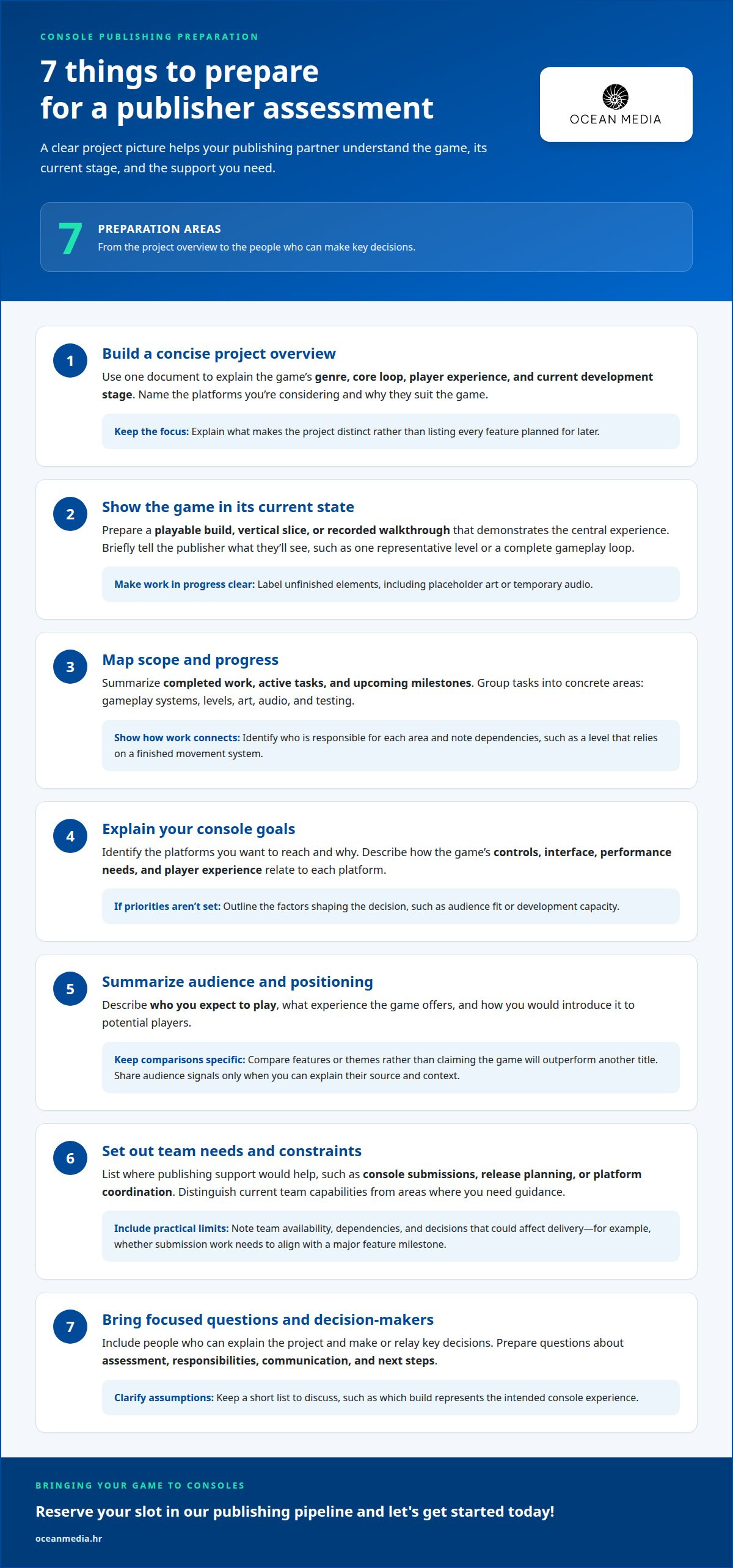
- Build a concise project overview. In one document, explain the game’s genre, core loop, player experience, and current development stage. Name the platforms you’re considering and why they suit the game. For example, a cooperative action game might emphasize shared objectives and controller-based play. Focus on what makes the project distinct rather than listing every feature planned for later. Learning how to work effectively with a publisher starts with giving them a clear view of the project.
- Show the game in its current state. Prepare a playable build, vertical slice, or recorded walkthrough that demonstrates the central experience. Briefly explain what the publisher will see, such as one representative level or a complete gameplay loop. Clearly label unfinished elements, including placeholder art or temporary audio. This helps reviewers assess the game without mistaking work in progress for a final presentation.
- Map the project’s scope and progress. Summarize completed work, active tasks, and upcoming milestones. Group tasks into concrete areas such as gameplay systems, levels, art, audio, and testing. Identify who is responsible for each area and note dependencies, such as a level that relies on a finished movement system. This overview helps a publisher assess whether the proposed scope and development plan fit the project’s current state.
- Explain your console goals. Identify the platforms you want to reach and why. Describe how the game’s controls, interface, performance needs, and player experience relate to each platform. If you haven’t set priorities, outline the factors shaping the decision, such as audience fit or development capacity. Specific goals make it easier to discuss publishing and technical needs without treating every platform as interchangeable.
- Prepare a clear audience and positioning summary. Describe who you expect to play the game, what experience it offers, and how you would introduce it to potential players. Compare specific features or themes rather than claiming the game will outperform another title. Share audience signals only when you can explain their source and context. This helps a publisher understand your intended positioning and the message you want to preserve.
- Set out your team’s needs and constraints. List where publishing support would help, such as console submissions, release planning, or platform coordination. Distinguish your team’s current capabilities from areas where you need guidance. Note practical constraints, including team availability, dependencies, and decisions that could affect delivery. For example, explain whether submission work needs to align with a major feature milestone. This helps both sides focus on the support and planning discussions that matter.
- Bring focused questions and decision-makers. Include people who can explain the project and make or relay key decisions. Prepare questions about assessment, responsibilities, communication, and next steps. Keep a short list of assumptions to discuss, such as which build represents the intended console experience. Working effectively with a publisher also means having the right people available to clarify priorities and move decisions forward.
What should you look for in a console publishing agreement, including rights, revenue share, and recoupment terms?
- Define exactly which rights the agreement covers. Identify the game, its console versions, downloadable content, updates, and related products. Distinguish the rights to publish a console version from rights to adapt the game or use its characters elsewhere. For example, permission to publish one title should not automatically imply control over a sequel. Clear boundaries help you understand what you retain and what the publisher may use.
- Set the platforms, territories, and term. Confirm whether the rights apply to named console platforms, specific territories, or both. Read how long the agreement lasts and whether the term changes after release. A term tied to a defined period differs from one that continues until an agreed milestone. Make sure the agreement also explains what happens when the term ends, including any ongoing sales or support responsibilities.
- Clarify exclusivity and sublicensing. Check whether the publisher receives exclusive publishing rights or can appoint other parties to perform parts of the work. Identify which platforms and activities any exclusivity covers. If the publisher uses a partner for localization or platform submissions, the agreement should explain what that partner may do and who remains accountable. Precise wording helps prevent a limited publishing role from expanding beyond your intentions.
- Understand the revenue-share calculation. Check the revenue base used to calculate each party’s share. The agreement should distinguish gross receipts from amounts remaining after defined deductions, such as refunds or platform-related charges. Review the calculation order and the statement that documents it. A percentage alone tells you little if “revenue” and permitted deductions are undefined. Ask for an example calculation based on the agreement’s terms.
- Read the recoupment waterfall line by line. Identify which costs the publisher can recoup, how they are documented, and whether recoupment happens before revenue is shared. Distinguish an agreed marketing expense from a cost that was never approved. Check whether recoupment applies to this game alone or draws on other titles. The agreement should show the sequence clearly, from receipts to deductions, recoupment, and any remaining share.
- Review reporting and payment mechanics. Find the schedule for sales statements, the information each statement includes, and the payment process. Check how the agreement handles corrections, disputed entries, and records supporting deductions. A useful statement lets you trace platform receipts through each calculation to the amount payable. Confirm how questions are raised and resolved to avoid prolonged accounting disputes over differences in interpretation.
- Match each party’s obligations to the rights granted. Compare the publisher’s stated commitments with the scope of rights it receives. Look for specific responsibilities around publishing operations, platform submissions, marketing, and communication. Avoid relying on broad phrases such as “commercially reasonable efforts” without understanding how progress will be discussed. The agreement should also identify your studio’s required approvals and materials, so responsibilities and decision points are clear.
- Check exit, breach, and rights-return terms. Find the process for addressing a missed obligation, resolving a dispute, and ending the agreement. Check what happens to publishing rights, game files, ongoing sales, and outstanding recoupment after termination. Ask how the contract treats a stalled release or an unfulfilled commitment. If you’re assessing console publishing support, use these topics to frame a clear discussion of responsibilities and project fit.
What should you and your publishing partner agree on for development support, deadlines, marketing, and promotion?
- Define each party’s development responsibilities. Record which tasks your studio owns and which the publisher will coordinate. Name specific workstreams, such as console submissions, platform communications, or release planning. If your team handles gameplay changes, clarify who manages submission materials. Assign a decision-maker to each workstream so requests reach the right person and responsibilities stay clear during production.
- Describe support as specific deliverables. Replace broad promises of “development help” with defined outputs and handoffs. These might include submission guidance, feedback on a milestone build, or a review of required materials. State what input your studio will provide and the format of the resulting work. A clear handoff, such as feedback tied to a named build, gives both teams a shared reference point.
- Build a milestone schedule around dependencies. List major development and publishing milestones in sequence, from a review build to submission preparation and launch readiness. For each milestone, identify prerequisites and the person responsible. Submission materials, for example, may depend on a stable build and completed store assets. If a task slips, the schedule should show which later activities may also need to move.
- Agree on how progress and delays are handled. Choose a regular reporting format that covers completed work, upcoming tasks, blockers, and decisions needed. Name the people who receive updates and can resolve issues. If a planned build is delayed, agree how the teams will document the cause, assess downstream effects, and propose a revised milestone. This makes a missed date a managed production decision.
- Set a process for changes and approvals. Explain how either team can propose a change to scope, schedule, or features. Record who assesses the impact and who approves the revised plan. Adding a feature, for example, may affect testing, submission materials, and promotional messaging. A written change record helps your studio and publisher work from the same current expectations rather than informal messages.
- Separate marketing responsibilities from development tasks. Specify who prepares each campaign asset, store description, announcement, or press material, including whether creator outreach is handled in-house or through specialist agencies like Advocators. Identify the source of approved game details and who signs off on public-facing content. If your studio supplies screenshots, clarify which build they should show and how they are approved. Defined ownership helps prevent conflicting information while coordinating development and promotion.
- Agree on promotion timing and decision points. Connect announcements and campaign activity to project milestones rather than treating promotion as a separate track. Identify what must be ready for each activity, such as approved key art or a stable gameplay capture. Set a review path for messaging changes. If the launch date moves, agree how both teams will update planned communications and assets.
- Document communication and escalation routes. Name the main contacts for development, publishing operations, and marketing, then clarify where routine updates and urgent issues should go. Agree how decisions will be recorded and shared with both teams. A platform submission question, for example, may need a different owner than a campaign approval. Clear routes keep work moving and create a reliable record of agreed actions.
How can you assess a console publisher's performance and address missed expectations?
- Turn commitments into review points. Use the agreement and project plan to identify the publisher’s specific responsibilities. For each commitment, note the expected output, its owner, and evidence of completion. A platform submission update, for example, is easier to assess than a general promise to support launch. This gives your studio a shared reference for tracking progress.
- Track delivery against agreed milestones. Keep a project record of planned dates, actual progress, dependencies, and decisions still needed. Compare the publisher’s deliverables with the current schedule, not an outdated version. If a submission task depends on an approved build, record both the build status and the submission milestone. This context helps distinguish a publisher delay from a dependency affecting both teams.
- Review communication quality and follow-through. Assess whether updates arrive through the agreed channel, explain blockers, and identify next actions. After each project discussion, record decisions, owners, and due dates. If the publisher agrees to provide platform guidance, for example, note what guidance is needed and which decision it will support. Consistent records make recurring gaps visible without relying on memory or impressions.
- Evaluate reports against the work they describe. Compare each update with the relevant deliverable, such as submission progress, release materials, or a marketing asset. Check whether the report explains completed work, open issues, and decisions your studio needs to make. If a status says “in progress” without a next action, request a clearer update. Useful reporting connects activity to the project’s agreed objectives.
- Describe the missed expectation precisely. When an obligation falls short, identify the relevant commitment, what happened, and its effect on the project. For example, explain that a missing asset review is delaying approval of store materials. Separate observable facts from assumptions about the cause. A clear description gives the publisher a practical issue to address and keeps discussion focused on the work.
- Agree on a corrective action and owner. Discuss what will resolve the gap, who will complete each task, and what evidence will show it is complete. If a submission milestone has moved, the plan might include a revised handoff and schedule. Record any dependencies and decisions your studio must provide. Make sure both teams acknowledge the revised actions so the remedy becomes part of the working plan.
- Escalate through the agreed process. If the same gap continues, use the communication or escalation route in your agreement. Share the timeline, relevant updates, and previous corrective actions with the appropriate contacts. Ask for a specific resolution rather than repeating the original complaint. If the issue concerns contractual obligations, follow the agreement’s dispute and notice procedures and seek appropriate professional advice where needed.
- Reassess whether the partnership remains aligned. Review the pattern of delivery, communication, and completed remedies against your project’s needs. A single delay with a clear recovery plan differs from repeated missed commitments without corrective action. Use documented examples to decide whether to reset expectations, adjust responsibilities, or consider contractual options. For support bringing your game to consoles, discuss your console publishing project and its priorities with our team.
Ocean Media
We help you bring games to consoles through our Console Game Publishing service. We support the technical and administrative work involved in console releases, including platform submissions. Turn to us when you’re ready to align your project’s publishing needs with a professional partner and establish a clear path through the publishing pipeline.
Bring your project overview, current build details, and release priorities to the conversation. Clear expectations around responsibilities, timelines, and communication can help us understand how to move forward together. If you’re ready to discuss your console publishing needs, contact us, reserve your slot in our publishing pipeline and let's get started today!
Move Your Game Toward Its Next Chapter
Turn a promising conversation into a working relationship that gives your game room to grow. A strong partnership is more than a handoff: it is an ongoing exchange that keeps creative intent connected to publishing realities as the project advances. Keep dialogue open, make decisions with the game’s long-term identity in view, and treat collaboration as part of the creative process.
Learning how to work effectively with a publisher means building shared direction and carrying it through future decisions. You don’t need every detail settled to take a useful next step. A clear sense of what you want your game to become can start a focused discussion about bringing it to consoles and the support that could help.
If you’re ready to move forward, reserve your slot in our publishing pipeline and let's get started today!


