

A publisher’s influence over your work depends on the agreement, not just the relationship. Retaining creative control with a publisher means knowing which decisions you keep, which require approval, and which the publisher can make.
It’s reasonable to expect a publishing partner to bring expertise and reach while respecting your creative vision. The balance depends on the publishing model and contract terms, including rights, editing, design, timing, and promotion. Clear language turns assumptions about control into shared expectations.
This article explains how creative authority differs across traditional, self-publishing, and hybrid models, what cover approval and other contract clauses can mean, and where negotiation may preserve choices that matter to you. If you’re bringing your game to consoles, reserve your slot in our publishing pipeline and let's get started today!
Key Takeaways
- Identify which creative decisions the contract assigns to you and which it gives the publisher authority to make.
- Clarify whether cover input means consultation or approval, and how the agreement handles final design decisions.
- Compare publishing models by the control they offer over editing, presentation, timing, and promotion.
- Negotiate important terms, including rights and decision-making processes, before signing.
- Bringing your game to consoles? Reserve your slot in our publishing pipeline and let's get started today!
Contract terms and the cost of legal disputes
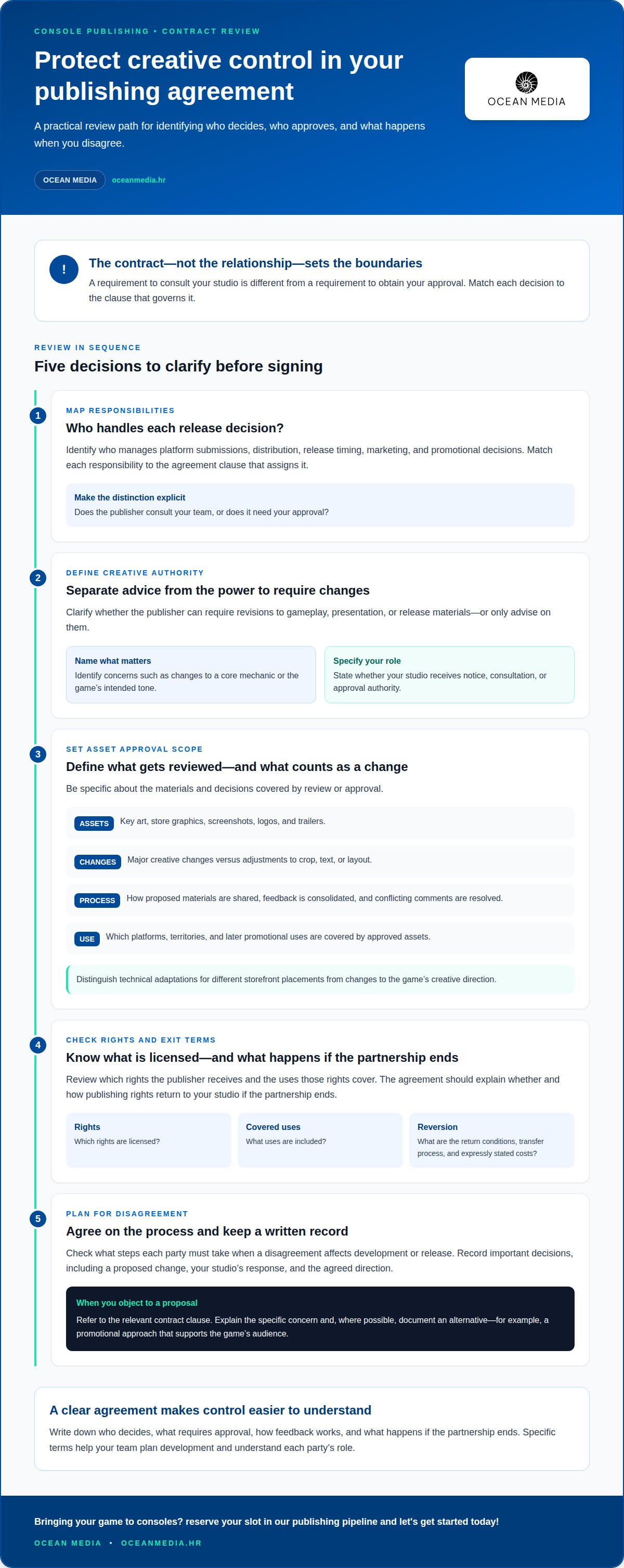
A console publishing agreement allocates responsibilities between your studio and its publishing partner. It may specify who handles platform submissions, release timing, marketing, and distribution. The wording matters: a requirement to consult your team differs from a requirement to obtain your approval. Match each creative or operational decision to the clause that governs it. This clarifies who has the final say if your studio and publisher disagree.
Rights and exit terms deserve close attention. A clause should describe which rights the publisher receives, the uses covered, and what happens if the partnership ends. For example, if your studio ends a console publishing partnership, the agreement should explain whether and how publishing rights return to you. For a game agreement, focus on its own rights-reversion conditions, transfer process, and any costs expressly stated.
Before signing, review how the agreement affects your release plan. Clarify who decides whether proposed changes to gameplay, presentation, or release materials go ahead. Start by reviewing:
- Creative changes: Does the publisher advise on changes, or can it require revisions to the game or its presentation?
- Release responsibilities: Which party manages platform submissions, distribution, timing, and promotional decisions?
- Rights and reversion: What rights are licensed, for which uses, and under what conditions can they return?
- Dispute procedures: What steps must each party take when a disagreement affects development or release?
These clauses shape what happens if you reject a publisher’s editorial or marketing decisions. If the contract gives the publisher authority over a decision, refusing its direction can lead to a dispute and delay agreed development or release work. The consequences depend on the agreement, including any process for resolving disagreements or ending the partnership. For example, your studio might propose an alternative promotional approach and document how it supports the game’s audience.
Protect your creative priorities by describing them concretely. If a proposed change would alter a core mechanic or the game’s intended tone, identify the concern and the decision-making process you want in the agreement. Don’t rely on a broad promise of collaboration when you need a specific approval right. Define whether your studio receives notice, consultation, or authority to approve the change.
Keep a written record of important decisions during development. For example, document a proposed narrative change, your studio’s response, and the agreed direction. When a disagreement arises, refer to the relevant contract clause rather than treating every difference of opinion as a breach. If negotiations stall, focus on the specific right or responsibility at issue and the impact on release plans. Clear terms help your team plan development and understand each party’s role.
Asset approval in console publishing contracts
For a game, the visual identity players see before launch includes key art, store images, logos, screenshots, and promotional graphics. These assets shape how audiences recognize a title. Your publishing agreement can clarify who creates them, who reviews them, and who makes the final decision. Your studio may have a strong creative vision, while a publishing partner brings platform and audience considerations to the presentation.
Separate consultation from approval. Consultation lets your team share feedback but may leave the final decision to the publisher. Approval language can give your studio authority over defined assets or changes. For example, you might request approval for changes to the game logo or central character art while allowing routine resizing and layout adjustments without another review. Specific wording makes the distinction clearer than a general promise to collaborate.
Define the scope of the review in practical terms. Your agreement could address:
- Asset types: Which key art, store graphics, screenshots, logos, or trailers require review?
- Changes: Does approval apply to major creative changes, or also to revisions in crop, text, and layout?
- Review process: How will the publisher share proposed materials, and how will your studio provide feedback?
- Use and updates: Which platforms, territories, or later promotional uses are covered by the approved assets?
These details matter when a platform storefront requires assets to meet presentation requirements. For instance, a composition that works in a wide promotional image may need adjusting for a smaller store tile. Your agreement can distinguish technical adaptations from changes to creative direction. That helps keep the game recognizable across different placements.
Set a workable feedback process before launch materials enter production. Define review stages, identify who consolidates studio feedback, and agree how conflicting comments are resolved. If your team objects to an image because it misrepresents gameplay, explain the mismatch and suggest a more accurate alternative. A focused response gives the publishing team a concrete direction to consider instead of a general rejection.
For teams bringing a game to consoles, visual decisions connect closely to release preparation and audience discovery. Coordinating asset responsibilities early can help your studio avoid late-stage disagreement over how the title appears. Our console publishing information for developers can help you understand how creative presentation fits into the wider console publishing process.
Console publishing gives studios a practical reason to clarify approval rights: assets may need to work across different platform storefronts and promotional placements. Your agreement can specify which materials your studio approves and how quickly it will provide feedback. For example, you could set a review deadline of June 16, 2019, and define how proposed changes are shared with your team.
The difference between input and final authority can be significant: your studio might review 30 plus asset variations before approving a final set for console release. These examples underline why your agreement should distinguish an opportunity to comment from a right to approve defined creative choices. Clear boundaries can preserve meaningful studio input while making final responsibility for promotional materials explicit. To make bringing your game to consoles easier, reserve your slot in our publishing pipeline and let's get started today!
Creative control across traditional, self-publishing, and hybrid publishing
For a game studio, the publishing model shapes how creative decisions connect with the work of preparing a console release. A traditional publisher may contribute market insight and release resources while the studio continues to shape the game’s core experience. For example, a publisher could recommend adjusting the opening sequence so players understand the controls sooner. Your studio can assess that suggestion against its design goals and intended player journey.
Self-publishing leaves more of the publishing process to your team. Your studio makes decisions about the game’s presentation and release strategy while organizing the work needed to bring the title to players. This can suit a team with a clear vision and the capacity to coordinate release tasks. For instance, your developers may choose how to position a distinctive mechanic, then plan how to communicate it in store materials.
A hybrid approach combines studio-led creative work with selected publishing support. The balance depends on which responsibilities your studio keeps and which it shares. One team might retain close control over gameplay and narrative while working with a publishing partner on platform submissions or distribution. Another arrangement may divide responsibilities differently. Compare what each model means for your team’s decisions and workload.
Consider how the models affect your day-to-day work:
- Traditional publishing: A publisher contributes to release planning, while your team brings game-design knowledge and evaluates recommendations against the player experience.
- Self-publishing: Your studio directs the creative and release choices, and organizes the publishing tasks needed to reach console audiences.
- Hybrid publishing: Your team and partner share selected responsibilities, with the division shaped by the arrangement.
The right model depends on your studio’s priorities, skills, and willingness to manage release work. A small team focused on completing gameplay may value support with platform processes. A studio with an established release operation may prefer to keep more responsibility. Neither choice automatically guarantees greater creative freedom. The day-to-day impact depends on the decisions your team retains, the support it receives, and how well those fit your production plan.
Think about the decisions that most affect the finished game. If your title depends on a particular control scheme, for example, decide how your team will assess proposals that could change it. If audience discovery depends on a specific genre position, consider who contributes to that positioning. Mapping these priorities to each publishing model makes the trade-offs tangible and helps you choose a structure that supports development and console release goals.
Negotiating publishing contract terms
Negotiate before signing the agreement. Start with the decisions that shape your game and its console release, then identify the rights and responsibilities tied to each. If a particular feature, character, or gameplay element is essential to the player experience, explain why. A clear rationale gives the publisher a specific point to discuss instead of a general request for creative freedom.
Separate decisions you want to control from those where consultation is enough. You might seek approval over substantial changes to your game while welcoming suggestions about its presentation. You could also request input on marketing materials, platform selection, or release timing. The useful question is not whether you have “creative control” overall, but who decides each aspect of bringing your game to consoles and how disagreements are handled.
Rights deserve the same precision. You can negotiate which platforms and territories the publisher may release your game in, rather than granting every right. Define the rights granted, the uses covered, and the intellectual property rights you are keeping. Make sure the contract explains how these terms apply to ports, updates, and other versions of your game.
Build your negotiation around a short list of priorities:
- Development changes: Specify whether the publisher can require revisions or must obtain approval for substantial changes to the game.
- Presentation: Define your role in platform store listings, marketing materials, and other elements that affect the game’s appeal.
- Rights: Name the platforms, territories, and uses granted, and identify the intellectual property rights you retain.
- Money: Clarify the revenue share and how costs or discounts affect it. Define how revenue is calculated and when payments begin.
- Exit terms: Set out when rights can return and what process applies if the game is no longer being published.
Revenue terms are negotiated, and payments may change depending on how sales are handled. Ask the contract to explain how the revenue share applies to those sales. A clause that names only a headline rate may leave important details unresolved. Clear calculations for each financial term help you understand what the agreement means for your game and audience.
Stay focused if the publisher resists a request. Offer a workable alternative: if final approval over every change is unacceptable, propose approval for changes that affect core gameplay or the release plan. Record agreed revisions in the contract before signing. Careful negotiation can move the discussion forward while protecting the aspects of your game that matter most. To make bringing your game to consoles easier, reserve your slot in our publishing pipeline and let's get started today!
Which publishing contract clauses affect your game's creative control?
Control is distributed across individual clauses, not granted by one broad promise. Review each term that governs how your game can be edited, presented, released, and used. For example, an agreement may allow routine technical changes while requiring studio approval for changes to core gameplay. That distinction clarifies where your team’s input carries authority.
The grant of rights clause defines what the publisher can do with your game. Check the platforms, territories, and uses it covers, then compare them with any rights your studio intends to retain. A broad grant could include uses beyond the initial console release. Naming specific rights, such as those for other platforms, helps distinguish permissions granted from those you keep.
Editing and approval clauses set boundaries for changes. Look for language that distinguishes suggestions from required edits and identifies whose decision is final. For instance, a clause might let the publisher request changes but require studio approval for substantial edits. If the agreement says only that you’ll be consulted, it may give you input without veto power.
- Presentation and design: Identify whether you receive consultation, approval, or final authority over console release assets and layouts.
- Console release schedule: Check who selects the release date and whether the agreement sets expectations for release timing.
- Marketing and promotion: Clarify who controls promotional plans and whether you can request specific campaign support.
- Reversion and termination: Read the conditions for ending the agreement and returning game rights, including the process and any stated requirements.
These terms can interact. If the publisher controls release timing, a separate clause might still require consultation before a delayed console release. If your studio has approval over release assets, check whether that right applies to later editions and new formats. A right limited to the initial release may not apply to a redesigned version. Read related clauses together to spot differences in scope.
Review commercial terms alongside rights and control. The agreement should explain which terms apply to each release condition. These terms don’t determine who edits the game, but they shape the commercial arrangement attached to bringing your game to consoles.
Before signing, mark each clause as publisher decision, shared decision, or studio approval. Then clarify any term that uses broad wording, such as “reasonable changes” or “consultation,” by specifying the decision and process it covers. For support with bringing your game to consoles, explore console publishing support and reserve your slot in our publishing pipeline and let's get started today!
Ocean Media
Ocean Media helps game developers bring their titles to consoles through Console Game Publishing. If you’re weighing how a publishing partner’s responsibilities fit your creative priorities, understanding the release process can help you define clear roles and expectations. Ocean Media’s expertise includes the technical and administrative complexities of console platform submissions and digital distribution, helping developers reach a global audience. This can be a useful next step when your team is preparing for a console release and wants a structured publishing path alongside its creative decisions. To discuss your project and console publishing with Ocean Media, get in touch.
Put your creative priorities into your release plan
Your next step is to turn the decisions that matter most into clear working expectations. As you plan a console release, consider how creative direction, platform submission requirements, and distribution responsibilities fit together. Naming these priorities early gives your team and publishing partner a practical basis for collaboration.
For game developers, retaining creative control with a publisher is part of shaping a release process that supports the game’s vision while addressing its technical and logistical needs. Ocean Media provides Console Game Publishing for teams bringing games to consoles, including support with platform-specific requirements and digital releases. Discuss your publishing plans with Ocean Media and how the process fits your project.
Contact Ocean Media to discuss your publishing plans, and take the next step toward bringing your game to consoles with clarity and confidence.
Frequently Asked Questions
How Much Control Does a Publisher Have?
A publisher’s control depends on the authority granted in your signed agreement, not on a standard level. For example, a contract might assign release timing to the publisher while giving you approval over substantial changes to your game. Trace a decision from proposal to final approval: who initiates it, who can object, and what happens if you disagree? That shows whether your input is advisory or binding.
What Does Creative Control Mean in a Console Publishing Agreement?
Creative control means the influence your contract gives you over changes to your game and how it is presented. The agreement may treat a minor update differently from a change to core gameplay. Consider whether you can approve that change, discuss it, or only receive notice. The wording clarifies how your creative priorities inform the process without assuming every decision is yours.
What Decisions Do Console Publishers Typically Control?
Publishers commonly direct decisions tied to market presentation and release execution, subject to the contract. These may include positioning your game for its audience, selecting a release window, coordinating promotion, and arranging console distribution. For example, a publisher might propose a release window to suit your game’s audience. Your agreement determines whether you can approve the plan, offer input, or simply be informed.
How Do Publishing Agreements Affect Studio Decision-Making?
Your studio may retain more decisions and execution, or share them with a publisher. Compare agreements by asking how much hands-on responsibility you want when bringing your game to consoles. Review the specific allocation of responsibilities before choosing a path. To follow a structured publishing pipeline, reserve your slot in our publishing pipeline and let's get started today!


