

Bringing your game to consoles starts a structured process, not the finish line. The next steps turn your goals into a practical plan for preparing and releasing your game.
You’ll get a clear view of each milestone, how decisions are made, and when to expect updates. Our team can help you understand how the publishing pipeline moves from planning to platform submissions. We’ll work with you to map the next steps, including production schedules, platform requirements, marketing, and communication. A shared plan keeps the process moving and helps you focus on development while staying involved in release decisions. To get started, reserve your slot in our publishing pipeline and let's get started today!
Key Takeaways
- Review the technical requirements for bringing your game to consoles and identify the support you need.
- Plan your console release timeline and map key steps in the publishing pipeline.
- Agree on communication preferences with our team so you can stay aligned throughout the process.
- Prepare your game’s build and materials for each platform milestone to keep your release on track.
- For help bringing your game to consoles, reserve your slot in our publishing pipeline and let's get started today!
What Happens Inside a Publisher, After I Sign the Contract?
After signing, the publisher turns the agreed terms into a working plan for preparing and releasing your work. In traditional deals, the publisher generally handles publishing operations; hybrid deals share responsibilities, while self-publishing leaves more coordination to you.
The Post-Signing Process
The post-signing process moves your agreement from signed paperwork into active publishing. The responsibilities assigned to each team and the rights you retain shape the decisions that follow.
The publisher’s contracts department uses the agreed terms to prepare the contract. Once both sides sign, the publisher can coordinate the work covered by the agreement. The terms define the rights granted, the work to be delivered, and the publisher’s role. Keep your signed copy accessible so you can refer to the agreement when questions arise.
Rights reversion means granted rights return to you. A contract may provide for reversion when specified conditions are met, such as a work no longer being available in a covered format. You can also request voluntary reversion by discussing it with the publisher. For example, you might want to pursue a translation or another derivative work. The agreement’s wording and the rights involved guide that discussion.
U.S. copyright law also provides a statutory termination route in some circumstances: according to the U.S. Copyright Office, a copyright transfer or license to another party can be terminated after 35 years under certain conditions. This is distinct from contractual reversion. The applicable conditions and agreement matter, so don’t assume that a particular transfer automatically qualifies.
Final Negotiations and Timing
Final negotiations settle contract language after an offer is accepted and before the agreement is signed. They matter because the written terms, not an informal understanding, define the rights and obligations both parties accept.
Finalizing a contract can take a few weeks to a few months or longer after an offer is accepted. The publisher drafts terms reflecting the agreed offer, then both parties resolve outstanding language before signing. Review the provisions covering granted rights, delivery expectations, payment stages, and any reversion conditions. If you have an agent, they can help raise questions during negotiations. Once signed, use the agreement as the reference point for the publishing relationship rather than relying on verbal assumptions.
That distinction supports long-term success: a clear contract gives both sides a shared basis for decisions. Before signing, make sure you understand which rights the publisher receives and which remain yours. If your plans change later, the contract’s reversion language can help clarify whether to request a return of rights, while statutory termination follows its own conditions.
Working with marketing and publicity
Marketing and publicity connect your work with its intended audience before and after release. The publisher’s plans can clarify how you can contribute.
Meeting Sales and Marketing Staff
Meeting the publisher’s sales and marketing staff helps you understand how they plan to position your work. Your knowledge of the project can provide useful context, contacts, and ideas.
Ask the team to outline its goals, likely audiences, and planned activities. Then identify communities, creators, or organizations you know that could help introduce the work to interested readers. For example, an author with established relationships in a field may know relevant groups or events. Share those leads with the team and clarify who will follow up.
Pre-Publication Marketing
Pre-publication marketing builds awareness before a release. Advance planning gives the publisher and author time to coordinate announcements and promotional materials.
Publishers usually begin marketing and sales work four to six months before publication, and they may start earlier. Ask when the campaign begins and which milestones need your input. A cover reveal, for instance, can introduce the project before its release. Double Booked’s cover reveal took place in September 2021, ahead of its June 2022 publication, a nine-month lead.
Use the planning discussion to agree on what information you can share, when announcements will happen, and which contacts you can contribute. A clear schedule helps you avoid releasing materials before the publisher’s planned reveal. It also gives you time to prepare your own communications alongside the campaign.
Publicity and Marketing
Marketing and publicity work together but serve different functions. Marketing organizes planned promotion; publicity seeks attention through coverage, interviews, or events. The publisher’s team can explain which activities it plans to pursue and where your participation would help.
Ask for the plan and identify practical ways to contribute. You might suggest interview topics or knowledgeable contacts, or share an announcement through your own channels when timing allows. Coordinate each activity with the team to keep messaging consistent across publisher and author communications.
Promotion can continue beyond launch. Authors are encouraged to maintain promotional efforts and set new goals for their book for several years after publication. That could mean revisiting useful contacts or finding fresh ways to reach readers as interest develops. For a game project, reserve your slot in our publishing pipeline and let's get started today!
Because publishers usually begin marketing and sales work for a book 4-6 months before its release, and may begin earlier, ask the marketing and publicity team when its plan is taking shape. Ask your publisher’s marketing and publicity team about the plan for your book, and identify useful contacts you can contribute. Bringing those contacts into the discussion can help the team consider where your knowledge may support the plan. Clarify which contacts you can share and how they may fit the publisher’s plans.
Communicating with your publisher
After you sign the contract and your publisher gives the go-ahead, you can begin coordinating with their team. They may send a welcome packet, then discuss bringing your game to consoles and the next steps with you.
Start by learning how your publisher prefers to communicate. Ask whether email or phone works best, what information to include in each message, and how to flag time-sensitive questions. The right channel varies by team. One contact may reply to email quickly but not return phone calls, so don’t assume everyone uses every channel equally.
Make each message useful. Give it a clear subject, state what you need, and include relevant context, such as a technical question or a decision awaiting input. If you have several related questions, group them in one organized note. This helps the publisher understand the issue and respond to the points that need attention.
Set expectations together rather than guessing at a universal response time. Ask how the publisher wants you to flag urgent matters and whether they prefer updates at agreed milestones. Contacting the team once a week can lead to unnecessary interruptions, so consider whether a message adds new information or requires a decision. A concise update tied to a real milestone is more useful than repeated check-ins without a change to report.
Your publisher can be a resource throughout the process. If a question concerns the contract, rights, or a point you’re unsure how to raise, discuss it with your publisher before moving ahead. For technical or logistical topics, write directly to the relevant contact once communication has begun. This routes each question to the person best placed to address it, rather than sending the same issue to multiple people.
Keep a simple record of key decisions. Save the welcome packet, publisher correspondence, and agreed next steps in one place. After a call, send a brief follow-up summarizing decisions or open questions. For example, if you and your publisher agree on a technical requirement, a written recap gives you both a shared reference as your game moves through the publishing pipeline.
Part of bringing your game to consoles is establishing a practical rhythm with your publisher. Good communication supports your partnership without turning every question into an interruption. Before reaching out, identify the decision, provide context, and choose your publisher’s preferred channel. This keeps conversations focused as the work moves forward. Reserve your slot in our publishing pipeline and let's get started today!
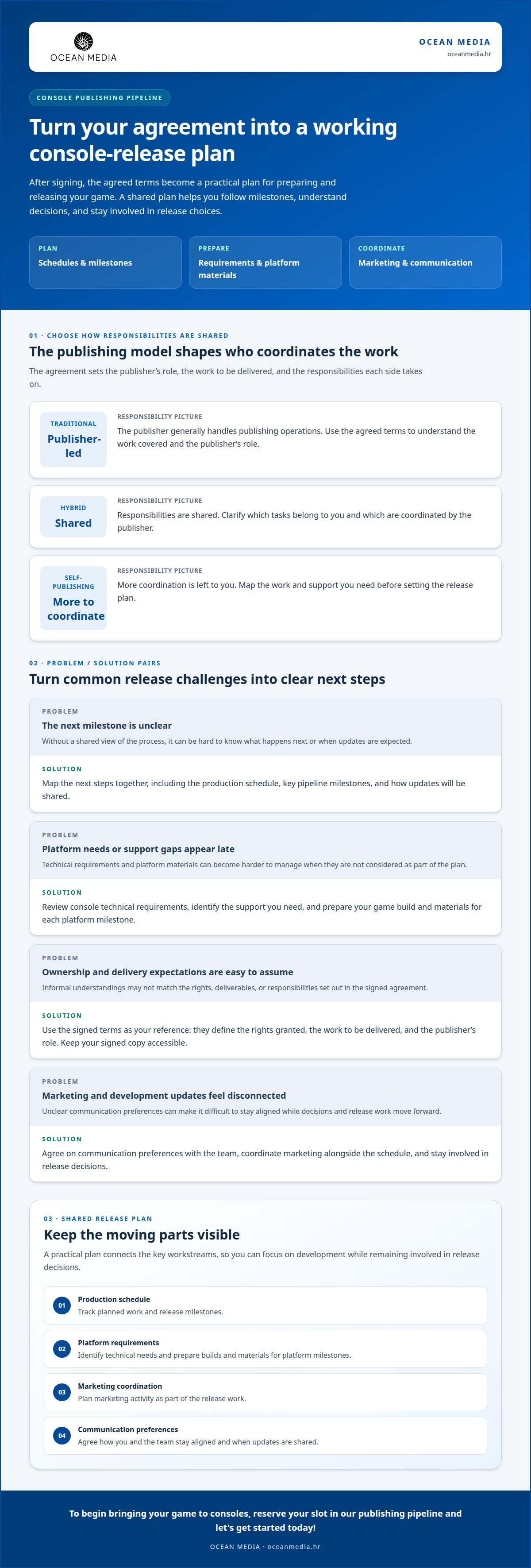
Development and release schedules
After you begin bringing your game to consoles, development and release planning turn your project into a console-ready release. The preparation period is described as a year, but individual stages depend on your game and release plan. Knowing how development, platform testing, and submission fit together helps you plan work and meet deadlines.
Console development can take several months after the project is scoped. Our team can help you review technical requirements, discuss needed changes, and check new builds as your game develops. A game may go through around 3-10 build revisions before it is ready to submit. Each revision should address the agreed release goals, rather than introduce unrelated changes that complicate the next review.
Delivery dates matter because a late build can disrupt testing and release schedules. Treat the deadline in your plan as a key production milestone. Break the work into smaller goals, leave time to test and revise, and tell us promptly if a problem affects delivery. This gives our team a chance to understand the impact on later stages.
Platform preparation also begins well before release. Studios normally work on console requirements 12 to 16 months before a game’s launch. In one example, teams completing platform preparations in January 2004 were preparing games scheduled for release in May or June 2006. The example shows why technical planning and approvals can happen long before players see the finished game.
Release preparation then brings approved builds and platform requirements together. A game is typically submitted around 1-2 months before release so teams can complete final checks and coordinate launch activities. This leaves time to align the release build with the publishing plan. Your game’s progress can therefore affect more than the development calendar.
Release timing varies with completion and the publisher’s schedule. A game may launch a few months after completion or 18-24 months after the studio signs an agreement. These are different points on the timeline: signing begins the process, while build completion allows later testing and submission work to proceed. Ask us how your agreed milestones connect with the planned release.
Keep a working calendar of build delivery, revision rounds, platform feedback, and other publishing deadlines. For example, if our team returns a build with requested changes, note the revision milestone alongside upcoming submission decisions. One schedule helps you see dependencies and avoid treating each request as an isolated task.
Bringing your game to consoles is a sequence, not a single final handoff. Development informs the release build, platform testing prepares it for submission, and final checks follow later. Staying on schedule and communicating about delays gives our team clearer options for managing the work. We can explain which milestone needs your attention next and help keep your game aligned with the publishing pipeline. To get started, reserve your slot in our publishing pipeline and let's get started today!
Publisher payments and milestones
An advance is money paid under a game publishing agreement before royalties are earned. The contract explains the amount, payment stages, and conditions attached to each installment. Read those terms alongside your project delivery schedule, because a payment may depend on signing, a development milestone, or release.
A game publishing agreement can divide an advance into stages such as signing, milestone completion, and release. This links payments to milestones rather than placing the entire amount at one point. For example, one installment might be due at signing, another after a development milestone, and the final portion at release. Your agreement sets the actual milestones and payment dates.
Examples of advances in publishing discussions include £5,000 and £50,000. Those examples illustrate different possible deal values, not a standard amount or a prediction of what any developer will receive. The size and structure of an offer belong to the specific agreement. Focus on how the stated amount is divided, what event triggers each payment, and whether the contract describes any additional conditions.
Payment timing matters too. Once the publisher receives signed contracts, the first portion of the advance may be due within 30 days, if that is what the agreement specifies. A payment schedule might set the first payment at half or a third of the total advance, with any agreed 15% fee or deduction stated in the contract. Read the payment language carefully, and distinguish the contract’s due date from the time needed to process a payment.
Keep a simple record of each installment. Note the amount specified in your agreement, its triggering milestone, and the due date. For instance, if a payment depends on completing a development milestone, record that milestone and retain the publisher’s written confirmation. This makes it easier to track what has been paid and what remains tied to a future stage.
Don’t treat the advance as a separate bonus unrelated to the rest of the deal. Its payment schedule sits alongside delivery commitments, release planning, and royalty terms. If a clause is unclear, ask your representative to explain it before relying on an assumption. Understanding the terms helps you plan without confusing an advance with income already earned from sales.
For developers, a payment schedule in another type of publishing agreement isn’t a template for a game publishing agreement. The useful lesson is to understand what each agreed milestone triggers and how it fits the project’s broader plan. If you’re bringing your game to consoles, reserve your slot in our publishing pipeline and let's get started today!
Ocean Media: Console Game Publishing
Ocean Media helps developers bring games to consoles through Console Game Publishing. Turn to the team when your release needs support with console platform submissions and the technical and administrative steps involved in digital distribution.
A publishing plan can help connect platform requirements with your project’s release goals. Ocean Media works with developers seeking to reach a global audience, helping make the console publishing process more manageable while you focus on your game. If you’re preparing for a console release, explore developer publishing support as a practical next step.
Contact Ocean Media to discuss bringing your game to consoles.
Turn Your Publishing Plans Into a Release
A signed agreement marks the start of the next phase, when your priorities help shape the project’s direction. The useful next step is to connect your creative goals with the right publishing path and make decisions that support the release you want to build.
Understanding what happens after signing a publishing deal can help you frame questions about a game project. Book publishing and console releases follow different processes, but both require clear goals and an aligned plan. Ocean Media offers Console Game Publishing for developers bringing games to consoles. Contact the team to discuss your project and next steps.
Share where your project stands and what you want its release to achieve. Contact Ocean Media to reserve your slot in our publishing pipeline and let's get started today!
Frequently Asked Questions
What is a Publishing Deal?
A publishing deal is an agreement that lets a publisher use specified rights to bring a creator’s work to an audience. It sets out the work covered, rights granted, payment terms, and each party’s responsibilities. For example, a book agreement may define which formats the publisher can produce. For a game, the agreement may cover digital publishing on console platforms. The contract’s scope determines what the publisher can do.
What happens after signing a book publishing contract?
After signing, the author and publisher move from negotiation into active work on the book. The author can make a public announcement once the contracts are signed, while coordinating timing with the publisher’s communications plans. The editor and author then discuss the work and next steps. For example, an author preparing an announcement can align its timing and wording with the publisher to avoid conflicting launch information.
What steps follow signing a publishing deal, from editing to publication?
The process moves from editorial review and revisions to design, final production, and release. Each stage depends on earlier decisions. For example, if an author’s revision substantially changes the manuscript, the publisher may need to reconsider how the finished work fits its design and release plan. Keeping feedback, approvals, and delivery expectations organized helps you see which decisions are holding up the next stage.
What advance and royalty payments are typical in a U.S. publishing deal, and when are they paid?
There isn’t one advance or royalty rate that applies to every U.S. book deal. The contract specifies the advance installments and the royalty calculation. Illustrative royalty examples include 10% of each paperback sold and 25% of each ebook sold, but these figures aren’t universal terms. The first advance portion is due within 30 days after the publisher receives signed contracts. Check the agreement for payment milestones and royalty bases.


