

A publisher-ready vertical slice needs to prove more than how your game looks at its best. It should show that the core player experience works and that your team can repeat the production process beyond one showcase level. If you’re unsure how much content to build or how much polish to invest before validating your approach, learning how to create a vertical slice for a publisher starts with defining what the slice needs to prove.
You don’t need to build the whole game to make a compelling case. You do need a focused, representative experience that communicates the gameplay loop, visual direction, and a credible path to production. This guide will help you set the scope, build a slice that demonstrates repeatable processes, and present your work clearly in a publisher discussion. As you consider bringing your game to consoles, Ocean Media can help connect publisher preparation to the wider publishing pipeline. We bring over 20 years of gaming industry experience to digital console publishing, including platform-specific requirements and certification. When you’re ready, reserve your slot in our publishing pipeline and let's get started today!
Key Takeaways
- Define what a publisher needs to learn from your slice, then focus the build on a representative, playable experience.
- Choose one gameplay sequence that brings the core loop, essential mechanics, UI, art direction, and audio together.
- Keep the scope focused. Polish should clarify the intended experience, not hide production assumptions that still need testing.
- Use a step-by-step workflow to connect each production task to a question your slice must answer.
- Present your vertical slice as both a player experience showcase and evidence of a repeatable production approach.
What a publisher needs to learn from your vertical slice
A vertical slice is a representative, playable sample of the experience you intend to deliver in the finished game. It should help a publisher understand the game’s identity and let you assess whether your approach to making it can be repeated. The vertical slice concept is useful because it connects a small section of content to the larger production ambition.
A vertical slice lets players experience the game’s defining appeal while showing a publisher how your team can produce that experience consistently. It isn’t a promise that every part of the finished game is solved. It’s a focused way to make the creative direction tangible and expose assumptions that still need testing. Publishers may assess projects differently, so there’s no universal acceptance formula. Make the evidence relevant to your game and clear enough to support a productive discussion.
Vertical slice versus prototype: what changes?
A prototype tests a specific idea: whether a movement mechanic feels satisfying, an interaction is understandable, or a design assumption holds up in play. It can use temporary assets and limited context because its main job is to answer that focused question. A vertical slice goes further. It brings representative gameplay, presentation, and supporting systems together so someone can experience the game as a coherent sample of the intended player journey.
It also tests whether your team can reproduce the quality and process behind that sample. A full game delivers the planned content across the complete experience; a slice doesn’t need to. When learning how to create a vertical slice for a publisher, distinguish between proving one idea works and showing that the larger production approach is plausible.
What questions should the slice help answer?
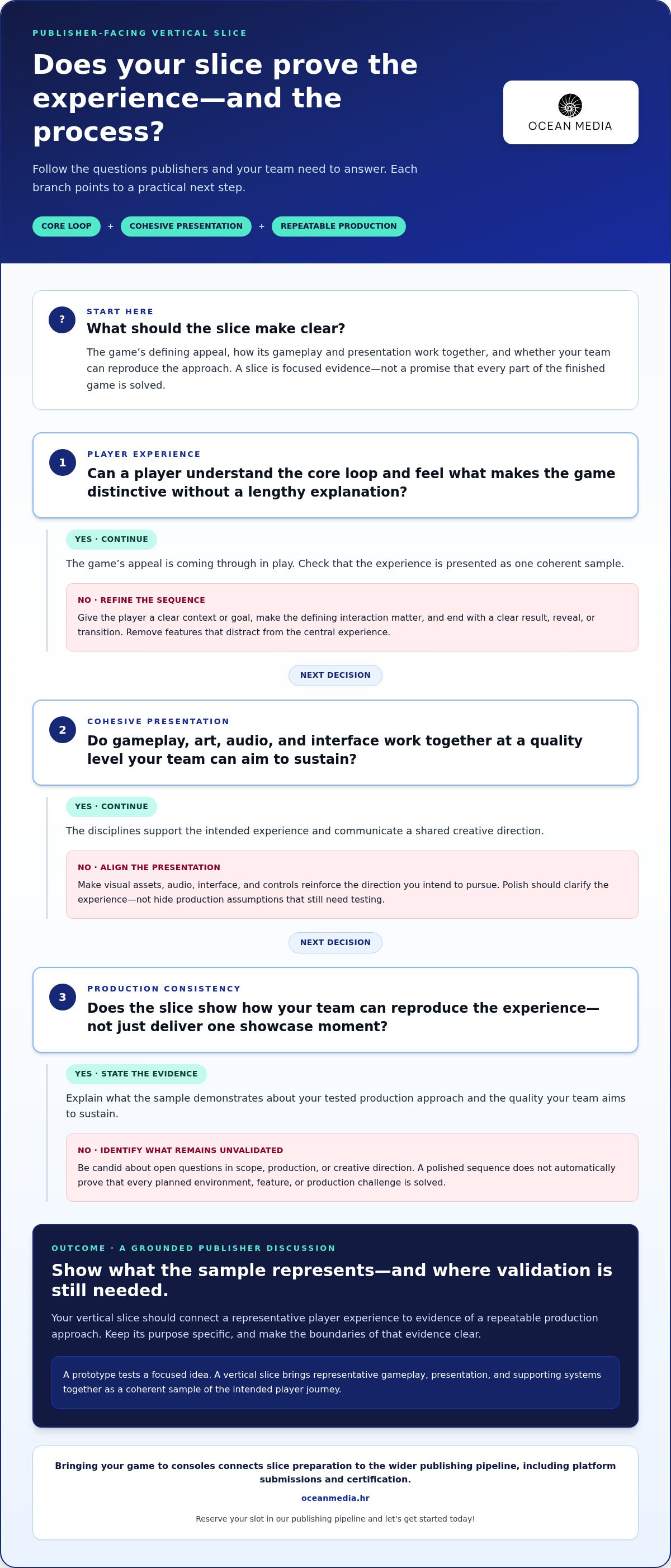
Shape the build around decisions a publisher and your team need to make. Each element should contribute evidence, not simply add content. Ask whether the sample makes the game’s appeal clear, whether the presentation feels cohesive, and which risks remain open.
- Player experience: Can a player understand the core loop and feel what makes the game distinctive without a lengthy explanation?
- Production consistency: Do gameplay, art, audio, and interface work together at a quality level the team can aim to sustain?
- Remaining uncertainty: Which questions about scope, production, or creative direction does this build answer, and which still need validation?
Be candid about the boundaries of your evidence. A polished sequence may communicate the intended experience, but it doesn’t automatically demonstrate that every planned environment, feature, or production challenge has been solved. State what the sample represents and where further validation is needed. That clarity makes the slice more useful in a publisher conversation and keeps the discussion grounded in the project’s actual status.
For developers preparing to bring a game to consoles, the slice handoff can also open a broader conversation about the publishing pipeline for developers, including platform submissions and certification. Keep the build’s purpose specific: show the experience you’re making, the production approach you’ve tested, and the questions you’re ready to work through with a publishing partner.
What to include in a publisher-facing vertical slice
Choose content for what it reveals, not for how much of the game it represents. A strong slice gives a reviewer enough hands-on interaction to understand the intended experience while keeping production effort focused on the parts that best express it. As you decide how to create a vertical slice for a publisher, treat every asset, mechanic, and moment as evidence of the same creative direction.
Choose a sequence that represents the game
Build around one short, representative sequence that introduces the core loop with minimal explanation. For example, a player might enter a space, learn a key interaction, use it to overcome a challenge, then see the result. That progression gives the experience context and a satisfying payoff without requiring a full level or lengthy briefing. Include only the mechanics needed to make the game’s distinctive appeal clear.
Before adding a feature, ask what it helps the reviewer understand. A new ability or elaborate set piece may look impressive, but it can distract if it doesn’t support the central experience. A useful sequence lets a player discover the intended rhythm through play.
- Start with context: Give the player a clear goal or situation, using a brief introduction if needed.
- Make the core interaction matter: Let the player use the defining mechanic to make a meaningful choice or solve a challenge.
- End with a clear beat: Provide a result, reveal, or transition that shows why the loop is engaging.
Demonstrate the core experience, not the full content plan. Completeness means the sample feels coherent from start to finish, not that it contains every planned feature, level, or system. A focused sequence with clear intent is more useful for evaluation than a wider selection of disconnected content.
Make presentation quality serve the experience
Presentation should help players understand what they’re doing and reinforce the game’s identity. Align visual assets, audio, interface, and controls with the direction you intend to pursue. If the world is quiet and atmospheric, for instance, sound and UI should support that mood rather than compete with it. Consistency makes the sample feel purposeful. Decorative detail that doesn’t clarify the experience can wait.
Prioritize what a reviewer needs to read, hear, and do. Make important prompts legible, ensure feedback helps explain player actions, and use audio to reinforce meaningful events. A guided introduction or concise in-game instructions can help an unfamiliar player begin without requiring you to narrate every step.
- Art: Establish the visual language through representative environments, characters, and effects.
- UI and controls: Make goals, feedback, and interactions easy to follow.
- Audio: Support the atmosphere and communicate useful cues without overwhelming play.
Use a simple test: can someone understand the sequence and feel its intended appeal without you explaining the design decisions over their shoulder? If not, refine the framing, feedback, or onboarding before adding more content. This gives your team a concrete way to prioritize polish and helps the build communicate its purpose on its own.
As you prepare the slice for a conversation about bringing your game to consoles, our console publishing experience can help connect the playable sample to the broader publishing pipeline.
How to balance polish, scope, and production evidence
A vertical slice has to feel intentional without implying that every part of the game is already solved. Too much scope can spread your team across content that doesn’t strengthen the evaluation. Too little polish can make it difficult to judge the intended experience. The useful middle ground is a focused build that communicates the game clearly and records how your team produced it.
| Approach | What it proves | What remains unclear |
|---|---|---|
| Over-scoped slice | There’s a broad range of planned content or features. | Whether the core experience and production quality can be delivered consistently. |
| Under-polished sample | A mechanic or early concept may be playable. | How the intended art, audio, interface, and gameplay work together. |
| Focused representative build | The core experience is understandable, and the team has tested relevant production workflows. | Any features, content, or dependencies intentionally left outside the sample. |
Polish should clarify the experience, not conceal unfinished assumptions. A refined interface can make the player’s next action obvious; it can’t prove that every planned menu or progression system is ready. Likewise, a polished environment can establish the game’s visual direction, but it doesn’t demonstrate how quickly or consistently new environments can be produced. Make the sample engaging, and be clear about what it does and doesn’t demonstrate.
How much of the game should the slice cover?
Set scope by the questions the build must answer, not by a universal playtime target. Select a limited sequence that establishes the core loop and includes a meaningful progression beat, such as a new challenge that asks the player to apply a familiar mechanic differently. Then name the boundaries. For example, the sample may show one environment and one progression path while leaving other levels or systems for later validation.
This framing helps a reviewer evaluate the slice on its intended terms. It also gives your team a practical filter: if an element doesn’t help answer a key question, consider leaving it out.
How can the build demonstrate a repeatable pipeline?
Production evidence comes from more than a finished-looking level. Record how key assets are made and integrated, which standards keep them consistent, and what tools or dependencies the workflow relies on. Note where the same process has been used across the sample, such as maintaining consistent interface behavior or applying the same asset standards to multiple environments.
Separate what you’ve demonstrated from what you’re assuming. A workflow used successfully in the slice is evidence; applying it to a larger volume of content may still need testing. Documenting that distinction keeps production planning grounded and gives a publisher a clearer view of the next questions to resolve.
- Demonstrated: Processes and quality standards exercised in the build.
- Still to validate: Dependencies, content volume, or workflows not yet tested at the intended scale.
As you prepare to bring your game to consoles, make the slice’s scope and production evidence part of a clear discussion about the wider publishing pipeline. To take that next step, reserve your slot in our publishing pipeline and let's get started today!
A step-by-step workflow for building the slice
A clear workflow keeps your vertical slice focused from planning through handoff. Before production expands, agree on what the build needs to demonstrate and how you’ll judge whether it’s working. This makes it easier to prioritize tasks, coordinate disciplines, and explain the sample’s purpose in a publisher discussion. Use each review to answer a specific question, then record what changed and why.
Plan the slice around clear evaluation goals
Start by writing down the intended player experience and the production questions the sample should answer. Select the sequence, essential mechanics, and required assets before adding work outside that scope. Assign an owner to each discipline and note dependencies, such as an interaction that needs animation before its feedback can be reviewed.
- Define the evaluation goals. What should a player understand or feel, and what production approach do you need to test? Turn each goal into a question you can review against the build.
- Map the sequence. Outline the player’s starting context, key actions, challenge, and outcome. Does this sequence communicate the intended experience without a spoken explanation?
- List the essentials and assign ownership. Identify the mechanics, assets, interface, and audio needed for that sequence. Who owns each task, and which tasks depend on others?
- Build a playable pass. Connect the essential elements before expanding presentation detail. Can a player complete the sequence and understand the core interaction?
- Review clarity and consistency. Invite someone unfamiliar with the project to play. Where do they hesitate, misunderstand a prompt, or miss important feedback? Do the gameplay, presentation, and audio feel like parts of the same experience?
- Stabilize and prepare the handoff. Resolve issues that block play or obscure the experience, then test the shareable build from start to finish. Can a reviewer launch it, understand the controls, and reach the intended endpoint?
Build, review, and prepare a stable handoff
Work in stages, with a review at each meaningful transition: first the playable flow, then presentation consistency, then a complete run for technical stability. Don’t treat every comment as a reason to expand scope. Fix issues that prevent evaluation; log lower-priority changes for later consideration. A short change log should identify what changed since the previous review and why, so collaborators can follow decisions without relying on memory.
Include concise handoff notes covering controls, the sample’s context, known limitations, and current status. Separate issues that block the intended experience from areas still being refined. This gives a publisher a fair basis for reviewing the build and helps your team keep the discussion precise.
If you’re preparing to bring your game to consoles, start a conversation about console publishing and how the slice fits into your next production steps.
How to present your vertical slice to a publishing partner
A playable build is strongest when its context is just as clear as its content. Pair the slice with a concise overview that explains the game, intended audience, core loop, and development status. Help a publisher understand what they’re about to play, what the sample is designed to demonstrate, and how it relates to the larger project. This turns a demo handoff into a focused conversation about creative direction and production readiness.
What should accompany the playable build?
Keep your supporting materials brief and useful. Introduce the intended player experience, explain how to begin, and outline the sample’s boundaries. A reviewer should be able to start playing without a lengthy live walkthrough, then refer to your notes for context or clarification.
- Project overview: Summarize the game, its intended audience, and the core loop.
- Development status: State what’s complete, what’s in progress, and what the sample represents.
- Open questions: Identify known production risks, assumptions, and decisions still under discussion.
Be specific about the evidence. For example, explain that the slice demonstrates a particular gameplay sequence and visual direction, while other planned content or systems remain outside its scope. Distinguish what the team has tested from what it still needs to validate. That honest framing helps a publisher assess the project without mistaking one representative sample for a complete production plan.
How does the slice connect to console publishing?
A strong slice supports evaluation, but it doesn’t guarantee a publishing agreement. Publishers use different evaluation processes, and a slice gives both sides a concrete starting point for discussing the project’s needs, production assumptions, and the support that may be relevant to bringing your game to consoles.
A publishing partner can help developers navigate platform requirements and certification as part of the release process. For background on how those responsibilities fit together, see our console publisher developer guide.
Use the meeting to connect what the slice demonstrates with what comes next. Be ready to discuss how your team expects to expand the experience, which production dependencies matter, and where you’d value publishing support. You don’t need every future decision resolved; you do need a clear view of what’s known and what remains open.
The slice is one step in a wider release journey. Ocean Media’s digital console publishing experience can help you navigate platform requirements and certification. To discuss your project and its place in the publishing pipeline, reserve your slot in our publishing pipeline and let's get started today!
Turn Your Slice Into a Clear Next Step
Your vertical slice can do more than support a review. Use it to guide the next production conversation: which parts of the experience are ready to expand, what assumptions need further testing, and where a publishing partner could help you move forward. The question of how to create a vertical slice for a publisher leads naturally to a broader one: what decisions will help your game progress from a compelling sample toward a console release?
Bring those decisions into the discussion openly. You don’t need every production question answered before exploring a publishing partnership. A clear sense of your goals, current challenges, and next priorities gives both sides a useful place to begin.
Ocean Media works with developers on digital console publishing, including support with platform-specific requirements and certification. If you’re ready to discuss your project and its next steps, reserve your slot in our publishing pipeline and let's get started today! We’ll take the next step together.
Frequently Asked Questions
How long should a vertical slice be?
There’s no single duration that fits every game or publisher discussion. Let the slice’s purpose set its length: include enough play for a reviewer to grasp the core loop and intended experience, then stop before additional time adds little insight. If a story setup or control explanation is needed, provide it briefly. Don’t add extra encounters simply to make the project seem bigger.
Does a vertical slice need to be fully polished?
No. It should feel coherent, with consistent quality in the elements that shape the game’s identity, but every planned feature and asset doesn’t need to be complete. As you decide how to create a vertical slice for a publisher, prioritize polish that improves understanding, such as clear feedback after a player action. Label temporary elements so reviewers can distinguish current direction from placeholder work.
Can a publisher evaluate a game without a playable vertical slice?
Yes. Publishers can use different evaluation processes, so a playable slice isn’t a universal requirement. Other materials, such as a short gameplay recording or project overview, can communicate specific aspects of a game, but they may leave questions about how the experience feels to play. State what each item demonstrates and what it can’t show. Don’t frame any material as a guarantee of publisher interest or approval.
What is the difference between a vertical slice and a demo?
The terms can overlap, so explain the purpose of your build rather than relying on its label. A vertical slice is commonly presented as a sample representing the intended game and its production quality. A demo may be built mainly to let players try the game. For example, clarify whether your build is intended to show a repeatable gameplay and art approach, offer a player preview, or serve both purposes.
Should a vertical slice include the whole game loop?
It should make the central player activity understandable, but it doesn’t need every system or progression feature. Consider whether a first-time player can explain what they’re trying to do, what choices they make, and what result follows. If one planned system is absent, use a short note to explain its role in the wider design. That helps reviewers understand the sample without mistaking its limits for the full game.
What should I do if the vertical slice is not representative of the final game?
Explain the difference plainly before a reviewer draws conclusions from the build. Identify which parts are deliberate tests, which are temporary, and what the final direction is expected to change. For example, if placeholder art supports a mechanic test, say so and describe the intended visual direction separately. Be precise about what the current build can demonstrate, and avoid presenting provisional mechanics or assets as settled decisions.


