

What if the support that makes a publishing deal attractive is only a promise, while the contract gives your studio few clear ways to rely on it? The red flags in a game publishing deal often sit in the gap between what’s discussed and what’s written. Dense wording can make the practical effects on your creative control, revenue, rights, and future plans easy to miss.
Look beyond the headline offer. A standard clause isn’t automatically a deal-breaker, but you should understand what it means for your game and studio before agreeing. This guide will help you spot terms that could limit your control, obscure how revenue is calculated, or leave publishing responsibilities and exit conditions unclear. You’ll also learn what to clarify and how to prepare for the next discussion.
For console releases, clear responsibilities matter. Platform submissions, certification, and the wider digital publishing lifecycle all shape the path to launch. Ocean Media supports developers with console publishing, including platform-specific requirements and certification. As you consider your next step, reserve your slot in our publishing pipeline and let's get started today!
Key Takeaways
- Spot red flags in a game publishing deal by looking for terms whose scope, practical effect, or assigned responsibility is unclear.
- Clarify how revenue is calculated, which deductions apply, and when reporting and payments happen.
- Separate publisher and developer responsibilities to reveal potential gaps or friction across development and release.
- Track uncertain clauses in a risk log, then prepare focused questions about their impact on your project.
- Compare the deal’s publishing scope with your console release needs, including platform submissions and certification.
Red Flags in a Game Publishing Deal: Spot the Gap Between Promises and Terms
Receiving a publishing offer can feel like a major step forward. You may be excited about the partner’s plans for your game while wondering what the agreement will mean for your studio day to day. That uncertainty is a reason to read carefully, not a reason to assume the offer is unsafe.
A publishing-deal red flag is a term whose scope, practical effect, or assigned responsibility is unclear enough that you can’t tell what your studio or the publisher is expected to do. Separate questions that need clarification from fundamental mismatches. A broad clause may become workable once both parties define it. A term that conflicts with your goals or leaves a critical responsibility unassigned may require a more substantial discussion.
Developers and publishers contribute different roles to a game’s journey. A general overview of the video game developer role can help frame that relationship, but your agreement needs to explain how responsibilities apply to your specific project.
When a publishing promise is not reflected in the agreement
Compare what you’ve been told with what the draft commits each party to do. Promises about marketing, platform support, or launch coordination may sound valuable, but broad wording is difficult to assess if it doesn’t explain the work involved. “Support the launch,” for example, leaves open what that support includes, who provides it, and when it happens.
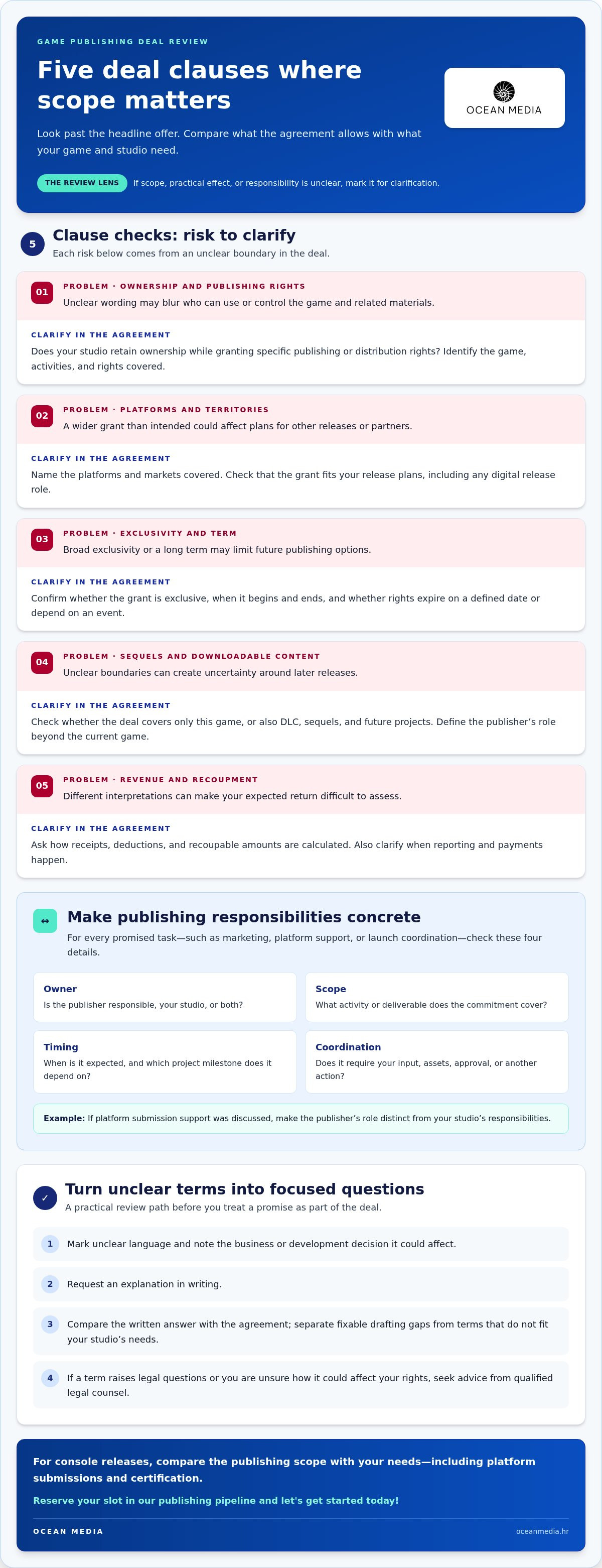
Make each promised action concrete. For every task, identify:
- Owner: Is the publisher responsible, your studio, or both?
- Scope: What activity or deliverable does the commitment cover?
- Timing: When is it expected, and which project milestone does it depend on?
- Coordination: Does the task require your input, assets, approval, or another action?
For example, if discussions included platform submission support, look for language that distinguishes the publisher’s role from your studio’s responsibilities. A written division of work helps both teams plan submissions and launch without relying on different interpretations of the same conversation.
Pressure to sign before you understand the terms
A fast-moving offer can create pressure, especially when you’re eager to move the project forward. Urgency alone doesn’t prove misconduct. It does make it more important to pause if you can’t explain what a clause means, how it affects your plans, or which party is accountable.
Ask for time to review the draft and gather your questions. Mark unclear language, note the business or development decision it could affect, and request an explanation in writing. Then compare that answer with the agreement. If a term raises legal questions or you’re unsure how it could affect your rights, seek advice from qualified legal counsel.
Clarity gives you a stronger basis for discussion. Resolve open questions before treating verbal assurances as part of the deal, and distinguish fixable drafting gaps from terms that don’t fit your studio’s needs.
Game Publishing Deal Terms: Check Scope, Rights, and Revenue
Once you understand the responsibilities on the table, examine what the agreement lets the publisher do with your game and how money will flow back to your studio. A headline percentage or broad grant of rights can hide important details. Defined scope turns a publishing agreement from a general promise into a plan you can assess against your game’s release needs.
| Clause area | What to clarify | Possible practical consequence |
|---|---|---|
| Ownership and publishing rights | Does your studio retain ownership while granting specific publishing or distribution rights? | Unclear language may blur which party can use or control the game and related materials. |
| Platforms and territories | Which platforms and markets does the grant cover? | A wider grant than intended could affect plans for other releases or partners. |
| Exclusivity and term | Is the grant exclusive, and when does it begin and end? | Broad exclusivity or a long term may limit future publishing options. |
| Sequels and downloadable content | Does the agreement cover only this game, or also DLC, sequels, or future projects? | Unclear boundaries may create uncertainty around later releases. |
| Revenue and recoupment | How are receipts, deductions, and recoupable amounts calculated? | Different interpretations can make the expected return difficult to assess. |
Rights, exclusivity, territory, and term
Separate ownership of the game from the rights you grant for publishing. Read the grant closely and identify the covered game, platforms, territories, and activities, including any role tied to digital release. The ESA on Intellectual Property and Copyright in Video Games offers context on why intellectual property matters in this industry, but your agreement should specify the rights involved in your deal.
Then consider how exclusivity and duration interact. An exclusive grant for particular platforms and territories has a different effect from one that covers broader future plans. Check whether rights end on a defined date or depend on an event, and whether language about sequels, downloadable content, or future projects gives the publisher a role beyond the current game. These terms can shape your studio’s options after launch.
Revenue share, recoupment, and reporting
Don’t assess the revenue share in isolation. Look for a defined calculation: what counts as receipts, which deductions are allowed, what costs can be recouped, and how those amounts affect the share over time. There isn’t one percentage that fits every deal. The useful question is whether you can understand the full calculation and assess it against the support and scope involved.
Trace the reporting process, too. Clarify how often statements arrive, when payments are due, and what detail supports each calculation. If deductions or recoupment are mentioned without a defined scope, you may struggle to forecast returns or identify why a payment changed. For console projects, connect rights and responsibilities to the actual publishing path, including platform submissions and certification. Explore our console publishing support for developers as you map the scope your release requires.
Control, Responsibilities, and Exit Rights: Where Deal Risks Surface
A deal can define rights and revenue clearly yet still leave uncertainty about who makes the next call. For a console release, decisions about submission materials, platform-facing communication, and release timing affect how the teams coordinate. The useful question isn’t whether one party has all control. It’s whether the agreement makes decision-making authority, required input, and accountability clear enough for your project.
Read each clause in context. The red flags in a game publishing deal are not automatically the clauses that sound broad or unfamiliar. They’re terms whose wording and practical effect leave you unable to tell how a decision will be made, what happens if a milestone shifts, or what your studio must deliver in response.
Approvals, milestones, and publishing responsibilities
For every development or release milestone, look for an objective description of the expected deliverable, who reviews it, and what follows approval or rejection. If “ready for submission” appears without explaining what materials or build state that means, the teams may have different expectations. Check whether review steps and decision timelines are described, and how a delay or requested change affects the next milestone.
Make responsibilities visible across the publishing process. Identify who prepares and approves submission materials, sets or confirms release timing, and handles platform-facing communications. Then distinguish those publisher deliverables from the work your studio must provide, such as project materials or responses needed to keep tasks moving. A named owner for each responsibility reduces the chance that both sides assume the other is handling it.
Termination, rights reversion, and future projects
Read the termination section alongside the rights grant, payment terms, and any duties that continue after the agreement ends. Establish what the wording says about granted rights, outstanding amounts, transition tasks, and access to or continued use of game materials. Don’t assume rights automatically revert or that every obligation ends at termination. The agreement’s specific language determines what happens, so unresolved points deserve a focused discussion.
Future-project clauses need the same care. A right of first negotiation generally gives a publisher an initial opportunity to discuss a future project with you. A right of first refusal generally relates to an opportunity to match terms offered by another party. Their exact effects depend on the clause wording, including which projects it covers and what steps or time limits apply. Neither label alone tells you whether the term fits your plans.
As you review, trace a realistic scenario: a milestone is delayed, the agreement ends, or you begin planning a sequel. Note who can act, which rights remain in place, and what each party still needs to do. If the text doesn’t give you a clear answer, ask for the language and process to be clarified. A clause may be workable in context, but both teams should understand its effect before relying on it.
How to Review a Game Publishing Deal Before You Sign
A repeatable review process helps you turn dense contract language into decisions your team can act on. Rather than treating every unfamiliar phrase as a deal-breaker, connect each concern to a practical effect: a release task that could stall, a right that could limit future plans, or an economic term you can’t reliably assess. This section offers a review framework, not legal advice.
- Map the promises. List the support, resources, and publishing tasks discussed during negotiations. For each one, locate the written term that covers it, or note that you haven’t found one.
- Mark unclear language. Highlight terms that leave the scope, owner, timing, calculation, or decision authority open to interpretation. Keep questions specific to the clause rather than labeling it risky without context.
- Assess the project impact. Consider what could happen if the term is interpreted differently than you expect. Would it affect a console release, your studio’s ability to plan a future project, or your understanding of revenue?
- Prepare questions and priorities. Separate points that need an explanation from material terms that may not fit your goals. Decide what needs a written answer or proposed revision before you can make an informed decision.
A simple risk log can keep that work focused. Record the clause, the uncertainty, the potential impact on your project, and the clarification or amendment you’re requesting. For example, if the agreement references a milestone without explaining how it’s assessed, note the missing criteria and ask how approval will be determined. Prioritize concerns by their practical effect, not by how unfamiliar the wording looks.
Turn contract concerns into specific questions
Replace “this clause is vague” with a request to define the scope, deadline, calculation, or decision-maker. Ask which written term covers each important verbal promise, and note where the draft doesn’t appear to address it. Keep a record of responses and proposed amendments alongside your draft so you can see whether the agreed clarification made it into the language.
That record is useful during negotiation. It helps your team distinguish an explanation from a change to the deal, and prevents a verbal answer from being mistaken for a written revision.
Decide whether the deal fits your studio
Compare offers using the same categories: publishing responsibilities, rights granted, revenue calculations and reporting, and what happens if the agreement ends. Then weigh the support offered against the rights and obligations requested. The best fit depends on your studio’s goals, project needs, and future plans, not a headline percentage or the number of services mentioned.
For a console release, consider whether the defined scope supports the path you’re planning, including platform submissions and certification. If a material concern remains unresolved, treat it as a decision point rather than a minor wording preference. Ask qualified legal counsel to interpret contract language and advise you on its implications. With our team, you can discuss bringing your game to consoles and how our publishing pipeline supports the digital release process.
Choose a Console Publishing Partner for a Clearer Path to Release
Contract review helps you understand the deal on paper. The next step is deciding whether the partner’s actual publishing scope fits your game, console-release goals, and studio plans. The red flags in a game publishing deal matter most when they point to a mismatch between the support your project needs and the rights or responsibilities the agreement assigns.
Match publishing support to your console-release needs
Look at the path from preparation to release, not just the offer’s headline. Does the agreement explain the partner’s role in digital console publishing, platform submissions, and certification? Can you see how that role connects with your studio’s responsibilities and the milestones your project must reach? This context helps you assess whether the proposed support fits your release needs, rather than relying on broad assurances.
Console submissions and certification are practical parts of bringing your game to consoles. A publishing partner with experience in these areas can help you understand the platform-facing work involved and how it fits into the wider digital publishing lifecycle. Ocean Media focuses on digital console publishing and supports developers with platform submissions and certification, drawing on more than 20 years of gaming-industry experience.
As you assess the agreement, connect each promised area of support to a clear role in your release plan. For example, consider whether the publishing scope accounts for the submission process your game requires, and whether the contract makes responsibilities between your studio and publisher understandable. This is not about expecting every project to follow the same path. It’s about knowing what support the partnership is designed to provide and how that supports your goals.
Start a publishing conversation with clear priorities
Bring your project goals and key deal questions into the conversation. Outline your target release plans, the areas where you need publishing support, and contract points that affect your studio’s decisions. A shared understanding of priorities gives both sides a practical starting point for discussing fit and the steps involved in the publishing pipeline.
For a digital console release, explore our console publishing support for developers and how we work with studios bringing their games to consoles. Use the review framework above to organize your questions and consider how a publisher’s scope aligns with your project.
Let’s turn your release goals into a clear next step. reserve your slot in our publishing pipeline and let's get started today!
Move Forward With a Deal That Supports Your Next Step
A publishing agreement should help your studio move toward its goals, not leave you guessing about what happens next. Use the questions that remain to guide a focused conversation with a potential partner. Clear answers can help you decide whether the proposed relationship gives your game and team a workable path forward.
The red flags in a game publishing deal are prompts to understand the trade-offs before you commit. Some can be resolved through clarification; others may reveal that the arrangement doesn’t fit your priorities. Keep your studio’s creative direction and release plans at the center of the decision.
If bringing your game to consoles is your next milestone, discuss your project goals and the support you’re looking for with our team. Start a conversation about your console publishing plans and take the next step with confidence.
Frequently Asked Questions
Should I sign an NDA before sharing my game with a publisher?
An NDA can help set expectations before you share confidential material, but whether to sign one depends on what you plan to disclose and the document’s terms. Before sharing a build, roadmap, or unreleased creative assets, understand what information it covers, how it may be used, and how long the obligations apply. An NDA doesn’t replace a publishing agreement or guarantee that every part of your project is protected. Consider qualified legal advice if you’re unsure.
Is a term sheet the same as a full game publishing agreement?
No. A term sheet typically outlines proposed business points, while a full publishing agreement sets out more of the working relationship, including detailed rights and responsibilities. Don’t assume a term sheet is non-binding or that every point will carry into the final draft. Its effect depends on its wording and applicable circumstances. Compare the two documents as the deal develops, and have qualified legal counsel review any language you don’t understand.
What is a right of first negotiation in a publishing deal?
A right of first negotiation generally gives the publisher an initial opportunity to discuss a covered future project with you before you negotiate that project elsewhere. Read the clause to see which games or related projects it covers, what starts the process, and how long negotiations can continue. For example, a clause might apply to a sequel, but the wording determines whether that specific project falls within its scope.
What is a right of first refusal in a game publishing contract?
A right of first refusal generally gives a publisher an opportunity to match an offer from another party before you accept it. The clause’s wording matters: check which projects it covers, what counts as an offer, how matching works, and what response period applies. This right differs from first negotiation, which typically concerns an initial discussion rather than matching an outside offer. Ask qualified legal counsel to interpret how a clause affects your plans.
Can I negotiate changes to a publisher’s draft contract?
Yes, you can raise proposed changes and ask the publisher to discuss them. A draft is a basis for negotiation, not a reason to leave important questions unasked. Focus on specific outcomes: for example, request clearer wording about which platforms a grant covers or how a project milestone will be assessed. Track agreed revisions in the document, and ask qualified legal counsel to review the revised language before you sign.
What should I do if a publisher promises support that is missing from the contract?
Identify the promised support and ask where the agreement describes it. If you can’t find a written commitment, request wording that defines the deliverable, responsible party, and relevant timing. For example, if platform submission assistance was discussed, ask how the contract describes the publisher’s role and your studio’s input. These are practical red flags in a game publishing deal because the written scope may not match your expectations. Don’t rely on an assumption; resolve the gap before signing.


