

A publisher meeting isn’t just a chance to sell your game. It’s a two-way conversation about fit, expectations, and what it would take to bring your game to consoles. Knowing how to prepare for a meeting with a publisher helps you focus on the details that matter, instead of trying to cover everything at once.
You may be wondering what to present first, which questions will reveal whether a publisher’s scope aligns with your project, and how to tell a positive conversation from a concrete opportunity. This guide shows you how to shape a focused pitch, prepare useful questions, and leave with clear next steps. You’ll also learn how to discuss your game’s audience, development status, and console plans with confidence.
Ocean Media supports developers through the technical and administrative complexities of digital console publishing, including platform submissions and certification. Use your meeting to explore how our publishing pipeline could support your game’s console release. When you’re ready to take the next step, reserve your slot in our publishing pipeline and let's get started today!
Key Takeaways
- Set a clear objective for the meeting, whether you’re making an introduction, pitching your game, or discussing the project in depth.
- To learn how to prepare for a meeting with a publisher, organize a concise overview of your game, its development status, intended audience, and publishing needs.
- Use focused questions to understand the publisher’s scope and working expectations, then note any answers that need follow-up.
- Rehearse your introduction and meeting objective so you can answer questions clearly and keep the discussion on track.
- Send a brief recap that separates immediate actions from longer-term decisions. When you’re ready to explore console publishing, reserve your slot in our publishing pipeline and let's get started today!
How to Prepare for a Meeting with a Publisher: Start with the Right Goal
Feeling nervous before a publisher meeting is normal. You’re discussing work you’ve invested in, and the conversation may shape how you bring your game to consoles. Set a clear goal so you can focus on exploring a professional partnership, not delivering a flawless performance. The most useful way to think about how to prepare for a meeting with a publisher is to decide what you need to learn, as well as what you want the publisher to understand.
A publisher’s role can cover different parts of a game’s journey, such as financing, marketing, or distribution. The Video Game Publisher overview offers helpful context, but each meeting has its own purpose. Your aim is to establish a shared understanding of your game, its publishing needs, and a practical next step. You’re assessing the publisher, too: a promising conversation should give you useful insight into fit, not just leave you hoping for approval.
What kind of publisher meeting are you preparing for?
An introductory conversation may focus on who you are, what you’re making, and whether there’s a reason to continue talking. A focused pitch gives more attention to the game and its potential. A project or publishing discussion may explore development status, console plans, and the support the project needs. Review the invitation and earlier correspondence for clues about the meeting’s purpose.
If the purpose is broad, prepare a concise overview and choose a few priorities. That gives the conversation room to develop while ensuring you know where to begin. If you’re discussing bringing your game to consoles, review our console publishing support for developers and note which parts of the publishing process you want to discuss.
Set a practical outcome before you join
Choose one primary goal. You might want to present the game clearly, understand how digital console publishing could support your plans, or decide whether a follow-up discussion makes sense. Then write down two questions that would make the meeting worthwhile. Make them specific to your project, such as asking what information is needed to assess publishing fit or which console release topics to cover next.
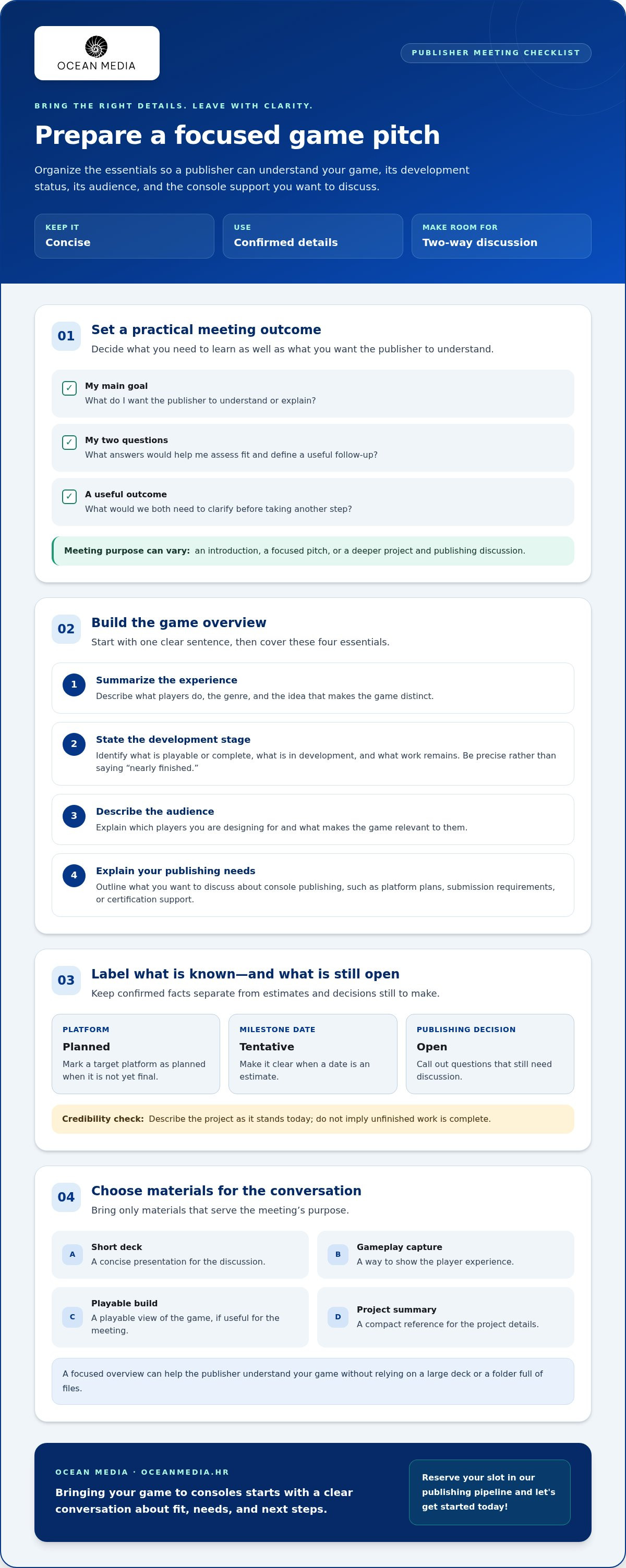
Use this quick prompt to sharpen your objective before the meeting:
- My main goal: What do I want the publisher to understand or explain?
- My two questions: What answers would help me assess fit and define a useful follow-up?
- A useful outcome: What would we both need to clarify before taking another step?
Don’t treat an initial conversation as a requirement to settle every business decision. A productive first meeting can confirm shared interest, surface open questions, and identify who will follow up on what. That’s progress. You and the publisher should leave with a clearer view of the project and whether your goals align, even if a partnership decision comes later.
Prepare Your Game Pitch and Materials for a Publisher Meeting
A focused pitch helps a publisher understand the game, its development status, and what support could move the project forward. A practical way to prepare for a meeting with a publisher is to build your story from confirmed details, then bring only materials that serve the conversation. Keep the overview clear enough to follow without relying on a large deck or a folder full of files.
Start with one sentence that captures the game and its current stage. For example: “We’re developing a cooperative exploration game for players who enjoy shared discovery. The core gameplay loop is playable, and we’re continuing to build out the project.” Make the description specific to your game, and don’t imply that unfinished work is complete. For additional pitch guidance, How to Pitch Your Game to a Publisher offers practical advice on tailoring your presentation to the publisher.
Build a concise overview of the game
Give the publisher a clear picture of the player experience, not just a list of features. Name the genre, intended audience, and creative hook, then describe progress in observable terms: what is playable, what is in development, and what remains. Explain why bringing your game to consoles matters to your studio, whether that’s reaching console audiences or supporting your release plans, if those are genuine priorities for your team.
- Summarize the experience. Describe what players do, the genre, and the idea that makes the game distinct.
- State the development stage. Identify what’s playable or complete and what work is still underway. Use precise language rather than broad claims like “nearly finished.”
- Describe the audience. Explain which players you’re designing for and what makes the game relevant to them.
- Explain your needs. Outline what you want to discuss about console publishing, such as platform plans, submission requirements, or certification support.
Keep confirmed facts separate from estimates and decisions still to make. You might label a target platform as “planned,” a milestone date as “tentative,” or a publishing question as “open.” Clear labels make your pitch more credible and help the publisher respond to the project as it stands today.
Organize supporting details and open questions
Choose materials based on the meeting’s purpose. A short deck, gameplay capture, playable build, or project summary may help, but don’t present every asset by default. Make it easy to focus on the game, and have supporting information ready if the discussion calls for it. For the broader release journey, refer to How to Publish a Game on Console: The Complete Developer Roadmap for 2026.
- Confirmed: Current development status, completed work, and established project details.
- Planned: Intended platforms, milestones, and dependencies that could affect the release path.
- Open: Unresolved publishing questions or decisions that need discussion.
Before the meeting, review our console publishing support for developers and identify the technical or administrative topics relevant to your project. For a focused discussion about bringing your game to consoles, reserve your slot in our publishing pipeline and let's get started today!
Assess Publisher Fit Through a Two-Way Meeting
A publisher meeting is a shared evaluation, not a one-sided audition. You’re learning whether the publisher’s scope and working expectations fit your project, while they’re learning what your game needs. A useful conversation clarifies where your goals align, which responsibilities need discussion, and what information would make a next step productive.
Keep the discussion collaborative. Ask open questions, listen for specific answers, and connect those answers to your project’s needs. You don’t need to settle rights, royalties, or contract terms in an introductory discussion. Instead, identify the topics that need careful review later and note who should follow up.
Ask how the publishing pipeline could relate to your project
Describe your console plans and project needs, then ask which parts of digital publishing are relevant. For example, discuss platform-specific submissions and certification at a high level, without assuming the process is identical across platforms. Ask what project details or decisions would help make a follow-up conversation more focused.
Topic: Publishing scope
Your question: Which parts of digital console publishing could relate to our project?
The answer you need: A clear view of relevant support areas and where responsibilities may sit.
Follow-up: Share any project details needed to make the next discussion more specific.
Topic: Platform submissions and certification
Your question: How do platform-specific requirements and certification fit into the publishing discussion?
The answer you need: An understanding of which submission or certification topics are relevant to your plans.
Follow-up: Note the platform questions that need a deeper conversation.
Check for shared expectations without turning it into an interrogation
Ask how the publisher approaches communication and project coordination, then compare the answer with how your team works. Do your goals for bringing your game to consoles align with the publisher’s stated scope and experience? For broader context on publisher roles, consult Console Game Publishers: A Developer’s Guide, then use the meeting to understand how those roles might apply to your project.
Use a few focused questions rather than running through a checklist. Give the publisher room to explain its approach, and share the expectations that matter to your team, such as how you prefer to track open decisions or discuss milestones. You’re looking for clarity and a constructive exchange, not a perfect answer to every question on the spot.
This is where how to prepare for a meeting with a publisher becomes a question of listening as much as presenting. Record what’s clear, what remains open, and whether both sides see a sensible next conversation. A productive meeting clarifies project fit, responsibilities, and next steps.
Ocean Media’s digital console publishing work includes support with platform submissions and certification. Discuss how these areas relate to your project and explore our console publishing support for developers. To begin a structured discussion about bringing your game to consoles, reserve your slot in our publishing pipeline and let's get started today!
Rehearse Your Publisher Meeting and Handle Difficult Questions
Rehearsal isn’t about memorizing a script. It helps you explain the game clearly, describe its current status accurately, and use the meeting time well. Link the core experience, development stage, console plans, and meeting objective in one clear narrative so the publisher can follow how they fit together.
Practice a clear, concise game introduction
Prepare a short opening that names your game, describes the core experience, and states where development stands. Add a sentence about your console plans, then leave the detail for the project overview. Ask a colleague who isn’t close to the project to listen. If they can’t explain the game back to you, simplify the language or clarify the creative hook. Review any claims that need stronger evidence before the meeting.
Then rehearse the flow of the conversation. A simple agenda gives you structure without making the meeting feel rigid:
- Introductions: Share names, roles, and the reason for meeting.
- Project overview: Present the game and its current development status.
- Publisher discussion: Explore relevant publishing scope and expectations.
- Questions: Clarify priorities, platform plans, and areas that need more discussion.
- Agreed next steps: Confirm actions, owners, and any information to share afterward.
Prepare for questions and keep the conversation collaborative
Think through questions about development progress, your team’s priorities, platform plans, and the support you’re seeking. You don’t need a polished answer for every unknown. If a decision is still open, say so directly, explain what you know, and identify what would help resolve it. Separate confirmed facts from estimates, and don’t present an aspiration as a commitment.
For example, if a milestone hasn’t been set, explain which work remains and what factors still shape the schedule. If a platform plan is under consideration, describe it as a plan under discussion rather than a confirmed release decision. Clear distinctions help both sides discuss the project on accurate terms.
Keep your notes simple during the meeting. Record commitments, unanswered questions, and the person responsible for each follow-up. This prevents a useful discussion from ending in vague recollections. Listen closely, too. The publisher’s questions can show you which project details need clarification and what would make the next conversation more productive.
Rehearsing helps you sound prepared without sounding scripted. Use the agenda as a guide, adapt to the discussion, and leave space for the publisher’s perspective. To discuss the technical and administrative aspects of bringing your game to consoles, reserve your slot in our publishing pipeline and let's get started today!
Follow Up After the Meeting and Move Toward a Publishing Partnership
A strong meeting only creates value if both sides leave with the same understanding of what was discussed. A concise follow-up preserves that clarity. Include it in your plan for how to prepare for a meeting with a publisher: it turns discussion into documented actions without suggesting that a partnership or deal is already complete.
Turn meeting notes into specific next steps
After the conversation, send a neutral recap of shared priorities, open questions, and agreed actions. Keep it brief and factual. Distinguish between a point both sides agreed to explore and a decision that still needs more information. If your notes reveal a misunderstanding, correct it promptly rather than letting it shape the next discussion.
Separate immediate follow-ups from longer-term decisions. An immediate action could be sharing a project overview or gathering details for a future discussion. Longer-term matters might include evaluating publishing fit or discussing business terms. Record an owner for each action, and include timing only if it was agreed during the meeting. Don’t turn a tentative intention into a deadline.
- Shared priorities: What both sides identified as relevant to the project.
- Immediate actions: Information to share or questions to address next, with an owner for each.
- Open topics: Decisions that remain unresolved and should guide a later conversation.
This record gives everyone a practical reference point. It also makes the next conversation more focused, because you can return to open questions instead of reconstructing the meeting from memory. Keep the recap collaborative: reflect what was discussed, not a commitment to terms that haven’t been agreed.
Explore a console publishing conversation with Ocean Media
Ocean Media brings more than 20 years of gaming-industry experience to digital console publishing. We support developers with global digital releases and platform requirements, including submissions and certification. If your next step is to explore console publishing, use the meeting to discuss your game’s needs and the project details that will make the conversation specific.
If regional context is part of your planning, Console Game Publishing in Europe: The Developer’s Guide to 2026 can help frame topics for a future discussion. Keep those topics separate from decisions that still need review. A meeting recap records progress, not a publishing agreement. Longer-term business decisions belong in their own detailed conversation.
With clear actions and open questions in hand, you can move forward with a more structured discussion about bringing your game to consoles. reserve your slot in our publishing pipeline and let's get started today!
Take the Next Step Toward Bringing Your Game to Consoles
Your publisher meeting can begin a deliberate decision about the path ahead. Treat it as a chance to explore whether a potential collaboration supports your studio’s goals and plans for bringing your game to consoles, not as a test you must pass in one sitting.
Knowing how to prepare for a meeting with a publisher means entering the conversation ready to make the next discussion useful. From there, choose a practical direction for your project: continue exploring publishing fit, identify topics that need deeper review, or consider how console publishing could support your plans. You don’t need every answer today. A clear direction gives you a stronger foundation for moving forward with the right partner.
Ready to explore a structured path for your console release? Reserve your slot in our publishing pipeline and let's get started today!
Your game has a future worth building. Take the next step with confidence.
Frequently Asked Questions
What should I bring to a meeting with a game publisher?
Bring a compact set of materials that makes the project easy to understand and discuss. A one-page overview can serve as your reference, supported by only the files relevant to the meeting. Label each item clearly, including the build or document version and what it demonstrates. If the invitation names specific materials, follow those instructions and focus your preparation on the requested items.
How do I pitch my game to a publisher in a meeting?
Lead with what players do and why that experience is distinctive, then connect it to the reason you’re exploring publishing. For example, explain the central player choice and how it shapes the game, rather than listing every feature. Keep your claims grounded in what the project can show today. A clear pitch leaves room for the publisher to ask where more detail would be useful.
What questions should I ask a game publisher?
Ask questions that reveal how work could be divided and what the publisher would need to understand your project. For example, ask how responsibilities for storefront information or platform submissions are approached, and what project materials would clarify those areas. You can also ask what a productive follow-up would focus on. Keep contract terms for a dedicated review, when there’s enough context to discuss them carefully.
What if my game is not finished when I meet a publisher?
You can still have a useful meeting if you describe the project’s present state accurately. Be specific about what someone can experience now, such as a playable level or prototype, and what is still being built. If a schedule is provisional, identify it as an estimate and explain what could affect it. That gives the publisher a grounded view of the project without overstating its readiness.
Should I send my game materials before meeting a publisher?
Send materials when the invitation requests them or when they directly support the stated purpose of the meeting. Make each file easy to identify with a descriptive name and a brief note explaining its relevance, such as “current gameplay build” or “project overview.” If nothing has been requested, prepare your materials without sending them in advance. Avoid sharing files that add no context to the discussion.
What should I do after a meeting with a publisher?
Send a factual recap to the people involved, then use the same notes to update your team’s project tracker. Separate confirmed actions from ideas that were only discussed, so no one mistakes interest for a commitment. If an action depends on another person or decision, record that dependency rather than treating it as underway. This creates a useful internal record while keeping the publisher relationship clear and professional.


