

The hardest part of bringing your game to the living room isn't the code; it's the paperwork. Your masterpiece is finished, the bugs are squashed, and the frame rate is locked. Yet, for many developers, the real boss fight begins after the final build is exported. Learning how to publish a game on console is often less about creative vision and more about surviving a compliance marathon. You've likely stared at the opaque requirements for Technical Requirements Checklists (TRCs) or winced at the mounting costs of dev kits and global age ratings. It's a daunting wall of administrative complexity that can make even the most seasoned studio feel like a novice again.
We understand that fear of rejection during the submission process is real, but it shouldn't stall your momentum. This guide provides the definitive roadmap for 2026 to help you master the journey from your local drive to global storefronts. We'll break down the specific steps of the submission process and weigh the pros of self-publishing against the benefits of finding a seasoned publishing partner. By the end, you'll have the clarity and confidence needed to start your application and see your title live on PlayStation, Xbox, and Switch.
Key Takeaways
- Identify the essential legal and hardware prerequisites, including the procurement of dev kits, required to clear the initial entry barriers for major platforms.
- Demystify the specific compliance standards for the major consoles, such as Sony's TRCs and Microsoft's TCRs, to reduce the risk of submission rejection.
- Master the technical submission lifecycle to understand how to publish a game on console, covering everything from the "Greenlight" phase to final SDK integration.
- Evaluate the administrative and financial trade-offs between self-publishing and partnering with a seasoned guide to manage the complex certification back-and-forth.
- Implement a global digital launch strategy that balances regional pricing and storefront visibility to maximize your reach across international markets.
The Prerequisites: What You Need Before Applying to Consoles
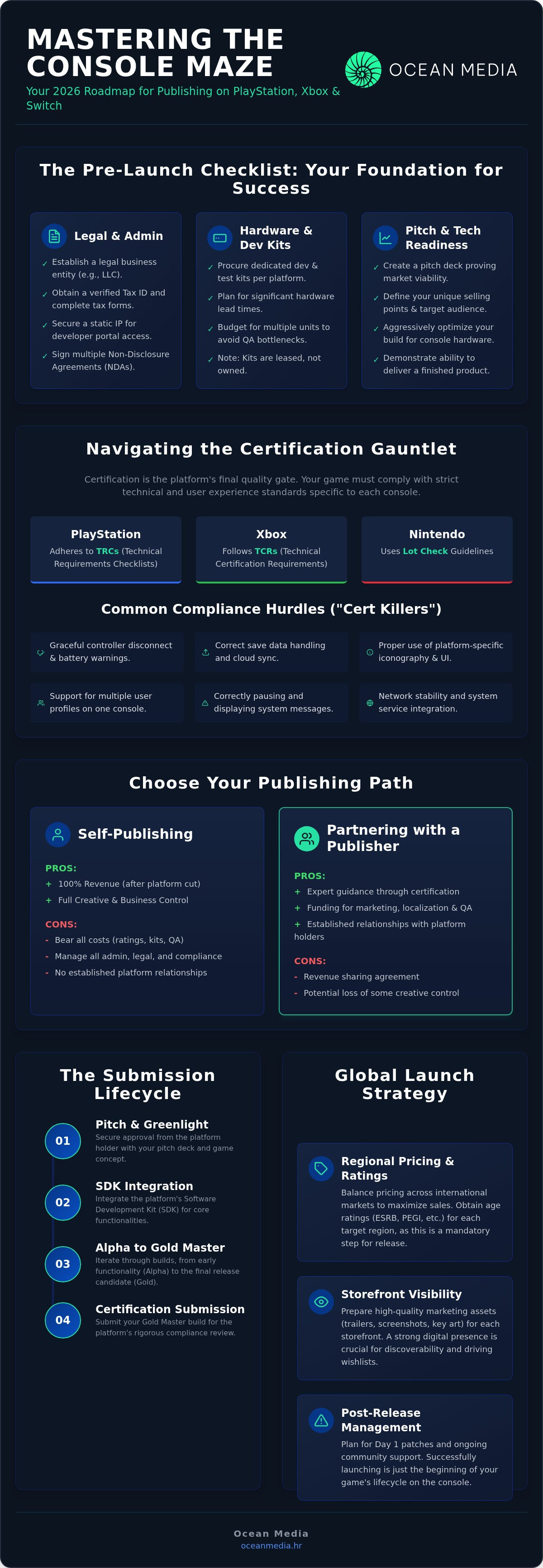
Before you write a single line of code for a specific platform, you must establish a professional foundation. Many developers assume that a polished build is enough to open doors, but console storefronts are closed ecosystems with strict gatekeeping. Transitioning from a PC environment to a console environment requires a shift in mindset from "creator" to "business partner." Understanding The Role of a Video Game Publisher can help clarify why these administrative hurdles exist; they ensure that every title on the storefront meets a baseline of legal and technical reliability.
Legal and Administrative Foundations
Establishing a legal business entity, such as an LLC or a private limited company, is your first non-negotiable task. Platform holders require a corporate structure to execute binding contracts and manage royalty payments. You'll need to provide a verified Tax ID and complete international tax documentation, such as W-8BEN forms for US-based platforms, to avoid payment delays. Additionally, securing a static IP address is often a requirement for accessing secure developer portals. These portals are where you'll find the sensitive documentation and SDKs needed for development. Expect to sign several Non-Disclosure Agreements (NDAs) early in the process. These legal shields protect the platform's proprietary technology and your own unreleased IP.
Securing Hardware: The Dev Kit Quest
You cannot test your game on a standard retail console. To understand how to publish a game on console, you must first procure dedicated development and testing kits. These specialized units allow for deep debugging and performance profiling that retail hardware simply can't handle. Lead times for this hardware can be significant, sometimes taking weeks or months depending on global supply and regional availability. It's best to budget for multiple kits per platform. Having only one unit creates a bottleneck for your QA team and risks stalling development if a single piece of hardware fails. Remember that these kits remain the property of the platform holder; you're essentially leasing the right to use them for your project's duration.
The Pitch Deck and Technical Readiness
Your PC build might run at a smooth 60 frames per second on a high-end rig, but that doesn't mean it's "console-ready." Consoles have fixed hardware specifications and unique memory constraints that require aggressive optimization. Beyond the technical build, platform holders want to see a compelling pitch deck. This document must prove your game's market viability, highlighting your unique selling points, target audience, and marketing plan. They aren't just looking for good games; they're looking for reliable partners who can deliver a finished, bug-free product that enhances their digital storefront.
Navigating the Console Certification (Cert) Process
Certification is the final gatekeeper. It is the systematic process where platform holders verify that your software doesn't just play well, but also behaves correctly within their specific ecosystem. Mastering how to publish a game on console involves more than just a stable build; it requires passing a series of rigorous compliance tests. The Console Certification Process is designed to protect the platform's reputation and the user's experience. Each of the "Big Three" has its own terminology and standards. Sony uses Technical Requirements Checklists (TRCs), Microsoft utilizes Technical Certification Requirements (TCRs), and Nintendo follows their own Lot Check Guidelines.
Technical Standards Explained
Technical compliance focuses on how your game interacts with the hardware and system software. A common hurdle is controller management. Your game must gracefully handle controller disconnects, display accurate battery warnings, and use the correct button iconography for the specific platform. If a user's controller dies, the game must pause and display a system-compliant message immediately. Save data and profile management are equally critical. Your game needs to support multiple user profiles on a single console and handle cloud syncing without corrupting data. TRCs are the technical rulebook for PlayStation software. Failing to adhere to even one minor rule in these documents can result in an immediate rejection.
Many developers are surprised by "Cert-Killers," which are often simple UI or UX oversights rather than game-breaking bugs. For instance, referring to a "Press Start" button when the hardware no longer uses a "Start" button is an instant fail. Platform holders use a mix of automated tools and manual testing teams to find these discrepancies. Automated scripts check for basic API compliance, while human testers look for edge cases in system-level interactions. Experienced teams often rely on professional console game publishing services to catch these errors before the official submission.
Age Ratings and Global Compliance
Choosing your path is a pivotal decision that dictates your studio's daily workload for months. While self-publishing offers total creative control and the allure of keeping all revenue, it demands a massive investment in administrative labor. Understanding how to publish a game on console as a solo entity means becoming an expert in legal contracts, tax law, and technical compliance overnight. It's a heavy lift. A publisher acts as a seasoned guide, absorbing the administrative shock so you can remain focused on the creative process.
The Self-Publishing 'Grind'
It's more than just uploading a final build to a portal. You'll spend hundreds of hours manually managing developer accounts and filling out complex tax documentation. You also face the "hidden" costs associated with Quality Assurance and the Submission Lifecycle, which can drain your budget before you even reach the storefront. Without a dedicated team, you are responsible for several grueling tasks:
- Localizing storefront metadata and legal disclaimers for dozens of global regions.
- Managing customer support and community feedback across three distinct console ecosystems.
- Handling the constant cycle of patches and hotfixes required by platform holders post-launch.
Perhaps the biggest hurdle is visibility. Major platforms often prioritize titles from established partners for "Storefront Featuring" slots. Independent self-publishers often find themselves buried in the "New Releases" section, fighting for scraps of organic traffic without a dedicated account manager to advocate for their game.
The Ocean Media Advantage
Partnering with an expert turns a chaotic submission process into a methodical one. We've spent 20 years building direct relationships with platform holders, which is vital for securing the visibility your game deserves. Our team manages the entire "Gold Master" approval process, handling the technical back-and-forth that usually derails independent submissions. We specialize in digital-only distribution, ensuring your game reaches global audiences without the need for you to open regional offices or hire international legal counsel.
By letting us handle the administrative "Certification" headache, you gain the freedom to polish your next project. We provide a bridge to the global market, leveraging our track record to streamline how to publish a game on console for teams of all sizes. It's a strategic balance; you trade a royalty split for the elimination of high upfront costs related to specialized QA and administrative staffing. This collaborative spirit ensures that your launch is not just a release, but a coordinated global event.
The Submission Lifecycle: From Alpha to Gold Master
Moving from a playable build to a retail-ready product is a journey of precision. Learning how to publish a game on console involves navigating a series of high-stakes milestones that transform your software into a platform-compliant experience. The process begins with the "Greenlight" or concept approval phase. During this step, you submit your storefront metadata, including descriptions, screenshots, and age ratings, for the platform holder's review. This ensures your project aligns with their brand values and technical capabilities before you commit to the final porting stretch.
Integrating Platform Features
Once your concept is approved, the technical heavy lifting of SDK integration begins. This is where you hook your game engine into platform-specific features that players expect, such as trophies, achievements, and friends lists. Trophy and achievement logic requires a delicate balance; you must follow platform-specific rules regarding reward tiers while keeping the challenges engaging. Social integration is equally vital, as you'll need to configure presence strings (the text that tells friends what a player is doing) and native share buttons. SDK integration must happen months before the target launch to ensure total stability.
The QA and Audit Phase
A rigorous Pre-Submission QA audit is your final line of defense. This is where you catch "Cert-Killers" that would otherwise lead to a costly and time-consuming rejection. Functionality alone isn't enough; your build must pass a strict "Compliance" test. This involves checking how the game reacts to system-level interruptions, such as a user signing out mid-session or the console entering rest mode. When you receive feedback, you must interpret rejection reports carefully, prioritizing "Must-Fix" issues that violate core platform standards. Many studios utilize a Day One patch to address minor bugs, ensuring the core build passes certification without unnecessary delays.
Final submission marks the beginning of the "Waiting Game." Platform testers will spend several days or weeks dissecting your build to ensure it meets every TCR and TRC requirement discussed earlier. If you pass, you achieve "Gold Master" status. This is the ultimate milestone where your build is locked and ready for the storefront. Achieving this status gives you the green light to set your global launch date and begin your marketing push. If the technical weight of these steps feels too heavy for your team, you can partner with a console game publisher to navigate these milestones with expert precision.
Global Launch Strategy and Post-Release Management
Launch day is a major milestone, but it isn't the finish line. Successful developers know that understanding how to publish a game on console includes a long-term strategy for visibility and player retention. Once you've cleared the "Gold Master" hurdle discussed previously, your focus shifts to global market penetration. This requires a sophisticated approach to regional pricing. Balancing USD and EUR with local currencies in emerging markets is essential for maximizing your reach. You shouldn't simply use a flat conversion rate; you need to account for local purchasing power to ensure your title is accessible and competitive worldwide.
Maximizing Storefront Discovery
Visibility is the lifeblood of digital sales. Console storefronts are crowded, and the algorithm often favors titles with strong early engagement. You must optimize your trailers and screenshots specifically for the console viewing experience (where text needs to be legible on a television from across a room). Pre-orders and wishlisting are critical metrics that platform holders track. A high number of pre-orders signals to the storefront algorithm that your game is "hot," often leading to better placement in "New and Trending" sections. Coordinating your global launch times ensures that social media momentum peaks simultaneously across all time zones, creating a unified surge in traffic.
Long-term Lifecycle Management
Ocean Media's digital-first focus ensures that your game remains relevant in a fast-moving market. With over 20 years of experience, we understand the nuances of platform-specific updates and how to leverage established relationships for storefront featuring. We handle the technical support logistics for a global player base, allowing you to focus on your next creative breakthrough. Mastering how to publish a game on console means looking past the launch window and building a sustainable lifecycle for your intellectual property.
Success in the console market requires more than a polished build; it's about mastering the administrative gatekeeping and technical compliance required by platform holders. The journey from initial prerequisites to a Gold Master involves a rigorous cycle of certification and strategic global positioning. Learning how to publish a game on console is a professional marathon that rewards those who prepare for the administrative heavy lifting as much as the creative development. You don't have to navigate this complex landscape alone.
With 20+ years of console publishing expertise, Ocean Media acts as your seasoned guide through the entire lifecycle. We provide expert management of TRC/TCR certification and leverage our established global digital distribution reach to ensure your title gets the visibility it deserves. Partner with Ocean Media to bring your game to the global console market and transform your creative vision into a commercial reality. Your masterpiece is ready for the living room. Let's make that launch happen together.
Frequently Asked Questions
How much does it cost to publish a game on PlayStation or Xbox?
Publishing costs involve several variables beyond a simple listing fee. You'll need to budget for hardware procurement, legal entity formation, and global age rating fees through organizations like the ESRB or PEGI. While platform holders generally don't charge for the act of submission itself, the administrative and technical overhead can be significant. Many developers find that the investment in specialized QA testing for compliance is the most substantial part of their pre-launch budget.
Do I need a dev kit to publish a game on consoles?
Dedicated development hardware is a non-negotiable requirement for the final submission phase. Retail consoles cannot run unsigned code or provide the deep debugging insights necessary to clear technical certification. You'll typically apply for hardware access once your project concept receives initial approval from the platform holder. These kits allow you to test how your game interacts with system-level features like trophies, controller disconnects, and memory management in a controlled environment.
How long does the console certification process take?
The certification cycle usually spans several weeks from the initial submission to the final "Gold Master" approval. A single round of testing often takes 5 to 14 business days, depending on the platform's current queue and the complexity of your title. If your build fails on a "must-fix" technical requirement, you'll need to patch the issue and restart the queue. Planning for at least two months of buffer time is a standard industry practice.
Can I self-publish on Nintendo Switch as an indie developer?
Nintendo provides a clear path for independent creators through their dedicated developer portal. You must register as a formal business entity and provide a compelling pitch to gain access to the ecosystem. While the process is accessible, Nintendo maintains high standards for storefront quality. Successfully learning how to publish a game on console like the Switch involves proving your game is technically stable and fits their current global content strategy.
What is the royalty split for console game publishing?
Most major console storefronts operate on a standard 70/30 revenue split, where the platform holder retains 30% of each sale. If you choose to work with a publishing partner, the remaining 70% is shared according to your negotiated agreement. These contracts often reflect the level of financial risk the publisher assumes, such as covering localization costs, marketing budgets, or the technical labor involved in managing the complex certification back-and-forth.
What are the most common reasons for console certification failure?
Compliance failures often stem from how the game handles system-level interruptions. For example, your build might fail if it crashes when a user signs out of their profile or if it fails to display the correct platform-specific button icons in the UI. Save data corruption during a simulated power loss is another common reason for rejection. These technical requirements exist to ensure that every game on the storefront provides a consistent and reliable user experience.
Is it better to launch on all consoles simultaneously or staggered?
A simultaneous multi-platform launch generates the highest marketing momentum and social media visibility. However, it also requires managing three different sets of technical requirements (TRCs, TCRs, and Guidelines) at the same time. For smaller teams, a staggered release can be a safer strategic choice. This approach allows you to focus your QA resources on one platform at a time and apply the lessons learned from the first launch to subsequent console ports.
Do I need a publisher to get my game on the PlayStation Store?
You can certainly apply to Sony's developer program as an independent studio without a third-party partner. However, many developers find that the technical and administrative burden of the submission lifecycle is overwhelming for a small team. A publisher manages the intricate details of how to publish a game on console, allowing your developers to stay focused on gameplay. They act as a bridge between your creative vision and the platform's strict technical gatekeepers.


