

What if the most difficult part of launching your game has nothing to do with the code you wrote? You've spent years perfecting every mechanic, yet the path to seeing your title on a Nintendo Switch often feels like a fortress of technical SDKs and certification hurdles. It's a common realization for talented creators; the gap between a finished build and a global console release is frequently wider than expected. When you start asking what does a game publisher do, you're usually looking for a way to bridge this technical (and often exhausting) professional divide.
We understand that frustration. You want to focus on gameplay, not the administrative weight of platform submissions or the hunt for direct contacts at major hardware manufacturers. This article will help you discover the essential roles a publisher plays in transforming your creative project into a globally recognized console title. We'll explore how a partner manages digital distribution and provides the marketing reach you need to succeed. You'll gain a clear framework to decide between self-publishing and finding a collaborative partner to bring your vision to a global audience.
Key Takeaways
- Understand that a publisher is a strategic partner, not just a financier. Learning what does a game publisher do reveals the bridge between your finished build and a global console release.
- Navigate the complex world of console certification with confidence. You'll understand platform-specific requirements like Lotcheck and Technical Requirements (TRCs/XRs) before you submit.
- Define the boundaries between creative development and the business of distribution. This clarity lets you focus on coding and assets while your partner handles the administrative weight.
- Leverage professional marketing and PR strategies to build momentum. It's about reaching the right audience on digital storefronts through proven promotional tactics.
- Identify the risks of inexperienced partnerships. Discover why two decades of console expertise is vital for avoiding the pitfalls of the submission process.
Beyond the Code: Defining the Role of a Modern Game Publisher
A modern game publisher is far more than a source of capital; it's a strategic partner that takes over the heavy lifting of business, technical, and marketing operations. While you focus on the creative heartbeat of your project, the publisher ensures that the game actually reaches players. In the current industry, asking what does a game publisher do leads to a simple answer: they transform your creative vision into a commercially viable product. They act as the essential bridge between your development environment and the global digital storefronts where your audience lives.
Think of your finished game as a computer folder full of high-quality assets and clean code. To you, it's a masterpiece; to a console storefront, it's just raw data. It isn't a "product" until it has been wrapped in the necessary metadata, localized for international markets, and passed through rigorous technical checks. The shift from physical retail to digital-first publishing has changed the game. We no longer worry about disc manufacturing or shelf space at a mall. Instead, we fight for algorithm visibility and platform compliance (a much more technical and data-driven battle).
The Core Mission: Commercial Viability
Your game is a piece of art, but to survive in a competitive market, it must also be a sustainable business asset. A publisher identifies the optimal market positioning for your title. This means looking at current platform trends and player behaviors to find where your game fits best. It's a delicate balance. We protect your creative vision while ensuring it meets the specific demands of the market and the strict standards of platform holders. This strategic alignment is what turns a niche project into a global success story. Understanding what does a game publisher do helps you see the value in this commercial transformation.
Why Indie Developers Need a Partner in 2026
The digital marketplace is crowded. With thousands of titles launching every month, the "noise" is deafening. Breaking through requires more than just a great trailer; it requires deep industry connections and a massive marketing reach. Success requires expertise that most small teams simply don't have the time to cultivate. Entering the console market is significantly harder than launching on PC. Console stores require specific SDK knowledge and strict adherence to technical guidelines. A game publisher serves as a strategic bridge for global digital reach.
The Four Pillars of Video Game Publishing Services
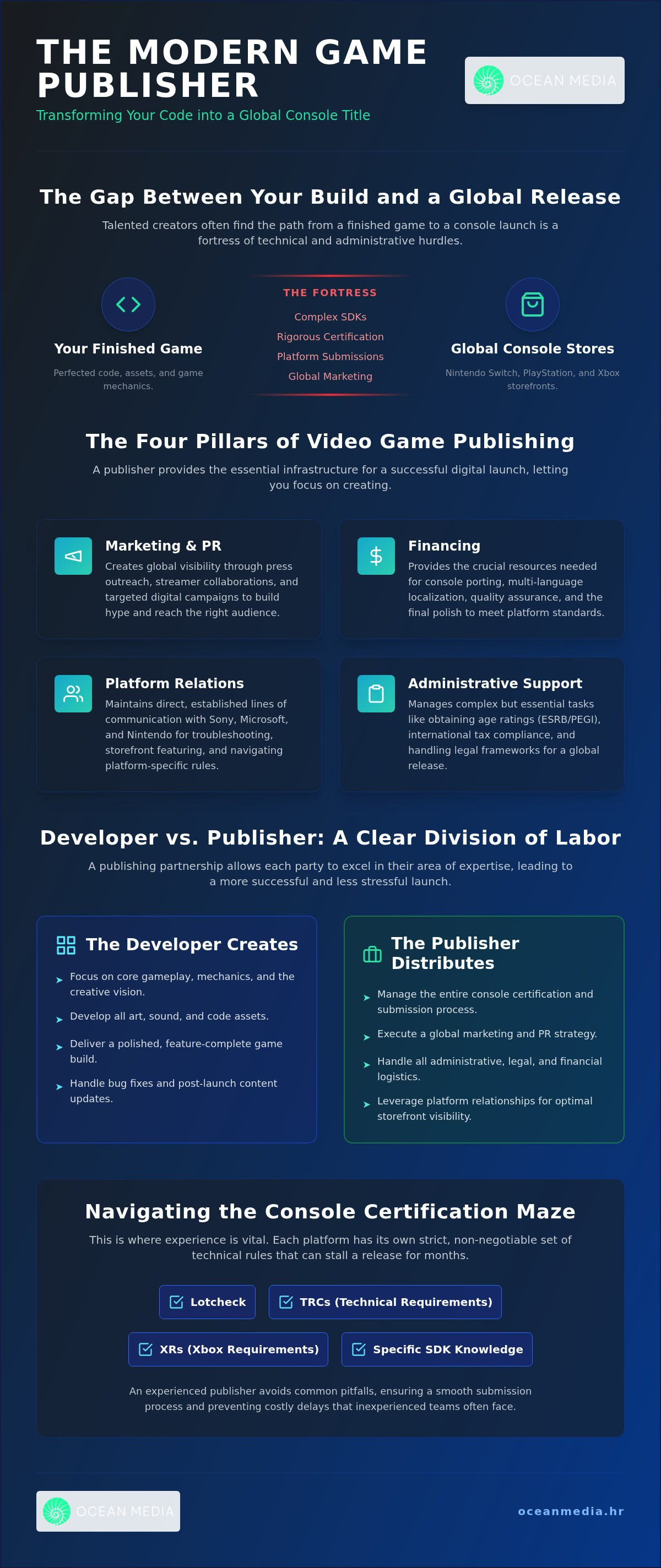
Effective publishing is built on more than just capital. It's a multi-faceted operation that covers the ground most developers find either too technical or too time-consuming. When exploring what does a game publisher do, you'll find their work generally falls into four critical categories: Marketing and PR, Financing, Platform Relations, and Administrative Support. These pillars form the infrastructure that supports a successful digital launch on consoles.
These pillars form the foundation of a professional release:
- Marketing and PR: Creating global visibility through press, streamers, and targeted campaigns.
- Financing: Providing the resources for porting, localization, and final polish.
- Platform Relations: Maintaining direct lines of communication with Sony, Microsoft, and Nintendo.
- Administrative: Managing complex age ratings (ESRB/PEGI), tax compliance, and legal frameworks.
Platform relations are particularly vital. Having direct lines of communication with major console holders isn't just a convenience; it's a necessity for troubleshooting and storefront visibility. Beyond the technical side, publishers handle the essential administrative tasks that can stall a release. This includes managing international tax compliance and ensuring royalty payments are processed accurately. If you're looking for a partner to manage these complexities, exploring digital publishing experts is the best way to safeguard your project's future.
Strategic Marketing and Global PR
Building hype in a saturated market requires a coordinated strike. A publisher manages key distribution, ensuring that major streamers and press outlets actually see your game. This isn't just about sending emails. It's about leveraging established relationships to get your title in front of the right eyes. Storefront optimization (ASO) is another critical piece. We ensure your game is discoverable on digital stores through precise keyword use and engaging visual assets. Long-term community management keeps the conversation going long after launch day, turning players into advocates.
Funding and Financial Management
Project financing often covers the final, most expensive stretch of development. This might include funding for porting your title to different hardware or localizing text and audio for global audiences. Localization is especially important for reaching non-English speaking markets. A publisher also manages the complex revenue split and royalty distribution process, providing transparency and financial stability. By handling these resources, the publisher allows you to maintain focus on gameplay while they secure the commercial foundation. Knowing exactly what does a game publisher do in this financial capacity helps you plan for the long-term health of your studio.
Navigating the Console Maze: Technical Certification and Platform Relations
Certification isn't just a formality; it's a grueling process where every single UI element and performance metric is scrutinized. Sony, Microsoft, and Nintendo maintain strict Technical Requirements (often called TRCs or XRs) that your build must satisfy before it can go live. Failing these checks leads to costly delays and missed launch windows. A publisher acts as your front-line defense, ensuring your game is compliant before the platform holders ever see it.
When developers ask what does a game publisher do, the most technical answer involves managing the "Lotcheck" or submission process. This is where seasoned authority becomes a competitive advantage. Having 20 years of industry experience (the kind of deep roots we have at Ocean Media) means we've seen every possible reason for a rejection. We help you bypass common errors that typically sink first-time submissions, from controller disconnect logic to save-data corruption edge cases.
Beyond the code, there's a massive administrative mountain to climb. Managing age ratings (ESRB, PEGI, or CERO) across different territories is a complex, time-consuming task. Each storefront has its own administrative quirks and metadata requirements that must be navigated perfectly. We handle these "boring" but vital details so your creative energy stays focused on the next patch or project.
The Platform Submission Lifecycle
Launching globally means more than just clicking a button. While shipping physical goods across those same regions would require the specialized packaging and supplies from OEM Materials & Supplies, a digital launch requires a different kind of logistical precision. Regional storefronts in North America, Europe, and Asia have unique requirements for metadata, localized assets, and legal disclosures. We also handle the high-level strategy of scheduling. You don't want your indie gem launching the same day as a massive AAA sequel. We ensure the game meets the specific administrative standards of every territory while finding the quietest window for maximum visibility.
A successful release relies on a clear division of labor. When you ask what does a game publisher do, you're really asking how the workload is split to ensure the game survives the market. The developer remains the soul of the project. You own the creative vision, the source code, the artistic assets, and the responsibility for squashing bugs. This focus allows you to iterate on mechanics without the distraction of storefront logistics. It's about protecting the "why" behind your game while we manage the "how" of its release.
The publisher's domain begins where the game meets the world. We handle high-level strategy, platform compliance, and the massive machinery of marketing and distribution. However, a "grey area" often exists regarding porting, quality assurance (QA), and localization. These tasks are collaborative. While the publisher might manage the localization team, the developer must ensure the code supports multiple languages. A collaborative spirit is always better than a cold, transactional relationship. We view our partners as equals, not just vendors. This synergy ensures that technical porting doesn't break the artistic intent of the original build.
The Development Focus
Your primary goal is to make the game "fun." If the core loop isn't engaging, no amount of marketing can save it. Modern publishing deals emphasize creative independence; we want you to make the game you envisioned. We handle the business so you can stay in the flow of creation. This clear boundary prevents the developer from burning out on administrative tasks. If you're ready to find a partner who respects this balance, contact Ocean Media to discuss your project and see how we can support your vision.
The Publishing Execution
The work doesn't end on launch day. True lifecycle management includes post-launch support, managing patches, and developing a DLC strategy that keeps players engaged. Ocean Media has managed the digital lifecycle for over two decades. We analyze sales data and player feedback to inform future updates or potential sequels. This data-driven approach ensures your game doesn't just launch; it thrives. Understanding what does a game publisher do in the long term helps you build a sustainable studio model. We look at the metrics to see where players are dropping off and help you decide where to focus your post-launch resources.
Finding Your Publishing Partner: Why Experience on Console Matters
Choosing the wrong partner can be more damaging than going it alone. While it's tempting to think that any support is beneficial, an inexperienced publisher can lead to failed certifications and missed launch windows. When you look at what does a game publisher do, their most valuable asset is their history with the platform holders. At Ocean Media, our 20+ years of experience in digital console publishing serves as a shield for our partners. We've navigated the evolving requirements of Sony, Microsoft, and Nintendo since the early days of digital storefronts. This longevity isn't just a number; it represents thousands of hours spent in certification labs and storefront dashboards.
Vetting a partner requires looking past the surface. You need a portfolio that matches your specific digital console goals. A publisher who specializes in mobile or PC might struggle with the technical rigor of a PlayStation or Switch release. We act as a seasoned guide, ensuring your project doesn't just exist in a folder but thrives on a global stage. A collaborative spirit is vital. You want a team that treats your game with the same passion you do, while maintaining the professional discipline required for a global rollout.
Key Questions to Ask a Potential Partner
Before signing any deal, you must peel back the layers of a publisher's operational history. The right partner will have transparent, data-driven answers to these specific questions:
- How many titles have you successfully navigated through console certification?
- What is your direct relationship like with platform holders like Sony, Microsoft, and Nintendo?
- How do you handle the administrative complexities of global digital stores, including regional metadata and tax compliance?
A publisher's value is often hidden in these technical details. If they cannot explain their process for handling regional age rating submissions or SDK updates, they might not be equipped for the demands of 2026.
The Next Steps for Your Indie Game
Preparing your pitch is about showing commercial readiness. Publishers need to see a stable vertical slice and a clear understanding of your target audience. They don't need a 100-page design document. They need to see that the core loop is polished and the technical foundation is solid. At Ocean Media, we focus strictly on digital console excellence. We don't get distracted by physical retail or work-for-hire development. This specialization allows us to provide a level of focus that broader entities simply cannot match. If you're ready to see what does a game publisher do when they're fully committed to your success, the path forward is clear. Partner with Ocean Media for your global digital launch and let us handle the technical maze while you build the future of play.
Bringing Your Vision to the Global Stage
Your creative journey shouldn't end at a finished build. The transition from a local folder to a global storefront involves a complex web of technical certification and strategic marketing. Understanding exactly what does a game publisher do is the first step toward reclaiming your time. It allows you to focus on the mechanics you love while an expert partner manages the heavy administrative weight. Success on modern consoles requires more than just clean code; it demands a deep understanding of platform-specific requirements and a clear path to digital visibility.
With over 20 years of console publishing experience, Ocean Media acts as your seasoned guide through the technical maze of Sony, Microsoft, and Nintendo certification. We provide the global digital distribution reach necessary to ensure your title finds its audience without the stress of navigating the submission process alone. It's time to transform your project into a market-ready asset. Get Your Game on Console with Ocean Media and take the next step in your development career. Your game deserves a global audience, and we're ready to help you reach it.
Frequently Asked Questions
Do I need a publisher for an indie game?
You don't strictly need a publisher to launch a game, but having one is often the difference between a local build and a global console release. Publishers provide the technical expertise and marketing reach that most small teams lack. If you want to focus on creative development while someone else handles the administrative weight of platform holders, a partner is essential. It's about deciding if you have the bandwidth for technical certification and global PR.
What percentage do game publishers take from indie developers?
Revenue splits vary based on the level of investment and services provided. While there is no universal standard, some industry professionals report splits ranging from 30% to 50% after the publisher has recouped their initial costs for porting or marketing. You should always review the specific terms of a contract to understand how royalties are distributed. The goal is a fair balance that reflects the risk and resources committed by both parties.
What is the difference between a developer and a publisher?
The developer is the creator, while the publisher is the bridge to the market. A developer handles the coding, asset creation, and core mechanics of the game. When asking what does a game publisher do, the focus shifts to strategy, platform compliance, and distribution. One builds the product; the other transforms that product into a commercially viable asset and ensures it meets the strict standards required for a successful digital launch.
How much does it cost to publish a game on PlayStation or Xbox?
There isn't a single fixed fee for publishing, but the costs manifest through development kits, age ratings, and localization. While platform holders may not charge a direct listing fee, you must account for the expense of meeting Technical Requirements (TRCs/XRs). A publisher often covers these upfront costs, including the price of physical dev-kits and the administrative fees associated with global age ratings like ESRB or PEGI.
Will I lose the rights to my IP if I sign with a publisher?
Not necessarily, and modern indie publishing deals frequently allow developers to retain full ownership of their Intellectual Property (IP). You are typically granting the publisher a license to distribute and market the game for a specific period or on specific platforms. It's vital to ensure your contract explicitly states that you keep the rights to the characters, world, and code. This creative independence is a hallmark of collaborative modern partnerships.
Can I self-publish on consoles without a partner?
Self-publishing is possible through programs like ID@Xbox or Nintendo's developer portal. However, the technical barrier is high. You'll need to manage your own SDK updates, secure dev-kits, and navigate the grueling certification process alone. Many devs find that the time spent on these administrative tasks distracts from making the game better. A partner manages these complexities so you can stay focused on the creative heartbeat of your project.
What is console certification (Lotcheck)?
Certification is the rigorous testing process platform holders use to ensure game stability and hardware compatibility. Nintendo calls this Lotcheck, while other platforms have their own terminology. Your build is tested against hundreds of technical requirements, ranging from how the game handles a controller disconnect to how it displays system messages. Failing even one check can delay your launch, which is why having a seasoned partner with 20 years of experience is a major advantage.
What does a digital game publisher do differently than a traditional one?
Digital publishers focus on storefront optimization and algorithm visibility rather than physical manufacturing and retail logistics. They specialize in navigating digital only submission pipelines and managing global storefront metadata. Because there are no physical discs to print, digital publishing is more agile. It focuses on post launch patches, DLC strategies, and long term community engagement. This data driven approach is exactly what does a game publisher do to survive in the modern console landscape.


