

A chart position can draw attention, but it is not a visibility plan. If you’re focused on getting visibility on the Nintendo eShop, make it easy for players to recognize your game and understand its appeal. In a crowded storefront, unclear messaging or mismatched assets can make a promising title harder to evaluate.
You can’t control every route players take to find a game, but you can plan the parts within your reach. This guide covers eShop search, browsing, charts, and recommendations, along with practical ways to prepare your storefront materials and coordinate launch communications. It also explains where publishing support fits, from platform submissions and certification to digital release execution. Ocean Media brings more than 20 years of gaming-industry experience to helping studios bring their games to consoles. When you’re ready to plan your release, our publishing pipeline gives you a structured path forward.
Key Takeaways
- Plan for several discovery routes on the Nintendo eShop instead of relying on chart placement alone.
- Compare search, browsing, charts, curated exposure, and external referrals by player intent, your influence, timing, and uncertainty.
- Use clear, accurate storefront information so interested players can quickly understand what your game offers.
- Connect audience positioning, storefront readiness, platform submissions, and launch communications, while keeping certification separate from marketing outcomes.
- A structured publishing pipeline can help coordinate platform submissions, certification, and digital release execution as you bring your game to consoles.
Getting visibility on the Nintendo eShop starts with understanding discovery
For a studio, visibility is the set of ways potential players encounter a game, decide whether it interests them, and find enough information to consider playing it. Getting visibility on the Nintendo eShop means planning for that journey instead of treating a chart position as the only measure of discoverability.
Discoverability is the opportunity for players to encounter and evaluate your game through relevant storefront and external touchpoints. It does not guarantee a particular ranking, feature, or sales result. Some touchpoints are controlled by the platform. You can’t decide where Nintendo places a game or how its charts are ordered. You can make your game’s presentation clearer and coordinate promotion beyond the store.
How players may find games on Nintendo eShop
Players can search the Nintendo eShop for content, including by entering a game’s title. Nintendo’s support guidance explains how users search the store. Make your game’s name and core identity easy to recognize across public-facing materials. Search is only one route: players may also browse available categories and other storefront surfaces, encounter charts, or see editorial and promotional placements when Nintendo makes them available.
Discovery can begin outside the eShop, too. A player might hear about your game through a community, creator, event, press coverage, or campaign, then visit the store to evaluate it. That journey differs from finding a title through storefront search or browsing, even if both lead to the same product page. The Nintendo eShop overview provides broader context on the platform’s history and features. For release planning, focus on the current player journey.
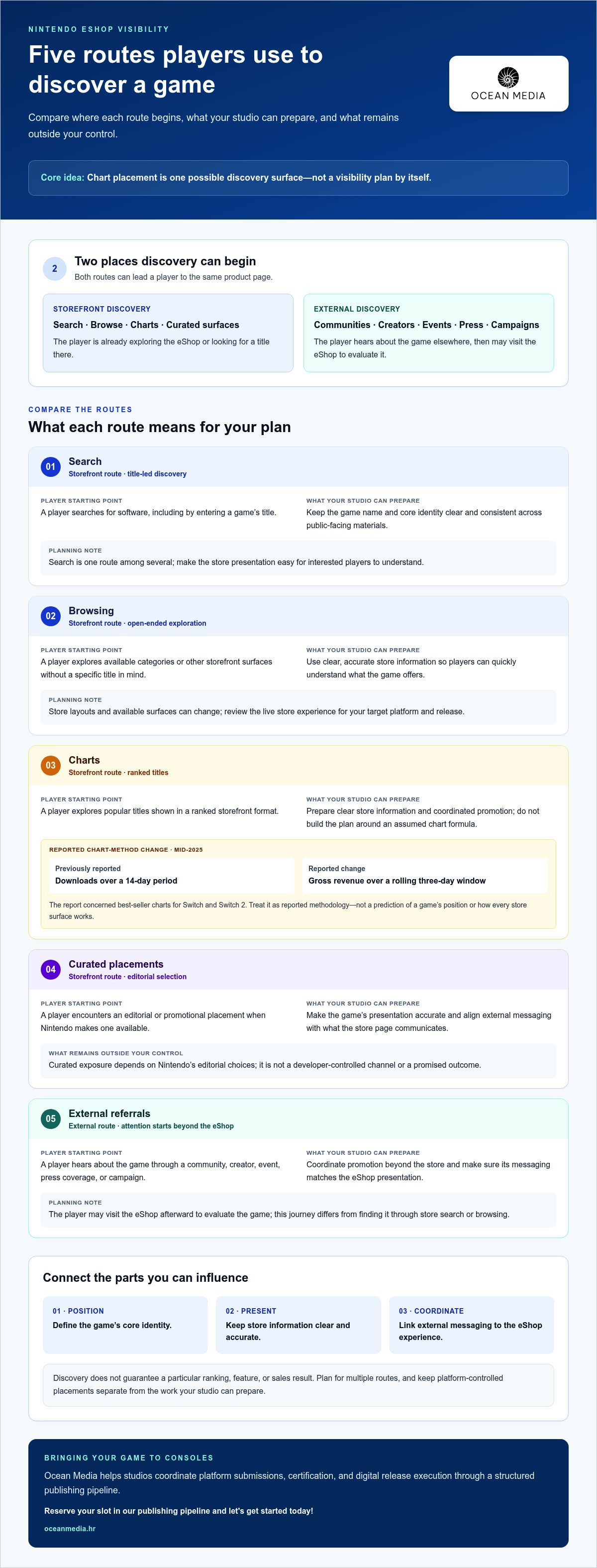
For planning purposes, separate discovery routes into two groups:
- Storefront discovery: Search, browsing, charts, and any editorial or promotional surfaces available to players.
- External discovery: Campaigns and communities that direct attention toward your game, whether or not the player has opened the eShop yet.
Storefront layouts and available surfaces can change. Use these routes as a planning framework, and review the live store experience for your target platform and release.
Why visibility is not the same as chart position
Charts are one possible discovery surface, not the whole storefront experience. Players may find a title by searching its name, browsing a relevant category, following an external recommendation, or exploring another available store surface. Each route reflects a different level of intent. Someone searching for a known game is behaving differently from someone browsing without a specific title in mind.
Don’t build your plan around an assumed chart formula. Ranking methods and timing can change, and a chart position alone won’t explain how players encountered your game or what helped them evaluate it. Instead, connect the touchpoints you can influence: keep promotional messaging consistent, make the store presentation accurately communicate the experience, and plan how external interest leads players to the eShop. This joined-up view gives you a more useful basis for decisions than chasing a single placement.
How Nintendo eShop discovery works across search, browsing, and charts
Each discovery route meets players at a different point. Search can help someone locate a title they already know or have heard about. Browsing gives players room to explore categories and other surfaces in the store. Charts display popular titles in a ranked format, while curated placements depend on Nintendo’s editorial choices. External referrals begin elsewhere, such as in a community or campaign, before a player reaches the eShop.
No single eShop surface guarantees discovery. A strong plan accounts for the routes you can support directly and the platform placements you can’t control. Store layouts and features may change, so review the live eShop experience for your target platform and market as release planning progresses.
Search and browse: support clear player evaluation
Nintendo’s player-facing guidance describes searching the eShop for software, including by title. Players may also explore available storefront categories and recommendations. Make your game’s name, description, and promotional materials communicate the same core identity. That consistency helps players connect what they heard elsewhere with the product page they find in the store.
Treat the store page as part of a wider release sequence, not an isolated asset. Your external messaging should set expectations the page can fulfill, and the page should help interested players understand the game. The console publishing roadmap can help you place storefront readiness within the broader work of bringing a game to console.
Charts and curated placements: distinct, uncertain routes
Charts and editorial exposure are different routes. A chart is a ranked storefront surface; a curated placement reflects a platform selection. Neither is a developer-controlled channel or a promised outcome. Reporting on Nintendo eShop discoverability updates described a mid-2025 change to best-seller charts for Switch and Switch 2: rankings shifted from downloads over a 14-day period to gross revenue over a rolling three-day window. Treat that as reported methodology, not as a way to predict a title’s position or assume how every store surface works.
For practical planning, distinguish what you can prepare from what the platform decides:
- You can prepare: Clear, accurate store information and promotion that directs interested audiences to your game.
- Nintendo controls: Chart ordering, editorial selection, and the storefront surfaces available at a given time.
- You should verify: Current search and browse features, placement opportunities, and reported ranking changes before using them to shape release decisions.
Focus on readiness across touchpoints rather than trying to reverse-engineer unconfirmed ranking signals. Our console publishing support helps coordinate platform submissions and digital release execution as you prepare your launch.
Compare Nintendo eShop visibility routes before choosing your priorities
Each route reaches players at a different point in their decision-making, and each gives your studio a different level of influence. Use this comparison to prioritize work your team can contribute to, rather than treating every route as equally predictable. Getting visibility on the Nintendo eShop is a coordinated effort: your presentation and communications can reduce friction, but they can’t determine platform-controlled exposure.
| Route | Player intent | Studio influence | Timing and uncertainty |
|---|---|---|---|
| Search | Often looking for a known game or topic | Support recognition with accurate, consistent game information | Relevant throughout the release; actual results depend on the store experience |
| Browse | Exploring available categories or storefront content | Prepare clear assets and messaging for players who encounter the game | Depends on current store surfaces and how players browse |
| Charts | Reviewing ranked or popular titles | Limited control over platform ordering | Can shift with chart methodology and performance; don’t assume placement |
| Curated exposure | Discovering titles through platform-selected features | Prepare materials, but selection remains with the platform | Timing and availability are uncertain |
| External referrals | Following a community, creator, press, or campaign recommendation | Coordinate audience communication and direct interested players to the store | Can be planned around a launch, but audience response varies |
Your studio controls the quality of its presentation and communications; the platform controls its placements and chart exposure. This distinction keeps planning grounded. A clear store page can help a curious player understand the game, but it does not predict a ranking. A campaign can bring attention from outside the eShop without guaranteeing a storefront feature.
Which visibility routes can a studio influence directly?
Start with the parts of the player journey your team can prepare. Check store assets and metadata for accuracy, make sure promotional language reflects the game, and coordinate launch timing with the audiences you want to reach. These steps don’t guarantee higher placement. They can help interested players recognize the title, understand its appeal, and decide whether to explore further.
Regional readiness also matters when your communications target markets with different languages. Include that work in the wider plan. Our global console localization guide offers context for considering localization as part of audience reach, rather than a last-minute storefront adjustment.
When should charts, promotions, or external discovery matter?
Use a promotion to support a clear release objective, not as a presumed shortcut to chart exposure. A discount may create a focused moment of attention, while sustained discovery depends on more than a single event. Balance promotional timing with ongoing community communication and a store presentation that remains useful after launch. That approach is more resilient than relying on charts or discounting alone.
Coordinate your visibility plan with platform submissions and release execution. Our publishing pipeline provides a structured way to organize the work of bringing your game to consoles.
Build a practical Nintendo eShop visibility plan before launch
A useful visibility plan turns creative positioning into coordinated release tasks. Getting visibility on the Nintendo eShop isn’t only a marketing exercise: storefront preparation, platform submission, certification, and launch communication each have a distinct role. Certification supports the technical release process. It does not guarantee marketing exposure or a particular store placement. Use this workflow to clarify responsibilities and move from planning through post-launch review.
- Define the audience and promise. Describe who the game is for and what experience it offers. Use that positioning to guide the description, visuals, and launch communications, so each touchpoint expresses the same central idea.
- Prepare the storefront presentation. Align the game description, visual assets, and audience promise. Check names, features, and claims for consistency and accuracy across platform-facing materials. Review Nintendo’s current submission specifications in the relevant platform guidance before preparing or approving assets.
- Coordinate submission and certification. Plan platform-specific submission tasks as part of bringing your game to consoles. Track technical readiness separately from promotion: completing publishing tasks and earning attention are different outcomes.
- Set a realistic launch communication plan. Coordinate announcements with your release plan and the community channels you already use. Give each communication a clear purpose, such as introducing the game, sharing a launch update, or directing interested players to its eShop page. Don’t imply that a campaign will produce a specific chart position.
- Review observable signals after launch. Use information available to your team, such as sales or distribution reports, engagement on your campaign channels, and direct community feedback. Note the source and time period for each observation. Don’t assume access to platform analytics or treat a change in one signal as proof that a particular activity caused it.
- Record learning for the next opportunity. Note what you communicated, when, which audience it was intended to reach, and what response you observed. Use those records to inform future updates or promotional windows, while recognizing that multiple factors can affect results.
Keep the storefront and the release plan connected
A clear store presentation helps players understand what your game offers, while coordinated communication can direct interested audiences to the listing. Neither guarantees discovery. Review both together before launch: if a campaign highlights a feature or experience, make sure the storefront describes it accurately. For regional audiences, consider how language and market readiness fit into the release sequence instead of treating them as last-minute adjustments.
Our support for bringing your game to consoles helps coordinate platform requirements and digital release execution within a structured publishing pipeline.
Bring your game to Nintendo eShop with a structured publishing pipeline
Visibility planning is one part of a console release. Your game also needs a coordinated path through platform-specific requirements, submission preparation, certification, and digital release execution. A publishing partner can help organize these connected tasks, clarify responsibilities, and keep release work moving in a structured sequence. That support makes bringing your game to consoles easier to navigate, without suggesting that operational readiness guarantees eShop featuring, chart placement, or sales.
What a publishing partner can contribute to eShop readiness
Ocean Media brings more than 20 years of gaming-industry experience to the practical work behind digital console releases. We coordinate platform requirements and submission preparation, manage certification tasks, and align release execution with your wider plans. Console publishing involves distinct requirements and handoffs. A clear process helps your studio understand what needs attention and how platform preparation fits into the release timeline.
These responsibilities are separate from marketing outcomes. We help prepare and manage release tasks, while platform editorial decisions and player response remain outside a studio’s control. For a broader view of how partner responsibilities can support a release, explore our console publisher guide.
Turn visibility goals into the next release conversation
Bring your game’s current stage, intended audience, and console ambitions into the conversation. Whether you’re shaping a release plan or organizing platform submissions, those details give us a useful starting point for aligning publishing tasks with your goals. Together, we can consider how storefront preparation and release execution fit into the publishing pipeline, while keeping platform-controlled exposure distinct from work your team can plan.
- Share your game’s stage: Explain where development and release planning currently stand.
- Identify your audience: Describe who you want to reach and the experience you want players to understand.
- Outline your console ambitions: Tell us which release objectives and platform tasks are priorities for your studio.
Ocean Media’s publishing experience connects these priorities with the platform-specific steps involved in a digital release. Let’s work through the next stage together.
Set your next console release in motion
Your visibility plan can evolve as your game and release strategy take shape. Choose a clear next milestone, such as aligning your audience positioning with the store presentation or organizing the release tasks that need to happen before launch. A focused conversation about your game’s stage and console ambitions can turn broad goals into a practical path forward.
Getting visibility on the Nintendo eShop is a studio effort, not a single placement to chase. Keep your goals grounded in the work you can plan, and leave room to learn from player response as your release develops. We’re ready to work with you on the next steps in bringing your game to consoles.
reserve your slot in our publishing pipeline and let's get started today! We look forward to helping you move toward your next release milestone.
Frequently Asked Questions
Can indie developers control where their game appears on the Nintendo eShop?
No. Developers can prepare accurate store information and coordinate their own communications, but Nintendo controls platform placements and chart ordering. For example, make sure a campaign announcement and product page describe the same gameplay features. You can’t decide whether the game appears in a particular store section. Focus your planning on the touchpoints you can manage, and treat platform exposure as uncertain rather than guaranteed.
How does Nintendo eShop search help players discover a game?
Nintendo eShop search lets players look for software by entering a title, which can help someone who has heard about your game reach its store listing. Check that the game’s official name is written consistently in announcements and other public materials. This helps interested players recognize the correct title when they search, without assuming that search guarantees a particular result position.
Does discounting guarantee better Nintendo eShop visibility?
No. A discount is a pricing and promotional choice, not a promise of improved placement or sales. Before scheduling one, decide what you want the promotion to support, such as re-engaging players during an update or giving them a timely reason to revisit the game. Consider the timing and how you’ll communicate the offer. Review the response afterward, but don’t assume the discount alone caused changes in attention or purchases.
How can a small studio improve its Nintendo eShop game page?
Make the page easy to understand at a glance. Use a description that explains the central gameplay experience, identify features accurately, and choose visual assets that represent what players will encounter. If a distinctive mechanic is central to the experience, explain it clearly rather than relying on broad claims. Review the page as a potential player would and remove ambiguity that could make the game harder to evaluate.
Does Nintendo eShop visibility differ between regions?
It can. The audiences you’re trying to reach may differ by region, as may the relevance of your messaging and promotional activity. Plan for the languages and cultural context important to your intended markets, and review how your game is presented to players in each target region. Avoid assuming that one campaign or description will fit every audience equally well. Regional planning can help your communications connect more clearly with players.
How do developers get their game featured on the Nintendo eShop?
There’s no guaranteed route to editorial featuring, since Nintendo controls selection. Developers can prepare accurate promotional materials and follow the current platform process for submitting them, but submission does not assure selection. Keep your launch plan effective without a feature: coordinate announcements with your own audience channels, make the game’s value clear, and treat curated exposure as an additional opportunity rather than a required step for release.


