

A fair global price is rarely a simple currency conversion. For regional pricing for digital console games, a converted amount can still feel out of step with local purchasing power, while large differences between markets may invite player criticism. Each console storefront can also bring its own pricing processes into your launch plan.
Pricing is more than a number. It’s a market-by-market publishing decision that balances player access, commercial goals, and a consistent global release. This guide explains what regional pricing involves, compares approaches using the same criteria, and lays out a practical framework for planning prices across markets. You’ll also see how platform-specific requirements fit into your publishing pipeline, so pricing is part of the console launch plan from the start, not an afterthought.
Ocean Media brings over 20 years of gaming-industry experience supporting digital console releases and helping developers reach a global audience. If you’re bringing your game to consoles, reserve your slot in our publishing pipeline and let's get started today!
Key Takeaways
- Define regional pricing as market-specific digital pricing, distinct from translation, age ratings, and broader game localization.
- Use regional purchasing power, currency movements, market context, and player expectations to inform your pricing decisions.
- Compare uniform conversion, market-adjusted pricing, and selective market-by-market review against consistent benefits, risks, and evidence.
- Build regional pricing for digital console games into your release plan, and document assumptions that need review, including platform-specific price-entry processes.
- Connect pricing decisions with platform submissions and global digital distribution as you plan your console launch.
Regional Pricing: What it Means for Console Developers
Regional pricing means setting market-specific digital prices for a game instead of applying the same currency conversion everywhere. For console developers, the decision connects player affordability with commercial goals and each storefront’s context. A price that looks consistent on a currency spreadsheet may feel out of reach in one market, or oddly positioned beside other digital entertainment in another. That’s why regional pricing for digital console games needs market judgment, not just arithmetic.
Exchange-rate conversion alone is not a regional pricing strategy. It translates a value between currencies, but doesn’t determine whether the result makes sense to local players or supports your release goals. The Video game industry overview provides broader context for the distribution and monetization environment in which these decisions sit.
Keep pricing distinct from localization. Translation adapts text and other language content; age ratings communicate suitability for audiences; game localization can involve adapting a broader player experience for different markets. Regional pricing concerns the amount a player sees for the digital game. These workstreams may meet during release planning, but they answer different questions and shouldn’t be treated as interchangeable tasks.
Regional pricing versus direct currency conversion
Exchange rates reflect currency relationships, not the full economic context in which players make purchase decisions. They don’t capture local purchasing power or expectations about what a digital game should cost. A straight conversion can also produce an awkward local price point that feels poorly matched to the storefront or market. Treat conversion as one reference point, then assess the result in context.
For example, imagine a converted amount that lands between familiar price points in a market. Rounding it automatically may improve presentation, but it doesn’t establish that the final amount is affordable or commercially appropriate. Ask what evidence supports the proposed price, what trade-offs it creates, and whether the same reasoning makes sense across the markets you plan to serve.
Why console players notice regional price differences
Digital storefronts make prices visible, and players may compare what a game costs across regions or platforms. Those comparisons can influence perceptions of fairness, especially when a difference appears difficult to explain. An IconEra thread illustrates this consumer concern by comparing a console price with a PC price in a particular example. It shows that players may question differences, not that every game or market faces the same reaction.
Use those discussions as a signal to review your pricing logic, not as a substitute for market evidence. A comparison may involve different storefront contexts or other factors, and one example can’t establish a universal pattern. As you plan to bring your game to consoles, make sure each regional price has a clear rationale that considers player expectations and your commercial objectives.
What shapes regional prices for digital console games
A regional price reflects more than currency. You’re balancing the likely audience for your game, local affordability, commercial objectives, market context, and the way a console storefront handles pricing. These factors explain why regional pricing for digital console games calls for informed judgment rather than a formula applied uniformly across every territory.
Start with the people most likely to consider your game. A niche title, a broad-audience release, and a game positioned at a premium price point may each call for a different market review. Your launch plan matters too: release timing, edition structure, and planned promotions can affect which comparisons are useful. Consider how these factors interact rather than assuming any one of them determines the answer.
Market context beyond exchange rates
Assess affordability alongside the audience you expect to reach. Available evidence may include market research, comparable games, and player feedback, but its depth and relevance can vary by region and project. Record gaps in the evidence as assumptions to revisit rather than filling them with unsupported certainty.
Currency movements also deserve attention. A rate that informed an initial decision can shift, changing how a price translates into another market. That doesn’t mean every movement should trigger an automatic adjustment. Consider the direction and significance of the change alongside your commercial goals and the need for a stable, understandable price. Steam’s regional pricing model offers a useful example of how a digital storefront can present pricing guidance, but its tools shouldn’t be assumed to apply to console stores.
Storefront and release considerations
Separate your pricing rationale from each platform’s available options and processes. PlayStation Store, Xbox Store, and Nintendo eShop may handle price entry and regional settings differently. Verify current capabilities and workflows for each platform as part of release planning. Don’t assume a process available on one storefront is shared by the others.
Make comparisons like for like. A different platform, edition, release date, or promotional period can affect the price a player sees, so a quick comparison may not explain the underlying decision. Record what you compared and why it’s relevant. Keep your commercial objectives distinct from the controls each platform provides: you can assess the market and set your objectives, while platform-specific processes shape how decisions are entered and presented.
For a practical review, capture the market, audience assumptions, evidence, comparable products, and relevant platform details in one place. This gives your team a clear basis for discussion and makes changes easier to evaluate as launch plans evolve. If you’re planning a digital console release, connect this review with the wider publishing process to keep regional decisions aligned with your launch.
Compare regional pricing approaches and their trade-offs
There’s no single model that fits every game or release. To compare approaches to regional pricing for digital console games, use the same questions for each: what decision does this model simplify, what could it overlook, and what evidence would help you judge whether it fits your audience and commercial goals? The options below are decision models, not standardized settings offered identically across console platforms.
Uniform conversion and market-adjusted pricing
Uniform conversion applies a consistent currency-conversion logic across markets. It can be easier to explain and maintain, but may overlook differences in purchasing power, player expectations, or local market context. Market-adjusted pricing gives you room to account for those differences, but calls for stronger evidence and more ongoing review. Neither approach guarantees affordability, revenue growth, or player approval.
| Approach | Potential benefit | Risk | Information needed |
|---|---|---|---|
| Uniform conversion | Provides a consistent starting point across markets and a clear basis for comparison. | Can produce prices that don’t reflect local affordability or familiar price points. | Base price, current exchange rates, and a review of how converted amounts appear in each target market. |
| Market-adjusted pricing | Allows your team to account for local audience and commercial context. | Requires more market evidence and can create differences that need a clear rationale. | Audience research, relevant comparable games, market context, and documented pricing objectives. |
| Selective market-by-market review | Directs deeper analysis toward markets with stronger audience or commercial evidence. | Markets receiving less review may rely on weaker assumptions; visible disparities can still draw criticism. | Market prioritization criteria, available evidence by region, and the reasoning behind review depth. |
When selective market review may be appropriate
A selective review can help when your team has different levels of audience insight across markets or needs to focus analysis where the release plan indicates it matters most. Set the criteria before comparing results. For example, prioritize markets based on expected audience relevance, the quality of available research, and commercial objectives, then document why each market received its level of attention.
Consistency still matters. Aim for a coherent pricing rationale across platforms, while recognizing that PlayStation, Xbox, and Nintendo storefront processes may differ. Verify how your chosen approach can be applied within each platform’s current process instead of assuming the same controls are available everywhere. A considered framework can make decisions easier to explain, but it can’t remove every price gap or prevent all negative reactions.
Regional pricing is one part of launch preparation. As you compare models, connect the decision to your broader release plan and console publishing preparation. If you’re bringing your game to consoles, reserve your slot in our publishing pipeline and let's get started today!
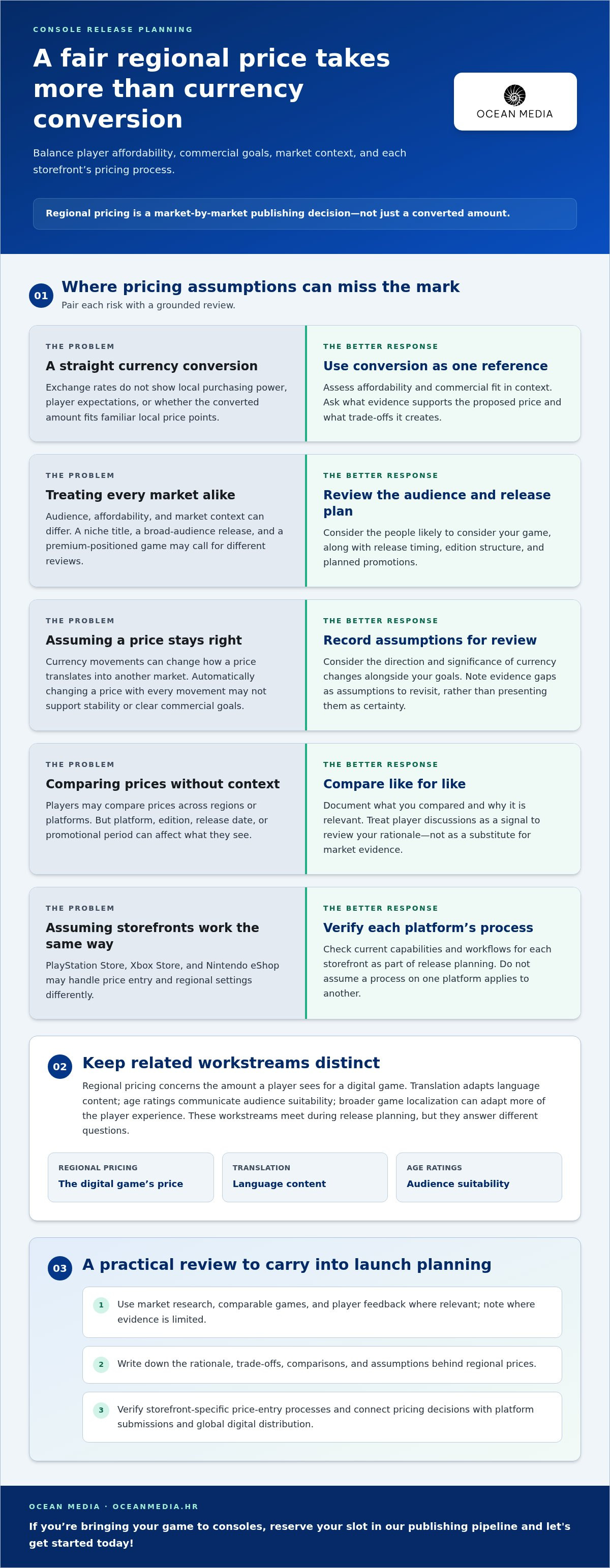
Build a regional pricing review for your console game
A repeatable review turns regional pricing from a one-off discussion into a decision your team can explain and revisit. For regional pricing for digital console games, connect each proposed price to the intended audience, the evidence available, your commercial objectives, and the relevant storefront process. Keep the review close to release planning so assumptions can be checked before launch and reconsidered when conditions change.
A practical market-by-market decision sequence
Use the same sequence for each market, while allowing the evidence and level of review to differ. This helps your team compare decisions consistently without pretending every region presents the same picture.
- Define the markets. Start with the audiences and territories relevant to your release plan. Note why each market is in scope and what you know about the players you aim to reach.
- Gather evidence. Collect available information on local affordability, currency conditions, relevant comparable games, and player expectations. Record the source and context for each reference. A comparison may not be useful if the platform, edition, or timing differs materially.
- Compare options. Evaluate the pricing approaches against your objectives. Note the likely trade-offs and what would need to be true for a proposed price to make sense in that market.
- Review platform processes. Verify current price-entry steps and regional capabilities for PlayStation Store, Xbox Store, and Nintendo eShop separately. Don’t assume the same controls or workflow apply across all storefronts.
- Document the decision. For each market, capture the proposed approach, supporting evidence, rationale, open questions, and who will revisit the decision. This creates a useful record for launch planning and later reviews.
Be explicit about assumptions that need verification. These may include whether market comparisons are genuinely comparable, whether currency information remains current, and how a platform’s current process handles the intended price. If evidence is limited, state that plainly in your internal rationale rather than presenting an estimate as a settled fact.
Reviewing disparities before and after launch
Before release, review how proposed prices appear across the relevant console storefronts. Check for unexpected differences between markets and make sure each has a reason your team can articulate. This is a consistency check, not a requirement to make every price equivalent or eliminate every disparity.
After launch, revisit the review when material currency or market conditions change, or when a storefront updates its relevant process. Set a clear owner and define what kinds of changes prompt a reassessment, without assuming a fixed review schedule. Update the rationale when decisions change so the record reflects the current plan.
A documented pricing rationale makes your decision traceable; it doesn’t guarantee affordability, revenue, or player approval. Connect the review to the wider digital release workflow, including the platform-specific requirements involved in bringing your game to consoles. For support coordinating those publishing steps, plan your console publishing pipeline.
How a console publishing partner supports regional pricing decisions
Regional pricing is one decision within a larger digital release, connected to platform submissions and global distribution. A publishing partner can help you connect your pricing rationale with the release plan, organize information for your team, and coordinate it with platform-specific requirements. This keeps the process clear while leaving commercial decisions with your team and platform processes with the relevant storefronts.
Connecting pricing decisions to the publishing pipeline
Build the pricing review into your console publishing pipeline while the release plan is taking shape. That gives your team space to align intended markets, proposed prices, release timing, and platform submission preparation. Ocean Media supports digital console publishing and platform-specific requirements, helping coordinate these workstreams and keep relevant assumptions visible as you prepare for release.
Your team’s commercial rationale and each platform’s current processes are distinct considerations. Define the objectives behind your proposed prices, then account for the platform-specific steps involved in preparing your release. Ocean Media’s publishing support helps you manage the technical and administrative complexities of console submissions as part of the broader digital release.
As you prepare, bring the reasoning behind your market choices into the same planning conversation as other release requirements. For each market, useful context includes:
- The audience and commercial objectives behind its inclusion in the release.
- The evidence supporting the proposed price and any unresolved assumptions.
- The relevant platform, edition, and release timing used for comparison.
- Any platform-specific submission steps that could affect how pricing information is handled.
This shared view can help your team spot dependencies early. For example, if a market decision relies on a comparison that changes with the edition or storefront, documenting that context makes it easier to review the decision consistently as release details develop.
Moving from analysis to a global console release
A productive publishing discussion starts with a clear picture of your project. Prepare your planned platforms and markets, release timing, audience priorities, proposed pricing approach, and the questions your team still needs to resolve. You don’t need every assumption settled before planning begins. Identifying open points helps the conversation stay focused on what needs coordination or verification.
Ocean Media brings over 20 years of gaming-industry experience supporting digital console releases and global digital launches. That experience provides a practical foundation for developers managing platform complexity and planning to reach a global audience. A wider console publishing roadmap can put regional pricing decisions in context with the work involved in bringing your game to consoles.
Let’s turn the analysis into a structured release plan. If you’re ready to move forward, reserve your slot in our publishing pipeline and let's get started today!
Take your console launch plan forward
Your regional pricing decisions can evolve alongside your game and its launch. Give your team a clear owner for revisiting assumptions as market conditions or release plans shift, and keep pricing connected to the broader player experience you want to create. That forward-looking discipline makes regional pricing for digital console games part of a thoughtful global launch, rather than a decision made once and left behind.
Bringing your game to consoles involves coordinating creative goals with the practical demands of digital publishing. You don’t have to map every step alone. Ocean Media works with developers on digital console publishing and global launches, helping connect release plans with platform-specific requirements.
Ready to turn your plans into action? Explore how Ocean Media can support your console release. Reserve your slot in our publishing pipeline and let's get started today!
Frequently Asked Questions
Can regional prices for a console game change after launch?
Yes, a publisher may review and change regional prices after launch, subject to the relevant storefront’s processes. A change could be considered if currency conditions shift, the release plan evolves, or you learn something new about a market. Before making an update, assess how it fits with your broader pricing rationale and any active promotions. Keep a record of what changed and why, so future decisions have useful context.
Do console storefronts automatically convert a game’s price into local currencies?
Don’t assume that a local-currency display means the storefront has converted a single base price automatically. Regional prices may be handled through platform-specific tools or price-entry workflows, and those processes can differ. Verify how each relevant storefront currently handles regional pricing before you finalize your release information. This helps you distinguish a displayed currency from the underlying pricing decision and avoid relying on an assumed conversion method.
Should a console game have the same price on every platform?
Not necessarily. Decide whether aligned pricing across platforms supports your commercial goals, then assess the practical storefront processes and comparable offers for each release. Differences may have a rationale, but unexplained gaps can complicate your messaging and invite questions from players. Keep a record of the factors behind platform-specific decisions, including edition and launch timing, so your team can explain the approach consistently without assuming every storefront offers identical controls.
How often should developers review regional game prices?
There’s no universal review interval that fits every title. Tie reviews to meaningful decision points in your release plan, such as preparing a major promotion, launching an additional edition, or evaluating new market information. You can also assign an owner to monitor relevant changes and bring them to the team when they could affect a pricing assumption. This keeps review purposeful without creating a schedule disconnected from the game’s actual needs.
Can regional pricing affect how players perceive a game’s value?
Yes. Players may interpret a price as a signal about a game’s value, particularly when they compare versions, platforms, or offers they can see. A difference doesn’t automatically mean the game is valued differently, but the context may not be clear to players. As you plan pricing and promotions, consider how the offer will appear alongside the game’s edition and storefront presentation, and prepare a consistent explanation for your team.
Is regional pricing the same as localizing a game?
No. Regional pricing concerns the amount offered in a market; localization focuses on adapting the game experience for players in different regions. They’re separate workstreams, even though both can affect a global release plan. For example, your pricing review can consider which markets you intend to reach, while localization planning addresses the language and cultural adaptation relevant to those players. Coordinating timelines helps teams prepare both without treating one as a substitute for the other.


