

What if bringing your game to consoles didn’t mean taking on every publishing task yourself? For a small team, platform submissions, certification, and release administration can feel like a second game to manage. Indie game publishing without self-publishing offers another path: work with a publishing partner while you stay focused on the creative work.
With over 20 years of gaming-industry experience, Ocean Media helps developers navigate digital console releases, from platform-specific requirements and submissions to certification and publishing lifecycle management. A partnership doesn’t have to mean handing over your creative role. Responsibilities, control, and commercial terms depend on the agreement, so clarity matters from the start.
In this guide, you’ll learn how partnership publishing differs from self-publishing, which parts of the console publishing pipeline can be handled collaboratively, and how experienced support can help move your game toward release. You’ll also find practical steps for bringing your game to consoles.
Key Takeaways
- Understand how partnership publishing shares agreed release responsibilities, while self-publishing keeps publishing tasks under your direct lead.
- See how indie game publishing without self-publishing can help you address console submissions and release coordination while maintaining your creative input.
- Follow the publishing pipeline from readiness assessment and platform materials through submission, feedback, and digital launch.
- Assess your team’s capacity and identify where console-specific publishing support could make bringing your game to consoles more manageable.
- When you're ready, reserve your slot in our publishing pipeline and let's get started today!
Indie game publishing without self-publishing: what the partnership means
Indie game publishing without self-publishing means working with a publisher on agreed parts of your game’s release. You remain the developer, while the publisher supports the publishing responsibilities set out in your written agreement. With self-publishing, your team leads those responsibilities directly, coordinating the release and platform processes itself.
Publishing support isn’t the same as making the game. Your studio creates the game’s content and guides its creative direction. A publisher can contribute expertise in digital console distribution and release operations without automatically taking over development, ownership, or creative decisions. The specific responsibilities, approval processes, rights, and commercial terms depend on your agreement with the publishing partner.
The term Indie game covers a broad range of independently developed projects. Whatever your team’s size or approach, a publishing partnership can provide a defined way to handle release work while you focus on the game.
What does a publisher do when bringing your game to consoles?
A console publisher can support digital distribution by helping you work through platform-specific requirements, prepare submissions, and address certification as part of the release process. These are publishing operations, not the creation of your game’s characters, story, or mechanics. Ocean Media brings over 20 years of gaming-industry experience to console publishing, including support for platform submissions, certification, and publishing lifecycle management.
For your team, the practical benefit is a collaborative division of work. You contribute project knowledge and make the decisions defined in your agreement, while publishing support helps move release tasks through an organized process.
What changes when you do not self-publish?
When you self-publish, your studio directly coordinates the publishing tasks it takes on, including platform administration and release planning. With a publisher, you agree in advance who handles each responsibility. A shared plan clarifies task ownership and approvals, rather than assuming the publisher makes every decision or removes your team from the process.
Before work begins, establish how responsibilities are divided and how decisions will be made. For a broader look at the publisher’s role, explore Console Game Publishers: A Developer’s Guide.
Inside the publishing pipeline: from console preparation to digital launch
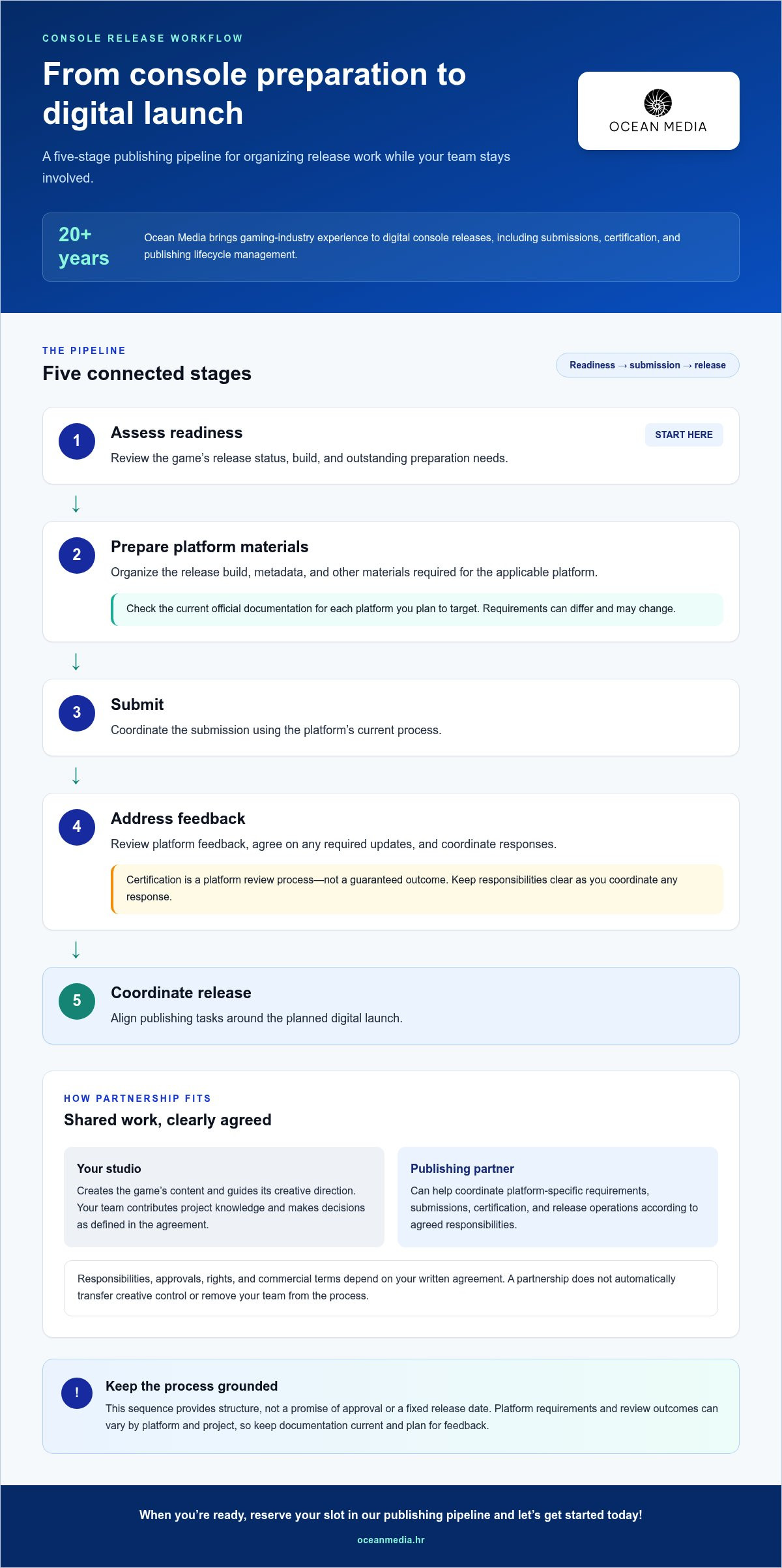
A clear publishing pipeline gives you an organized route from assessing your game’s readiness to coordinating its digital release. Each platform has its own requirements, so review the relevant, current official documentation for every platform you plan to target. A publishing partner can help coordinate administrative and technical submission work, while you stay involved in decisions and updates that affect your game.
The process can be viewed as five connected stages:
- Assess readiness: Review the game’s release status, build, and outstanding preparation needs.
- Prepare platform materials: Organize the build, metadata, and other materials required for the applicable platform.
- Submit: Coordinate the submission using the platform’s current process.
- Address feedback: Review platform feedback, agree on any required updates, and coordinate responses.
- Coordinate release: Align publishing tasks around the planned digital launch.
This sequence provides structure, not a promise of approval or a fixed release date. Requirements and review outcomes can vary by platform and project, so keep documentation current and plan for feedback.
Preparing a game for platform submission
Preparation starts with an organized release build and supporting materials. Confirm which platform requirements apply, then review the official documentation before submitting. Requirements can differ across platforms and may change, so don’t rely on assumptions or materials prepared for another platform. A publishing partner can help coordinate this review and submission work. For a wider view of the release journey, see How to Publish a Game on Console: The Complete Developer Roadmap for 2026.
Managing certification and submission feedback
Certification is a platform review process, not a guaranteed outcome. If the platform provides feedback or identifies updates, you and your publishing partner can coordinate who reviews the notes, manages the response, and prepares any changes. Keep your team aligned on responsibilities so technical updates and publishing tasks move forward together. Check current official platform documentation throughout the process, since specific requirements depend on the platform.
Ocean Media supports digital console releases, including platform submissions, certification, and publishing lifecycle management. Explore our console publishing support for developers to learn about the publishing process.
Publisher partnership vs self-publishing: compare responsibilities and trade-offs
Choosing a publishing model means deciding who organizes the release work and how your team stays involved. With self-publishing, you lead the publishing process directly. With a partnership, you and the publisher divide agreed responsibilities. That can redistribute administrative work, but it doesn’t automatically remove your input or decision-making.
| Area | Self-publishing | Publisher partnership |
|---|---|---|
| Task ownership | Your team coordinates the publishing tasks it takes on. | You and the publisher assign tasks in the written agreement. |
| Platform administration | Your team leads platform administration and submissions. | The publisher can support platform submissions and related administration, as agreed. |
| Release coordination | Your team organizes the release process. | You and the publisher coordinate the responsibilities allocated to each party. |
| Developer workload | Your team manages publishing work alongside development priorities. | Agreed publishing tasks can be shared, helping your team focus its capacity. |
This is a framework, not a universal division of labor. The actual scope depends on your agreement and project. Indie game publishing without self-publishing can be practical when your team wants console publishing support while staying active in the release process.
Which publishing tasks can a partner take on?
Ocean Media supports digital console distribution, platform submissions, certification, and publishing lifecycle management. This support can help coordinate the operational side of bringing your game to consoles. You and the publisher should define which tasks the publisher handles and which remain with your team. A clear allocation helps a small studio plan its capacity and protect time for development priorities.
How can you protect role clarity and creative collaboration?
Put the working relationship in writing before publishing work begins. Set out who owns each task, how approvals work, how you’ll communicate, and what rights each party holds. Clarify which decisions need developer input and how feedback will be handled. These details give both sides a shared reference as the release moves forward.
Creative control isn’t governed by one rule that applies to every publisher or game. It depends on the negotiated agreement, as do rights, revenue shares, and scope. Discuss these terms directly and document the outcome, so collaboration supports your goals without leaving expectations unclear.
How to decide whether publishing support fits your indie game
Start with your team’s actual release capacity. List the console publishing tasks you can manage confidently, then mark the ones that would compete with development priorities. For example, your team may be comfortable preparing a game build but have limited experience coordinating platform submissions or launch administration. That gap can help you decide whether a publishing partner would add practical value.
Publishing support may be a good fit if:
- Your studio has limited experience with console platform processes and would benefit from submission and certification expertise.
- Development work leaves little capacity for platform administration, release preparation, and launch coordination.
- You want support coordinating digital distribution across major console platforms.
Use these points as a starting place, not a rule. The right arrangement depends on your project, your team’s strengths, and the responsibilities you want to share. Indie game publishing without self-publishing can support your studio with console release operations while keeping your development team central to the game’s progress.
Questions to resolve before agreeing on a publishing scope
Before committing, write down the responsibilities you want a partner to take on. Then compare the proposed scope with your priorities. Clear answers help prevent assumptions from shaping the working relationship.
- Responsibilities: Who coordinates platform administration, submissions, certification, and release tasks?
- Decision rights: Which decisions require your approval, and how will feedback or requested changes be handled?
- Deliverables: What work will each party provide, and how will progress be communicated?
- Rights and revenue: What exact terms does the proposed agreement set out?
Review the communication approach as carefully as the task list. Know who your team works with, how updates are shared, and how questions are resolved during the publishing process. Rights, revenue arrangements, approvals, and scope are agreement-specific, so assess the written terms rather than relying on assumptions about how publishers generally work.
For regional context, see Console Game Publishing in Europe: The Developer’s Guide to 2026. You can also explore Ocean Media’s console publishing support for developers.
Bring your game to consoles with an experienced publishing partner
A publishing partner can bring practical console-release experience to your project without replacing your role as its developer. You continue to shape the game and contribute to decisions according to your agreement. Your partner can help organize publishing work around those creative priorities, giving your team a clearer route from preparation toward digital release.
Ocean Media brings over 20 years of gaming-industry experience to console publishing. Its support covers digital distribution on major console platforms, platform-specific requirements, submissions, certification, and publishing lifecycle management. For your studio, that means working with a partner familiar with the operational steps involved in bringing your game to consoles, with responsibilities and approvals defined by your agreement.
What Ocean Media brings to a console publishing partnership
Platform knowledge is most useful when it connects to a structured process. A publishing pipeline helps organize release work, from understanding platform requirements and preparing materials to coordinating submissions, certification, and launch activities. Ocean Media supports global digital launches, helping developers plan for a release beyond a single storefront or market. The specific scope is shaped around the project and partnership.
This is publishing support, not a substitute for your studio’s creative direction. You bring the game and your goals; our role is to help move the agreed publishing work forward. A well-defined collaboration keeps your team informed while giving platform and release tasks focused attention.
Start a conversation about your game's release
Your next step can be straightforward. Share where your project is in development, which console platforms you’re considering, and what you want the release to achieve. That gives us a starting point to discuss your goals and the publishing scope that could support them. You can also explore our console publishing support for developers as you consider the path ahead.
Choosing indie game publishing without self-publishing doesn’t mean stepping away from your game. It means exploring how an experienced publishing partner can help your team manage the release process while you stay focused on making it. Together, we can build a clear path for bringing your game to consoles.
Bring your console release into focus
Indie game publishing without self-publishing gives you a way to share agreed release responsibilities with a publishing partner while staying involved in your game’s creative direction. A clear written scope helps define who handles submissions, approvals, and launch coordination. A structured publishing pipeline can then guide the work from preparation toward digital release.
Ocean Media brings over 20 years of gaming-industry experience, with expertise in console digital distribution and platform submissions, plus support for certification and global digital launches. Our role is to work alongside you, helping your game move through console publishing processes while you stay focused on development.
Ready to explore a publishing partnership for your project? reserve your slot in our publishing pipeline and let's get started today! Let’s take the next step toward bringing your game to consoles.
Frequently Asked Questions
What does indie game publishing without self-publishing mean?
Indie game publishing without self-publishing means working with a publisher on agreed parts of your release instead of managing every publishing responsibility independently. For a console game, support may include digital distribution, platform submissions, certification coordination, and publishing lifecycle management. You remain central to creating the game. The written agreement should explain each party’s responsibilities, approval process, rights, and revenue arrangements, since these terms depend on the specific partnership.
Can an indie developer work with a publisher and keep creative control?
Yes, a publishing partnership can include developer input and creative decision-making, but the agreement determines how those decisions are handled. Before committing, clarify rights, approvals, responsibilities, and which decisions require your team’s involvement. Make sure the written scope reflects your priorities and explains how decisions will be made throughout the project. Arrangements differ between agreements and projects.
What does a console game publisher do for an indie studio?
A console game publisher can support digital distribution and help coordinate platform-specific requirements, submissions, certification, and release lifecycle tasks. The exact responsibilities depend on the partnership agreement. Ocean Media focuses on console game publishing and brings over 20 years of gaming-industry experience to helping developers navigate platform processes. Review the agreed scope so you understand which publishing tasks the publisher coordinates and where your studio remains responsible or involved.
Is self-publishing better than working with an indie game publisher?
Neither approach is automatically better for every studio. Self-publishing means your team takes direct responsibility for organizing its publishing tasks, while a partnership can provide support with console distribution, submissions, and release coordination. Consider your team’s experience and capacity, then compare them with the work involved in your planned release. A partnership may be a better fit if agreed publishing support helps you focus on development priorities.
How does a publisher help get an indie game onto console storefronts?
A publisher may help organize platform-specific materials, coordinate submissions and certification, and support the broader digital release process. Each platform has its own requirements, so use current official platform guidance when preparing a submission. A publishing partner can bring experience to the process and coordinate agreed tasks, but approval and release outcomes depend on the relevant platform process. Define responsibilities and communication expectations in the publishing scope.
What should an indie developer clarify before signing a publishing agreement?
Clarify the publishing scope, responsibilities, decision rights, approvals, rights, communication expectations, and revenue arrangements. Read the proposed agreement carefully and resolve unclear terms before signing. Don’t rely on assumptions about what publisher agreements usually include; each partnership can differ. A shared understanding of who handles each task and how project decisions are made helps keep the publishing pipeline organized. Ready to begin? Reserve your slot in our publishing pipeline and let's get started today!


