

A CERO rating for games in Japan uses five age marks: A for all ages, B for ages 12 and up, C for ages 15 and up, D for ages 17 and up, and Z for adults aged 18 and older. Content icons offer a separate view of the expressions in a game. CERO review can also affect how content appears in a Japanese console release, making censorship part of the practical picture for developers.
A rating is more than a label to translate for a new market. Age marks, content disclosures, and review criteria all matter when preparing a game for Japanese players and planning its console release. This guide explains what CERO marks and icons communicate, which expressions CERO reviews or restricts, and how review-related changes can affect a game’s presentation. You’ll get a clearer picture of the rating system and how to account for it in your publishing plan.
Key Takeaways
- Learn how CERO’s content review categories shape the age mark assigned to a game.
- Use the age marks to understand the intended audience, then read content icons for added context.
- See how review criteria and banned expressions can influence a game’s Japanese release.
- Understand why censorship is a practical consideration when planning a console launch in Japan.
- Explore how console game publishing can help you manage the technical and administrative work of bringing your game to consoles.
Content and expression categories reviewed
CERO reviews both a game’s age suitability and its content expressions. Age marks and content icons answer different questions, so read them together.
Content Icon Categories
CERO’s content icons identify content categories present in a game, separate from its age mark. The system has nine categories, and the icons give players a content-focused reference rather than another age level. CERO defined these icons in April 2004. On game boxes, they appear on the back, except for A-rated games and Educational/Database titles.
The nine categories are a reminder to look beyond a single letter. An age mark indicates suitability by age, while an icon can identify the kind of expression reviewed. Don’t infer an icon’s meaning from its color or position alone. Check the wording associated with it on the Japanese release.
CERO Age-Rating Categories
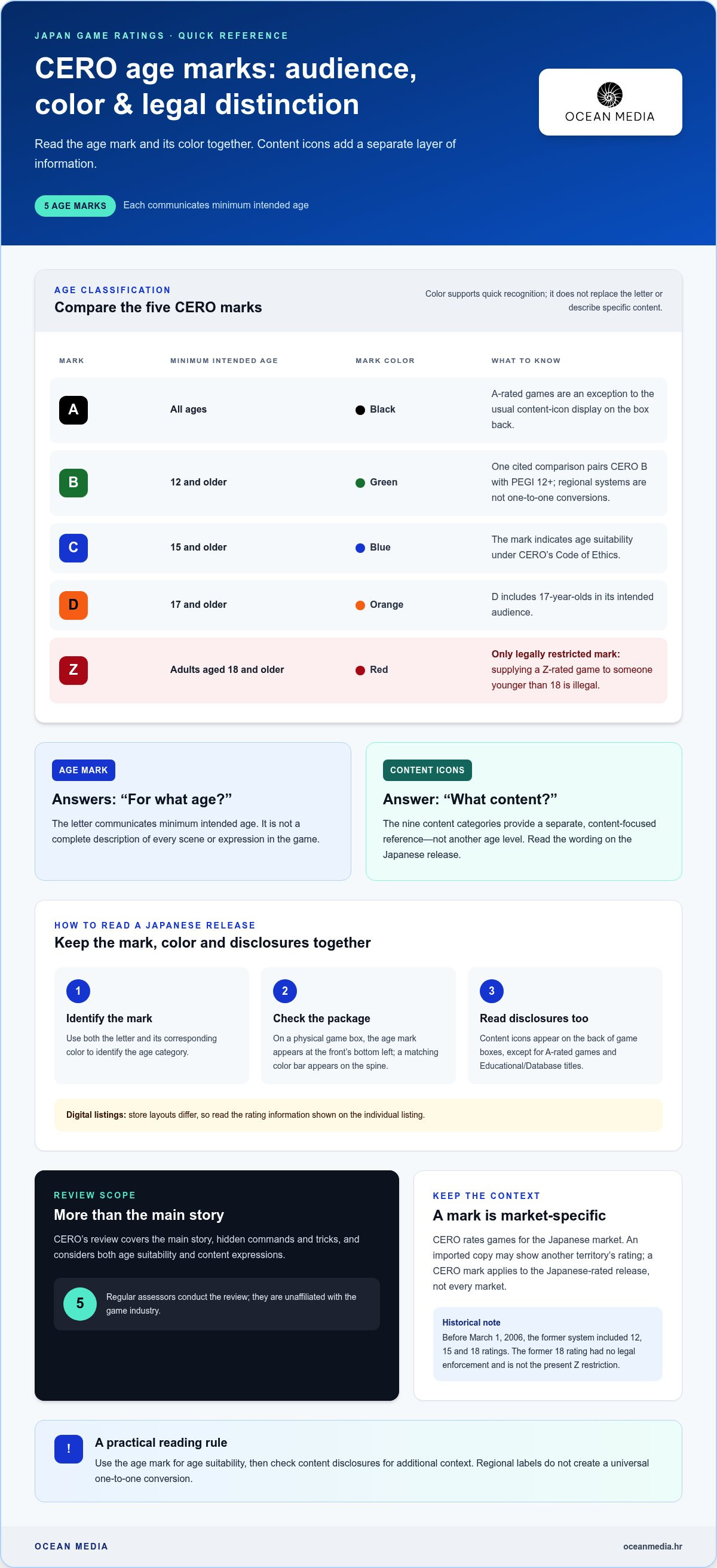
CERO’s age-rating categories use five marks to show the minimum intended age: A for all ages, B for 12 and older, C for 15 and older, D for 17 and older, and Z for adults aged 18 and older. Their colors are black, green, blue, orange, and red, respectively. The mark indicates that the game was reviewed under CERO’s Code of Ethics.
Before March 1, 2006, the former system included 12, 15, and 18 ratings. CERO’s current marks therefore shouldn’t be read as a direct continuation of those numbered labels. Across regions, ESRB, PEGI, and USK use their own classification systems; their labels do not create a one-to-one conversion. One comparison in the supplied facts pairs CERO B with PEGI 12+, while PEGI also uses 3 and 7 marks.
For publishers, the review process begins with a game submission. CERO’s review is conducted by five regular assessors who are unaffiliated with the game industry. It covers the main story, hidden commands, and tricks, and considers both age suitability and content expressions.
Do CERO ratings apply to imported games and games sold outside Japan? CERO rates games for the Japanese market. An imported copy may display a rating from another territory. A CERO mark applies to the Japanese-rated release, not universally to every market.
How much does CERO certification cost, and how long does it take? Fees and timing depend on the submission and review requirements, so the mark itself doesn’t indicate the cost or turnaround. The review covers recorded expressions beyond the main story.
What are examples of popular games in each CERO category? The available example is Freedom Planet, whose developer compared its CERO B rating with PEGI 12+. For other titles, use the mark on the specific Japanese release rather than assuming its category from an international version.
The CERO rating for games in Japan is one part of release planning: the age mark communicates suitability, while content icons add another layer of information. Consider both when assessing how your game’s expressions may be presented to Japanese players.
Age classification marks and their meanings
CERO’s five age marks indicate the audience a game is considered suitable for. They help you assess age suitability separately from content disclosures.
Age Mark Colors
Each CERO age mark has a corresponding color to help players distinguish the categories quickly. A is black, B is green, C is blue, D is orange, and Z is red. On a physical game box, the mark appears at the bottom left of the front, with a matching color bar on the spine.
Use both the letter and color when identifying a Japanese edition. For example, orange identifies D, the mark for ages 17 and older. Color supports recognition; it doesn’t replace the letter or explain the game’s specific content. For digital stores, read the rating information shown on the individual listing, since the physical box placement doesn’t specify a screen position.
Meaning of CERO Marks
CERO’s age marks show the minimum intended age for a game reviewed under its Code of Ethics. A means all ages; B means 12 and older; C means 15 and older; D means 17 and older; and Z means adults aged 18 and older.
The distinction between D and Z matters: D includes 17-year-olds in its intended audience, while Z excludes them. Treat the mark as an age classification, not a complete description of every scene or expression. Content icons provide an additional content-focused reference when they appear on the package.
CERO, the Computer Entertainment Rating Organization, uses these marks to communicate review outcomes to players and families. For studios, they also provide a clear reference point when preparing Japanese release materials. Keep the assigned letter, its color, and any accompanying content disclosures consistent across the game’s packaging and product information.
Are CERO ratings legally binding age restrictions in Japan? CERO Z is the only legally restricted rating, and supplying a Z-rated game to someone younger than 18 is illegal. The other marks communicate age suitability, rather than that same legal restriction.
Where is the CERO age rating displayed on Japanese game packaging and digital stores? On a physical box, it appears at the bottom left of the front, with a corresponding color bar on the spine. Digital store listings have their own layouts, so read the rating information shown on each listing.
Before the current marks, CERO used numbered ratings, including 12, 15, and 18, before March 1, 2006. The former 18 rating had no legal enforcement; it shouldn’t be confused with the present Z restriction. This historical change is useful when comparing older Japanese releases with current editions.
As you map rating information into a release plan, developer resources can help frame the wider console launch process.
Content icons and disclosures
CERO content icons provide content-specific information alongside a game’s age classification. Use them to look beyond the age mark when assessing a Japanese release.
Content Descriptor Icons
CERO content descriptor icons are symbols that disclose content categories identified during review. The system has nine categories, giving players another reference beyond the age mark. CERO defined the icons in April 2004. Their purpose is disclosure, not a replacement for the age classification assigned to the game.
On a physical release, look for the icons on the back of the box. CERO’s packaging exception applies to A-rated games and Educational/Database titles. The absence of icons on these boxes shouldn’t be mistaken for a separate content rating or an additional age mark.
When reviewing a release, distinguish between the two kinds of information. First, read the age mark to understand the intended age group. Then check any content icons and their accompanying wording. This keeps the age classification distinct from the content disclosure, even when both appear on the same package.
The nine-icon structure also helps organize information across product pages and physical packaging. When preparing Japanese materials, associate icon information with the correct game version. If the build or presentation changes, review the content information for that release instead of reusing it automatically.
Content Descriptors
Content descriptors explain what a content icon represents. They add context to the symbol, while the age mark communicates age suitability. Read the descriptor and icon together; neither replaces the other.
For example, a player comparing two releases can use their age marks to understand the intended audiences, then consult each release’s descriptors for content information. This makes the disclosure useful before play, rather than relying on the age category alone to describe a game’s expressions.
For developers, a practical step is to align the descriptors on Japanese packaging with the information shown for the same release in digital storefronts. Keep content disclosures clear and consistent. Don’t use an icon as shorthand for details it doesn’t communicate.
Because CERO’s icon system has nine categories, careful interpretation is more useful than guessing from artwork or color. Use the printed descriptor to understand an icon’s meaning. This gives players clearer content information while keeping age classification distinct from content disclosure.
CERO criteria and banned expressions
CERO’s criteria are the standards used to assess game content, assign an age classification, and identify expressions that exceed permitted limits. For publishers, the key distinction is between content that affects an age rating and an expression that crosses a ban threshold.
CERO reviews the game’s expressions, not just its main story. The recorded content includes hidden commands and tricks, so optional or concealed material is also within scope. A scene players can reach through a command remains part of the submitted game, even if it isn’t central to the narrative.
The review information describes 24 expression items, while the criteria also evaluate 30 different expressions, each with an upper limit. These figures refer to separate descriptions of the review framework, so don’t treat them as interchangeable totals. The practical point is that CERO examines multiple expression types against defined limits, rather than judging only a game’s overall tone.
An upper limit is the boundary an expression must not exceed under the applicable review criteria. If a game exceeds the limit for a banned expression, CERO doesn’t assign it a rating. This differs from receiving a more restrictive age category: a higher age mark still classifies the game, while exceeding a ban limit prevents a rating from being assigned.
CERO identifies six expressions that are not allowed and treats them as banned expressions. This matters for content planning: teams need to review potentially sensitive material throughout the complete game, rather than relying only on its age category or visible story scenes. The criteria establish the number of banned expressions, but this guide doesn’t name them individually.
What is the difference between CERO ratings and Japan’s prohibited expression rating? CERO’s age rating communicates the intended age group, while prohibited expressions are content that must stay within applicable limits. A game that exceeds a limit for a banned expression receives no CERO rating, rather than simply moving to another age mark.
For a development review, map expression-heavy sequences across the complete build, including hidden commands and optional routes. Compare those elements with the applicable criteria before final submission. Focus on the game itself: an advertisement describing a scene doesn’t replace assessment of the recorded expression in the game. Educational titles and database games also fall under distinct packaging exceptions, so don’t use those labels to infer how content limits apply.
These criteria make content review a release-planning concern, not merely a label added to a finished package. Assessing the full game early can help your team identify material that may need revision before the Japanese console submission.
Censorship in Japanese console games
Censorship in a Japanese console release means changing game content for that market. CERO’s guidelines regulate video game content released in Japan, and console games released there may be censored. This is separate from assigning an age mark: a rating classifies a reviewed game, while censorship concerns what players encounter in its Japanese version.
CERO rates household computer and video games sold in Japan, including cellular phone-type games. Its review considers expressions across the game, while console platform requirements also shape the release process. Digital game ratings aren’t mandatory in general, but Sony Interactive Entertainment Japan requires a CERO rating for console games. For console publishers, that distinction makes platform submission requirements a practical part of release planning.
Content changes aren’t automatic for every game or rating. The relevant question is whether the game’s expressions align with CERO’s guidelines and the platform’s release requirements. A review can affect how a Japanese edition presents content, but there is no universal list of required edits. Assess censorship in relation to the specific game, rather than treating it as a blanket rule for all video games.
Public criticism also shows why these decisions attract industry attention. In April 2024, EA Japan General Manager Shaun Noguchi criticized CERO’s handling of Dead Space and Stellar Blade. That criticism illustrates debate around review outcomes, but it doesn’t by itself establish what changes either title received or why. Keep the distinction clear: a named controversy is evidence of industry discussion, not a template for predicting another game’s review.
Start with a content audit of the Japanese build. Map scenes and interactive expressions, including material outside the main story. Compare that inventory with CERO’s review criteria, then account for the console submission process. This helps your team identify questions early without assuming that a particular scene will need to be removed or altered.
A game’s compatibility with a Japanese console release depends on both content review and platform submission requirements. Track the Japanese version separately from builds for other markets, and document content changes for the team preparing submission materials. CERO’s age classification is a rating outcome; it doesn’t prove that every market version has identical content.
If you’re planning a Japanese console launch, connect content review with your broader publishing schedule. Plan your console publishing path as you prepare the release, so review considerations sit alongside platform submission work rather than appearing as a last-minute surprise.
Ocean Media: Console Game Publishing
Ocean Media supports developers preparing a Japanese console release through Console Game Publishing. If CERO review and platform submissions are part of your launch plan, publishing support can help manage the technical and administrative work involved in bringing your game to consoles.
Use the rating and content considerations in this guide to prepare release materials and plan your submission. Ocean Media focuses on console publishing, helping developers navigate platform requirements and distribute titles digitally across console platforms. It’s a practical next step when your team is ready to move from market preparation into the publishing process.
To discuss your console release, contact Ocean Media or visit oceanmedia.hr. Reserve your slot in our publishing pipeline and let's get started today!
Make Your Japan Release Part of the Creative Plan
Treat the CERO rating for games in Japan as one input to your release strategy, not a final label to add after creative decisions are locked. Planning market-specific content alongside platform preparation helps your team make deliberate choices about presentation, build management, and how the Japanese edition fits into your wider release. This keeps the game’s creative intent connected to the practical work of reaching a new audience.
Align the people responsible for the game, content review, and console publishing plan. Clear ownership helps your team carry decisions consistently from development through submission and keep the Japanese release connected to the wider publishing process.
Ocean Media offers Console Game Publishing for teams preparing console releases. Contact Ocean Media to discuss your project and take the next step toward bringing your game to consoles. Your Japanese launch can move forward with a considered plan and a clear path ahead.
Frequently Asked Questions
What is CERO and what does it rate in Japan?
CERO is the Computer Entertainment Rating Organization, which maintains Japan’s game age-classification system. It reviews household computer and video games for the Japanese market, including console and cellular phone-type games. The system began on October 1, 2002. If you’re preparing a release, identify the specific Japanese version for review, since its content and presentation may differ from another territory’s edition.
What are the five CERO rating categories and their age limits?
The five categories are A, B, C, D, and Z: all ages, 12 and older, 15 and older, 17 and older, and adults aged 18 and older, respectively. The distinction between D and Z is especially useful for release planning: 17-year-olds fall within D’s intended audience, but not Z’s. Treat these as Japanese classifications, not direct conversions from another region’s rating label.
What content criteria determine a CERO rating?
CERO evaluates expressions throughout the game, including the main story and recorded material such as hidden commands or tricks. Reviewers assess content against expression criteria and applicable upper limits; six expressions are treated as banned. Before submission, inventory optional routes and concealed content alongside story scenes to give your team a fuller picture of the material being assessed.
How do CERO ratings compare with ESRB, PEGI, and USK ratings?
ESRB, PEGI, and USK use their own classification systems, so their labels do not convert directly to CERO marks. One comparison pairs CERO B with PEGI 12+; PEGI also uses 3 and 7 marks.
How much does it cost and how long does CERO certification take?
Fees and timing depend on the submission and review requirements. Review covers recorded expressions beyond the main story, including hidden commands and tricks.
What are examples of popular games in each CERO category?
The cited example is Freedom Planet: its developer compared its CERO B rating with PEGI 12+. Use the rating on each specific Japanese release rather than inferring it from an international version.


