

A publishing deal can build momentum for a game, but the wrong terms can leave you with less control and uncertain returns. The clearest red flags in a publishing contract include broad rights grants, vague recoupment terms, unexplained charges, and responsibilities that are not clearly assigned. Before signing, you should understand what the publisher controls, how and when you’ll be paid, and what happens if either party falls short.
It’s reasonable to focus on the headline offer, but the details shape the working relationship. This guide explains how to assess rights clauses, advances and clawbacks, charges, contract review, and each party’s responsibilities, so you can identify terms that deserve closer attention.
We’ll look at how revenue shares, reporting, approvals, and exit provisions fit together. The goal is to help you understand the full agreement, not just its most attractive promise.
Key Takeaways
- Define exactly which rights the publisher receives, for what scope and term, and what happens when the agreement ends.
- Trace how advances and other recoupable costs affect your share, including which expenses can be deducted before payments begin.
- Ask for a clear breakdown of publishing services and charges so added work doesn’t become an unexpected cost.
- Review payment reporting, audit access, termination terms, and breach procedures to understand how you can protect your position.
- Assign approvals, milestones, and delivery duties clearly so both sides know what they must do to keep the publishing relationship moving.
1. Rights of first negotiation, first refusal, and last refusal
Start by distinguishing three rights that can limit your next deal. A right of first negotiation gives a publisher the first chance to discuss another project with you. A right of first refusal can affect how you approach potential publishing partners, so clarify the process in the contract. A last-refusal clause may let the publisher match a competing offer at the end of that process. The contract should define each step and its deadline.
Exclusivity matters during those discussions. If a clause prevents you from negotiating with another publisher, identify when the restriction starts, what work it covers, and when it ends. For example, an option on your next game should not quietly restrict unrelated projects or remain active after the publisher declines. In book publishing, an option clause may allow the publisher thirty to sixty days after manuscript submission to consider the next book. A game agreement should clearly state its own trigger and response period.
Terms worth negotiating include the work covered, platforms, territories, languages, exclusivity period, response deadline, and whether the publisher must match all material terms of a competing offer. Ask for written notice when the publisher exercises or declines its right. If the publisher refuses to define these boundaries or explain how a clause works, treat that as a warning sign. Clear wording gives both parties a defined path instead of placing an open-ended hold on your next project.
What are common red flags in subsidiary rights and licensing clauses? Watch for grants that bundle merchandise, adaptations, or other licensing rights without defining their scope, revenue share, or approval process. Retaining adaptation rights gives IP owners the freedom to explore serialised video or launch branded streaming channels through services such as Dramnex OS. A clause giving the publisher broad control over unrelated rights, without a clear accounting method, can make it difficult to assess what you’re owed.
How should a publishing contract define out-of-print status and rights reversion? It should describe the sales or revenue threshold, how performance is measured, and the notice-and-cure process before rights return. A sales-based annual reversion threshold of 250-500 copies and a notice-and-cure period of no more than six months are useful terms to negotiate; define whether digital availability alone counts as being in print.
What warranties, indemnity, and legal liability clauses are risky for authors? Broad warranties can make you responsible for claims beyond your control, while one-sided indemnity may require you to cover losses without matching accountability from the publisher. Review what triggers liability, whether responsibility is limited to your own breach, and how claims are handled.
2. Advance payments and clawbacks
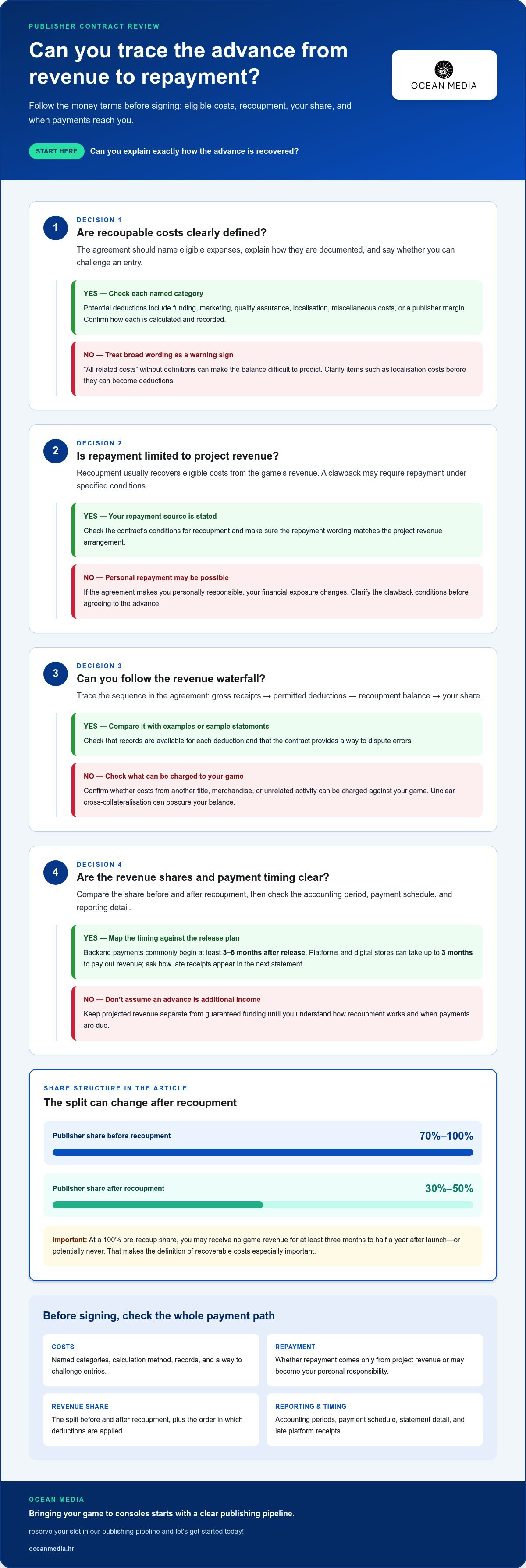
An advance can fund development before launch, but the agreement must explain how it is recouped. Distinguish recoupment from a clawback: recoupment usually means the publisher recovers eligible costs from the game’s revenue, while a clawback may require repayment under specified conditions. Ask whether repayment can come only from project revenue or whether the contract makes you personally responsible. That distinction changes your financial exposure.
Read the recoupment definition line by line. It should identify eligible expenses, explain how they’re documented, and state whether you can challenge an entry. Potential deductions may include funding, marketing, quality assurance, localisation, miscellaneous costs, or a publisher margin. A clause allowing “all related costs” without definitions can make the balance difficult to predict. For example, clarify whether localisation costs require prior approval or can simply appear as deductions later.
The revenue split before and after recoupment also matters. Publisher shares before recoupment commonly range from 70% to 100%; after recoupment, they commonly range from 30% to 50%. At a 100% pre-recoup share, prepare for the possibility of receiving no game revenue for at least three months to half a year after launch, or potentially never. That structure makes the definition of recoverable costs especially important.
Payment timing can widen the gap between release and revenue. Backend payments commonly begin at least three to six months after release, and some platforms and digital stores can take up to three months to pay out revenue. Your agreement should specify the accounting period, payment schedule, reporting detail, and treatment of late platform receipts. For example, ask how a platform payment received after a reporting cutoff will appear in your next statement.
Before signing, map the payment waterfall: gross receipts, permitted deductions, recoupment balance, and your share. Compare that sequence with the agreement’s examples or sample statements. Confirm whether costs from another title, merchandise, or unrelated activity can be charged against your game. Require clear records for each deduction and a process for disputing errors. These steps can reveal hidden cross-collateralisation and make it easier to assess the advance’s real effect.
For a console project, connect these payment terms to the operational plan: approval delays, localisation, and quality assurance may affect when costs arise. Reviewing the console publishing process alongside the agreement can help you align funding assumptions with the release pathway. Keep projected revenue separate from guaranteed funding, and don’t treat an advance as additional income until you understand how recoupment works.
Before agreeing to the advance, ask the publisher to distinguish eligible costs from excluded items and explain how each eligible category is calculated. Funding, marketing, quality assurance, localisation, miscellaneous costs, and any publisher margin should be named plainly, not hidden inside a broad catch-all. The same definitions should apply throughout the agreement and its statements, so you can check the recoupment balance against the categories you accepted.
Ask whether each category requires prior approval and what records support it. Make sure the agreement explains how disputed or incorrectly classified expenses are handled. A defined list makes it easier to compare recoupment terms with the advance and see which costs may reduce future receipts.
3. Clear scope of services and charges
Before signing, match every promised service to a written deliverable. A contract might mention platform submission, quality assurance, localisation, marketing, or release coordination. Those labels alone don’t explain what work is included. For example, “marketing support” could mean campaign planning, asset preparation, or a launch announcement. Define the expected work, the responsible party, and the completion point for each service.
Build a scope table based on the agreement. For each task, record who performs it, what materials they provide, and who approves the result. A platform submission entry could identify who prepares the build, completes submission materials, and handles feedback. A localisation entry could state which versions are included and who reviews them. This makes gaps easier to spot before production begins.
Next, separate included work from billable additions. The contract should explain which charges are covered and which require extra payment. For example, if a requested language or revised asset falls outside the stated scope, the agreement should explain how that change is priced and approved. A charge with no defined task or approval process is one of the clearest red flags in a publishing contract.
Require written approval for new work. A practical change process identifies the request, its effect on deliverables, and the person authorised to approve it. If quality assurance reveals a new issue, document whether fixing it falls within the original scope or counts as additional work. Don’t rely on an informal conversation to change the agreement or assign responsibility.
Look for scope that expands as production moves forward. Watch for phrases such as “necessary services” or “related costs” without clear limits or a decision-maker. The same problem occurs when a contract names a service but leaves its boundaries open. If the publisher adds a task, require a written description and approval before work starts, rather than discovering the charge later.
Compare the scope with the project’s release plan. For a console launch, list relevant platform submissions, required assets, testing responsibilities, and handoffs. Mark each as included, excluded, or subject to separate approval. This review can reveal whether the written agreement matches your team’s understanding of the publisher’s role and the work needed to prepare the release.
Finally, check that the charges section uses the same service definitions as the scope. If one clause includes localisation while another bills for it separately, clarify the conflict before signing. Keep approved changes with the agreement so your team can track commitments as production develops. These red flags in a publishing contract are easier to address before work begins than after a disputed charge appears.
4. Professional contract review
A publishing contract can run to ten pages of dense legal language, so review it systematically rather than relying on a summary. Read the full agreement alongside any schedules, exhibits, and referenced policies. A promise in a presentation does not override a conflicting clause in the signed document. Mark every term that affects rights, payments, approvals, obligations, or termination.
Review the agreement from three perspectives: signing it, exiting after mistreatment, and using it as the publisher. On the first pass, identify what you grant and what you receive. On the second, trace what happens if either party fails to perform. On the third, consider how the publisher could use each clause in practice. For example, check whether broad language could cover a sequel or unrelated game.
Read the Grant of Rights clause carefully. Phrases transferring “all rights, title, and interest” in a work, including its copyright, deserve close scrutiny. Compare that language with every other copyright provision. If one clause says you retain ownership while another transfers it, ask for consistent wording before signing. For work that is not work-for-hire, a publisher should not take ownership of the author’s copyright.
Define the boundaries of every grant. The contract can identify language and territory, such as English and North America, and should specify the platforms or uses it covers. Set the contract term and explain whether rights return to you when it ends. A stated term is not enough if renewal, continued availability, or reversion provisions leave control unclear.
Then review warranties, indemnity, liability, and termination together. Check what facts you promise, which claims could trigger indemnity, and whether responsibility is limited to your own breach. Read the termination clause for a way to exit if the publisher breaches the agreement or fails to meet its obligations. A milestone that repeatedly fails approval may be defined as a breach; the agreement should clarify notice and the time allowed to fix the issue.
Before signing, take the draft to a lawyer experienced in game publishing. Ask them to explain how rights, payment terms, audit access, breach remedies, and termination interact, rather than reviewing clauses in isolation. Bring a written list of questions and request proposed edits in a form you can track. This gives you a practical record of what changed and why, while helping your team understand the commitments it accepts.
When a rights transfer is temporary, distinguish ownership during the contract from what happens when it ends. Make sure the Grant of Rights language and other copyright provisions describe the same arrangement, including when any reversion occurs. A future return of rights does not mean the author owns the copyright throughout the contract.
An agency agreement that signs an author's work rights over to the agency is a major red flag, so do not treat it as routine paperwork. Seek legal review before committing; many game-industry lawyers offer a free consultation. Use that discussion to clarify whether a proposed grant is limited by language and territory, such as English and North America, and whether copyright-transfer language conflicts with provisions elsewhere in the contract.
5. Publisher and developer responsibilities
A publishing agreement works best when each obligation has an owner, a deliverable, and a clear completion point. For example, assign the developer responsibility for submitting agreed builds and assets, while specifying the publisher’s duties for platform submissions and feedback coordination. If the contract says both parties will “support launch,” it doesn’t explain who handles each task or how completion is judged.
Define delivery, acceptance, revisions, and publication deadlines together. The agreement should identify the build or materials due at each milestone, the publisher’s review period, the acceptance criteria, and how revisions are handled. It should also explain how the release schedule changes if a submission is rejected or feedback arrives late.
Set expectations for approval, not just delivery. The contract should state how long the publisher may take to approve or reject a milestone payment, what reasons justify rejection, and what information the developer receives. For example, a rejection tied to a named technical requirement gives your team a specific correction target. An open-ended right to reject without explanation can leave payment and production timing uncertain.
Define the developer’s responsibilities just as precisely. List required builds, assets, documentation, and responses to publisher feedback, then identify the person or team responsible for each. If your studio must fix a reported issue, clarify how it is documented and how the revised submission is evaluated. This helps distinguish a missed obligation from a disagreement about quality.
The publisher’s obligations also need measurable actions. Specify who coordinates submission materials, communicates platform feedback, manages approvals, and reports schedule changes. Tie each task to a named milestone or deliverable. A contract that requires the developer to meet deadlines but gives the publisher no corresponding response duties creates an imbalance in practical control.
Connect missed milestones to the agreement’s breach process. Repeated failure to obtain milestone approval may be defined as a breach, so the contract should explain how that failure is determined. It should also say whether the publisher must notify you and allow time to fix the issue. Clear notice and cure steps help both sides address a problem before it disrupts the release plan.
A useful final test is to trace one milestone from delivery through approval, payment, and publication. If the publisher’s review has no deadline, or a revision request has no defined process, negotiate that gap before signing. For a console release, plan your console publishing path with clear handoffs and responsibilities from the outset.
Ocean Media: Console Game Publishing
Ocean Media provides Console Game Publishing for developers bringing games to consoles. Its services support digital distribution across console platforms and help developers navigate technical and administrative platform submissions. Turn to this publishing support when your team is planning a console release and wants a structured publishing process with clearly defined contract responsibilities.
As you plan the next step, align your publishing agreement with the work required to prepare and submit your game. A clear view of responsibilities can help your team coordinate its obligations with the publishing process. To explore a path for bringing your game to consoles, reserve your slot in our publishing pipeline and let's get started today!
Visit oceanmedia.hr to learn more about working with Ocean Media.
Turn contract clarity into release readiness
Make the agreement part of your project’s working process. Assign someone to track commitments, keep approved changes alongside the signed version, and ensure the people managing development and release understand the same obligations. This turns contract language into decisions your team can use as production moves forward.
Keep a short record of open questions and unresolved edits before committing. The most useful response to red flags in a publishing contract is a specific action: clarify the wording, document the agreed change, or pause until responsibilities are understood. This approach helps protect the game’s future while keeping the team focused on bringing it to consoles.
When you’re ready to discuss Console Game Publishing, contact Ocean Media about your publishing needs. A considered next step can help you move forward with greater confidence.
Frequently Asked Questions
Are agent fees, editing fees, or other upfront charges in publishing contracts a warning sign?
Charges can be a warning sign if they’re unexplained, added without prior disclosure, or unrelated to clearly described work. A legitimate service should have a defined scope, named payee, and stated approval process. For example, if editing is billed separately, the agreement should identify what editing includes and when payment is due. Before agreeing, compare each charge with the promised services and look for costs that could expand during production.
What contract terms should authors negotiate before signing, and when should they consult an attorney?
Negotiate the rights granted, exclusivity, payment calculations, service scope, delivery obligations, termination process, and what happens to rights when the agreement ends. Consult an attorney before signing if clauses conflict, liability appears one-sided, or you can’t trace how payment or termination works. Share the full draft and any schedules, then request specific edits in writing. For a game deal, choose counsel familiar with publishing agreements and game rights.


