

A publishing deal involves more than the revenue split. A console game publishing partner can manage some or all of the platform access, development tools, integration, certification, and approved store-submission process. Costs and revenue shares depend on the work involved and the agreed terms. The right structure reflects the support your game needs and the responsibilities each party takes on.
Before committing, get clear answers about which platforms a publisher supports, what the arrangement covers, and how revenue is shared. These details affect your budget, schedule, and control over the release, so discuss them early.
This guide explains how platform support works, what can affect publishing costs and revenue splits, and what to prepare for an evaluation. It also covers the points to clarify in an agreement, helping you assess whether a publishing partnership fits your game and console-release plans.
Key Takeaways
- Map the console platforms you’re targeting and identify the integration and certification support your release will need.
- Assess publishing costs by the work involved, then compare revenue-share terms alongside each party’s responsibilities.
- Plan store setup and release management as part of the publishing process, not as last-minute tasks.
- Prepare a clear project overview and development materials to support a focused evaluation and agreement discussion.
- Review submission readiness early so your game, assets, and release plans are organized for the next steps.
Which platforms do you publish on?
Platform coverage can range from one console ecosystem to several. Define your target platforms first, then compare the integration, certification, distribution, and rights support involved for each.
Supported Platform Coverage
A publisher may manage access and release steps for some or all target platforms. To define the project’s scope, identify every console platform you’re targeting and map the support required for each. A plan for one platform does not automatically cover another.
Create a platform-by-platform scope before evaluating proposals. If you plan to launch across several console ecosystems at once, for example, ask for responsibilities and milestones to be set out separately for each. This shows whether the proposed support matches your launch goals, rather than relying on a broad promise of “console publishing.”
Distinguish current targets from possible later releases. Adding a platform port later can change the work and release sequence. Include the platforms covered by the initial scope, and list future targets separately as possibilities.
Platform Integration and Certification
Integration is the work needed to adapt a game to a platform’s technical environment. Certification may be part of preparing a game for platform review. A publisher can manage some or all of platform access, development tools, integration, certification, and approved store submission.
For each target platform, clarify who coordinates access, handles integration tasks, and prepares and submits the game for review. Assign these responsibilities in the proposed workflow. For example, specify whether your studio supplies a finished build for the publishing team to submit, or whether both teams contribute during preparation.
Treat certification as a release milestone, not an assumed formality. Include the submission sequence in your schedule, assign an owner to each task, and allow time to address review feedback. The work depends on the platform and the game’s implementation.
Distribution and Platform Rights
Digital distribution is how a game reaches players through platform storefronts. Platform rights define which party can publish the game, on which platforms and in which territories, and for what period. Set these terms out in the agreement, not just in informal launch discussions.
Compare the rights scope with your release plan. If the agreement covers one console platform, make sure it does not unintentionally grant a broader scope than you intend. Clarify who controls store submission, manages the release listing, and approves changes to the planned distribution.
Keep platform rights distinct from ownership of the game and its underlying intellectual property. Clearly record the platforms, territories, term, and responsibilities. This helps your team understand where the publisher’s role begins and ends, and how a console release fits your wider distribution plans.
What does it cost me, and how is the revenue split set?
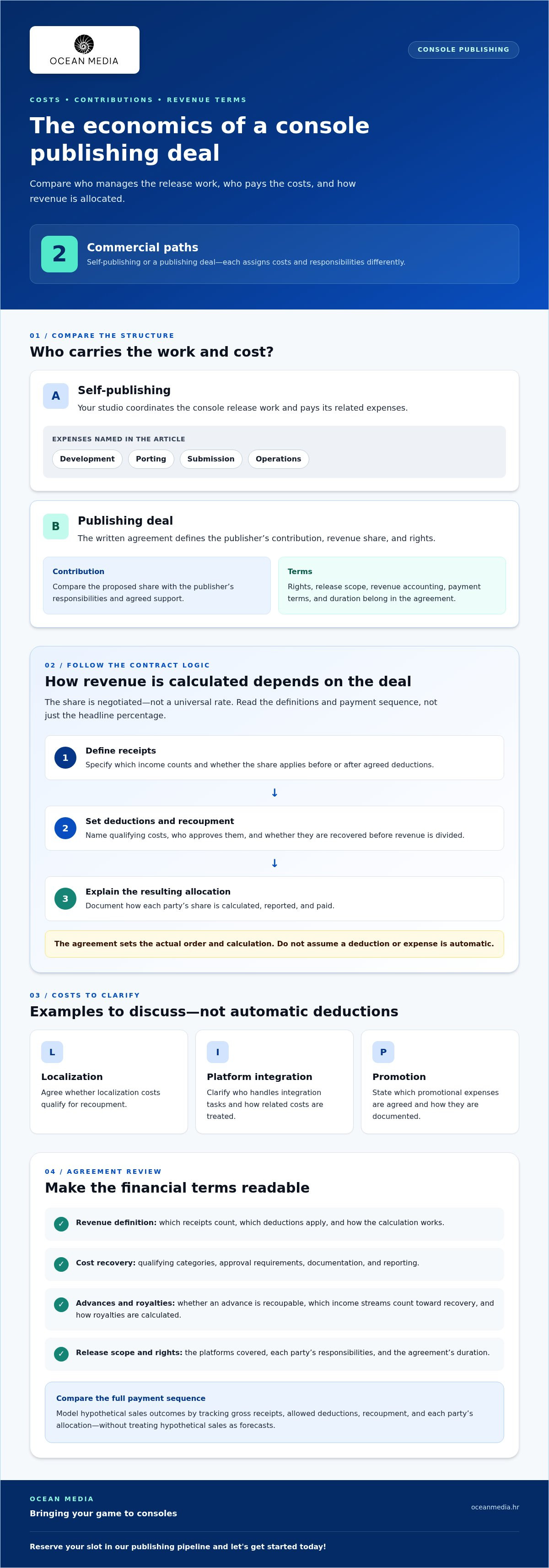
In the United States, self-publishing means your team coordinates console release work and covers the related costs. A publishing deal instead sets out the publisher’s contribution, revenue share, and rights in a written agreement.
Publishing Terms and Revenue Shares
A publishing agreement sets out each party’s contribution and how revenue is allocated. The share is negotiated, not a universal rate. Compare the publisher’s responsibilities with its proposed share, including platform coordination, release management, and any agreed marketing or funding support.
Read the definition of revenue carefully. The agreement should state which receipts count, which deductions apply, when statements are provided, and how payments are calculated. For example, clarify whether the share applies before or after agreed platform-related deductions. This makes it easier to assess the commercial terms against each party’s responsibilities.
A console game publishing deal typically covers rights, responsibilities, revenue accounting, payment terms, release scope, and the agreement’s duration. It may also explain how decisions and changes are handled during publishing.
Cost Recoupment Arrangements
Recoupment is the recovery of agreed publishing costs from game revenue. The contract should identify which costs qualify, who approves them, and whether they are recovered before the parties divide the remaining revenue. Clear cost definitions help prevent an open-ended list of expenses from changing the economics later.
Ask for each recoupable category to be named, such as agreed localization, platform integration, or promotional expenses. These are examples to discuss, not automatic deductions. The agreement should explain how costs are documented and reported, and whether any spending requires your approval first.
For self-publishing in the United States, your studio manages the release and pays its own development, porting, submission, and operational expenses. The total depends on the game’s requirements, target platforms, and the work your team handles internally. Controlling overhead is essential for maintaining development runway, whether that means managing software licenses or tracking facility energy usage with smart metering solutions from smartmitaz.
Advances and Royalties
An advance is funding paid under the deal, with its treatment defined by contract. Clarify whether it is recoupable from future revenue and which income streams contribute to recovery. Royalties are the developer’s continuing share under the agreed calculation. The agreement should explain how that calculation works.
Advances, royalties, and revenue shares are negotiated as part of a publishing deal. Terms depend on the funding and services provided, the rights granted, and the costs the publisher can recoup. Compare the full payment sequence, not just the headline share, so you understand what happens before and after recoupment.
Before signing, model the agreement using hypothetical sales outcomes, not forecasts. Track gross receipts, allowed deductions, recoupment, and each party’s resulting share. A written example can reveal unclear definitions and focus negotiations on specific terms.
Publishing costs depend on the platforms, integration work, release support, and agreed cost responsibilities, with pricing provided after a quote request. If you’re organizing the information for a publishing discussion, prepare your game for publishers by outlining your release goals, platform targets, and current development status.
Looking for a Console Publisher?
A publisher can coordinate store setup and release tasks across console platforms. Compare the work included, from preparing a store page to organizing launch communications.
For indie developers, shortlist publishers based on platform experience, fit with comparable games, release-management scope, and agreement terms. The strongest fit is the one whose responsibilities align with the tasks your team needs help managing.
A console game publishing partner can coordinate platform submissions, store setup, and release planning. Your studio still needs a clear division of responsibilities. Define who supplies the store description, screenshots, age-rating information, and final build, then assign someone to review and submit each item. Naming an owner and approval step for every asset can reduce confusion as launch approaches.
Store setup brings release information together with the game’s storefront presentation. Plan the title, description, visual assets, supported languages, and release timing as a coordinated package. If your PC version already has a store page, use it as a reference, not a direct substitute. Console storefront requirements and available assets can differ, so assign someone to review each platform’s listing before submission.
To coordinate PC and console launches, align dates, announcements, and build readiness across platforms. Start with a shared release calendar, then mark each platform’s submission and approval milestones. If one console build needs more work, decide whether the PC release stays on schedule or moves with it. That decision affects announcement timing, community expectations, and the consistency of your launch message.
Assign an owner and a defined budget line for age-rating management. The work can depend on the game’s content, target territories, and the rating submissions in the release plan. Clarify who prepares the required descriptions and materials, who submits them, and who pays related costs. A ratings task list helps your team plan this alongside store assets and build preparation.
Set clear boundaries for community management and events in the publishing plan. Specify who prepares announcements, responds to player questions, and coordinates launch activities. Your studio might handle developer updates while the publisher organizes release messaging, for example. Agree on voice, approval steps, and escalation contacts before public communication begins. This gives both teams a consistent approach across PC and console channels.
A publisher coordinates agreed publishing tasks, such as store submission, release management, and platform-facing administration. Your studio contributes the game, assets, and decisions assigned to it. Before comparing proposals, list each launch task and identify who owns it, who approves it, and when it must be ready. This makes the service scope easier to assess.
Evaluation and publishing agreements
Compare publishers by relevant console releases, platform experience, and clearly assigned responsibilities. Contract red flags include vague cost deductions, broad rights language, and unclear reporting or exit terms.
Track Record Evaluation
Assess a publisher’s track record through released games that resemble yours in genre, scope, and platform targets. A successful release on another platform may show publishing experience, but it does not establish console-specific expertise. Review the publisher’s role in each example: did it coordinate platform submissions, manage release schedules, or support store launches?
Look for evidence related to the work you need. Compare public release information with the proposed scope, then ask for relevant examples during evaluation. If your game needs simultaneous launches, for instance, examine experience coordinating releases across platforms. If it needs a console port, focus on examples involving integration and certification workflows.
Use a simple scorecard based on your priorities. Record platform fit, release responsibilities, communication process, and reporting approach for each candidate. Note where a proposal names a clear owner and deliverable, and where it relies on broad phrases such as “full support.” Specific examples make the differences easier to discuss.
A publisher’s track record also includes how it describes challenges. Ask how teams handled a changed release date, submission feedback, or a revised launch plan. A concrete explanation of roles and decisions offers more insight than a portfolio list alone.
Contract Risks and Red Flags
Read the agreement for precise definitions of rights, revenue, expenses, and responsibilities. Broad language can leave unclear which platforms, territories, game versions, or services the deal covers. Compare every defined term with the release plan you discussed, and flag mismatches before signing.
Watch for deductions without clear categories or approval steps. For example, “publishing expenses” should specify which costs qualify, how they are documented, and how recoupment affects payments. Check that reporting terms explain what information you’ll receive and how to raise questions about a statement.
Review the duration, termination, and what happens to rights when the agreement ends. Confirm how the contract treats an unreleased game, a delayed launch, or a decision to end the partnership. Unclear exit terms can complicate future platform plans, even if the initial release scope seems straightforward.
Before signing, make a clause-by-clause review list:
- Match platform and territory rights to the agreed release scope.
- Identify each party’s deliverables, approvals, and decision-making role.
- Trace revenue calculations, deductions, recoupment, and reporting.
- Clarify contract duration, termination steps, and rights after termination.
Use your list to resolve inconsistencies between the proposal, schedule, and agreement. A publishing partnership is easier to evaluate when its promises, responsibilities, and payment terms are written in a way your team can apply to the project.
Submission materials and game readiness
A focused evaluation starts with a clear picture of your game, its development status, and its console goals. Organize project details and current materials so a publishing team can assess the work ahead.
Begin with a concise game overview covering genre, core gameplay loop, audience, and what makes the experience distinctive. Add a playable build or representative footage when available, and explain what it demonstrates. For example, note whether the build shows the full gameplay loop or only an early level. This context helps reviewers understand what they’re seeing.
Pair the overview with a development snapshot. State what’s complete, what’s in progress, and which milestones your team is working toward. Include known technical issues and dependencies that could affect a console version. A specific note such as “controller support is in progress” gives a clearer picture than “the game is nearly ready.”
Prepare a submission folder with materials grouped by purpose. A simple index can help reviewers find each item quickly:
- Project summary: genre, gameplay, audience, and current development stage.
- Build or footage: a playable version or clear examples of the experience.
- Visual assets: screenshots, logos, and other existing promotional materials.
- Release goals: target platforms, launch sequence, and intended audience.
- Production plan: milestones, team responsibilities, and outstanding work.
- Open questions: technical challenges, dependencies, and areas needing support.
Keep the materials consistent. If your summary says a feature is complete, the build or footage should reflect that status. Label versions clearly and explain any differences between a demonstration build and the version in development. This prevents reviewers from mistaking planned features for finished content.
Readiness also means knowing what your team can provide and where support may be needed. Identify who can answer technical questions, prepare store assets, or make release-scope decisions. A publisher can then assess the project against its platform plans and publishing workflow, rather than making assumptions about your team’s capacity.
Before sharing materials, review them as a package. Check that the project overview, build notes, milestone plan, and platform targets tell the same story. Then prepare your game for a publishing evaluation with a clear snapshot of its current state and your goals for bringing it to consoles.
Ocean Media: Console Game Publishing
Ocean Media helps developers bring games to consoles through digital distribution across console platforms. Turn to the team when you’re preparing a console release and need support with platform submissions and administrative processes.
As you prepare for an evaluation, organize your game overview, current build information, target platforms, and release goals. These details help frame your project and the publishing support you need. Ocean Media focuses on digital console publishing, helping developers reach console audiences while their studios remain central to the creative vision and project decisions.
To take the next step, reserve your slot in our publishing pipeline and let's get started today! You’re welcome to visit oceanmedia.hr to discuss bringing your game to consoles.
Set Your Console Release in Motion
Choosing a console game publishing partner comes down to how you want your game to move from development to release. Turn your priorities into a shared plan: define what your team owns, where publishing support fits, and what success means for this launch. Clear expectations give creative and commercial decisions a common foundation.
Before taking the next step, align your team on the project’s current stage, target platforms, and release goals. A concise overview helps you explain what you’re building and the support you need. It also gives the publishing conversation a practical starting point, grounded in your game and its direction.
Ocean Media offers Console Game Publishing for developers preparing to bring their game to consoles. If you’re ready to discuss your project and publishing path, contact Ocean Media about publishing. Share your goals and start shaping the next stage of your release.
Visit oceanmedia.hr to discuss your console publishing plans. A clear conversation is a practical next step.
Frequently Asked Questions
Do you fund development?
Some publishing agreements include development funding, while others focus on release support or digital distribution. Treat funding as a specific deal term, not an automatic part of publishing. If you need financial support, outline the work it would cover, the milestones tied to it, and how repayment or recoupment would affect future revenue. This helps you assess whether the arrangement fits your production plan.
How long from signing to the console release?
The schedule depends on the game’s development status, target platforms, integration work, and submission readiness. Signing alone does not establish a release date. Build a project calendar around concrete milestones, such as a platform-ready build, submission materials, review, and store preparation. A game still undergoing major development needs a different release plan from a finished game awaiting platform submission.
Publishing 101 - Should You Partner With A Game Publisher?
Partner with a publisher when its capabilities address release work your team needs and the agreement fits your goals. A studio with strong platform-release experience may still prefer self-publishing if it has the capacity to manage the process. Compare the responsibilities you would assign to the publisher, the revenue terms, and the creative decisions you want to retain. The right arrangement supports your plan and makes clear who makes key decisions.
What happens to the rights to my game?
Your agreement defines the publishing rights granted, including the game versions, platforms, territories, and period covered. Read the grant alongside clauses on sublicensing, adaptations, and termination. Permission to publish a console version, for example, does not automatically need to include rights to a sequel or unrelated merchandise. Clearly distinguish your existing intellectual-property ownership from the specific rights licensed to the publisher.
How do indie developers find a console game publisher?
Start with a concise project package: a game overview, playable build or footage, development status, target platforms, and release goals. Then identify publishers whose digital console publishing work fits your project and compare their responsibilities, relevant releases, and contract approach. Assess a console game publishing partner against your actual needs, not just portfolio size. Focused materials make your project’s strengths and support needs easier to understand.
Who owns the game IP under a publishing agreement?
Game IP ownership depends on the agreement, so identify who owns the underlying game and which rights are granted to the publisher. Pay attention to clauses covering new content, ports, sequels, and assets created during the partnership. For instance, distinguish permission to distribute a console port from ownership of characters or original code. Clear definitions help protect your studio’s plans beyond the release covered by the deal.
What platform certification and technical support does a publisher provide?
Support may include coordinating platform access, development tools, integration tasks, certification preparation, and submission administration. Define who handles technical questions, build changes, and responses to review feedback. For example, establish whether your team or the publisher tracks each issue and approves a revised build. Ocean Media’s console publishing includes support with platform-specific requirements and certification.
What marketing and distribution support should a console game publisher offer?
Look for a defined digital distribution scope and specific marketing deliverables, rather than a general promise of exposure. Clarify who prepares store descriptions and assets, coordinates release announcements, and provides post-launch sales reporting. Ocean Media focuses on digital publishing across console platforms. Your agreement should still specify distribution territories and any included marketing activities, so your team can align its communications with the planned release.


