

A translation order isn’t a console game localization strategy. If languages, text, visual assets, testing, and release preparation are planned separately, late changes can create avoidable rework as launch approaches. The challenge is choosing a scope that fits your game, audience, team capacity, and publishing goals.
You may already know localization can help your game connect with players in more markets. The harder questions are where to begin, which languages to prioritize, and how to keep decisions aligned with development and console publishing. This guide explains how to build a practical plan, organize content for adaptation, and coordinate localization work with your publishing pipeline.
We’ll look at how to assess market priorities, prepare your game and assets early, and factor localization into console release planning without treating translation as the whole strategy. Ocean Media brings over 20 years of gaming-industry experience to digital console publishing and release coordination. If you’re bringing your game to consoles, discuss your publishing fit and release needs with our team.
Key Takeaways
- Build your console game localization strategy around your game, audience, team capacity, and publishing goals, not translation alone.
- Use player, community, sales, and platform data where available to assess candidate markets, and label assumptions clearly.
- Compare text, audio, visual, and cultural adaptation by player impact, content volume, production effort, and review needs.
- Plan localization early and assign clear owners for source text, assets, review, implementation, and issue resolution.
- Coordinate localization with console publishing as related workstreams. To discuss bringing your game to consoles, explore Ocean Media’s console publishing services.
What a console game localization strategy needs to solve
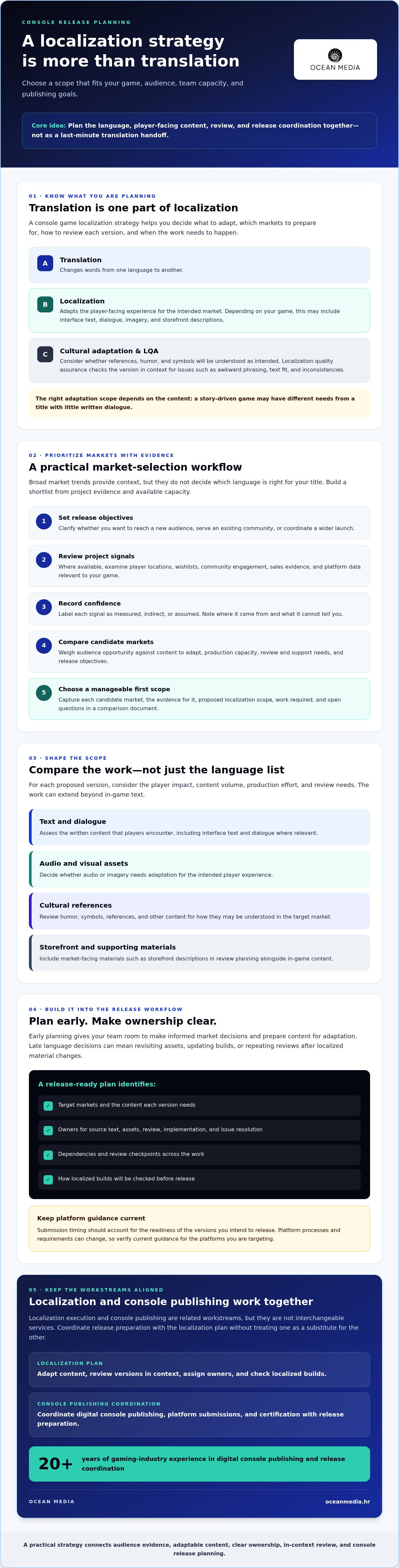
A console game localization strategy is a plan for adapting a game’s language and player-facing content, testing each target-market version, and coordinating that work with the release. It helps you decide what to adapt, which markets to prepare for, how to review the results, and when each task needs to happen. Translation is one part of that plan, not the whole process.
Localization versus translation: what changes in a console release?
Translation changes words from one language to another. Localization adapts the player-facing experience so it makes sense in the intended market. Depending on your game, that may involve interface text, dialogue, imagery, or storefront descriptions. The right scope depends on the content: a story-driven game may have different adaptation needs from a title with little written dialogue.
Cultural adaptation considers whether references, humor, symbols, or other content will be understood as intended. Localization quality assurance (LQA) checks the localized version in context. It can help identify awkward phrasing, text that doesn’t fit the interface, or inconsistencies between the game and its supporting materials. These activities are connected, but they solve different problems. The Video game localization overview provides useful background on the broader process and its approaches.
Why localization decisions belong in release planning
Plan early, while you can still make informed choices about target markets and prepare content for adaptation. If language decisions come late, your team may need to revisit assets, update builds, or repeat reviews after localized material changes. A plan with owners, dependencies, and review checkpoints helps you track this work instead of treating localization as a final handoff.
Console release preparation involves more than what players see in the game. Storefront descriptions and other market-facing materials may need review alongside in-game content. Submission timing should also account for the readiness of the versions you intend to release. Platform processes and requirements can change, so verify current guidance for the platforms you’re targeting rather than relying on assumptions.
Make the plan actionable by identifying target markets, the content each version needs, who owns review and implementation, and how localized builds will be checked before release. Localization execution and console publishing are related workstreams, but they aren’t interchangeable services. Ocean Media supports digital console publishing, platform submissions, and certification. Its team can discuss how release coordination may fit your publishing plans. If you’re bringing your game to consoles, learn about console publishing for developers.
How to choose languages and markets for your console game
A useful console game localization strategy starts with evidence about your game and audience, then checks whether your team can support the scope. Broad market trends can provide context, but they don’t tell you which language is the right priority for your title. The International Trade Administration’s overview of the global video game industry value can help frame the wider market. Your decisions should still rest on relevant project evidence and available capacity.
Which signals can help prioritize target markets?
Use a consistent workflow to build and compare a shortlist. Gather the information you already have, and mark what you don’t know rather than treating an assumption as a forecast. A simple comparison document can record each candidate market, the evidence for it, the proposed localization scope, the work required, and any open questions.
- Set your release objectives. Clarify whether you’re aiming to reach a new audience, serve an existing community, or coordinate a wider launch.
- Review project signals. Where available, examine player locations, wishlists, community engagement, sales evidence, and platform data relevant to your game.
- Record confidence. Label each signal as measured, indirect, or assumed. Note where the data comes from and what it can’t tell you.
- Compare candidate markets. Weigh audience opportunity against the content to adapt, your production capacity, review and support needs, and release objectives.
- Choose a manageable first scope. Prioritize markets with the clearest evidence that fit the resources you can commit. Document what new information would prompt you to reassess the choice.
Language priority should follow project evidence and team capacity, not a universal market ranking. For example, community interest may suggest a language is worth evaluating, while limited production resources may lead you to phase that work rather than prepare every candidate market at once.
How should a studio choose localization depth?
Match adaptation depth to the game’s content and the audience you’re targeting. Text-focused adaptation may suit a title whose key player interactions rely on menus and written dialogue. A dialogue-heavy game may warrant evaluating audio localization as well. Visual or cultural changes may merit review when specific imagery, references, or presentation choices could affect how the experience is understood.
Compare each option by player impact, content volume, production effort, and review needs. Don’t assume every market expects the same treatment, or that a broader scope will automatically produce better results. Record what you know, what you’re still validating, and what your team can deliver alongside the console release.
If you’re bringing your game to consoles, you can discuss how your release goals fit a digital publishing plan with Ocean Media’s console publishing team.
How to compare localization approaches, scope, and quality
Choose a scope that supports your game and target markets, rather than relying on a fixed formula. A dialogue-heavy adventure may benefit from reviewing audio options, while a game with limited spoken content may focus on text and interface clarity. For each option, assess player impact, content volume, production effort, and review needs. Your console game localization strategy should make these trade-offs visible before work is scheduled.
What parts of a game may need localization?
Start with an inventory of confirmed player-facing content. Depending on your game, it may include dialogue, menus, tutorials, subtitles, store descriptions, or player-facing support content. Check visual assets too: text embedded in images can be easy to miss and may need a separate adaptation decision. Treat these as categories to review, not a claim that every game needs every type of localization.
| Approach | May fit when | Compare |
|---|---|---|
| Text | Players rely on menus, tutorials, dialogue, or written descriptions. | Text volume, context, terminology, and review coverage. |
| Audio | Spoken dialogue or voice performance is central to the experience. | Audio content volume, production effort, and review needs. |
| Visual | Images or other visual assets contain text or market-sensitive references. | Which assets need changes and how those changes are checked in context. |
| Cultural adaptation | Humor, symbols, references, or presentation choices may not carry the intended meaning. | Player impact, creative intent, and the review needed for each change. |
How can teams build a reliable localization quality process?
Separate linguistic review from in-context checks. Linguistic review examines wording, meaning, and consistency. In-context checks look at how localized content appears and reads in the game. A glossary for recurring terms and concise style guidance help reviewers make consistent decisions across menus, dialogue, and supporting materials.
Track issues in a shared list. Record each defect’s location, description, and severity, then assign an owner to resolve it and confirm the fix. Include enough context for the implementer to find the issue, such as the screen or content area where it appears. This makes review actionable instead of leaving teams with feedback that’s difficult to implement. The IGDA localization best practices can provide another reference as you shape your process.
Localization execution and console publishing remain distinct workstreams. Ocean Media focuses on digital console publishing and release coordination, not localization services. You can explore console publishing for developers and discuss your console release needs.
How to build localization into your console release workflow
Localization works best as a planned production stream, with clear handoffs from content preparation to localized-build validation. A practical console game localization strategy makes ownership visible and connects each checkpoint to the broader console release schedule. That way, a text change or asset revision can be tracked before it disrupts later review or release preparation.
What should teams prepare before localization begins?
Start by identifying player-facing content and flagging lines that depend on context, such as character relationships, humor, or references to earlier scenes. Prepare a glossary, tone guidance, character notes, and visual references so reviewers can understand how each line functions in the game. Keep source text and assets organized, record revisions clearly, and identify which version is ready for review. This reduces the risk of reviewing outdated material or missing text embedded in an asset.
How should localization fit into build and submission planning?
Use a sequence with an owner for each handoff. Your team may assign these responsibilities to different people or combine them in a smaller studio, but every task should have a clear point of contact.
- Review content and scope. The game team identifies player-facing text, assets, and context needed for adaptation.
- Prepare source materials. The content owner organizes text and references; the asset owner flags visual material that may need review.
- Coordinate language review. Set review checkpoints against the release schedule and route questions to the appropriate creative owner.
- Implement approved changes. The implementation owner brings reviewed content into the relevant build and tracks revisions.
- Validate the localized build. Review content in context, checking display, layout, and gameplay flow. Log defects, assign an owner, and confirm fixes.
Schedule these checkpoints alongside console submission planning, not after it. The localization and publishing workstreams need to share a view of build readiness and release milestones while keeping their responsibilities distinct. Check current platform guidance for the requirements that apply to your release; don’t rely on outdated assumptions about submissions or certification. Regional content review may also inform age-rating preparation, so coordinate that work with the relevant release owners.
For your broader roadmap, connect localization milestones with decisions about bringing your game to consoles. Ocean Media supports digital console publishing, platform submissions, and certification, helping developers coordinate release needs through the publishing lifecycle. If you’re evaluating publishing fit, discuss your console release plans.
How a publishing partner can support your localization-ready console launch
Localization execution and console publishing are connected, but they’re not interchangeable services. Your localization team handles language and market adaptation; a console publishing partner can help align release coordination with platform submissions and certification support. Keep responsibilities clear, then connect the workstreams through shared milestones, build status, and decisions about target markets.
Ocean Media is a digital console game publishing company with over 20 years of gaming-industry experience. Its role is to support developers through console publishing lifecycles, including platform submissions and certification, not to provide localization services. That publishing perspective can help you discuss how localization readiness fits into the wider release plan. Verify current platform guidance for your planned release, and confirm responsibilities with each partner directly.
What should you ask a console publishing partner?
Start with questions that clarify ownership and coordination. Ask how publishing milestones can align with your localization plan, who manages platform submissions and certification tasks, and how updates will be shared between the publishing and localization workstreams. Confirm which activities are included in the publishing relationship. Don’t assume localization execution is part of it.
A useful discussion should leave you with a clearer picture of handoffs: who provides localized materials, who tracks build readiness, and where submission-related questions should go. Your studio remains responsible for understanding its localization scope and ensuring contributors know when decisions or content are needed.
What should you prepare before discussing your project?
A concise project brief helps both sides focus on fit and release needs. Include:
- Game and platforms: Summarize the title and the console platforms you’re targeting.
- Markets: List intended markets and the evidence or assumptions behind those choices.
- Development status: Describe where the game stands and any release objectives you’ve established.
- Localization status: Separate completed work from planned work and open decisions. Be clear about what’s ready and what still needs review.
- Release coordination needs: Note upcoming milestones, known dependencies, and questions about submissions or certification support.
This brief gives a publishing partner enough context to discuss how console release coordination may align with your console game localization strategy, without implying that the partner will execute localization. To explore whether Ocean Media’s digital console publishing support fits your plans for bringing your game to consoles, discuss your console publishing needs.
Make your global release plan actionable
A strong console game localization strategy connects market choices, adaptation scope, quality checks, and release milestones. Use evidence to prioritize languages, prepare content and assets early, and assign clear owners so localization work stays coordinated with your console launch.
Localization execution and console publishing are distinct workstreams, but they need to align. Ocean Media brings over 20 years of gaming-industry experience to digital console publishing, including support with platform-specific submissions and certification. If you’re planning a release, share your target platforms, intended markets, localization status, and publishing goals with our team.
Discuss your console publishing needs with Ocean Media. Clear plans and release coordination can help your team move forward as you bring your game to consoles.
Frequently Asked Questions
What is a console game localization strategy?
A console game localization strategy is a plan for adapting a game for selected markets and coordinating that work with release preparation. It covers more than translating dialogue: you decide which languages and player-facing content to address, how cultural adaptation and quality checks will work, and who owns each task. A clear plan connects these decisions to your game’s audience, team capacity, and publishing goals.
How do you choose which languages to localize a console game into?
Choose languages by weighing project evidence against the work your team can support. Review available player, wishlist, community, sales, and platform data, then document how reliable each signal is. Separate measured evidence from assumptions. Compare candidate markets based on audience opportunity, adaptation scope, review and support needs, and release objectives. Avoid treating broad market rankings as a substitute for information about your specific game.
Does localization mean translating every line of a game?
No. Localization doesn’t automatically mean translating every line or adapting every asset. First inventory the content players encounter, such as menus, dialogue, tutorials, subtitles, store descriptions, and text embedded in images. Then decide what fits each target market and your release goals. Some projects may prioritize key text, while others may need to assess audio, visual, or cultural adaptation as well.
When should a studio start planning console game localization?
Start planning while you can still shape content, prepare assets, and coordinate review with development and release milestones. Early decisions help you identify the context reviewers need, organize source material, and assign owners for implementation and issue resolution. Waiting until a build is nearly ready can mean revisiting assets or repeating review after changes. Include localization checkpoints in your console release plan and verify current platform guidance.
Can a small indie team localize a game for multiple console markets?
Yes, a small team can evaluate a multi-market release, but the scope should match its capacity. Prioritize languages using available audience evidence, then compare content volume, production effort, review needs, and release objectives. You might phase markets or adaptation types rather than taking on every possibility at once. Assign clear owners, track decisions, and be candid about what’s complete, planned, or still undecided.
What should localization quality assurance test in a console game?
Localization quality assurance should check both language and how localized content works in context. Review meaning, terminology, consistency, and tone, then inspect the content in the game for display, layout, and gameplay-flow issues. Check relevant player-facing materials as well as in-game text. Track defects with a severity level, assign an owner to resolve each issue, and confirm that fixes appear correctly in the updated build.
How does game localization fit into console certification and submission?
Localization and console submission are related release workstreams, but they aren’t the same task. Plan localized-build review and implementation alongside submission milestones, and confirm current platform-specific requirements for your release rather than relying on assumptions. A publishing partner may support digital console publishing, platform submissions, and certification, while localization execution remains a separate responsibility. If you’re bringing your game to consoles, discuss your console publishing needs with Ocean Media.


