

What if the biggest risk to an indie game global release isn’t choosing the wrong market, but treating each launch decision as a separate task? Reaching players worldwide takes more than preparing a store page or translating text. Territory priorities, console storefront readiness, platform submissions, and release timing need to work together.
It’s understandable to feel unsure where to begin. Console launches involve platform-specific processes, and regional preparation can seem like a moving target. A clear sequence helps you make informed choices without losing sight of your game or your audience. In this guide, you’ll learn how to assess markets and storefronts, organize key release work, and prepare for a coordinated digital launch.
We’ll also explain how console publishing support can help you move through the publishing pipeline. Ocean Media brings over 20 years of gaming industry experience to helping developers navigate console submissions, certification, and the publishing lifecycle. When you’re ready to discuss bringing your game to consoles, explore Ocean Media’s publishing support.
Key Takeaways
- Plan an indie game global release as a coordinated effort across selected markets and storefronts, not just a shared launch date.
- Connect territory priorities, platform availability, store materials, localization, and age-rating preparation in your release plan.
- Choose a simultaneous or phased rollout based on your team’s capacity, platform readiness, and ability to support players.
- Use a practical sequence to clarify launch goals, confirm readiness, and coordinate release decisions before moving forward.
- Consider digital console publishing support for platform submissions and certification when planning a console release.
Why an Indie Game Global Release Takes More Than a Worldwide Launch Date
A worldwide digital release brings creative, technical, and operational decisions together. You’re choosing where the game will be available, preparing each selected storefront, confirming platform readiness, and coordinating the work around launch. For an indie studio, these decisions compete for the same limited time and attention as development, testing, and community communication.
A shared launch date doesn’t automatically mean every territory and platform is ready. Store materials, language versions, age-rating preparation, and platform submissions may each need their own review and coordination. The goal isn’t necessarily to launch everywhere at once. It’s to define a release scope your team can prepare for and support.
What does a global game release involve?
A global digital game release is a coordinated plan to make a game available across the markets and storefronts a developer selects. That plan connects territory priorities, store preparation, platform submissions, and launch coordination. Availability depends on the platforms you choose and the release plan you confirm, so “global” doesn’t have to mean every storefront or market.
Keep general launch planning separate from platform-specific submission work. Confirm current platform and territory requirements before setting expectations. If you’re considering publishing support, the role of video game publishers can include helping independent developers bring a release to market. Ocean Media focuses on digital console game publishing, helping developers navigate the publishing lifecycle.
Why should indie studios plan beyond the launch date?
Your team may be balancing final creative decisions with store assets, submission tasks, and launch coordination. Regional language preparation and age-rating planning also deserve attention as separate workstreams. Assigning owners and clarifying what must be ready for each chosen platform and market can help you identify gaps before they affect the release plan.
Start with a manageable scope, then check that your team can prepare and support it. A phased release may suit some studios, while a coordinated multi-market launch may suit others. Neither approach fits every game. For a broader view of console release planning, explore our console game publishing support.
The Building Blocks of an Indie Game Global Release
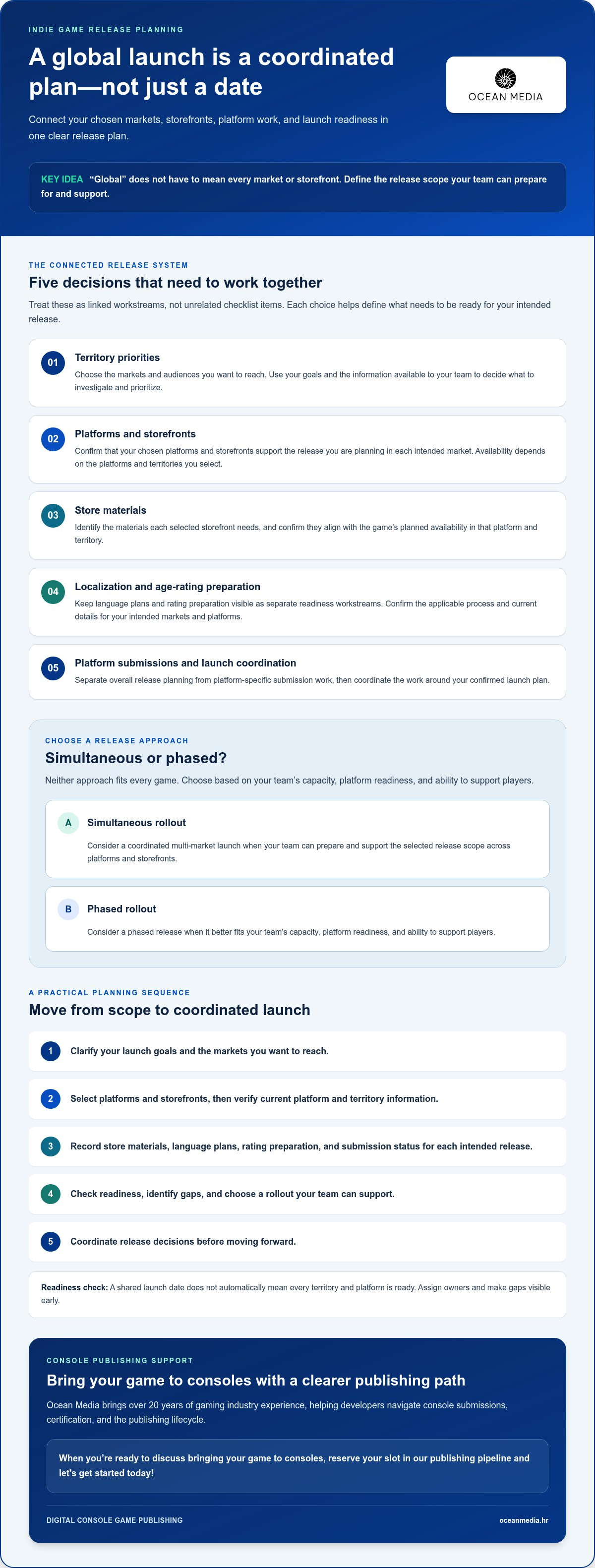
A strong release plan connects several workstreams. Territory priorities influence which storefronts you prepare for; platform choices shape submission work; and store materials, localization, and age-rating preparation all need to align with the availability you intend to offer. Treat these as linked decisions, not a checklist of unrelated tasks.
Start by defining the audiences and markets you want to reach. Then confirm that your chosen platforms and storefronts support the release you’re planning in those markets. Don’t assume demand, platform access, or commercial performance. Use your goals and the information available to your team to decide what to investigate and prioritize.
How do territory and storefront decisions fit together?
For each intended market, create a simple readiness record with the selected platform and storefront, store materials to prepare, relevant language plans, and submission status. This makes gaps visible early. A storefront listing can support your plan only when the game’s availability and accompanying materials are confirmed for that platform and territory.
Separate overall release planning from platform-specific submission requirements. The first defines where and how you want to launch; the second concerns the process for each chosen platform. Requirements can change, so verify current platform and territory information before finalizing your plan. Digital distribution means making the game available through selected digital storefronts, not through physical retail.
Where do localization and age ratings fit?
Localization and age-rating preparation are distinct readiness workstreams. Localization considers which languages to support and how text and other player-facing content will be adapted. Rating preparation involves identifying the applicable process for your intended markets and platforms, then confirming current details. Keep both visible in your schedule instead of assuming they’ll resolve themselves once the launch date is set.
For a deeper look at language planning, read our global console localization guide. Our global console age-rating guide explores rating preparation in more detail.
Before moving forward, check that each planned storefront has an owner, the required materials are accounted for, and platform-specific steps are being verified. If you’re bringing your game to consoles and want to understand how publishing support fits into that work, review our developer publishing information.
Simultaneous or Phased Launch: Choose a Release Approach You Can Support
A global release doesn’t require every market and platform to launch on the same date. The right approach for your indie game global release depends on what your team can prepare, coordinate, and support. A coordinated launch brings planned availability together, while a phased rollout sequences markets or platforms when readiness differs. Neither approach is automatically better.
Before choosing, compare each platform and territory’s readiness with your team’s capacity. Consider who will coordinate store materials, communications, and player support at each stage. Then confirm feasibility with your publishing partners for your specific game and release plan.
| Decision factor | Coordinated multi-market launch | Phased rollout |
|---|---|---|
| Platform readiness | Can suit a plan where selected platforms are ready to align. | Can accommodate platforms reaching readiness at different points. |
| Territory preparation | Requires intended markets and their release preparations to be coordinated together. | Allows the plan to sequence markets when their preparations aren’t aligned. |
| Team coordination | Concentrates launch coordination around one planned release stage. | Requires coordination across multiple planned stages. |
| Communications and support | Calls for clear communication about the planned availability across selected storefronts. | Calls for updates that clearly explain what’s available at each stage and what’s planned next. |
When might a coordinated launch make sense?
Consider a coordinated launch when your selected platforms are progressing in step and your team can prepare the required store materials and territory details together. Ask whether each planned storefront and market is ready for the same release stage, and whether your team can coordinate communications and support around it. Confirm feasibility with your publishing partners before treating a shared date as final.
When might a phased rollout be more practical?
A phased rollout may be worth considering if platform readiness or market preparation can’t be aligned. You might sequence selected platforms or territories according to confirmed readiness, then communicate clearly about availability at each stage. Keep the plan consistent across your store information and launch communications so players can understand where the game is available. A phased approach doesn’t guarantee stronger sales, greater discovery, or platform approval; choose it because it fits your preparation and support capacity.
Use the comparison to identify which work can align and which needs a separate stage. Ocean Media’s digital console publishing support helps developers navigate platform submissions, certification, and publishing coordination as they plan to bring a game to consoles.
Build a Global Release Plan in a Practical Sequence
A written sequence turns global launch planning into decisions your team can confirm and track. For an indie game global release, define the scope first, then verify what each selected platform and territory requires. Use this checklist as a working plan, not a fixed timeline.
- Define your release goals. Clarify the audiences you want to reach and what you want the launch plan to achieve. Output: a short statement of your release priorities.
- Select platforms and territories. Identify where you intend to release and on which platforms. Output: a confirmed scope, with undecided markets or platforms recorded for review.
- Assign task owners. Name who is responsible for store information, localization, age-rating preparation, platform submissions, and launch communications. Output: clear ownership for each workstream.
- Prepare store and regional materials. Check that planned store information and assets are accounted for, and identify language and age-rating preparation relevant to the selected territories. Output: a materials checklist that reflects your release scope.
- Verify platform-specific guidance. Review current requirements for each intended platform and territory rather than relying on generic assumptions or past submissions. Compare the guidance with your game materials and regional preparations. Output: a record of what needs attention and the status of each submission.
- Coordinate the launch plan. Confirm how availability, communications, and remaining tasks will align across selected storefronts. Output: a shared plan with agreed release details and open items visible.
What should a studio clarify before platform submission?
Before submitting, make sure your intended platforms, target territories, release priorities, and task owners are recorded. Check that relevant game materials and regional preparations align with current platform guidance. Submission steps can vary by platform, so confirm details for your specific release. For a wider view of the console submission journey, read our console publishing process guide.
How can you keep launch work coordinated?
Keep one shared record of tasks, decision owners, dependencies, and confirmed status. If the release date or territory scope changes, update the record and communicate the change to relevant team members and publishing partners. This keeps store preparation, regional work, and submission planning connected as decisions evolve.
If you’re bringing your game to consoles, Ocean Media’s digital console publishing experience can help you navigate the technical and administrative publishing lifecycle. Learn more about our console publishing support.
Bring Your Game to Consoles with a Publishing Partner
Console publishing can add technical and administrative work to an already demanding release plan. If your team is unfamiliar with platform submissions, certification, or the publishing lifecycle, a publishing partner may help you understand the work involved and coordinate steps for your project. This can be especially useful when turning an indie game global release plan into a console launch with defined platforms, territories, and responsibilities.
Ocean Media is a digital console game publishing company with over 20 years of gaming industry experience. We help developers navigate platform requirements, submissions, certification, and the publishing lifecycle for digital releases across console platforms. A partner can bring experience to the process, but your project’s scope and responsibilities should be discussed directly. Certification, sales outcomes, and release dates aren’t guaranteed.
What can a console publishing partner help coordinate?
Publishing support may help you understand platform-specific requirements, prepare and manage submission work, and track certification and other steps across the publishing lifecycle. Before moving ahead, clarify which platforms and territories you’re considering, what work your studio will own, and what you expect the publisher to coordinate. Confirm current platform guidance for your game rather than relying on general assumptions.
Good alignment starts with clear responsibilities. You and your publishing partner should discuss the project scope, decision owners, and how updates will be shared as the release plan develops. The exact arrangement depends on your project, so make sure expectations are clear before work proceeds.
How can you take the next step with Ocean Media?
Start with the essentials: share information about your game, the platforms you’re considering, and your global release goals. That gives you a practical foundation for discussing your plans, relevant publishing work, and how bringing your game to consoles could fit your studio’s priorities.
Ocean Media provides digital console game publishing. We don’t offer physical retail distribution or work-for-hire game development. Our focus is helping developers navigate the technical and administrative complexities of console publishing, with a clear discussion of project scope and responsibilities from the outset.
To discuss your console release plans, explore Ocean Media’s publishing support.
Move Your Global Console Launch Forward
A successful indie game global release starts with a plan your team can deliver. Set clear territory and platform priorities, connect store and regional readiness, and choose a coordinated or phased approach that fits your capacity. Then track decisions and confirm current platform requirements before submission.
You don’t have to manage every publishing complexity alone. Ocean Media brings over 20 years of gaming industry experience, with expertise in platform submissions and certification. Our digital console publishing supports developers working to reach players worldwide and bring their games to consoles.
Share your game, intended platforms, and global release goals with us. Together, we can discuss the publishing path that fits your project and clarify the next steps. Explore Ocean Media’s console game publishing support.
Start the conversation with a clear release plan and the console publishing support your project needs.
Frequently Asked Questions
What does an indie game global release mean?
An indie game global release is a plan for making your game digitally available across selected markets and platforms. It involves more than choosing a launch date: you’ll need to coordinate territory choices, storefront preparation, platform submissions, and regional readiness. The scope depends on your game and intended release plan, so decide which platforms and markets you’re targeting. Before confirming availability, check the current requirements for each platform and territory.
Should an indie game launch worldwide at the same time?
Not necessarily. A coordinated launch may fit if your selected platforms, territories, and preparation work can be ready together. A phased release may be more practical if your team needs to sequence platform or market readiness. Compare your team’s capacity, platform status, territory priorities, and ability to coordinate communications before deciding. Neither approach guarantees stronger sales or visibility, so choose the plan your studio can prepare and support.
How do you prepare an indie game for a global console release?
Start by listing your intended platforms and territories, then map the work for each one. Coordinate store materials, localization, age-rating preparation, and platform submissions, and verify current requirements rather than relying on assumptions. Assign an owner to each task and track dependencies and submission status in one shared plan. A console publishing partner can help you navigate platform-specific technical and administrative steps as you bring your game to consoles.
Is translating a game enough for a global release?
No. Translation or other language adaptation is one part of regional preparation, not the entire launch plan. You may also need to coordinate storefront information, age-rating preparation, platform submissions, and availability across intended territories. The work depends on your chosen platforms and markets, so check current relevant guidance for each. Treat localization as a connected workstream within your release plan, with its own decisions and owner, rather than the only regional task.
What does a console game publisher do for an international release?
A console game publisher can help developers navigate the digital publishing lifecycle and platform-specific requirements. Depending on the agreed project scope, support may include assistance with submissions, certification processes, and publishing coordination. Ask a potential partner to clarify responsibilities for your game and chosen platforms. Publishers don’t all offer the same services. Ocean Media focuses on digital console publishing and does not offer physical retail distribution or work-for-hire development.
When should an indie studio contact a console publishing partner?
Consider contacting a partner as you plan to bring your game to consoles, especially if you need help understanding platform submissions or the publishing pipeline. Share details about your game, intended platforms, and release goals so you can discuss whether the publishing scope fits your project. Ocean Media brings over 20 years of gaming industry experience and helps developers navigate console publishing complexities. To discuss your plans, explore Ocean Media’s publishing support.


