

A console publishing deal is only as clear as its terms. A useful console publishing agreement checklist focuses on the clauses that shape your revenue, responsibilities, creative control, and options if the partnership changes. Review the definitions and mechanics, not just the headline royalty rate.
Looking beyond the advance is essential: royalties depend on how revenue is calculated, which costs can be deducted, and when statements and payments are due. This guide explains what to examine in advances and royalties, promotion commitments, costs and accounting, rights and reversion, and dispute resolution. You’ll also learn how to assess whether each clause is specific enough to guide the release, protect your contribution, and set expectations on both sides. A structured review turns broad promises into practical terms that govern bringing your game to consoles.
Key Takeaways
- Assess the advance alongside the royalty calculation, payment schedule, and reporting terms to understand how revenue will flow.
- Look for specific promotion commitments, including the activities, responsibilities, and timing each party agrees to.
- Clarify how the agreement handles assignment and complimentary copies so expectations are clear if ownership or access changes.
- Review allowable deductions, accounting statements, and audit rights to understand how costs and revenue are tracked.
- Make sure the dispute process and governing law are clear. When you’re ready to bring your game to consoles, reserve your slot in our publishing pipeline and let's get started today!
Advances and royalty rates
Review the advance and royalty clauses together: they determine how payments relate to revenue and which conditions apply. In your console publishing agreement checklist, focus on written definitions, payment triggers, platform scope, and the reports you’ll use to track earnings. A headline rate means little without clear calculation rules.
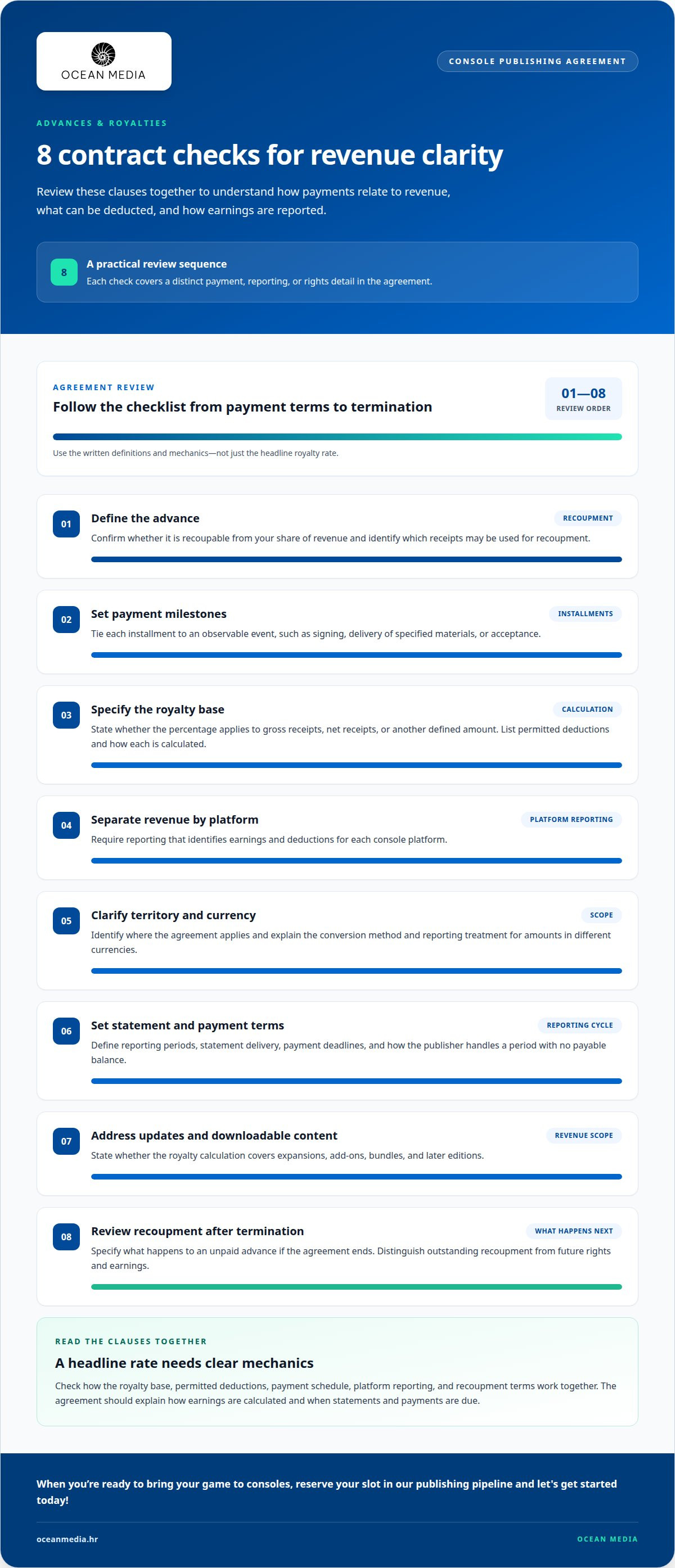
- Define the advance in the contract. Confirm whether it is recoupable from your share of revenue, and identify which receipts may be used for recoupment.
- Set payment milestones. Tie each installment to an observable event, such as signing, delivery of specified materials, or acceptance. This makes payment timing easier to assess.
- Specify the royalty base. State whether the percentage applies to gross receipts, net receipts, or another defined amount. List permitted deductions and how each is calculated.
- Separate revenue by platform. Require reporting that identifies earnings and deductions for each console platform. Separate reporting helps you understand how different release channels perform.
- Clarify territory and currency. Identify where the agreement applies and how amounts in different currencies are converted. The contract should explain the conversion method and reporting treatment.
- Set statement and payment terms. Define reporting periods, statement delivery, payment deadlines, and how the publisher handles a period with no payable balance.
- Address updates and downloadable content. State whether the royalty calculation covers expansions, add-ons, bundles, and later editions. Clear scope reduces disagreement about revenue from related content.
- Review recoupment after termination. Specify what happens to an unpaid advance if the agreement ends. The clause should distinguish outstanding recoupment from future rights and earnings.
How do exclusivity and platform-specific publishing terms compare across console agreements? Exclusivity depends on the agreement’s wording. It may cover a particular platform, territory, release window, or broader distribution rights. Compare the rights granted, exceptions, term, and release obligations in each console agreement rather than assuming their scope is the same.
What are the delivery milestones, acceptance criteria, and release deadlines? The contract should identify each required build or deliverable, its acceptance criteria, and the process for recording approval or requested changes. It should also explain how missed milestones affect payment, release timing, or either party’s rights.
For example, tie an advance installment to a named deliverable and define what counts as acceptance. Set out a written process for reporting defects, resubmitting a build, and resolving disagreements about whether it meets the agreed criteria. Clear steps make the schedule actionable.
As you map platform-specific milestones to your release plan, keep your console development planning aligned with the agreement’s payment triggers. Before signing, have a qualified legal professional review how the royalty, recoupment, exclusivity, and termination clauses work together.
Advertising and promotion commitments
Turn broad promises into trackable duties. Define the audiences, campaign assets, approval process, and reporting each party will handle. For example, “promote the game” is vague. Naming store-page updates, trailer placement, and campaign reporting creates clearer expectations.
- List the publisher’s promotional activities. Identify planned work such as platform-store merchandising requests, social posts, press outreach, trailer distribution, or participation in relevant showcases. Treat each activity as a commitment only when the contract assigns responsibility clearly.
- Separate commitments from intentions. Distinguish required actions from language such as “may promote” or “will use reasonable efforts.” That distinction helps you understand whether a missed campaign is a missed obligation or a change in marketing plans.
- Define your studio’s role. Specify which assets you’ll supply, who creates copy, and who secures approvals. A practical example is assigning the studio to provide approved screenshots while the publisher prepares store-page copy.
- Set the approval workflow. Identify who approves trailers, key art, announcements, and public statements. Include how feedback is delivered and what happens when an asset needs revision.
- Clarify campaign timing. Connect promotional actions to release milestones, such as the store-page launch, announcement, or release date. State how both parties coordinate changes if the release schedule moves.
- Specify campaign reporting. Identify what information the publisher shares after a campaign, such as placements completed, assets used, and available performance reporting. This gives your team a basis for reviewing activity.
- Address marketing assets and usage rights. Define which party supplies each asset and the permitted uses, territories, and duration. Include how the publisher can adapt your studio’s materials for platform storefronts or promotional channels.
- Record approval and escalation steps. Name the contact or role responsible for resolving disagreements about messaging. A written escalation path can prevent an unresolved asset review from delaying a planned announcement.
Who controls pricing, discounts, bundles, and sales promotions? The agreement should assign decision-making authority and explain any consultation or approval rights. Specify whether the publisher can change prices, bundle the game, or schedule discounts without your consent.
For each promotion, define how revenue is reported and whether discounts affect the royalty calculation. A bundle clause should explain how the game’s share is allocated, while a sale clause should specify how price changes are communicated to your studio.
Review the full campaign workflow alongside your release plan. A clear console publishing process can help you coordinate marketing responsibilities with the practical steps of bringing your game to consoles.
Assignment and free copies
Define who may transfer the agreement, which game assets it covers, and what access your team retains. A console publishing deal can involve the game, updates, marketing materials, and platform-specific builds. Treat each as a distinct asset in the assignment clause. If either party changes ownership or restructures, the agreement should explain whether rights and duties transfer automatically, require consent, or trigger another review.
- Limit assignment to clear conditions. State whether a publisher may transfer the agreement to an affiliate or successor, and whether you receive notice or approval rights.
- Protect your ability to reorganize. Identify whether your studio can transfer the agreement to a successor entity or affiliated company, subject to stated conditions.
- Name covered materials. Distinguish the finished game from source code, development tools, updates, artwork, and promotional assets. A broad reference to “materials” can obscure what changes hands.
- Set access rules for working files. Specify who can access source code, for which purposes, and how access ends when the publishing term expires.
- Define complimentary entitlements. State whether the publisher, developer, platform partners, or reviewers receive game codes, and identify permitted uses and recipients.
- Keep records of code distribution. Set a process for issuing, tracking, and deactivating complimentary codes, including who handles requests and reports distribution to your studio.
- Separate transfer from sublicensing. Explain whether platform partners may use the granted rights to list, distribute, or promote the game, and keep that permission within the agreed scope.
A recommendation for book authors is 20-30 free copies per edition. That print-publishing benchmark should not be applied to a console release; instead, specify any complimentary digital entitlements and their intended recipients.
How are intellectual property, sequel rights, and source code handled? The agreement should identify who owns the game’s intellectual property and which rights the publisher receives, including their scope and duration. Address sequel rights separately, and define source-code ownership, access, permitted use, and return or deletion when the agreement ends.
For example, distinguish the original game from a sequel, spin-off, or standalone expansion. State whether the publisher receives an option, a negotiation right, or no rights to future titles. Specific language helps prevent a grant for one release from silently covering later creative work.
For source code, set practical access boundaries: can the publisher use it for platform submission, updates, or troubleshooting, and can it share files with platform partners? Tie access to the agreement’s purpose. Also specify the return or deletion process when the relationship ends, including any copies retained for agreed support.
Before signing, review the assignment, IP, and access clauses together. A transfer right should not expand the underlying license, and a code-access clause should not quietly grant ownership. Ask a qualified lawyer to review these connected provisions in light of your studio’s release and sequel plans.
Costs, accounting, and audit rights
Define allowable deductions before calculating your share of console revenue. The agreement should distinguish platform charges, refunds, taxes, marketing expenses, and other deductions. Specify a clear calculation method and supporting records for each category. This makes royalty statements easier to reconcile with the game’s performance.
- List deductible costs. Name each cost category and state whether the publisher needs your approval before charging it. For example, separate platform fees from campaign expenses instead of grouping both under “costs.”
- Set limits on sub-publisher deductions. A 20% cap is commonly used for sub-publisher deductions. Define which receipts the cap applies to and whether other deductions are calculated separately.
- Clarify reserves against returns. The checklist recommends limiting a publisher’s reserve against returns to 25% for 6 months. Specify when the reserve is released and how the publisher accounts for any unused balance.
- Set statement frequency. Publishing agreement accounts are usually issued half-yearly and sometimes quarterly. State the reporting periods, delivery deadline, payment date, and detail each statement must include.
- Require platform-level records. Ask for statements that separate console platforms, territories, currencies, and revenue types. For example, a report should distinguish base-game sales from downloadable content where the contract treats them separately.
- Define audit access. Specify who may inspect the relevant books, how records are made available, and how discrepancies are resolved. The checklist recommends that the publisher bear audit costs when errors exceed 5-10%.
- Set pass-through timing. Subsidiary-rights proceeds should pass through to the author 30-60 days after receipt. For a game agreement, define comparable timing for any proceeds the publisher collects for your account.
- Keep supporting documentation. Identify the records behind deductions, reserves, and reported receipts. A statement with a deduction but no category or calculation method is difficult to verify.
What rights and territories are covered in a console publishing agreement? The agreement should identify the granted rights, platforms, territories, languages, and any permitted sublicensing. Separate the scope of the publishing grant from accounting categories so reports show where and how revenue arose.
What are the termination, breach, cure, and rights-reversion terms? Define what counts as a breach, how notice is delivered, and what opportunity the other party has to cure it. Explain which rights revert when the agreement ends, how outstanding accounts are settled, and what happens to platform listings, updates, and records.
Use a sample statement to test the accounting language before signing. Trace a platform receipt through each permitted deduction, reserve, and royalty calculation. Confirm that the audit clause covers the records used for that calculation. Then compare the termination provisions with payment and reporting duties, so your studio can identify which obligations survive the agreement’s end. The agreement should make both the money trail and the transfer of rights understandable.
Dispute resolution and governing law
Set out a clear process for handling disagreements before they arise. The contract should identify the governing law, dispute forum, required notice, and steps before formal proceedings. For example, a dispute over a royalty statement should have a defined process for raising the issue, sharing supporting records, and seeking resolution. Ask a qualified lawyer to review the agreement before signing, especially if the parties operate in different jurisdictions.
- Identify the governing law. Name the jurisdiction whose law interprets the agreement, rather than relying on a party’s address or assumptions.
- Specify the forum. State where a formal claim may be brought and whether the parties must use courts, arbitration, or another agreed process.
- Set notice requirements. Explain how each party gives notice, which contact receives it, and when delivery counts as effective.
- Build an escalation path. Specify who first reviews a dispute, such as the business leads, before it moves to senior representatives or formal proceedings.
- Define the process for records. For a royalty disagreement, state which statements, platform reports, and deduction records the parties exchange.
- Allocate procedural costs. Explain how the agreement handles filing, mediator, or arbitrator costs, without assuming one party automatically pays.
- Protect ongoing work. Clarify whether platform submissions, updates, payments, or other agreed duties continue while a dispute is being addressed.
- Align remedies with the issue. Distinguish a late report from a missed delivery or an unauthorized rights use, since each may require a different response.
What legal and regional compliance issues apply to US console game publishing agreements? The contract should identify its governing law and dispute forum, while clearly assigning responsibility for regional requirements tied to the agreed release territories. Review platform terms, territory scope, and each party’s assigned tasks together, since relevant considerations can differ by market and release activity.
For a US release, “United States” alone is not a complete governing-law clause. The agreement should name the applicable jurisdiction and explain how disputes are handled there. If it covers additional territories, define whether the same dispute process applies everywhere or whether particular issues are treated differently.
Before signing, compare the dispute clause with the termination and rights-reversion language. For example, confirm whether a disagreement about acceptance or payment can trigger termination, and what happens to active platform listings afterward. Clear drafting connects the trigger, notice, cure process, and resulting rights instead of leaving those provisions in conflict.
Use legal review to resolve those connected terms before the release plan is locked. For practical support with the steps involved in bringing your game to consoles, map your publishing requirements and agreement milestones together.
Ocean Media: Console Game Publishing
Ocean Media provides Console Game Publishing for developers preparing to bring their games to console platforms. Turn to this support when assessing how your publishing agreement connects with platform submissions and digital distribution. A clearly defined publishing process can align those practical steps with your release plans.
Use the terms in this checklist to identify the agreement questions that matter to your studio, then consider how publishing support fits your next steps. If you’re ready to move forward, reserve your slot in our publishing pipeline and let's get started today!
To explore Console Game Publishing, visit oceanmedia.hr.
Move from agreement review to release planning
Your next step is to turn negotiated terms into a working plan for bringing your game to consoles. Use the console publishing agreement checklist to connect the contract with your studio’s release decisions, keeping responsibilities aligned with the project as it moves forward. Clear ownership of each next action helps your team balance creative and publishing priorities.
Ocean Media offers Console Game Publishing for developers preparing their console release. If you’re ready to discuss how publishing support could fit your game and plans, contact Ocean Media about your console release.
Take the next step with confidence and keep your game moving toward its audience.
Frequently Asked Questions
What should a console game publishing agreement checklist include?
A console publishing agreement checklist should cover the deal’s payment model, each party’s responsibilities, the rights granted, and how disagreements are handled. Also record who supplies platform submission materials and who communicates with platform representatives. For example, if your studio submits a revised build, the agreement can identify who receives it and how its status is documented. Review connected clauses together, since a change in release scope can affect several obligations.
How are publishing advances, royalties, and revenue shares calculated?
The calculation depends on the contract’s defined revenue base, agreed percentage, and permitted deductions. An advance may be recouped from your future share, but the contract should say whether recoupment applies and which revenue counts. For example, compare a hypothetical sale receipt with the contract’s deduction categories before applying the royalty rate. Check whether the same calculation applies to each platform or product type, and how statements show any unrecouped balance.
Who pays for development, porting, QA, localization, marketing, and platform fees?
The agreement should assign each cost to a party and explain whether it is paid directly, reimbursed, or recouped from revenue. Treat development, porting, QA, localization, marketing, and platform fees as separate line items. For example, if one party arranges localization, specify who approves the work and whether the expense reduces the developer’s royalty share. Avoid broad terms such as “release costs” unless the agreement defines what they include.
What marketing commitments and launch support should the publisher provide?
Specify concrete launch activities, responsible parties, and timing. Support may include preparing store materials, coordinating announcements, pitching promotional placements, or managing campaign assets, if the publisher agrees to those tasks. For example, assign responsibility for supplying screenshots separately from preparing store copy. Define approval steps and how schedule changes affect planned promotion, so your team can coordinate announcements with the actual release plan.
What audit, accounting, reporting, and payment terms should developers negotiate?
Require statements that show receipts, deductions, royalty calculations, and outstanding balances in a form your team can reconcile. Specify reporting periods, payment triggers, the process for correcting errors, and access to supporting records. For example, agree how to raise a disputed platform entry and reflect it in a later statement. Align audit rights with the publisher’s recordkeeping duties, and state how any resulting adjustment affects payment.


