

If you’re asking what do console publishers look for before considering a game, a strong concept is only the starting point. Publishers assess how clearly your game serves an audience, how well it plays, and whether the project is ready for the practical demands of a console release.
It can be difficult to know which details matter most when you’re balancing creative goals with production realities. This guide will help you prepare for a publishing conversation, explain your game’s potential with confidence, and identify strengths and open questions without overpromising. You’ll learn how publishers may evaluate your game, its audience, and your plan for bringing your game to consoles.
We’ll also cover what to prepare, from a playable build and clear positioning to plans for platform submissions and certification. A publishing partner can guide the digital publishing lifecycle and help you navigate platform requirements. Ocean Media brings 20 years of games-industry experience and more than 350 console releases to the publishing conversation, connecting creative ambition with the practical work in a publishing pipeline.
Key Takeaways
- Learn what do console publishers look for by considering game identity, audience, execution readiness, and partnership fit together.
- Explain who your game is for by connecting its experience, genre conventions, and differentiators to relevant comparable titles.
- Present your project’s development stage, team capacity, and outstanding needs clearly. There is no need to suggest every game must be at the same stage.
- Prepare a concise pitch that covers your game, intended audience, current status, publishing needs, and key questions.
- See how a digital publishing partner can help guide your project toward a console release.
What Do Console Publishers Look For Beyond a Great Game Idea?
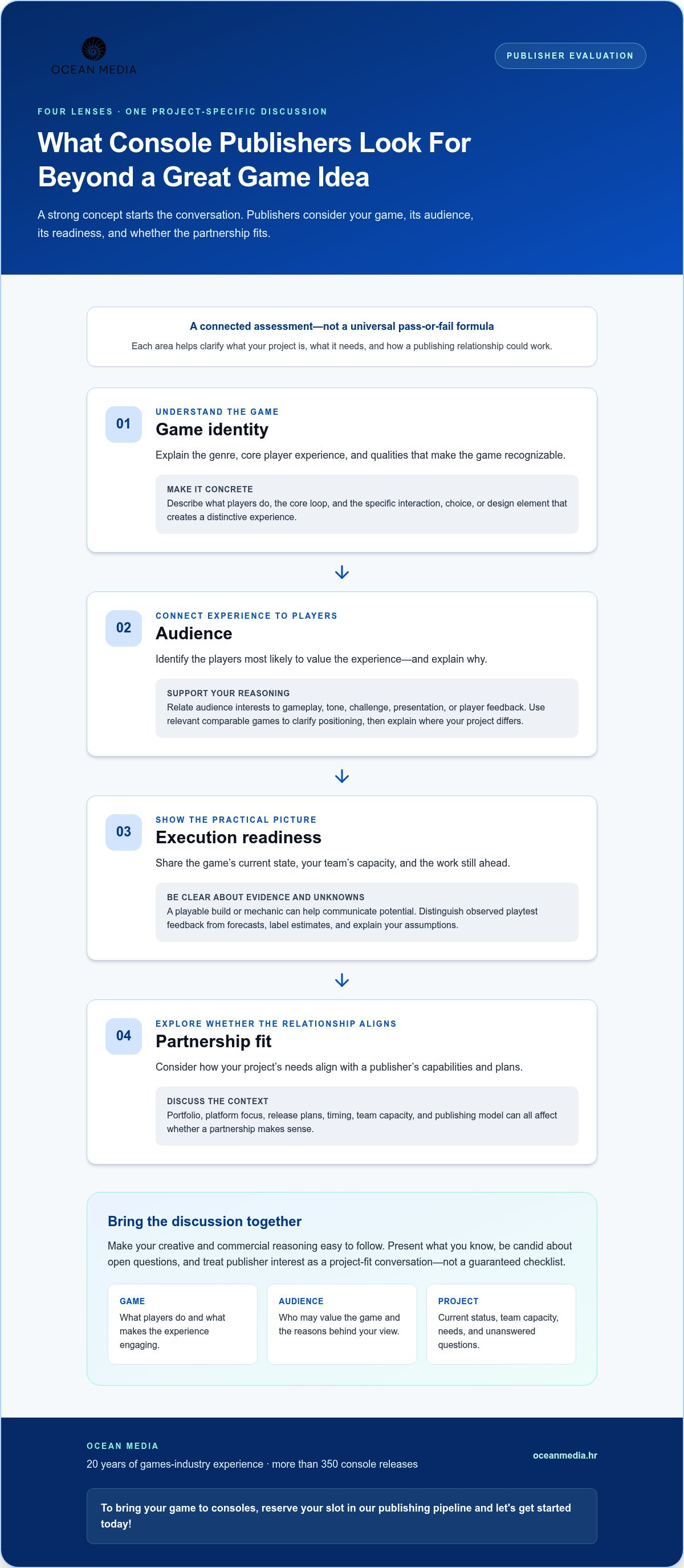
A memorable concept can open a conversation, but it doesn’t show by itself how a game will work as a console release. To understand what do console publishers look for, treat evaluation as a project-specific discussion rather than a universal pass-or-fail formula. Publishers consider the game’s creative identity, intended audience, execution readiness, and fit with the publisher’s capabilities and plans. The role of video game publishers can include support for commercial and release activities, so the conversation often extends beyond the concept.
These four areas work together. Each helps a publisher understand what your project is, what it needs, and how a publishing relationship could work:
- Game identity: The genre, core player experience, and qualities that make the game recognizable.
- Audience: The players most likely to value that experience and the reasons you believe they will.
- Execution readiness: The game’s current state, your team’s capacity, and the work still ahead.
- Partnership fit: Whether the project’s needs align with a publisher’s portfolio, platform focus, release plans, and publishing model.
A compelling concept describes a possibility. A persuasive publishing discussion connects that possibility to evidence, such as a playable mechanic, a clear player experience, or a thoughtful explanation of how the game serves its intended audience. You don’t need to claim certainty about future performance. You do need to make your creative and commercial reasoning easy to follow.
How a game’s identity helps publishers understand its potential
Start with a concise description of what players do and what makes that experience engaging. Name the genre, explain the core loop, and describe the game’s distinctive appeal in concrete terms. Instead of calling a game “unique,” point to a specific interaction, choice, or design element that creates a different experience.
Specific examples make your project easier to discuss. A publisher can better understand its positioning when you connect the creative identity to actual gameplay. If you’re preparing for digital console publishing, explain the experience you want players to have and how the design supports it. Keep the description clear enough for someone unfamiliar with the project to grasp its central appeal.
Why publisher interest is not a guaranteed checklist
Publishers assess projects in context. A game may fit one publisher’s portfolio but fall outside another’s current focus. Platform, timing, release plans, team capacity, and publishing model can all affect whether a partnership makes sense. Priorities can also shift as a publisher’s slate develops.
No single feature guarantees a deal. A strong concept, playable build, or defined audience can help communicate potential, but each is only part of the picture. Present what you know, be candid about open questions, and treat the conversation as a way to explore project fit, not as a test with a fixed answer key.
How Do Console Publishers Assess Audience and Market Fit?
Audience fit is the connection between the experience your game offers and the players most likely to value it. A publisher needs to understand not only who might play, but why the game’s mechanics, tone, challenge, and presentation matter to that group. If you’re asking what do console publishers look for, make your audience case specific and grounded in the game, rather than claiming it will appeal to everyone.
What to explain about your game’s intended audience
Describe likely players in practical terms: their interests, the kinds of play they enjoy, and what your game offers them. Then connect that picture to evidence, such as the gameplay, visual and narrative presentation, or player feedback you’ve gathered. If you have limited feedback, say so. A focused audience description is more useful than saying the game suits all ages, tastes, or experience levels.
Separate observation from prediction. You can describe what players did in a playtest or the feedback they shared, if you have that information. Forecasts about future demand, sales, or reach are estimates, not established results. Label them clearly and explain your assumptions. This helps a publisher assess your reasoning without mistaking an ambition for proven market evidence.
How comparable games can clarify positioning
Choose a few relevant comparable games to communicate genre conventions, player appeal, or the audience you have in mind. Explain the specific point of comparison, then say where your project differs. Comparisons can clarify positioning, but they don’t establish that your game will achieve similar commercial performance.
For example, you might compare a game’s perspective or core activity to a familiar title, then explain how its pacing, setting, or player choices create a different experience. Avoid relying only on high-profile successes. Explain why each comparison is relevant so the publisher can understand your intended audience without overstating the opportunity.
Market fit also involves the route to players. For a digital console release, storefront context can shape how you plan to categorize and present the game. That is a planning consideration, not a promise of featuring, visibility, or sales. Describe your intended positioning while recognizing that discovery depends on more than the pitch alone.
Publisher fit is part of this assessment: your project’s audience and positioning need to make sense alongside a publisher’s focus and release plans. For more on that relationship, see our developer publishing information. As you prepare, distinguish what you know from what you expect, and make the reasoning behind your audience and market choices clear.
What Signals Show a Game Is Ready for Console Publishing?
Readiness isn’t a single milestone or a universal threshold. A publishing conversation depends on what exists today, what remains to be done, and what kind of partnership could support the project. An early concept, a playable build, and a near-release game each provide different information. Be clear about your stage and describe next steps without presenting plans as completed work.
How project stage changes the publisher conversation
At the concept stage, explain the core experience, the intended direction, and what you’re working to validate. With a playable build, show how the game feels in practice and identify what is still evolving. Near release, focus on what’s complete, what remains outstanding, and how you’re preparing for launch. An unfinished game can still be discussed when you describe its status and open questions accurately.
For a useful project update, separate completed work, current priorities, and unresolved risks. Distinguish a feature that’s implemented from one that’s planned, or a confirmed production need from a possible future task. This gives a publisher a grounded view of progress and keeps the conversation focused on what the project needs next.
How to present production and console-release readiness
Summarize the people and capabilities behind the project, your development plan, and the areas where publishing support may help. Include practical details, such as who is responsible for production and what major work remains. You don’t need to frame every gap as a weakness. Clear disclosure helps both sides understand whether the project’s needs and a potential publishing relationship align.
Keep creative readiness distinct from platform submission and certification preparation. A game may have a clear creative direction while still needing platform-specific work. Requirements and submission processes can vary by platform and project, so a general development milestone does not guarantee approval. Plan certification as a dedicated workstream alongside production. For context on digital console publishing support, consider how submission guidance fits into the broader release plan.
As you prepare to discuss readiness, organize your information around questions a publisher can act on:
- Current build: What can someone experience now, and what is still in progress?
- Production plan: What are the next priorities, and who is responsible for them?
- Team capacity: Which capabilities are already covered, and where might support be needed?
- Console preparation: What platform submission or certification work remains to be planned?
This gives a publisher a practical basis for discussing scope, timing, and support without overpromising. If you’re weighing what do console publishers look for at different development stages, focus on evidence of progress and a realistic view of the work ahead. Readiness isn’t about pretending every task is finished. It’s about showing that you understand the path from your current build to bringing your game to consoles.
How Can You Prepare a Strong Console Publishing Pitch?
A focused pitch makes it easier to discuss your game, its current needs, and whether a publishing relationship could fit. Keep it concise and factual. Separate what’s already true of the project from assumptions and estimates so a publisher can understand both its potential and the work ahead. A clear pitch answers what do console publishers look for by showing how you think about the game as both a creative project and a console release.
What to include in a concise project overview
Build your overview in a logical order. Start with the player experience, then explain the intended audience, development stage, team capabilities, and practical support you’re seeking. Use specific details rather than broad claims, and label projections as estimates.
- Summarize the game. Describe its genre, core experience, and the defining activity or appeal players will encounter.
- Describe the audience. Identify the players you’re aiming to reach and connect that audience to the game’s experience and presentation.
- State the current stage. Say whether you’re at concept, playable build, or release preparation, and distinguish completed work from planned work.
- Outline the team and needs. Explain which capabilities your team brings and where you’re seeking publishing support for a digital console release.
- Prepare focused questions. Note what you want to understand about project fit, publishing responsibilities, and communication during the process.
How to discuss risks, questions, and project needs
Be direct about known challenges, such as work still required for a console release or areas where your team needs support. Give each issue context: what it affects, what you’ve done so far, and what remains uncertain. Don’t overstate or minimize the risk. Clear context helps everyone discuss the project realistically.
Keep questions specific and useful. You might ask how responsibilities are organized, how updates are shared, or how the publisher evaluates fit with its portfolio and plans. The goal is to understand how you could work together, not to present a perfect project with no open questions.
Take care with materials you send. Under Ocean Media’s terms, any question, idea, feedback, or other information submitted to the company assigns all intellectual property rights in that submission to Ocean Media, which may use it without acknowledgment or compensation. Review the applicable terms before sending confidential material or project content.
Once your overview is ready, explore Ocean Media’s developer publishing services as a next step toward bringing your game to consoles. If you’re ready to begin, reserve your slot in our publishing pipeline and let's get started today!
How Ocean Media Helps Developers Bring Games to Consoles
Knowing what do console publishers look for is useful, but turning a game into a console release also takes a clear plan for the publishing work ahead. Ocean Media provides digital publishing for developers across console platforms, including guidance through platform submissions and certification. With 20 years of games-industry experience and over 350 console releases, our team brings practical experience to conversations about project fit and release needs.
What an experienced digital publishing partner can bring
A publishing partner can help you understand the steps involved in a digital console release and how those steps relate to your project. Platform submissions and certification are distinct workstreams that need attention alongside development. The support your project needs depends on the game, its current stage, and your team’s requirements.
Ocean Media’s digital publishing work helps developers reach console audiences while supporting the publishing process. We start by understanding your game and goals, then discuss how publishing support can fit the work ahead. You bring the creative direction and knowledge of your team. Together, we can consider the practical route for bringing your game to consoles.
A useful starting overview can cover:
- Your game: Its core experience and current development stage.
- Your goals: The audience and console release you’re working toward.
- Your needs: The publishing or platform-process support you’re seeking.
- Your questions: The points you want to discuss about fit and next steps.
Start a conversation about your console publishing project
A clear project overview helps set up a focused conversation. Share what’s complete, what’s still in progress, and where you need publishing support. You don’t need to overstate readiness or predict results. An honest picture of the project gives us a practical foundation for discussing how our digital publishing work can align with your goals.
Ocean Media works with developers throughout the publishing journey, including navigating platform submissions and certification. Bring your overview and questions to our developer pathway so we can start with your project and the release goals you want to pursue.
reserve your slot in our publishing pipeline and let's get started today!
Take the Next Step Toward Your Console Release
The question “what do console publishers look for” can help you focus your next move: make your project’s current position and needs clear. You don’t need every detail resolved before starting a publishing conversation. A thoughtful overview gives you a practical place to begin, and open questions can become part of a productive discussion about your game’s direction.
As you consider a publishing partner, look for a shared understanding of your goals and the work involved in bringing your game to consoles. Ocean Media’s global developer network provides a collaborative context for exploring how digital publishing can support your project. Start with the information you have, be clear about what you’re working toward, and let’s take the next step together.
reserve your slot in our publishing pipeline and let's get started today!
Your game’s next chapter starts with a clear conversation. We look forward to exploring the possibilities with you.
Frequently Asked Questions
What do console publishers look for in an indie game?
For an indie game, what do console publishers look for? Publishers consider the game’s identity, intended players, development progress, and the publishing support it may need. Priorities vary by publisher. Make your pitch tangible: describe a moment of play that captures the game’s appeal, name the kind of player likely to enjoy it, and explain what supports that view. Be candid about remaining work instead of presenting an unfinished element as complete.
Do console publishers only consider finished games?
No. A game doesn’t always need to be finished before a publishing conversation can begin. The useful material depends on the project stage. For an early concept, explain what players will do and why the experience has a clear direction. If you have a playable build, identify what it demonstrates and what is still under development. This lets a publisher respond to the project as it stands, rather than to assumptions about its eventual form.
Do I need console development experience before approaching a publisher?
Not necessarily. A lack of prior console releases doesn’t by itself determine whether a project is a fit. Describe your team’s experience, such as shipping games on other platforms or managing production, and clarify which console-release areas are new to you. For example, note whether your team has planned platform submission work before. This gives a publisher a clearer basis for discussing how its expertise and publishing pipeline might complement yours.
What should I include when pitching a game to a console publisher?
Include a short game description, intended audience, current build or development stage, team overview, and the publishing support you’re seeking. Add relevant gameplay material if it’s available, and explain what it demonstrates rather than expecting it to speak for itself. Mark estimates as estimates, especially audience or commercial forecasts. This context helps a publisher understand your project and ask focused follow-up questions without relying on inflated sales claims.
Does a console publisher guarantee that a game will pass certification?
No. A publisher may help you navigate platform submissions and certification, but that support isn’t a guarantee of approval, a release date, or a particular review outcome. Treat certification as a distinct part of release preparation, taking platform requirements and project circumstances into account. In your discussions, distinguish guidance and process support from decisions made through platform review. That keeps expectations clear as you plan the work involved.
How do publishers evaluate a game’s commercial potential?
Publishers may consider how clearly the game is positioned, which players it is designed for, and how its genre and comparable titles help explain its place in the market. Use comparisons to clarify the experience, not to imply matching sales. For example, explain that your title shares a genre convention with a comparable game but has a different setting or play style. Separate observed player feedback from forecasts so estimates aren’t mistaken for proven demand.


