

A strong game pitch document template does more than describe your game. It clarifies the core experience, gives publishers a reason to continue the conversation, and shows how your team plans to deliver. Studying effective pitch decks can help you make a concept distinctive without overwhelming readers with detail.
A compelling idea needs more than enthusiasm to earn attention. Your pitch should explain the gameplay, establish your team’s credibility, and make the project’s current state easy to understand. This guide shows how to bring those elements together in a presentation that invites a productive conversation.
We’ll cover what to include, how to present your team and gameplay, and what notable pitch decks can teach you about structure and clarity. When you’re ready to take the next step toward a console release, Ocean Media provides digital console publishing support, including help with platform submissions and distribution.
Key Takeaways
- Shape your pitch around the game’s most distinctive ideas, with clear sections and concise, high-impact slides.
- Build developer credibility by showing relevant experience, team strengths, and a realistic plan for delivering the project.
- Study successful pitch decks for lessons in how to communicate a game’s identity and make its potential easy to grasp.
- Use a pitch build to demonstrate the core gameplay and the activities players will spend most of their time doing.
- When you’re ready to focus on bringing your game to consoles, reserve your slot in our publishing pipeline and let's get started today!
What does a successful game pitch deck look like?
A strong pitch deck makes your game’s identity, audience, and production plan easy to grasp. If you’re a newer developer, build a concise presentation that earns interest and opens a conversation, rather than trying to settle every detail at once.
-
Choose a Pitch Deck Structure
Start with a game pitch document template as a guide, then shape its sections around your project. A deck for a first game might move from the concept and core loop to visual direction, audience, team, and production plan. Keep each section focused, and use project-specific headers instead of forcing your game into a generic structure. A presentation commonly runs 10-15 minutes, so prioritize what supports the central idea.
-
Describe the Game’s Audience and Market
Define your target audience by their preferences and behaviors, then connect those traits to your game’s design. Describe the game’s place in the market through comparable genres or experiences, and explain what sets it apart. For example, you might identify players who enjoy tactical choices, then show how your game adds a distinctive setting or mechanic. Avoid unsupported market-size claims. A clear account of audience fit is more useful than an unsubstantiated number.
-
Set Out Budget, Schedule, and Team
Present the budget, schedule, and team responsibilities clearly. Show how the funding you’re seeking relates to development needs, which milestones it would support, and who is responsible for key work. Briefly describe relevant team experience, such as shipped projects or specialist skills. Keep estimates consistent across slides, and don’t present a publisher’s investment or a release date as secured unless it is.
-
Avoid Common Deck Mistakes
Remove details that distract from the game’s defining experience. Dense paragraphs, inconsistent art direction, unexplained jargon, and unsupported claims make a pitch harder to assess. Choose distinctive images that convey the intended mood, and use a clear example to explain unfamiliar mechanics. Check that every slide supports the same central idea. The deck should invite follow-up questions, not bury its strongest point beneath production history or long feature lists.
-
Make the Presentation Interactive
Use an interactive pitch deck template only when clickable elements genuinely help explain the game. A link to a prototype or gameplay clip can give publishers a direct view of the experience, but label it clearly and include a concise explanation in the slides. Treat the deck as a guided presentation, not a menu of unrelated links. Test every interactive element before sharing, and make sure the core pitch remains clear without it.
Establishing developer credibility
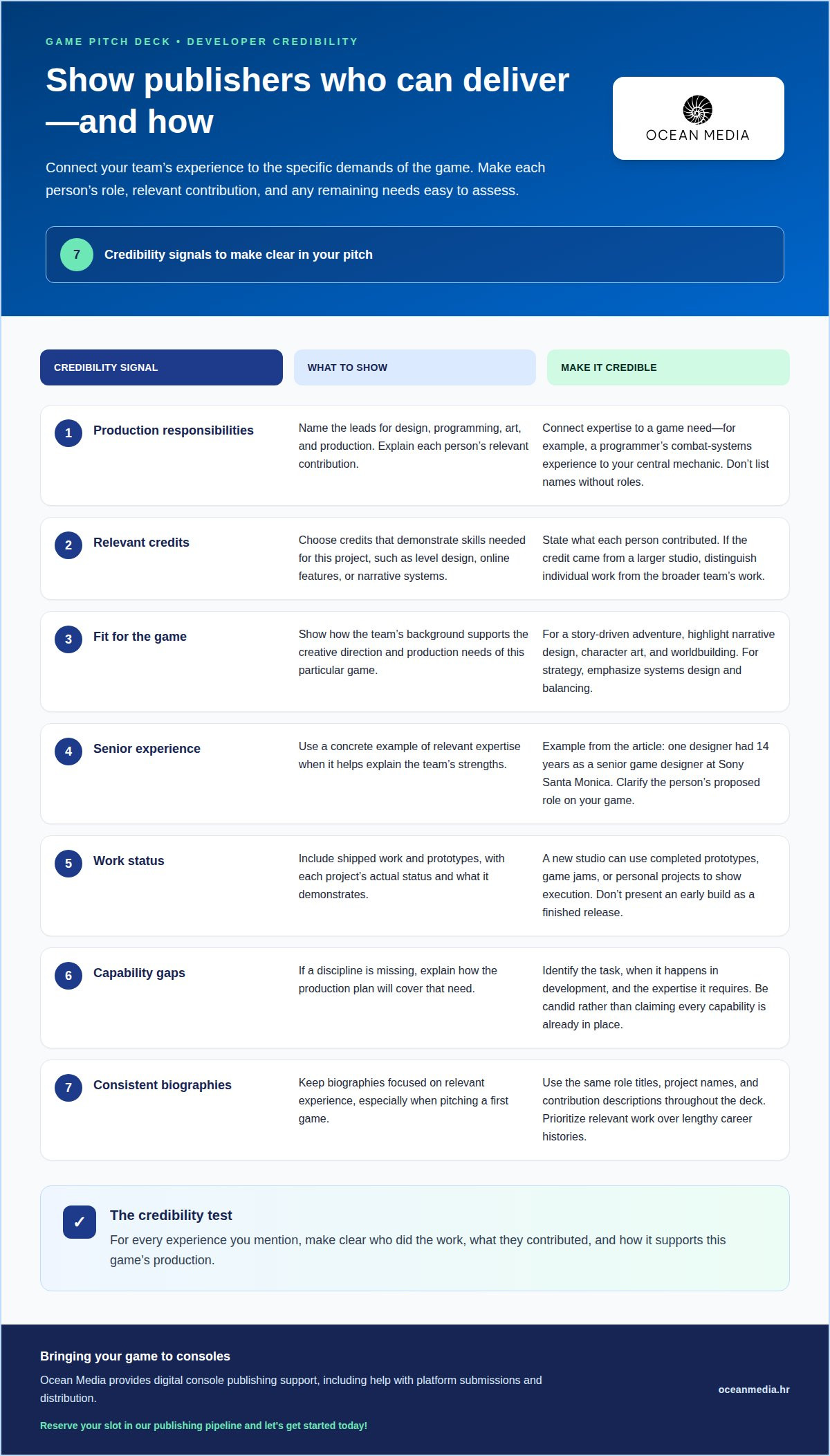
Build credibility by connecting your team’s experience to the demands of this particular game. Publishers need to know who can deliver each major part, how their experience applies, and where the project still needs support.
- Assign each key production responsibility to a team member. Name the leads for design, programming, art, and production, then explain their relevant contributions. For example, connect a programmer’s experience with combat systems to your game’s central mechanic. Avoid listing names without roles. A concise responsibility map shows how your team’s capabilities support the proposed experience.
- Choose credits that demonstrate relevant skills, not just recognizable titles. Explain what each team member contributed, such as level design, online features, or narrative systems. If a credit came from work at a larger studio, distinguish the individual’s contribution from the broader team’s work. That context helps publishers assess experience without overstating ownership or responsibility.
- Show how your team’s background fits the project’s creative direction. A team pitching a story-driven adventure might highlight narrative design, character art, and worldbuilding. A strategy game team could emphasize systems design and balancing. Link each example to a production need so your credentials demonstrate project fit rather than read like a detached biography.
- Include a concrete example of senior experience where it helps explain your team’s strengths. One designer’s career included 14 years as a senior game designer at Sony Santa Monica. Use examples like this to establish relevant expertise, while clarifying the person’s proposed role on your game. A résumé detail matters most when publishers can see how it applies.
- Describe shipped work and prototypes accurately. Label each project’s actual status, then explain the contribution and what it demonstrates. If your studio is new, completed prototypes, game jams, or personal projects can show your ability to execute. Don’t imply that an early build is a finished release. Clear context helps publishers assess progress fairly.
- Address gaps with a practical plan. If your team lacks experience in a discipline, explain how the production plan will cover that need. Identify the task, when it occurs in development, and the expertise it requires. Don’t claim that every capability is already in place. A candid account shows you understand the work ahead and have considered how to deliver it.
- Keep biographies focused and consistent across the deck. Use the same role titles, project names, and contribution descriptions throughout. For a first game, prioritize relevant work over lengthy career histories. If you’re preparing for console release, explore developer publishing support as part of planning your next steps.
Examples of game pitch decks
Study real decks for decisions you can adapt, not layouts to copy. Each example connects its pitch to a particular game, studio, and publishing moment.
- Use the BioShock pitch deck to examine how a pitch can support a publishing conversation. It helped secure a publishing deal for the game in 2002. Focus on the relationship between the game’s identity and the material presented. Ask what a publisher would need to understand from each slide, then apply that clarity to your own project. Remember, the value lies in the example’s communication choices, not in reproducing its visual style or claims.
- Compare the Backbone pitch deck with Egg Nut’s publishing outcome. Egg Nut used the deck in 2019 to secure a publishing deal with Raw Fury. Note the named studio, game, and publisher as part of the example’s context. When reviewing the slides, consider how a pitch can make a project legible to a specific audience. Don’t assume the same format will produce the same outcome for another game or team.
- Look at the Diablo pitch deck as an example tied to an early franchise milestone. Blizzard North created the deck in 1994 as part of securing a publishing deal for the first game in the series. Separate the historical context from the general lessons. Identify how the pitch frames a game idea, then ask which parts would still help a publisher understand your project today. Avoid treating an older deck as a current production checklist.
- Review the Baldur’s Gate 3 pitch deck example with its date in mind: 2023. Use it to study how a contemporary project can be presented, but keep your analysis specific to what the example shows. Note the sequence of information, visual hierarchy, and how each slide contributes to the presentation. Then map those choices against your own game’s needs. A polished reference can inspire structure without dictating your content.
- Turn your observations into a practical comparison. Create a short table with columns for game, studio, date, pitch purpose, and one presentation choice worth studying. Add BioShock, Backbone, Diablo, and Baldur’s Gate 3 as separate entries. Mark which ideas support your game’s concept, team, or build, and discard the rest. This step keeps your research focused on decisions rather than collecting slides for their own sake.
Finally, compare the examples’ purposes before borrowing their approaches. BioShock and Diablo are connected to publishing deals, while Backbone’s use is tied to Egg Nut’s deal with Raw Fury. Baldur’s Gate 3 provides a dated reference point. These distinctions matter: a pitch deck should serve your own project and conversation. Use examples to sharpen your editorial choices, then build a presentation that reflects your game rather than someone else’s history.
Pitch builds and core gameplay
Pair one or two distinctive illustrations with a build that demonstrates the core gameplay. Show what players will actually do instead of relying on description alone.
-
Prepare Pitch Builds
Shape the build to show what the game should feel like 12-24 months before release. Prioritize the activities players will perform 90% of the time, such as movement, combat, or puzzle-solving. A short, focused sequence gives publishers a direct view of the intended experience. Avoid adding unfinished systems that distract from the game’s defining loop.
-
Add Visuals and Prototype Materials
Choose one or two distinctive, appealing illustrations and use them to clarify the game’s visual direction. Pair them with prototype materials that show a real interaction, such as a short playable encounter or a clear gameplay sequence. Label concept art and prototype footage accurately, so viewers can tell the intended look from the current gameplay.
- Build the demo around one representative player journey. Start with a clear objective, show a meaningful choice, then reveal its result. For example, a stealth game might show the player scouting, choosing a route, and escaping after detection. This sequence makes the core loop and its connections easier to understand without a lengthy explanation.
- Make the opening moments easy to follow. Add a brief instruction screen or spoken introduction to explain the controls and objective. Remove setup steps that don’t support the demonstration. If viewers need to understand a special mechanic, introduce it through play and show how it affects the next decision. Interaction should communicate how the game feels.
- Prepare a reliable route through the build before presenting it. For a linear game lasting longer than about 20 minutes, save states mapped to F1-F10 can help you reach key moments quickly. Test each state and confirm it resumes at the intended point. Avoid relying on a long, unskippable opening when the important gameplay appears later.
- Match the materials to the intended platform and the pitch’s central claim. If the pitch emphasizes responsive combat, demonstrate the controls and feedback. If it highlights exploration, show how players discover points of interest. Keep the build, illustrations, and spoken explanation consistent, so each element supports the same experience rather than suggesting different versions of the game.
How long should a game pitch document be?
Keep the pitch as short as possible while providing enough context for publishers to understand the game. Choose the length based on the presentation, not the number of sections in a template.
- Set a clear time limit before drafting. A game pitch presentation usually lasts no longer than 20 minutes, so plan only the material you can explain within that window. A concise deck helps the audience follow the idea without racing through every detail. Treat each slide as support for what you’ll say, not as a script packed with full paragraphs.
- Use 10-15 slides as a practical reference for a typical game pitch deck. A template designed for 15-20 high-impact slides may provide additional prompts, but that doesn’t mean every slide belongs in your final presentation. Select the slides that make your concept, gameplay, team, and production plan clear. Remove sections that repeat information or distract from the game’s central appeal.
- Distinguish a reusable template from a finished deck. One video game pitch deck template contains 24 slides, while another reference describes a typical deck as 10-15 slides. That difference shows why a template’s slide count shouldn’t dictate your final length. Use a template as a guideline, then tailor the structure to the decisions your presentation needs to support.
- Give each slide one main point. For example, dedicate a slide to the core loop instead of combining mechanics, story, audience, and features in dense text. If a section needs a lengthy explanation, simplify the message or move supporting details to an appendix. Use project-specific section headings, and don’t add slides just to make the deck feel comprehensive.
- Rehearse the full presentation with the planned build or demo. If the walkthrough runs long, shorten it to the gameplay that best represents the experience. A pitch should spark interest and further conversation, not exhaust every topic or secure a contract on the spot. Leave time for discussion, and prepare additional details for follow-up.
- Use slide count as an editing tool, not a measure of quality. A 16:9 widescreen format can help organize a presentation visually, while editable templates make rearranging content easier. Keep the final file focused on your game, even if the starting template has more slides. To plan the next steps for bringing your game to consoles, reserve your slot in our publishing pipeline and let's get started today!
Ocean Media: Console Game Publishing
Ocean Media provides digital console game publishing for developers preparing to bring their games to consoles. Once your pitch and build communicate the game’s direction, Ocean Media can help with the technical and administrative complexities of console platform submissions. The company also specializes in digital distribution across console platforms, helping developers reach a global audience.
If you’re moving from a publisher-ready pitch toward a console release, consider whether support with submissions and distribution fits your next step. Contact Ocean Media to discuss bringing your game to consoles, reserve your slot in our publishing pipeline and let's get started today!
Turn your pitch into a path forward
Your pitch starts a partnership conversation; it doesn’t finish one. Use the responses to identify your studio’s next decision, whether that means refining the project’s direction or preparing for a console release. A clear game pitch document template can help keep the discussion focused as the project develops.
When bringing your game to consoles becomes the next priority, Ocean Media provides digital Console Game Publishing. Discuss how console publishing fits your project and what steps could move it toward release. A direct conversation can help you move from presenting your idea to planning what comes next.
Contact Ocean Media to discuss your game pitch and explore a practical next step for your game. Your creative vision deserves a clear route toward its next audience. Let’s take that step together.
Frequently Asked Questions
What sections should a game pitch document include?
Include the information a publisher needs to understand the project and its production context. Along with the concept, gameplay, audience, team, and schedule, add a concise project-status section. Explain what exists now, what remains in development, and what decision or support you’re seeking. For example, distinguish a playable prototype from planned features. This helps readers assess the pitch accurately and identify useful follow-up questions.
Is there a free game pitch document template to download?
A free game pitch document template can provide a starting structure, but the finished pitch should reflect your project. Before using a file, check whether its sections suit your game and whether you can edit the layout. You can also create a simple document with project-specific headings and concise supporting material. Keep a working copy separate from the presentation version so revisions don’t disrupt the final deck.
What information should a game pitch include about gameplay and core loop?
Describe the player’s recurring actions and the choices that make them meaningful. For example, a crafting game might show how players gather materials, make equipment, and use it to reach new areas. Explain what starts the loop, what changes during play, and what rewards continued engagement. A short sequence of screenshots or a prototype capture can clarify transitions that are hard to explain in text alone.
How do you create a game pitch deck for publishers?
Start with the publisher’s decision: what should they understand or discuss after the presentation? Arrange the material to answer that question, then remove slides that don’t support it. Use consistent project names, readable labels, and a clear distinction between completed work and plans. Before sharing, open the deck on another device and test any embedded media. A presentation that works without special setup keeps attention on your game.
What do game publishers look for in a pitch document?
Publishers need to assess whether the concept, team, and production plan form a coherent project. Clarify the intended player experience, explain why your team fits the work, and show how the project could progress from its current state. Be specific about what you want the publisher to discuss. A focused request gives the reader a practical starting point for considering next steps.
What common mistakes should you avoid in a game pitch?
Don’t present planned features as finished, make impressive claims without evidence, or describe the game differently from slide to slide. If the project-status slide says a mode is playable, the build should demonstrate it. Replace unexplained abbreviations with plain language, and remove artwork that suggests a visual direction the game doesn’t support. A final consistency check can catch mismatched names, labels, and project details before you present.


