

Your game description isn’t a lore summary; it’s a clear promise of what players will get to do. For studios, writing a compelling game description for console starts with the experience at the heart of the game: the choices, challenges, and moments that set it apart.
It’s tempting to squeeze every feature and story detail into the copy. But players need a quick, accurate sense of whether the game is for them. Lead with the core experience, then support it with specific gameplay features and concise, action-oriented language. Every claim should reflect what the game actually offers.
This guide will help you describe the player experience, choose details that show your game’s value, and keep the copy focused without losing its personality. We’ll also cover how accurate, easy-to-skim messaging can support your console launch. When you’re ready to move from description to release, Ocean Media’s Console Game Publishing can help with digital console publishing and platform submissions. Get in touch to discuss your game.
Starting Console Publishing
- Start bringing your game to consoles with a clear first step and a structured publishing path.
- Follow our publishing pipeline to navigate the technical and logistical steps of console publishing.
- We’ll help you understand what comes next, making it easier to begin the process.
- Work with our team for support as you move through each stage of the publishing pipeline.
- When you’re ready to bring your game to consoles, reserve your slot in our publishing pipeline and let's get started today!
Communicating the player experience and value proposition
Start with the player’s central reason to choose your game, then make that promise easy to find. The Centers for Medicare & Medicaid Services notes that metadata descriptions may appear in search results after users enter a search term.
Open With a Targeted Hook
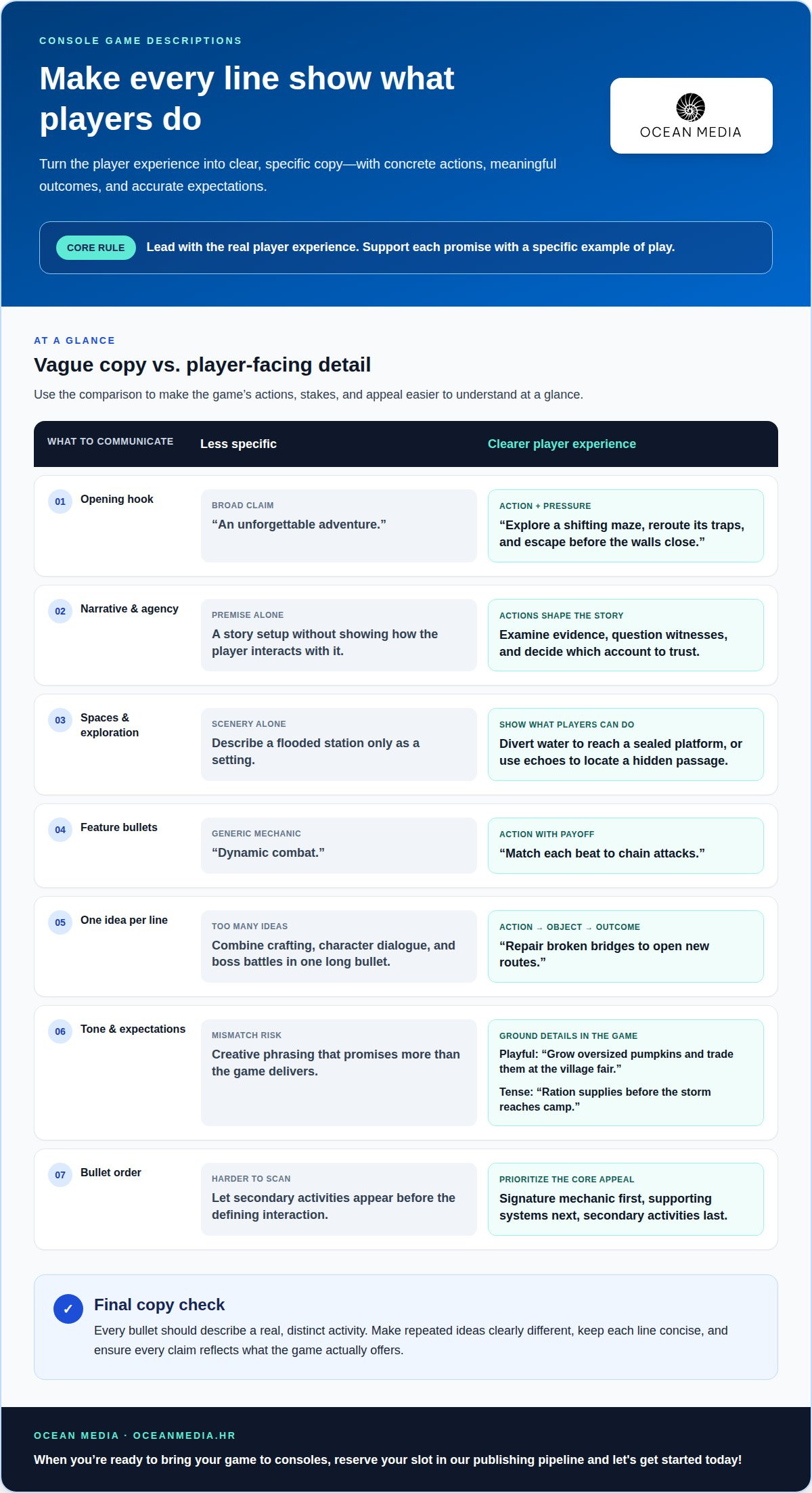
Lead with the game’s defining action and intended audience, not a broad claim such as “an unforgettable adventure.” For example, “Explore a shifting maze, reroute its traps, and escape before the walls close” signals exploration, puzzles, and pressure. Check that the opening reflects the actual play experience, and avoid promising an appeal the game doesn’t deliver.
Describe the Narrative and Player Experience
Translate the premise into what players do and how those actions shape the story. A detective game might invite players to examine evidence, question witnesses, and decide which account to trust. That sequence communicates both narrative and interaction. Keep lore in service of the player’s experience; a kingdom’s history matters less than the choices players make within it.
- Show how the game’s spaces support play. If players explore a flooded station, name a meaningful interaction: they might divert water to reach a sealed platform or use echoes to locate a hidden passage. Describe spaces through their opportunities and obstacles, not scenery alone. This helps readers picture how exploration works and what they can accomplish.
- Clarify the relationship between the player-character and the player’s decisions. In a strategy game, the character might command a small crew, while the player chooses which route to take and which risks to accept. Distinguish the character’s role from the player’s agency. That makes the game’s appeal more specific than simply calling the hero powerful or the story emotional.
- Connect each promise to a concrete example of play. Replace “a world full of secrets” with “search abandoned cabins for clues that reveal who changed the map.” Use the game’s actual actions, stakes, and setting to establish its identity. Then consider the intended audience: a tactical challenge should sound tactical, while a relaxed building game should foreground creation and experimentation.
Using gameplay feature bullet points
Use feature bullets to make a game’s defining interactions easy to scan. Each line should pair a clear player action with a reason it matters.
- Choose features that distinguish the play experience. Start with the mechanics players will use repeatedly, not every system in the design document. For a rhythm-action game, “Match each beat to chain attacks” communicates an interaction and its payoff. A generic phrase like “dynamic combat” provides less useful information. Choose details that show what makes the gameplay distinctive.
- Build each bullet around one player-facing idea. A useful pattern is action, object, outcome: “Repair broken bridges to open new routes.” That shows what players do and what changes. Avoid combining unrelated features, such as crafting, character dialogue, and boss battles, in one long bullet. Separate ideas so readers can scan for the features they value.
- Use language that matches the game’s tone. A playful farming game can say, “Grow oversized pumpkins and trade them at the village fair.” A tense survival game might say, “Ration supplies before the storm reaches camp.” Both lines describe actions, but their verbs and details set different expectations. Keep creative phrasing grounded in mechanics players will encounter.
- Order bullets by importance to the intended audience. Put the signature mechanic first, then supporting systems, then secondary activities. For a co-op platformer, the sequence might highlight coordinated jumps, shared puzzle-solving, and unlockable outfits. This gives readers the core appeal before optional details. Keep each line focused so a quick scan still reveals the game’s main draw.
- Review the list for clarity, repetition, and scanability. If two bullets both promise exploration, make their distinction explicit: one could describe uncovering hidden paths, while another explains using found tools to reach them. For teams writing a compelling game description for console storefronts, concise bullets make each feature easier to assess. If you’re preparing copy alongside console release planning, explore our developer publishing resources.
A useful final test when writing a compelling game description for console players is whether every bullet describes a real, distinct activity. Remove any line that repeats another feature or promises more than the game delivers.
Preparing for Console Publishing
Bringing your game to consoles starts with a clear plan. PlayStation, Xbox, and Nintendo Switch have different submission processes, so prepare for each platform’s requirements. We’ll help you follow a structured path, from reviewing what each submission requires to preparing your materials and getting your release ready.
Start with Your Release Plan
Begin by identifying the platforms you’re targeting and the work needed to prepare your game for release. We’ll help you organize the next steps, clarify what needs to be ready, and keep your team focused on the requirements for each platform. With a clear plan, you can move forward without having to figure out the process alone.
Prepare for Each Platform
Review each platform’s current submission specifications before preparing your release materials. Keep track of the requirements for PlayStation, Xbox, and Nintendo Switch, and adapt your preparation for each one instead of assuming a single process fits all three. Check the required fields and stated limits, and confirm the details for each submission as you go.
- Start with a shared checklist of the work involved in preparing your console release. Note the platforms you’re targeting and the requirements you need to address for each. We can help you organize the process into clear steps, so you know what to focus on first and what comes next.
- Gather the information and materials needed to prepare your submission. Keep your game’s key details together, then review what each platform requires. This gives you a clear view of what’s ready and what still needs attention before you move forward.
- Work through platform requirements one at a time. If a submission needs adjustments for a particular platform, record them and update your materials accordingly. We’ll help you spot gaps, keep the process moving, and make the technical and logistical steps easier to manage.
- Prepare a platform-specific version after confirming its requirements. Keep a simple comparison document with one column per platform and one row per task or submission field. It makes missing or mismatched information easier to spot and helps your team track progress before submission.
- Do a final review of your release preparations. Check that you’ve addressed the requirements for each platform and know what remains before submission. Our team can support you through the process, giving you a structured path for bringing your game to consoles. Reserve your slot in our publishing pipeline and let's get started today!
Descriptive, action-oriented game copy
For console storefront listings, use short paragraphs, active verbs, and clear formatting that’s easy to scan. Lead with the game’s premise, then show its distinctive actions through specific examples.
For example: “Track a stolen signal across a frozen colony. Decode transmissions, repair your rover, and uncover who went silent.” This illustrative copy pairs context with actions instead of relying on broad claims.
- Start each sentence with a playable action. Choose verbs that show what players do, such as track, build, negotiate, or escape. In the Don’t Starve description example, three of its four descriptive sentences start directly with action words. Use that pattern as an editing test, not a formula that overrides your game’s voice.
- Pair action with consequence. “Redirect the river to expose a buried temple” tells readers more than “solve environmental puzzles.” The verb shows the interaction, while the result gives it purpose. For a racing game, “Tune your engine to handle tight mountain turns” links customization to a clear gameplay challenge.
- Make each detail specific and readable. Aim for a fifth-grade reading level so players can skim without decoding jargon. Replace “utilize traversal mechanics” with “swing between rooftops.” Keep specialized terms only when they help explain the game, such as naming a distinctive resource or move and showing how players use it.
- Balance atmosphere with activity. Give readers a strong image, then connect it to play. “A storm is swallowing the city” sets the scene; “salvage parts and power shelters before nightfall” explains the player’s role. Avoid passive phrasing like “the city is explored by you.” Active sentences keep the player at the center.
- Compare the draft with the actual game. Mark each action verb, then confirm the game lets players perform that action. If the copy says “forge alliances,” show a meaningful choice involving another character. If it promises stealth, describe the relevant approach, such as avoiding patrols or using cover. Remove vivid phrases that imply mechanics the game doesn’t deliver.
- Read the copy aloud and refine its rhythm. Alternate a brief premise sentence with a more descriptive action sentence. For example, follow “The moon is breaking apart” with “Pilot between falling fragments and recover the lost navigation cores.” Cut repeated adjectives and clauses that delay the player’s next action. Keep the final wording clear, energetic, and faithful to the experience.
Keeping claims about features accurate
- Map every claim to evidence in the game. Match each description sentence with a gameplay feature, current build, or approved design detail. If the copy promises branching choices, identify a real decision and its consequences. If it says “build any vehicle,” confirm that players can do so without that restriction. Remove wording that stretches a limited feature into a broader promise.
- Separate released features from future plans. Describe what players can experience in the version being promoted. If a draft says “explore new regions,” confirm those regions are included in the planned release, not merely a possible update. Don’t present roadmap ideas as available content. A clear distinction prevents the description from promising a feature players can’t access.
- Give feature claims precise boundaries. Words such as “endless,” “fully customizable,” and “every choice matters” imply broad possibilities. Replace them with supportable specifics. For example, “customize your ship’s engine and armor” sets a clearer expectation than “build anything.” Check whether modifiers, limits, or locked options change what a claim means.
- Verify multiplayer and player-count language carefully. A phrase like “team up with friends” signals multiplayer, while “shared-screen co-op” describes a particular format. Use only terms that match the actual mode. Confirm which activities support it, then avoid implying that every mission or feature works the same way. Precise wording helps players understand what playing together means.
- Review claims with the people closest to the feature. Ask the design or production team to connect each technical phrase to a real game behavior. For “adaptive enemies,” for instance, confirm what changes during play and what triggers it. Playtest feedback and market research can also help identify language players understand. Keep the final wording clear without overstating what those details mean.
- Run a final claim-by-claim edit before submission. Highlight promises about content, modes, progression, and customization. For each one, record the supporting feature and revise any wording that goes further. Check that the description matches the build and the store copy prepared for release. To align accurate messaging with the next steps for bringing your game to consoles, reserve your slot in our publishing pipeline and let's get started today!
Ocean Media: Console Game Publishing
Ocean Media supports developers preparing to bring their game to consoles through Console Game Publishing. Turn to the team when your title is ready for the technical and administrative work involved in console platform submissions. Digital publishing across console platforms can help your game reach a global audience, while a clear store description gives players an accurate first impression.
Your description and publishing preparation serve different roles: one communicates the player experience, the other supports the release process. Keep both aligned with the game you’re bringing to market. Contact Ocean Media to discuss your console publishing needs, reserve your slot in our publishing pipeline and let's get started today!
Carry your game’s promise into its release
As you prepare for launch, treat writing a compelling game description for a console title as part of your release preparation. The copy can give players a first point of connection with your game and help your team keep its positioning consistent across storefront materials. Give the description a clear owner and revisit it when the game or release plans change.
That alignment matters as your studio moves from creative development toward bringing your game to consoles. Ocean Media offers Console Game Publishing for developers preparing that next step. A publishing partner can help you navigate the technical and administrative complexities of console platform submissions, so your team can focus on presenting the game accurately.
When you’re ready to discuss your game and its console release, contact Ocean Media, reserve your slot in our publishing pipeline and let's get started today! Your next step can be a clear conversation about your publishing goals. Move forward with confidence and keep your game’s value at the center.
Frequently Asked Questions
Where do you start?
Start by sharing your game and your console release goals with our team. You don’t need to have every technical or logistical detail figured out before reaching out. We’ll learn about your project, discuss what support you need, and help you identify the next steps for bringing your game to consoles. This gives you a clear starting point and a structured path into the publishing process.
What does the console publishing process involve?
Our publishing pipeline gives you a structured path from getting started to preparing your console release. We’ll work with you to understand your needs, map out the process, and help you navigate the technical and logistical work involved. You’ll know what to focus on next, so you can keep moving toward your release without having to plan every step alone.
How soon can you start?
You can start by reserving a slot in our publishing pipeline and telling us about your project. We’ll help you understand the process and the support available for your release. You don’t have to wait until every part of your game or plan is final to begin a conversation. Getting started early gives us a chance to work together on a clear path for bringing your game to consoles.
What information should you have ready?
Be ready to tell us about your game, your goals for a console release, and the areas where you’d like support. If you already have questions about technical or logistical requirements, bring those too. You don’t need a complete release plan to take the first step. We’ll use what you share to understand your needs and help you work out what comes next.
What support is available to developers?
We help developers with the technical and logistical aspects of console releases. The support you need will depend on your project and goals, so we’ll start by learning what you’re working on and where you need a partner. Together, we can identify the next steps and follow a structured publishing pipeline, making it easier to navigate the transition into a professional console release.
How do you prepare for a first conversation?
Think about what you want to achieve with your console release and which parts of the process feel unclear. You can also share your current stage and any questions you have about bringing your game to consoles. There’s no need to prepare a polished pitch before reaching out. We’ll help you focus the conversation, understand your options, and find a practical way to get started.
How will you know what to do next?
We’ll work with you to clarify your needs and outline a structured path through the publishing process. You can ask questions as they come up, and our team will help you understand the technical and logistical steps ahead. Rather than figuring out the console release process on your own, you’ll have a partner to help you keep moving toward your goals.
How do you get started with our publishing pipeline?
Take the first step by reserving your place in our publishing pipeline. Share a little about your game and the support you’re looking for, and we’ll help you get oriented and move forward. Bringing your game to consoles can feel more manageable with a clear process and a partner by your side. reserve your slot in our publishing pipeline and let's get started today!


