

A certification-ready build comes from repeated testing, not a last-minute submission. To understand how to pass Sony TRC, start with Sony’s Technical Requirements Checklist and treat compliance as an iterative process that depends on QA and clear communication with management. Begin testing during alpha so your team can find and address issues before they put launch plans at risk.
It’s easy to focus on the final submission, but preparation throughout development makes that milestone more manageable. Each round of testing can reveal gaps in functionality, documentation, or platform-specific behavior while there’s still time to respond.
This guide explains how to identify the requirements relevant to your console release, organize submission materials, and build internal simulations around key gameplay and system scenarios. You’ll also learn how to structure QA reviews and plan for regional certification stages, with a practical path from development testing to submission.
Key Takeaways
- Map the applicable TRC requirements to your game and target regions before preparing a submission build.
- Build internal tests around save logic, suspend and resume behavior, and controller or network interruptions.
- Use iterative QA reviews and clear team communication to identify issues while there’s time to address them.
- Organize your submission materials alongside testing so your team can track findings and prepare each review.
- Plan for regional certification stages and keep compliance testing part of development, not just a final release check.
Sony TRC requirements and console certification
Sony TRC is the Technical Requirements Checklist for a PlayStation game submission, not a personal certification exam. Prepare through iterative build testing, clear QA records, and regular communication between QA and management.
-
Review Certification Requirements and Topics
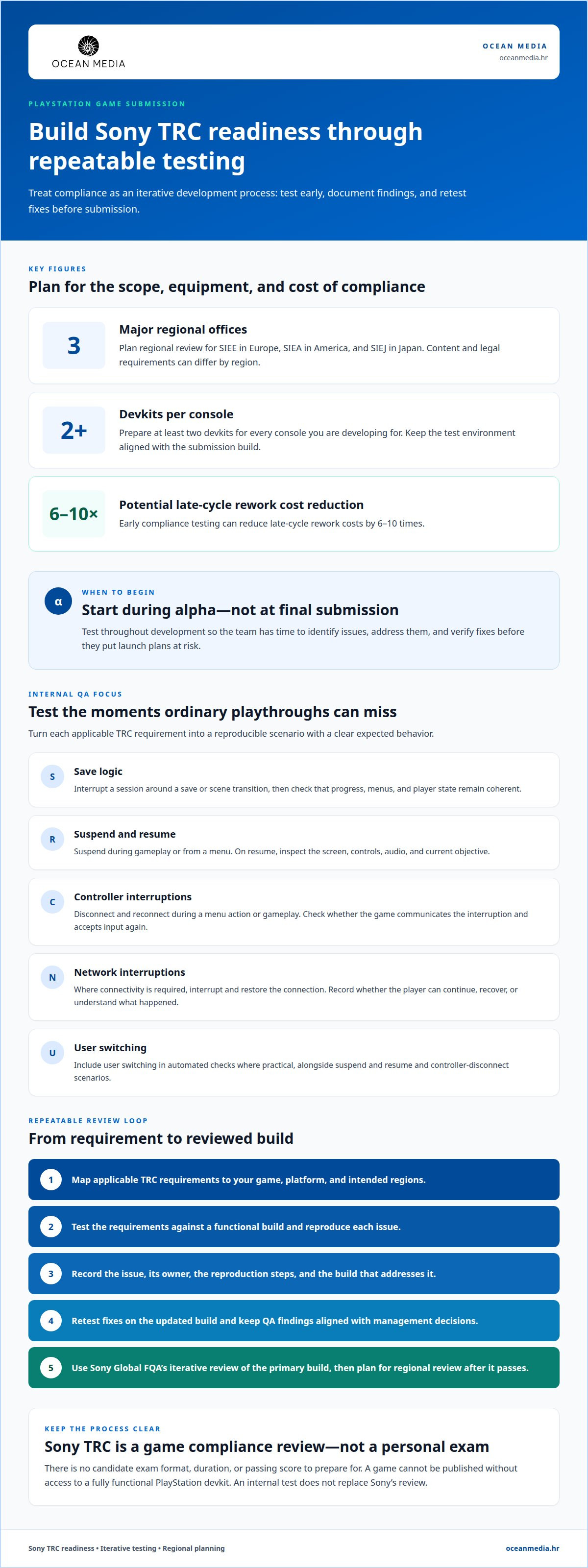
Start by mapping the Technical Requirements Checklist to your game, platform, and intended regions. Sony TRC testing is iterative, so record each issue, who owns it, and which build addressed it. Test save logic, suspend and resume, and controller or network interruptions during development. These scenarios can reveal problems that ordinary playthroughs miss.
Plan regional review as part of the submission path. Sony Interactive Entertainment has three major regional offices: SIEE in Europe, SIEA in America, and SIEJ in Japan. Content and legal requirements can differ by region. For example, console games must adhere to data laws such as GDPR and platform-specific data mandates, according to the European Union. Regional requirements and review facilities may therefore affect submission planning.
-
Understand the Exam Format and Rules
Prepare a functional game build and test it against the applicable TRC requirements. Sony TRC is a game compliance review, not an individual exam, so there is no candidate exam format, duration, or passing score to prepare for. A game cannot be published without access to a fully functional PlayStation devkit. Plan access for the platform you are developing for, and keep the test environment aligned with the submission build.
No exam identification or personal items apply to this process. The relevant materials are the game build and the technical information needed to review it. Testing depends on how the title behaves against the requirements, not on a developer bringing exam materials to a test location. Don’t treat a successful internal test as a substitute for Sony’s review.
-
Prepare for the Certification Exam
Begin compliance testing during alpha rather than waiting for feature freeze. Assign QA owners to requirements, record reproducible steps for each issue, and retest fixes on the updated build. Prepare at least two devkits for every console being developed for. Automate suspend and resume, user switching, and controller-disconnect scenarios where practical, then include network interruptions and save logic in manual checks.
Use each test cycle to resolve specific failures before submission. For example, reproduce a save issue, document its conditions, verify the fix, and retest affected scenarios. Late changes can create rework; early compliance testing can reduce late-cycle rework costs by 6-10 times. Keep QA findings and management decisions aligned throughout the process.
-
Check Results and Retake Options
Track build feedback through Sony Global FQA’s iterative review of the primary build. After it passes, developers are most likely to submit copies to regional facilities. This is a game certification workflow, not an individual result portal or personal certificate exam. Use each review outcome to identify remaining requirements, assign fixes, and prepare the next build.
There is no exam retake count or candidate exam fee in this process. A failed or incomplete build instead goes through further testing and revision; the work depends on the issues found. Requirements and regional review can differ across SIEE, SIEA, and SIEJ, so organize builds and findings around the intended release regions.
What topics and skills are covered on the Sony TRC?
Use the Technical Requirements Checklist as a framework for testing game behavior, not as an individual exam syllabus. Focus QA on repeatable scenarios that can expose problems during gameplay and system transitions.
- Turn each applicable requirement into a testable game scenario. A checklist item is useful when QA can reproduce the behavior, record the result, and link any issue to a specific build. Make the expected behavior clear to the team. This turns review findings into actionable tasks instead of leaving developers to interpret a vague failure report.
- Test save logic during ordinary play and interruptions. For example, save progress, interrupt the session, then resume and confirm the game restores a coherent state. Check what happens if a save begins near a scene transition. Record whether progress, menus, and player state remain consistent after the interruption.
- Test suspend and resume as a lifecycle, not just a button press. Suspend during active gameplay, then resume and inspect the screen, controls, audio, and current objective. Repeat from menus and other meaningful game states. This helps QA find situations where the game returns but no longer responds as players expect.
- Simulate controller interruptions during active play. Disconnect a controller during a menu action or gameplay sequence, then reconnect it and observe the result. Check whether the game clearly communicates the interruption and accepts input again. Record the precise sequence, because timing and the current game state can affect reproduction.
- Test network interruptions wherever the game depends on connectivity. Interrupt the connection during an online interaction, restore it, and examine the resulting game state. Note whether the player can continue, recover, or understand what happened. Keep network-dependent behavior separate from offline behavior in test records.
- Build QA skills around concise evidence and clear communication. For each issue, capture the starting state, player actions, interruption, and observed result. A useful report lets another tester repeat the sequence without guessing. Share findings with the relevant development and management teams, then track fixes through retesting.
- Use regression testing to protect scenarios that already worked. After a save, suspend, controller, or network fix, rerun the affected test and nearby gameplay flows. A change to one system can affect another. Record the build and outcome so the team can distinguish a fixed issue from a recurring one.
If you’re aligning compliance work with bringing your game to consoles, developer resources can help connect submission readiness with release planning.
What is the Sony TRC exam format, duration, and passing score?
Sony TRC is a game certification review, not an individual exam. There’s no candidate exam duration or personal passing score. The submission proceeds through iterative build testing, and completion depends on the game meeting applicable requirements. Use the steps below to plan the review workflow and understand what determines its progress.
- Prepare a primary build for review. Identify the version your team is submitting and keep its contents consistent during testing. Sony Global FQA reviews a primary build iteratively. Record changes between versions so QA can link a finding to the build where it appeared and verify the correction.
- Organize each review as a requirements check. Treat feedback as findings about the game build, not as a candidate’s score report. For each finding, record the affected requirement, observed behavior, and conditions needed to reproduce it. This gives developers a concrete action and helps QA assess the changed build under the same conditions.
- Use review outcomes to determine the next submission step. If the primary build still has unresolved findings, address them and prepare another iteration. If it passes, developers are most likely to submit copies to regional facilities. The practical milestone is therefore a passing build, followed by the relevant regional submissions.
- Plan duration around the review cycle, not an exam timer. This process has no candidate test session with a fixed duration. Timing depends on the review findings, the work needed to address them, and the next build’s readiness. For example, a finding that requires a game change needs implementation and retesting before the team can submit that iteration.
- Define success as meeting requirements across the submitted build. There is no personal passing score or percentage to target. Sony’s review evaluates whether the game meets applicable requirements. Track outcomes requirement by requirement rather than relying on a single internal test or a general impression that the build is ready.
- Include regional facilities in release planning. After the primary build passes, prepare copies for regional review where applicable. Sony Interactive Entertainment has three major regional offices: SIEE in Europe, SIEA in America, and SIEJ in Japan. Regional submissions follow the primary-build review, so coordinate version records and region-specific content for each handoff.
- Keep QA and management aligned between iterations. Share findings, assigned fixes, and retest outcomes with the people coordinating the submission. This helps the team decide whether a build is ready for another review or still needs work. A clear decision record also reduces confusion when multiple builds or regional submissions are active.
What study materials and practice tests are available for Sony TRC?
Prepare with the applicable Technical Requirements Checklist and repeatable internal tests, not exam-preparation materials. Sony TRC is a game compliance review. The most useful practice resources are the requirements, test builds, QA records, and scenarios that reproduce your game’s behavior.
- Turn the Technical Requirements Checklist into a working test plan. Create a test entry for each applicable requirement, including the expected behavior and a way to reproduce it. For example, if a requirement concerns a system transition, record the game state before and after it. Tie the plan to the build under review so QA knows which version each result describes.
- Use internal test cases as practice runs. Sony TRC is not a candidate exam, so a conventional practice test or mock score does not prepare someone for certification. Instead, have QA run the game scenarios required by the checklist. Record the result, reproduction steps, and observed behavior. After a fix, repeat the test to confirm the same scenario behaves as expected.
- Build scenarios around save logic and interruptions. Test a save during ordinary play, then examine the game after an interruption or return. Include suspend and resume, controller disconnection, and network interruption in the test plan. These scenarios are relevant to Sony TRC compliance testing. For each run, record the starting state, action taken, and resulting game state.
- Keep a defect log that supports retesting. For each issue, record clear reproduction steps, the affected build, expected behavior, and actual behavior. A report such as “save fails after interruption” needs more detail. Capture the sequence that led to the failure and whether it recurs after restarting. QA can then retest the same conditions after the development team updates the build.
- Practice system transitions through automation where practical. Automate suspend and resume, user switching, and controller-disconnect scenarios. Automated runs can repeat the same sequence and expose regressions after a code change. Keep manual testing in the plan too, especially when a tester needs to assess the visible result or confirm gameplay continues coherently after a system event.
- Use each Sony Global FQA iteration as a new learning cycle. Compare feedback with internal test records, resolve the relevant issues, and rerun affected cases on the updated build. Keep findings and management decisions together so the team can see what changed between submissions. After the primary build passes, prepare for likely submissions to regional facilities.
How can I prepare for Sony TRC step by step
- Set a certification owner. Assign one person to coordinate submission planning and keep decisions visible to the team. This owner can route questions to the right discipline, such as engineering, design, or production. Clear coordination helps prevent teams from working from different assumptions about the release build.
- Define the submission scope. Record which game modes, features, languages, and release regions are planned for launch. For example, distinguish launch content from features planned for a later update. This scope gives the team a shared reference for reviewing proposed changes and deciding whether they affect certification preparation.
- Build a milestone plan around decisions. Identify when the team needs to settle major release choices, such as launch content and build readiness. Work backward from the intended submission window, allowing time for internal review and fixes. Keep dependencies visible so a delayed feature decision doesn’t quietly become a submission blocker.
- Control changes to the release candidate. Establish a clear process for deciding whether a late change belongs in the candidate build. For example, document the reason for a change, the features it affects, and who approved it. This gives production and QA a shared view of the candidate’s scope instead of leaving changes undocumented.
- Keep submission records organized. Store the current build identifier, release scope, known issues, and decisions in one accessible project record. Use consistent labels for versions and dates. When a team member asks which build is under review, everyone should find the same answer without relying on private messages or memory.
- Review the player-facing experience as a complete release. Ask reviewers unfamiliar with recent changes to move through the game’s main paths. For example, have them start a new session, reach key menus, and follow the intended progression. Their observations can reveal unclear messaging or inconsistencies that feature-focused reviews may miss.
- Prepare a decision path for unresolved issues. Agree how the team will assess an issue’s impact on the planned release. Record its owner, the decision, and any follow-up needed. This helps everyone see what remains open and why, without confusing a deferred production decision with a resolved technical finding.
- Connect your certification plan with release planning. A practical way to understand how to pass Sony TRC is to coordinate submission decisions with the game’s broader launch plan. If you’re bringing your game to consoles, use our developer publishing resources to align certification planning with your publishing pipeline.
Integrate certification testing with release planning so the team can assess readiness while there is still time to respond. Early testing can help prepare a game for launch and reduce the risk of delays or costly changes shortly before launch. Use findings to revisit the documented scope, candidate build, and unresolved-issue decisions, then make the resulting actions visible to the certification owner. This connects testing observations with the release record used by production and QA, supporting informed decisions before submission.
Ocean Media
Ocean Media supports your PlayStation release through Console Game Publishing, helping you navigate the technical and administrative demands of bringing a game to consoles. Turn to our team when planning submission milestones and looking for publishing support that fits your game’s release path. We help connect certification readiness with the broader publishing pipeline, so your team can focus on resolving requirements and preparing the title for launch.
Every release has its own development schedule and submission needs. Contact Ocean Media to discuss your game, reserve your slot in our publishing pipeline and let's get started today!
Move your PlayStation release forward
Understanding how to pass Sony TRC is one part of building a release plan your team can act on. Make certification readiness a shared production priority, with clear ownership of decisions and a publishing path that supports the game’s wider launch goals. This alignment helps carry the work from development toward release.
Ocean Media offers Console Game Publishing for studios bringing games to consoles. If you’re ready to connect your submission planning with the next stage of your release, contact Ocean Media about your game. Your team can take the next step with a clear direction and keep its creative momentum moving forward.
Frequently Asked Questions
What is Sony TRC and what does it test?
Sony TRC is the Technical Requirements Checklist used to evaluate a PlayStation game build against platform requirements. It focuses on how the game behaves in relevant situations, rather than testing a developer’s personal knowledge. For example, QA can examine whether an in-progress game state remains coherent after a system interruption. The specific checks depend on the game’s features and the requirements applicable to its release.
What are common reasons people fail Sony TRC?
Sony TRC isn’t an individual exam, so developers don’t pass or fail personally. A submission can encounter problems when the game build doesn’t meet a requirement or a defect remains unresolved. For instance, a game might not recover as expected after a controller disconnect, or its behavior after an interruption may differ from the intended experience. Clear reproduction steps help the team isolate and address the issue.


