

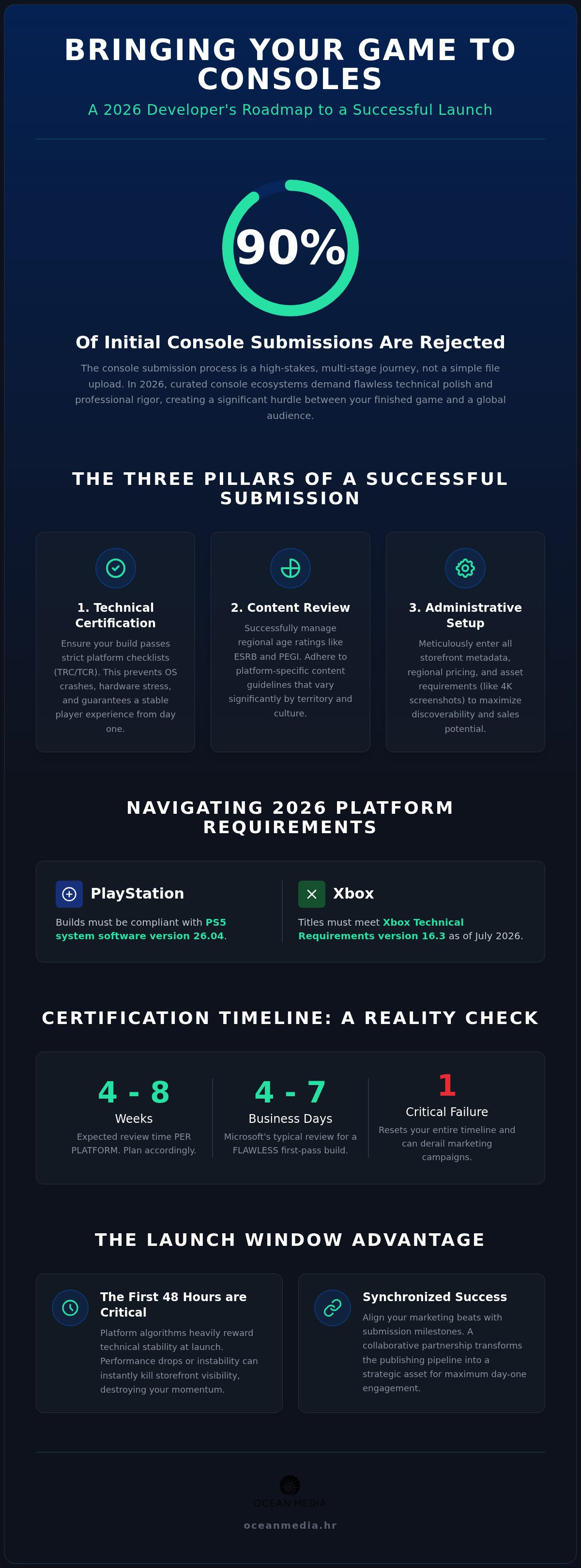
Did you know that nearly 90% of initial console submissions are rejected? It's a staggering figure that often catches even the most prepared indie teams off guard. Mastering the console game submission process isn't just about passing a technical checklist; it's about ensuring your hard work actually reaches the hands of players worldwide. We understand the pressure of staring down a looming launch date while wrestling with platform-specific metadata and certification anxiety. It feels like a wall between your creative vision and your audience, but bringing your game to consoles doesn't have to be an overwhelming obstacle.
You've built something incredible, and you deserve a launch that reflects that effort. We believe the submission phase should be a strategic bridge, not a technical barrier. In this guide, we'll provide a clear roadmap for 2026 certification. We'll explore how to meet the latest Xbox Technical Requirements version 16.3 and align your metadata for maximum storefront discoverability. Our team is here to simplify the transition into a professional environment so you can focus on what you do best. Reserve your slot in our publishing pipeline and let's get started today!
Key Takeaways
- Learn how to navigate the console game submission process by transforming a technical checklist into a strategic launchpad for global discoverability.
- Master platform-specific Technical Requirements (the essential hurdles for any release) to ensure your build passes certification without costly delays.
- Sync your marketing beats with submission milestones to leverage unique storefront algorithms and maximize day-one player engagement.
- Follow a clear roadmap that identifies critical "point of no return" milestones to keep your project moving forward.
- Discover how a collaborative partnership simplifies bringing your game to consoles; reserve your slot in our publishing pipeline and let's get started today!
What is the Console Game Submission Process in 2026?
The console game submission process is the final, high-stakes bridge between your local development environment and the global market. It isn't just a file upload. It's a multi-stage journey that transforms a finished build into a live product on a digital storefront. While PC platforms offer a relatively open door with minimal friction, consoles remain curated ecosystems. They demand a higher level of professional polish and technical rigor that distinguishes hobbyist projects from professional releases.
Bringing your game to consoles in 2026 means navigating a landscape of significantly stricter standards. Platform holders have shifted their focus toward long-term engagement and technical stability. They no longer accept builds that are "good enough" for a patch later. This gatekeeping ensures that players receive a consistent, high-quality experience, but it also means your submission must be flawless from the very first interaction. There is no room for error when the reputation of the hardware is on the line.
The Three Pillars of Console Submission
Success in this professional environment rests on three critical foundations. First is Technical Certification. This goes beyond simple bug hunting; it ensures your software doesn't crash the operating system or stress the hardware beyond safe limits. Second is Content Review. We help you manage regional age ratings like ESRB and PEGI while adhering to platform-specific content guidelines that vary by territory. Finally, there is Administrative Setup. This involves the meticulous entry of storefront metadata, regional pricing, and digital availability across various global territories to ensure your game is discoverable.
Why 2026 Demands a Strategic Approach
Modern platform algorithms are incredibly sensitive. In 2026, these systems reward technical stability during the crucial first 48 hours of a launch. If your build shows instability or performance drops, storefront visibility can plummet instantly, killing your momentum before it starts. This makes the coordination of your indie game global release more important than ever before. You need a synchronized effort across every region to maintain positive algorithm scores. We define the submission pipeline as a comprehensive commercial roadmap that guides your project from final code to market dominance. Let's ensure your game meets the highest standards and reaches its full potential. Reserve your slot in our publishing pipeline and let's get started today!
Navigating the Technical Publishing Pipeline: Certification Requirements
Passing the console game submission process requires more than just a stable build; it demands absolute adherence to the Technical Requirements Checklist (TRC) for PlayStation and the Technical Certification Requirements (TCR) for Xbox. Managing SKU complexity across PlayStation, Xbox, and Nintendo simultaneously is a logistical marathon. Each platform has unique demands. For instance, builds must be compliant with PlayStation 5 system software version 26.04, while Xbox titles must meet the specific Xbox Technical Requirements version 16.3 as of July 2026. These technical hurdles represent significant challenges for indie game developers who must balance aggressive bug-fixing with the implementation of mandatory 2026 features like haptic feedback profiles or activity cards.
Certification Timelines and Expectations
You should plan for a 4 to 8-week submission review process per platform. While Microsoft's certification review is typically the fastest, often taking 4 to 7 business days for a clean build, first-pass success is rare. Nearly 90% of initial console submissions are rejected. A critical failure at this stage is more than a technical setback; it resets your timeline and can potentially derail your entire marketing campaign. We recommend rigorous pre-certification internal testing to catch common pitfalls before they reach the platform holder. If you want to avoid these common traps, our console publishing services provide the seasoned oversight needed to clear these hurdles on the first try.
Metadata and Storefront Assets
Your storefront presence is the digital face of your studio. In 2026, 4K displays are the baseline, meaning your trailers and screenshots must be captured and optimized for high-resolution viewing without compression artifacts. Storefront descriptions must be written to trigger internal platform search algorithms, ensuring your game appears in relevant "more like this" categories. Managing localization assets for a global digital launch adds another layer of administrative weight. Every regional storefront requires translated metadata and localized assets to ensure your game resonates with players in every territory. We help you synchronize these assets so your launch is consistent across every time zone.
Bringing your game to consoles is a transformative step for any studio. We are here to act as your expert guide through every technical requirement and administrative hurdle. Reserve your slot in our publishing pipeline and let’s get started today!
The Strategic Impact of Submission on Marketing Success
Stop thinking of the console game submission process as a technical finish line; it's actually the starting gun for your global visibility. Your marketing strategy should be built directly onto your submission milestones. While PC platforms allow you to host store pages for years without a firm date, console storefronts operate with much higher stakes. Wishlisting on consoles is most effective when tied to a confirmed "Coming Soon" slot. This visibility often requires a verified level of certification. Getting your game approved early doesn't just reduce stress; it secures prime real estate on digital dashboards that simply cannot be bought with a traditional ad budget.
The moment your build achieves technical "gold" status, your marketing shifts from speculation to high-intensity PR. This is the point of no return where your release date is locked and your trailers can finally feature a definitive launch day. We've seen that teams who sync their marketing beats with their technical progress achieve much higher day-one engagement. In 2026, where 63% of publishing deals use a concurrent recoupment model, those early sales are vital for your studio's cash flow and long-term sustainability.
Leveraging Platform Featuring
Pitching your game for an "Indie Spotlight" or a storefront banner requires more than just a catchy trailer. Platform holders want to see a clean certification pass before they commit their limited homepage real estate to your title. A history of technical stability builds trust with account managers. You should use the quiet window during the certification review to share dev-logs and behind-the-scenes content. This builds community trust while the platform holders verify your code, ensuring you have an warm audience ready for the moment the "Buy" button goes live.
Regional Launch Coordination
A global release requires precise timing to avoid being overshadowed by AAA blockbusters that dominate the conversation. Coordinating with a console game publishing partner helps you manage time-zone-specific updates and regional storefront nuances. Remember that for major industry events like Gamescom 2026, the submission deadline for forms and content is 3 pm on August 11, 2026. Regional ratings like the USK are mandatory for these trade fairs and aren't covered by standard IARC storefront ratings. We help you navigate these regional hurdles to unlock every marketing opportunity available. Reserve your slot in our publishing pipeline and let’s get started today!
Executing Your 2026 Launch: A Step-by-Step Roadmap
A successful digital launch requires a 12 month roadmap that treats development, marketing, and the console game submission process as a single, unified effort. You shouldn't view these as separate tasks. Instead, they are interdependent phases where a delay in one can trigger a domino effect across your entire timeline. By the six month mark, your focus must shift from pure creation to the technical realities of the publishing pipeline. This period is your preparation for the "point of no return" (the moment you submit your final gold master and lock your global release date).
Positioning your studio correctly is vital before you enter the final stretch. Understanding what is an indie game in the context of 2026 helps you tailor your pitch to platform holders. They look for unique voices that also demonstrate professional-grade stability. We recommend finalizing your vertical slice early to ensure your core systems are compliant with platform standards long before the final deadline.
Pre-Submission: The Preparation Phase
The first step in your roadmap is finalizing your vertical slice and conducting rigorous internal QA. You cannot rely on platform certification to find your bugs. Step two involves securing all necessary age ratings, including ESRB, PEGI, and CERO. Remember that to apply for developer programs with Sony and Microsoft, you must be a registered legal entity. Step three is the preparation of your final storefront marketing assets. These must be optimized for 4K displays to meet the high visual standards of 2026 console dashboards.
Submission and Beyond: The Launch Window
Step four takes you into the platform-specific certification portals where you will navigate the technical requirements discussed earlier. Once you clear the initial hurdles, step five is managing your "Coming Soon" page to drive a final wishlist surge. Step six is the execution of your global release. Your work doesn't end at launch; platform holders expect a "Day One" patch to address any minor issues found in the final weeks. Monitoring storefront performance and player feedback in the first 48 hours is critical for maintaining visibility. If you want to ensure every step is handled with professional precision, our console game publishing services provide the roadmap you need. Reserve your slot in our publishing pipeline and let's get started today!
Why Ocean Media is the Ideal Partner for Your Publishing Pipeline
Ocean Media isn't just another service provider; we are a partner invested in your long-term success. With 20+ years of industry experience, we've seen the medium evolve from physical discs to the digital-first era we dominate today. We act as your seasoned guide through the complexities of the console game submission process, offering a level of insight that only comes from decades of successful launches. Unlike large, cold transactional entities that treat your game as just another SKU in a massive volume, we prioritize a collaborative partnership. We handle the technical heavy lifting and administrative hurdles, ensuring your vision reaches a global audience without the unnecessary overhead or logistical strain of physical retail distribution.
The Boutique Advantage in 2026
In a market often saturated with generic, dry technical advice, our boutique game publishing strategy offers a distinct competitive edge. Personalized attention means we take the time to understand the specific nuances and goals of your project. We've spent over twenty years building deep, reliable relationships with platform holders at Sony, Microsoft, and Nintendo. These connections translate directly into smoother communication and faster resolutions during the high-pressure certification phase. This expert-led management provides the peace of mind you need to stay focused on your next creative milestone while we navigate the intricate administrative portals on your behalf.
Let’s Bring Your Game to the Global Market
Bringing your game to consoles should be an exciting evolution for your studio, not a source of constant anxiety. We've refined our publishing pipeline into a structured, reliable path to success that simplifies every transition into the professional environment. From the initial build review to the final management of regional storefront metadata, we ensure no detail is overlooked. You focus on the creative vision that makes your game unique; we manage the logistical complexities of the global digital marketplace. We are ready to act as the bridge between your studio and players worldwide. Reserve your slot in our publishing pipeline and let’s get started today!
Secure Your Global Launch with Expert Guidance
Mastering the console game submission process is the final, critical step in transforming your creative vision into a global commercial reality. We've explored how technical certification acts as a powerful marketing engine and why a structured 12 month roadmap is essential for keeping your studio on track. Success in 2026 requires more than just stable code; it demands a strategic alignment of your build, your metadata, and your storefront presence. This professional environment is where your project finally meets its audience.
With 20+ years of console publishing expertise, we specialize in helping you clear every hurdle in the publishing pipeline. We act as your seasoned guide for global digital distribution, providing expert management of technical certification to ensure you don't face the common pitfalls of initial rejection alone. Our collaborative approach simplifies the transition from development to a successful digital launch. Reserve your slot in our publishing pipeline and let’s get started today! Your game belongs on the world stage, and we're ready to help you navigate the path to get it there.
Frequently Asked Questions
What is the console game submission process for indie developers?
The console game submission process is the formal technical and administrative path from a final gold master build to a live digital storefront. It requires navigating through platform registrations, dev kit procurement, and strict technical certification. We've spent 20 years refining this path to help studios avoid common administrative traps. Our goal is to simplify this transition so you can focus on creativity.
How long does it take to get a game approved on consoles in 2026?
Plan for a 4 to 8 week submission review process per platform in 2026. While Microsoft's certification review is often the fastest at 4 to 7 business days for clean builds, rejections are frequent. Each failure resets your timeline and can impact your marketing beats. We help you manage these timelines to ensure your global digital launch stays on schedule without unexpected delays.
What are the main reasons games fail console certification?
Nearly 90% of initial submissions fail because of OS level crashes or hardware specific violations. Common issues include builds not being compliant with PlayStation 5 system software version 26.04 or failing Xbox Technical Requirements version 16.3. Incorrect age rating metadata is another major hurdle. We provide the expert oversight needed to catch these critical failures before they reach the platform holder.
Do I need a publisher to submit my game to PlayStation or Xbox?
You don't strictly need a publisher to submit to PlayStation or Xbox, as indie programs like ID@Xbox are accessible to registered legal entities. However, many studios partner with us to handle the technical heavy lifting and administrative complexities. We act as a seasoned guide, allowing you to focus on development while we manage the global distribution logistics and platform relationships.
How much does it cost to publish a game on console storefronts?
Registration for major developer programs is free in 2026. Xbox dev kits cost $2,000 as of late 2025, while Sony often provides PS5 kits as loans to accepted partners. Storefronts typically take a 30% commission on your digital sales. Understanding these overheads is vital for your financial planning. We help you navigate these costs as part of a collaborative publishing partnership.
Can I market my game before it has passed certification?
You can and should market your game before certification, but your strategy must be precise. Building wishlists is essential for early visibility. However, most storefronts only grant high level Coming Soon placement once you've cleared specific submission milestones. We help you sync your PR campaigns with your technical progress to ensure you don't waste marketing spend on an unconfirmed launch window.
What is the difference between a TCR and a TRC in console publishing?
These terms refer to platform specific technical checklists. TCR, or Technical Certification Requirements, is the standard for Xbox, while TRC, or Technical Requirements Checklist, is the PlayStation equivalent. Both sets of rules ensure your game doesn't crash the hardware or provide a poor user experience. Mastering the console game submission process requires meeting these standards across every platform you target simultaneously.
How do storefront algorithms impact my game’s visibility after submission?
Storefront algorithms heavily favor games that demonstrate technical stability in the first 48 hours of launch. A clean console game submission process ensures your build doesn't trigger negative flags that could tank your visibility. High engagement and low crash rates signal quality to the platform. Reserve your slot in our publishing pipeline and let's get started today to maximize your storefront potential!


