

What if the label "indie" is no longer about who funds the project, but who owns the vision? You've likely felt the pressure to stay "pure" while facing the high costs of a global launch. It's a confusing crossroads, especially when weighing the impact of a game publisher vs investor on your studio's future. We know that maintaining your creative spark is non-negotiable, even as you scale for a major release.
This guide clarifies the evolving indie definition in 2026 and provides the professional roadmap you need for bringing your game to consoles. We'll show you how to maintain creative autonomy while navigating the complex certification requirements of PlayStation, Xbox, and Nintendo. You'll gain a clear understanding of the digital distribution landscape and the steps required to reach a global audience without losing your identity. If you're ready to move from development to a successful launch, reserve your slot in our publishing pipeline and let's get started today!
Key Takeaways
- Explore how the 2026 definition of "indie" focuses on creative autonomy and owner-led vision rather than just budget constraints or team size.
- Analyze the critical differences between a game publisher vs investor to determine which partnership model best preserves your studio's independence and creative control.
- Identify the core characteristics that separate indie titles from AAA productions, including agile team structures and the freedom to explore experimental mechanics.
- Gain a clear understanding of the technical roadmap for console certification, from creating a vertical slice to navigating the specific requirements of major digital platforms.
- Learn how to bridge the gap between boutique development and global distribution; reserve your slot in our publishing pipeline and let's get started today!
Defining the Indie Game: More Than Just a Budget
Defining an independent video game in 2026 requires looking far beyond the size of a studio's bank account. Historically, the "indie" label was a badge of financial isolation. It suggested a developer working in a vacuum without any external support. Today, the definition has matured into a focus on creative autonomy. An indie game is any title where the development team retains the final word on design, narrative, and mechanics. This shift has moved the industry toward a creative-first model. You no longer have to choose between total obscurity and corporate control. Instead, you can leverage professional support while keeping your vision intact.
As you plan your release, you'll likely weigh the merits of a game publisher vs investor to fund your journey. While an investor might provide capital in exchange for equity, a modern publishing partner focuses on the technical logistics of bringing your game to consoles. This digital-first strategy allows you to bypass traditional gatekeepers and reach global audiences on platforms like the PlayStation Store and Xbox Games Store. Whether you are a solo creator or part of the growing "Triple-I" (III) category of high-production independent studios, the goal remains the same: total ownership of your intellectual property.
The Evolution of the Independent Label
The path from 1980s shareware to the 2026 digital storefront dominance has been transformative. In the early days, distribution was the primary barrier. Today, digital platforms have democratized access, allowing boutique titles to sit alongside blockbusters. The debate over what constitutes an 'indie game' has evolved as middleware like Unity and Unreal lowered the entry barrier for technical excellence. You can now achieve high-fidelity results that were once reserved for massive corporations. This technological leap has made the "independent" label more about the spirit of the project than the limitations of the tools used to build it.
Indie Spirit vs. Financial Structure
Creative freedom is the true hallmark of an indie title. Can a game be indie with a million-dollar budget? In the current market, the answer is a resounding yes. High-production indies, or Triple-I games, often command significant resources but maintain a flat hierarchy and agile decision-making processes. The distinction lies in your funding choice. When comparing a game publisher vs investor, the right partner should act as a bridge to the market rather than a creative director. At Ocean Media, we've spent 20 years perfecting this balance. We handle the complex certification requirements of major consoles so you can stay focused on the experimental mechanics that make your game unique. If you're ready to scale without losing your soul, reserve your slot in our publishing pipeline and let's get started today!
The Core Characteristics: What Makes a Game 'Indie'?
What truly defines an indie game? It is a blend of creative risk and operational agility that larger corporations simply cannot replicate. While some critics point to pixel art as a defining trait, the reality is much broader. Independent games are defined by their willingness to explore niche genres and experimental mechanics that haven't been sanitized by a corporate boardroom. This agility often stems from team size; whether you're a solo developer or a boutique studio of twenty, your proximity to the creative core remains tight. You aren't just a cog in a machine; you're the engine itself.
When you're deciding between a game publisher vs investor, understanding these core characteristics is vital. An investor might focus solely on the financial return of a proven genre. In contrast, a seasoned publishing partner understands that the indie identity is tied to pushing boundaries. Creative risk in 2026 is the deliberate choice to prioritize mechanical innovation over market-tested safety nets to capture a dedicated, underserved audience. This spirit is what keeps the industry vibrant and moving forward.
Innovative Mechanics and Niche Genres
Independent developers have single-handedly revitalized "dead" genres. Think of the massive resurgence in Metroidvanias or the high-octane thrill of Boomer Shooters. These games succeed because they offer a specific hook, such as a unique gameplay twist or a striking aesthetic, that AAA studios often find too risky for their massive overhead. By focusing on these niche spaces, you aren't just making a game; you're building a community around a shared passion for specific mechanics. This direct engagement with your player base creates a feedback loop that massive studios struggle to emulate.
The Role of Digital Distribution
The shift away from physical-only retail was a turning point for the industry. It leveled the playing field. Global digital launches on the PlayStation Store, Xbox Games Store, and Nintendo eShop allow for niche success on a massive scale. You can reach a player in Tokyo as easily as one in London. However, this global reach requires careful planning, especially regarding preparing game for global console launch through localization and regional compliance. Digital storefronts have made it possible for a small team to achieve millions of downloads without a massive physical supply chain.
Navigating these storefronts is a technical hurdle, but it's where your game finds its life. The choice between a game publisher vs investor often comes down to who can help you navigate these digital gates. We specialize in the technical and administrative complexities of console platforms so your team can stay focused on the community-centric development that drives long-term loyalty. If you want a partner who respects your creative risk while handling the corporate logistics, reserve your slot in our publishing pipeline and let's get started today!
Indie vs. AAA: Understanding the Industry Spectrum
The gaming industry isn't a binary choice between a basement coder and a global conglomerate. It's a spectrum. On one end, you have AAA titans with thousands of specialized staff and corporate parent companies. On the other, agile indie teams operate with flat hierarchies where everyone wears multiple hats. The primary differentiator isn't just the final product's graphics, but the structural resilience and the game publisher vs investor funding model that powers the studio. AAA titles are built as corporate assets; indies are built as creator-led projects.
When you're weighing the merits of a game publisher vs investor, the decision impacts your structural agility. Investors often seek high-growth venture capital returns, which can push a studio toward rapid, sometimes unsustainable expansion. A publishing partner, however, focuses on the project's market reach and technical viability. This choice defines how you navigate the industry spectrum, especially as you move from a prototype to a professional release.
The Budget and Risk Factor
AAA titles often require millions of units sold just to break even. This financial weight creates a culture of risk aversion where sequels and proven formulas dominate. Independent studios thrive on niche loyalty. Lower overheads allow you to fail fast, pivot creatively, and experiment with mechanics that a corporate entity would find too volatile. We're also seeing the rise of "Triple-I" or "AA" studios. These are mid-sized teams that produce high-fidelity games but retain their independent status and agile decision-making processes, effectively blurring the lines between the two extremes.
Publishing and Support Systems
Navigating the publishing pipeline is where the gap between indie and AAA becomes most visible. Major studios have in-house legal, QA, and certification departments to manage platform requirements. Independent developers usually lack these dedicated resources. To compensate, many partner with experienced console game publishers who provide the technical infrastructure needed for a professional launch. This partnership allows you to focus on community-centric marketing and viral growth while your partner handles the administrative heavy lifting.
The indie-to-console transition is the ultimate test of your game's professional polish. It requires meeting the same rigorous technical standards as the giants, but without their massive budgets. At Ocean Media, we've spent two decades acting as the bridge for creators who want to scale. We simplify the transition into a professional console environment so you can compete on the global stage. If you're ready to bring your vision to the PlayStation Store, Xbox Games Store, or Nintendo eShop, reserve your slot in our publishing pipeline and let's get started today!
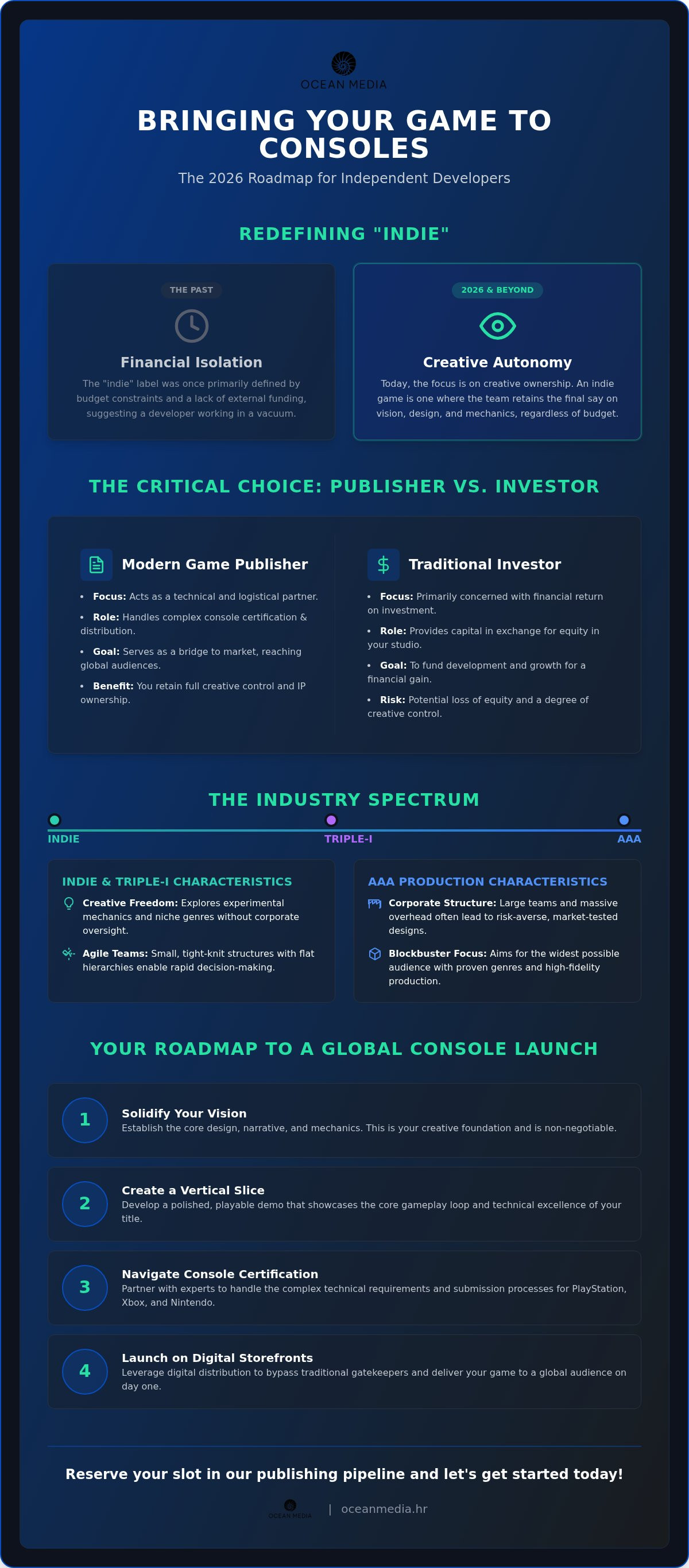
The Path to Market: How Indie Games Reach Players
Moving from a playable prototype to a global storefront is the most demanding phase of your development cycle. It begins with the "Vertical Slice." This is a polished segment of your game that demonstrates core mechanics, visual fidelity, and technical stability. This slice isn't just for internal testing; it's your primary asset when negotiating the merits of a game publisher vs investor. While an investor might look at your slice to gauge financial ROI, a publisher evaluates it to determine technical feasibility for a console release. This distinction is critical because capital alone doesn't solve the administrative hurdles of platform holders.
The journey continues through the rigorous console certification process. This is where many independent visions stall due to technical complexities. Finding a digital console game publisher to handle this technical lift allows your team to remain focused on the creative finish. Once certification is cleared, you move into the global digital launch phase. This involves managing storefront assets, regional age ratings, and post-launch support to ensure your game reaches its full potential on every major platform simultaneously.
Navigating Console Certification
Console submission is often the biggest hurdle for first-time indie devs. Unlike the relatively open nature of PC storefronts, consoles require you to pass strict protocols. You'll encounter terms like "Lotcheck" for Nintendo or "TRC" (Technical Requirements Checklist) for Sony and Xbox. These checklists ensure your game doesn't crash the system, handles save data correctly, and follows platform-specific UI rules. Mastering how to publish a game on console involves managing these technicalities alongside your final development sprints. A seasoned partner simplifies this by providing a pre-vetted path through these corporate gates.
The Advantage of Global Digital Distribution
A digital-only launch is the most sustainable model for indie studios in 2026. It allows you to reach the PlayStation Store, Xbox Store, and Nintendo eShop simultaneously without the overhead of physical logistics. You'll need to navigate global age ratings, such as ESRB for North America and PEGI for Europe, which are mandatory for console visibility. Digital distribution ensures your niche title can find its audience globally from day one. It also gives you the agility to push post-launch patches and content updates directly to your players, keeping your community engaged and your game stable.
The transition from development to distribution requires a specialized skillset. When comparing a game publisher vs investor, the right choice provides the infrastructure you lack. We've spent 20 years acting as the bridge for creators who want to scale professionally. If you're ready to see your vision on the world's biggest digital storefronts, reserve your slot in our publishing pipeline and let's get started today!
Bringing Your Indie Game to Consoles with Ocean Media
Ocean Media serves as a seasoned guide for developers ready to cross the bridge from boutique creation to global console distribution. For over 20 years, we've helped independent creators navigate the complexities of the digital landscape while preserving their unique spirit. When you evaluate the choice of a game publisher vs investor, you are ultimately deciding on the level of technical support your vision receives. While an investor provides capital, we provide the technical and administrative infrastructure required to meet the rigorous standards of PlayStation, Xbox, and Switch.
Our team handles the corporate technicalities that often drain a developer's energy. We believe that your time is best spent on game mechanics and community engagement, not on administrative paperwork or regional compliance. By choosing a collaborative partnership over pure self-publishing, you gain access to a streamlined path that has been refined through decades of successful launches. We are committed to a digital-only focus; this ensures your game reaches the world's most influential storefronts without the distractions of physical retail logistics.
Why Experience Matters in the Publishing Pipeline
Navigating the publishing pipeline alone can lead to costly delays and failed certifications. Avoiding common pitfalls requires a deep understanding of platform-specific requirements that only comes with time. We leverage two decades of established platform relationships to advocate for your game's success. Our expertise allows us to manage the administrative complexities of global storefronts, including age ratings and store metadata, with precision. This seasoned authority ensures that your game doesn't just launch; it launches with the professional polish expected by console audiences.
Reserve Your Slot Today
The transition from a small development team to a professional studio begins with choosing the right partner. When comparing a game publisher vs investor, the right choice provides the infrastructure you lack. We invite you to leverage our experience and specialized knowledge to bring your vision to life on the global stage. Our process is designed to be efficient, transparent, and focused on your success as a creator. Don't let technical hurdles stand in the way of your global debut. To secure your place in our upcoming release schedule, reserve your slot in our publishing pipeline and let's get started today!
Scaling Your Vision for the Global Stage
Bringing your independent vision to life in 2026 means navigating a landscape where creative autonomy is your greatest asset. We've explored how the indie label has evolved into a focus on ownership and risk-taking, allowing boutique studios to compete alongside industry giants. Whether you're refining a vertical slice or preparing for a global digital launch, the path to consoles requires a blend of agile development and professional technical polish. Balancing the merits of a game publisher vs investor is a pivotal decision that defines how you maintain that creative spark while scaling for a worldwide audience.
With over 20 years of console publishing expertise, our team acts as the bridge between your creativity and the technical requirements of PlayStation, Xbox, and Nintendo Switch. We specialize in digital distribution and have a proven track record of navigating complex console certification processes so you don't have to. The transition from developer to professional studio is a journey we've mastered alongside hundreds of partners. It's time to bring your game to the players who are waiting for it. Reserve your slot in our publishing pipeline and let's get started today!
Frequently Asked Questions
Can an indie game have a publisher and still be considered 'indie'?
Yes, an indie game can absolutely have a publisher and retain its status. The core definition of "indie" in 2026 centers on creative autonomy and intellectual property ownership rather than financial isolation. When comparing a game publisher vs investor, a publisher acts as a technical partner to handle distribution logistics. This allows your team to keep the final word on all design decisions while benefiting from professional infrastructure and global console reach.
What is the average team size for an indie game studio in 2026?
Team sizes in 2026 range from solo developers to boutique studios of approximately 20 staff members. While solo creators account for about 86% of self-funded projects, many successful independent titles are now produced by mid-sized teams that maintain flat hierarchies. These agile structures allow for rapid pivoting and creative experimentation. Regardless of size, the focus remains on a collaborative spirit that prioritizes the developer's vision over corporate bureaucracy.
How do indie games make money on consoles?
Indie games primarily generate revenue through digital sales on the PlayStation Store, Xbox Store, and Nintendo eShop. Platform holders typically take a 30% commission, leaving 70% for the developer and their partners. Subscription models and season passes are also growing revenue streams. When deciding between a game publisher vs investor, remember that a publisher helps maximize these earnings by ensuring your title meets all technical requirements for a successful global digital launch.
What is a 'Triple-I' (III) game?
A "Triple-I" game is an independent title produced with a high production budget and technical polish that rivals AAA standards. These games are often developed by mid-sized studios that have secured significant funding while retaining full creative control. They bridge the gap between small-scale experimental projects and massive corporate blockbusters. This category proves that "indie" is about the spirit of independence and ownership rather than just a lack of resources.
Do I need a publisher to get my indie game on PlayStation or Xbox?
You don't strictly need a publisher, but navigating the process alone is technically and administratively complex. Console platforms require you to have a registered legal entity and pass rigorous certification tests. For example, setting up an LLC can cost between $500 and $1,500. While programs like ID@Xbox provide dev kits to accepted developers, the technical burden of meeting platform-specific APIs and save systems often makes a professional publishing partner a more efficient choice.
What is the difference between an indie game and a AA game?
The difference lies in budget scale and the level of external corporate involvement. Indie games prioritize creative autonomy and are often self-owned. AA games typically have mid-tier budgets and may be funded by larger entities, though they still operate with more agility than AAA giants. Understanding the dynamic of a game publisher vs investor is crucial here; AA studios often rely on publishers for marketing and distribution while maintaining a distinct, creator-led identity.
Why are indie games often more experimental than AAA games?
Lower overhead costs allow independent developers to take risks that would be financially impossible for AAA studios. A major blockbuster often requires millions of units sold just to break even, which leads to formulaic design. Indies thrive by targeting niche audiences with experimental mechanics or revitalizing "dead" genres. This freedom to fail fast or pivot creatively is the engine of innovation in the gaming industry, ensuring that fresh ideas constantly reach the market.
How do I start the console publishing process for my indie title?
Starting the process begins with creating a polished "Vertical Slice" that demonstrates your game's core mechanics and visual style. Once you have a stable build, you must prepare for the technical certification requirements of each console platform. This involves managing platform-specific APIs and regional compliance. To simplify this journey and ensure a professional global release, reserve your slot in our publishing pipeline and let's get started today!


