

What happens after launch when a player reports a serious issue, a patch needs platform submission, and your team is already focused on its next project? Post-launch support for console games works best when ownership is clear before release, not decided in the middle of a problem.
Launch day is a milestone, not the end of your game’s journey with players. Keeping a console game supported raises practical questions: who reviews feedback, prioritizes issues, coordinates updates, and handles platform-related follow-up? A clear plan helps you answer those questions while balancing your studio’s capacity and goals.
In this guide, you’ll learn what post-launch support can involve, how to define responsibilities before release, and where a publishing partner can contribute to your console release. We’ll also look at how platform expertise and certification fit into the publishing pipeline. Ocean Media brings over 20 years of gaming-industry experience to digital console publishing, helping developers plan for bringing their games to consoles and reaching global audiences. When you’re ready to take the next step, reserve your slot in our publishing pipeline and let's get started today!
Key Takeaways
- Post-launch support for console games continues after release, so define its scope and owners before launch.
- Clarify who reviews player feedback, prioritizes issues, and coordinates follow-up through the publishing pipeline.
- Compare studio-led, publisher-supported, and shared-responsibility approaches against your team’s capacity and roadmap.
- Agree on communication routes and keep decision records to make post-launch work easier to coordinate.
- Ocean Media’s digital console publishing experience can support your plan for bringing a game to consoles. To get started, reserve your slot in our publishing pipeline and let's get started today!
What post-launch support for console games actually covers
Post-launch support for console games is the work of assessing issues, planning follow-up, and keeping players informed after a game becomes available. Its scope depends on the project, publishing agreement, platform, and release plan. It differs from launch execution, which prepares and coordinates the release, and certification, which addresses platform submission requirements. It also isn’t a substitute for game development: post-launch work concerns agreed needs for a released game.
Which responsibilities can continue after release?
Possible responsibilities include reviewing reported issues, planning updates, coordinating platform-related follow-up, and maintaining storefront information. A technical fix might address a bug or performance concern through a software patch. A content update may add or adjust in-game material, while player-facing communication can explain known issues or planned changes. Because these tasks involve different skills and decision-makers, assign an owner to each rather than assuming one team handles everything.
Before release, agree with your publishing partner who reviews incoming feedback, who prioritizes issues, and who approves proposed updates. Define escalation paths as well. If a report needs technical investigation or platform follow-up, document who takes the next step and how the decision is shared. A written division of responsibilities helps both teams coordinate without confusing publishing tasks with development work.
Why console releases need coordinated follow-through
Console platforms have platform-specific processes that can affect how a post-release update is prepared and submitted. A fix may require more than a development decision: teams may need to coordinate build readiness, submission planning, and communication about the next step. Responsibilities vary by platform and publishing agreement, so make the handoffs part of your release plan.
Clear communication helps your studio weigh player feedback against available capacity and the existing roadmap. It can’t guarantee a particular outcome or timing, but it can prevent confusion about priorities and ownership. Keep the process practical: record the issue, assign someone to assess it, and agree who communicates the decision.
For broader context on how release preparation connects with platform requirements and digital publishing, explore our console publishing resources for developers. Ocean Media brings over 20 years of gaming-industry experience to digital console publishing and platform submission requirements. If you’re planning your publishing path, reserve your slot in our publishing pipeline and let's get started today!
How post-launch support fits into the console publishing pipeline
The console publishing pipeline doesn’t stop when a game goes live. The focus shifts from release readiness to reviewing new information and deciding what follow-up makes sense. For post-launch support for console games, make that transition deliberate: agree on owners, communication routes, and decision points before your team needs them.
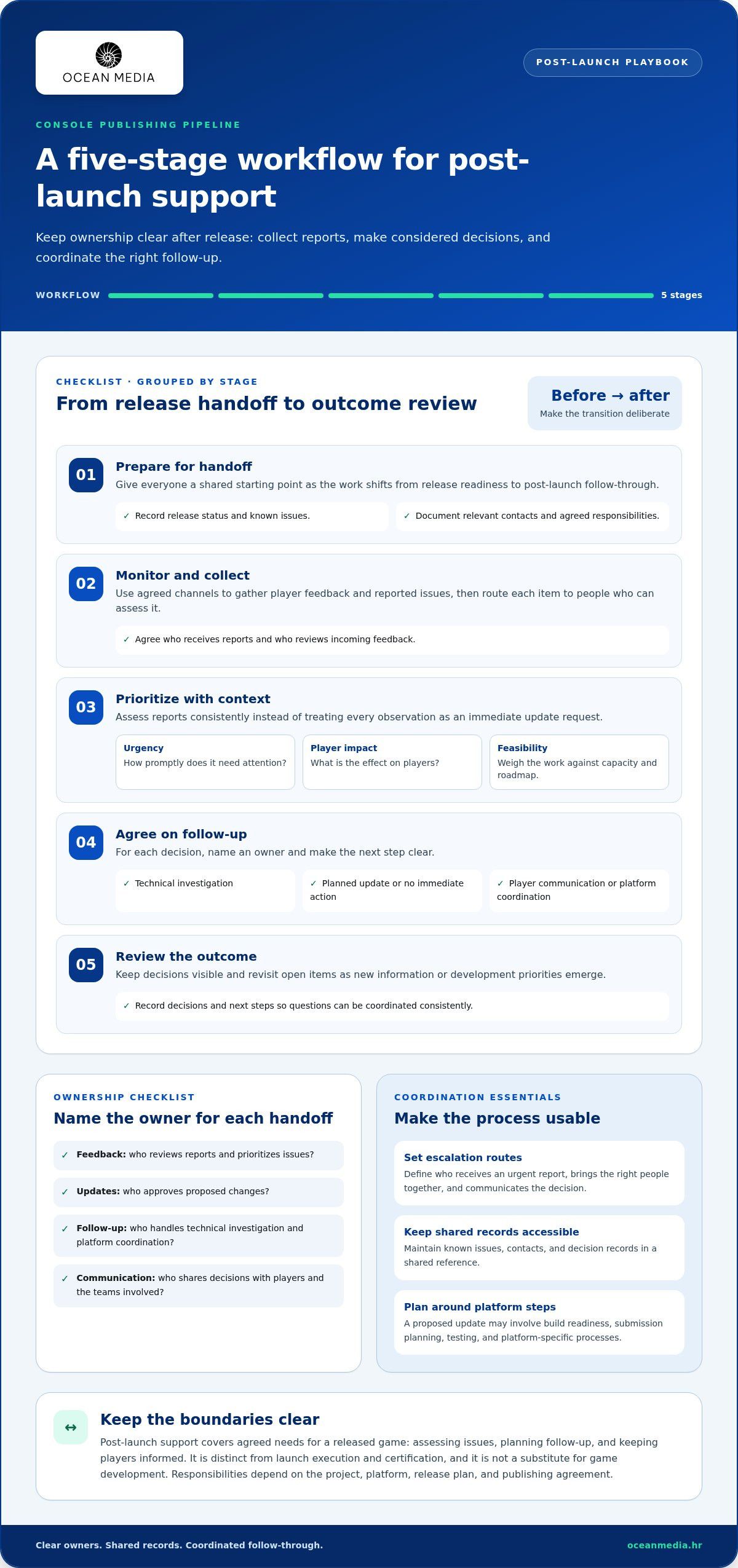
Organize the workflow into clear stages:
- Prepare for handoff: Record release status, known issues, relevant contacts, and agreed responsibilities so everyone starts with the same information.
- Monitor and collect: Gather player feedback and reported issues through agreed channels, then route them to the people who can assess them.
- Prioritize: Weigh urgency, player impact, and feasibility before deciding whether an issue needs investigation, a planned update, or no immediate action.
- Agree on follow-up: Assign an owner and next step, such as further technical assessment, player communication, or platform-related coordination.
- Review the outcome: Record decisions and revisit open items as new information or development priorities emerge.
Where responsibilities change after the game goes live
Before release, teams focus on getting the game ready. Afterward, responsibilities may shift toward monitoring feedback and deciding what deserves attention. Your studio may assess a reported issue, while a publishing partner coordinates agreed publishing or platform follow-up. Platform processes may also affect how a proposed update moves forward. Spell out these handoffs in the publishing agreement instead of leaving ownership to assumption.
Set escalation routes in advance: who receives an urgent report, who brings the right people together, and who communicates the decision? Keep release documentation accessible, including known issues, contacts, and decision records. A shared reference helps the team respond consistently when questions resurface or attention shifts to other work.
How to keep post-launch decisions coordinated
Use a consistent method to assess feedback rather than treating every report as an immediate update request. Separate high-impact issues from lower-priority observations, then weigh each against the work involved and the game’s roadmap. If you propose an update, connect the decision to testing and any applicable platform submission steps. Certification requirements depend on the platform and submission; consult the dedicated console certification guide for more on that process.
Good coordination supports informed decisions, not guaranteed outcomes or a fixed update cadence. The International Trade Administration’s overview of the U.S. video game industry provides broader industry context, while your publishing plan turns responsibilities into a project-specific workflow. To explore how our digital publishing partnership can support bringing your game to consoles, visit our console publishing resources for developers.
Publisher support or studio-led support: how to compare the approaches
There’s no single right owner for post-launch support for console games. The best arrangement depends on your project’s scope, your team’s capacity, and the responsibilities in your publishing agreement. A publisher-supported model doesn’t mean giving up creative control. Coordination means managing agreed tasks and information flow; you and your partner should define creative ownership and decision-making clearly.
| Approach | Ownership and coordination | Platform expertise | Potential fit |
|---|---|---|---|
| Studio-led | Your team owns issue assessment, priorities, communication, and follow-up. | The studio organizes platform-related work using its own processes and experience. | A fit when internal capacity and established release processes can accommodate ongoing support alongside the roadmap. |
| Publisher-supported | The publisher coordinates the responsibilities agreed in the publishing relationship; the studio remains involved in decisions assigned to it. | Publishing experience can help organize platform administration and submission-related follow-up. | A fit when the studio wants publishing coordination as part of its console release partnership. |
| Shared responsibility | Studio and publisher divide tasks, with named owners for decisions, communication, and escalation. | Platform-related work is coordinated according to each party’s agreed role and experience. | A fit when the studio wants to retain specific work while drawing on publishing support for other responsibilities. |
When a studio-led model may fit
If your team has capacity after launch and a release process it can maintain, studio-led support may suit your plans. You keep direct oversight, but you’re also responsible for organizing issue review, prioritization, platform follow-up, and communication. This approach isn’t inherently better or worse than publisher support. The key question is whether the work fits your team’s capacity and roadmap.
When publisher coordination can help
A publishing partner can bring digital console publishing and platform administration experience to help coordinate agreed release and follow-up tasks. Ocean Media draws on over 20 years of gaming-industry experience to support developers through the publishing lifecycle, including platform-specific requirements and certification. For a clearer view of how publishing roles can be divided, read our console publisher responsibilities guide.
Agree on boundaries early: who assesses feedback, who recommends next steps, and which decisions remain with your studio? A written division of responsibilities helps protect your creative direction while making collaboration practical. For perspective on player feedback and iteration, see this Game Developer case study on post-launch community management.
Choose the arrangement that supports your goals for bringing your game to consoles. To explore a structured publishing path,
How to plan post-launch support before your console game releases
A useful plan connects launch preparation to the work that may follow, without assuming every game needs the same updates or support cadence. For post-launch support for console games, map responsibilities to your game’s roadmap and publishing agreement. This gives your team and publishing partner a shared reference as feedback arrives and priorities change.
Set support scope and ownership before launch
Start by identifying the work your project may need, then assign owners for responsibilities agreed with your publishing partner. Set approval paths for technical fixes, content updates, storefront changes, and platform communications. For context on how this planning connects with the wider release journey, explore our console game publishing roadmap.
Use this sequence to turn your plan into a working process:
- 1. Define the scope. Identify possible needs such as issue review, update planning, platform follow-up, player communication, or storefront information. Record what’s in scope and what will require a new decision.
- 2. Assign decision owners. Record who collects and assesses reports, recommends priorities, approves changes, and communicates decisions. Name an escalation route for issues that need input from more than one team.
- 3. Set communication routes. Agree where the studio and publishing partner will share reports, raise questions, and document decisions. Make the process easy to follow so information doesn’t depend on informal handoffs.
- 4. Prepare reference materials. Keep release notes, known issues, relevant contacts, and platform submission information together. Documenting this context helps the team make consistent decisions as work moves between people.
- 5. Plan issue review and updates. Decide how feedback will be grouped by urgency, player impact, and feasibility. Connect proposed updates to the work needed for assessment, testing, and applicable platform processes, without assuming a deadline or update cadence.
- 6. Review after release. Use agreed channels to review incoming information, record decisions and owners, and revisit open items as the roadmap changes. Consider whether plans for new audiences affect communication or storefront information.
Make the review cycle practical for your team. Decide how often to revisit priorities based on the project’s needs, and make sure relevant people can see what’s been decided. If you plan to reach audiences across regions, include localization and player-facing information in roadmap discussions alongside other planned work.
Ocean Media brings over 20 years of gaming-industry experience to digital console publishing, including platform-specific requirements and certification. If you’re planning the publishing path for bringing your game to consoles,
How Ocean Media helps developers bring games to consoles
Bringing your game to consoles involves more than preparing a build for release. Platform-specific requirements, certification, digital publishing, and plans for follow-up all need to fit together. Ocean Media is a digital console publishing partner, helping developers coordinate this wider journey. Our role is publishing, not work-for-hire game development, so your studio remains at the center of creating and shaping its game.
A publishing partner for the full digital console journey
With over 20 years of gaming-industry experience, Ocean Media supports developers through the publishing lifecycle. Our experience with platform requirements and certification helps organize submission-related work as part of a coordinated publishing pipeline. Global digital distribution across console platforms connects your release plan with the goal of reaching console audiences.
Define post-launch responsibilities for each project. You and your publishing partner can agree how platform follow-up, update planning, and other publishing tasks will be coordinated as part of the release plan. This connects release readiness with post-launch planning while keeping responsibilities and decisions grounded in your game’s needs.
Take the next step with Ocean Media
A strong partnership starts with a clear view of your project and goals. Share those details through our developer partnership page to begin exploring a structured publishing path. The conversation can focus on your console release plans, publishing needs, and how the partnership can support your game’s journey.
If you’re preparing for launch or mapping out the next stage of your console release, let’s explore the right publishing approach together.
Plan the next stage of your console release
Post-launch support for console games is easier to coordinate when you decide early who owns feedback, prioritization, platform follow-up, and update decisions. Match those responsibilities to your studio’s capacity, roadmap, and publishing agreement. Your plan can be studio-led, publisher-supported, or shared, as long as every role is clear.
Ocean Media brings over 20 years of gaming-industry experience and digital console publishing expertise to help developers navigate platform-specific requirements and certification. A publishing partnership connects release preparation with the work that follows, with responsibilities aligned to your project and goals.
Ready to explore a structured path for bringing your game to consoles? Your next step can be a clear, collaborative plan for reaching console players.
Frequently Asked Questions
What does post-launch support for console games include?
Post-launch support for console games can include issue triage, update planning, platform follow-up, and storefront coordination. It differs from launch execution, which focuses on preparing and coordinating the release. The exact scope depends on your project and publishing agreement, so define responsibilities before release. Clarify who reviews reports, who makes or approves decisions, and how issues are escalated. Then your team will know where to direct each task after the game goes live.
How long does post-launch support for a console game last?
There’s no single support duration that fits every console game. The period depends on your release plan, project scope, update plans, and the responsibilities agreed between your studio and publishing partner. Include the intended support period in your publishing discussions, along with review points for reconsidering priorities as the game evolves. A project-specific plan gives both teams a shared expectation without relying on a universal industry timeline.
Who handles patches and updates after a console game launches?
Responsibility for patches and updates may sit with your studio, your publisher, or both, depending on the agreement and each team’s role. Decide who prioritizes proposed changes, approves them, coordinates testing, handles relevant platform submission considerations, and communicates decisions. A publisher may coordinate publishing tasks and bring console publishing expertise, while technical development remains a separate responsibility. Name owners so development work and publishing tasks connect smoothly.
Can an indie studio manage post-launch support without a publisher?
Yes. An indie studio can manage post-launch support itself if it has the capacity, expertise, and internal processes to organize the work. Define who reviews feedback, sets priorities, coordinates updates, and manages platform-related responsibilities. Self-management needs to fit your team’s workload and roadmap. A publishing partner can contribute coordination and console publishing expertise where agreed, while your studio remains responsible for its development role.
Is post-launch support automatically included in a console publishing agreement?
Post-launch support isn’t identical across publishing agreements. Each partnership defines its own scope and responsibilities, so make planned post-release work explicit before launch. Document who handles issue triage, update decisions, platform communications, and reporting, as well as how decisions are shared. Clear, project-specific expectations help you understand where the publisher’s role ends and the studio’s begins. Avoid assuming a standard package or guaranteed level of support.
How should developers prepare for post-launch support before release?
Before release, define the support scope, owners, communication routes, documentation, and review points. Decide how your team will collect and categorize player feedback, then agree how issues will be prioritized and proposed updates considered. Keep the plan aligned with your game’s roadmap and publishing agreement. This preparation gives your studio and publishing partner a shared process for post-release decisions instead of leaving responsibilities unclear or decisions entirely ad hoc.
What is the difference between launch support and post-launch support?
Launch support focuses on preparing and coordinating the release; post-launch support covers agreed work after the game becomes available. Some tasks, such as platform communication or issue tracking, may continue across both phases, so the transition isn’t always a clean break. Define the handoff point in your publishing plan and specify which responsibilities continue after release. Clear roles help your team move from launch readiness to ongoing decisions without losing important context.


