

A publisher’s recoupment clause can matter more than the headline royalty rate. Recoupable expenses in game publishing are agreed costs, often including an advance and specified publishing expenses, deducted from game revenue before the developer’s royalty or profit share is calculated.
It’s easy to focus on the revenue split, but the definition of net revenue and the order of deductions can determine when your studio starts receiving payments. This guide explains how advances and publisher investments are recouped, which costs may be deducted, and how cross-collateralization can connect game revenue to physical production expenses. It also explains why clear definitions, spending limits, and reporting terms matter when reviewing a publishing agreement.
Key Takeaways
- Compare the royalty base with the agreement’s definition of net revenue, since the deductions allowed can change what remains for revenue sharing.
- Identify which publisher costs are recoupable, and look for approval rights or agreed budget limits that help control spending.
- Understand whether an advance is recouped before revenue sharing begins or alongside it, and how that affects payment timing.
- Check whether cross-collateralization lets costs from one game or product reduce revenue from another, including physical production costs.
- When you’re bringing your game to consoles, reserve your slot in our publishing pipeline and let's get started today!
Net revenue definitions
Net revenue is the revenue left after applying the deductions defined in the agreement. The deduction base determines whether publisher costs reduce the full revenue pool or only your share.
Revenue Bases for Recoupment
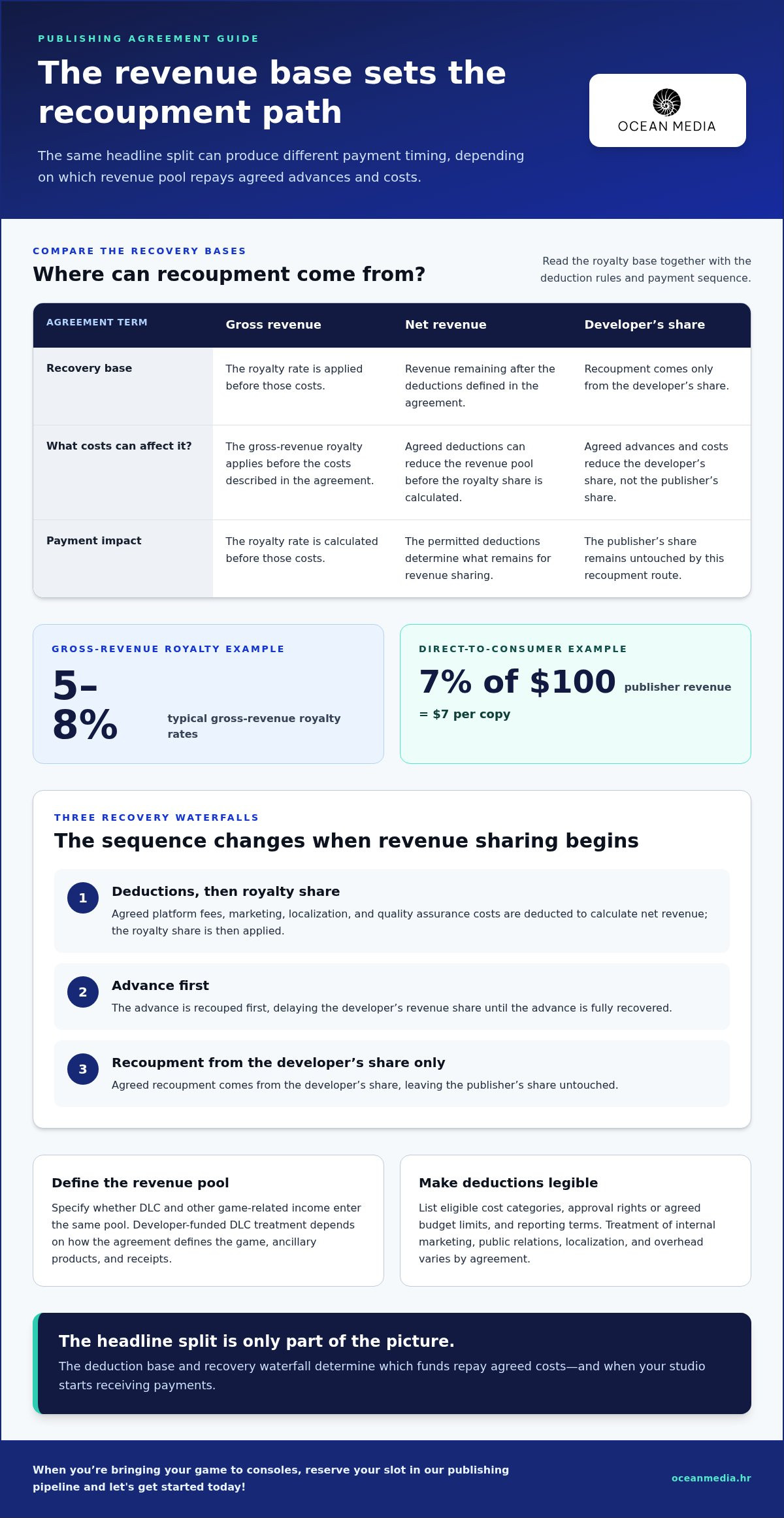
Whether recoupment comes from gross revenue, net revenue, or the developer’s share determines which funds repay agreed advances and costs. That distinction affects when you receive royalties, even if the headline split stays the same.
A gross-revenue royalty instead applies its rate before those costs; typical gross-revenue royalty rates are 5%-8%. In a direct-to-consumer example, 7% of $100 in publisher revenue equals $7 per copy.
Developer-funded DLC can create a separate revenue stream, but its treatment depends on how the agreement defines the game, ancillary products, and receipts. If the definition includes DLC revenue, the publisher may apply agreed deductions to that income. If the content is excluded, its revenue may follow a different calculation. Name each funded expansion and its associated income in the definition.
How do recoupment terms differ between game publishers and self-publishing? A publisher can recoup an agreed advance and specified costs from the revenue base stated in the deal. With self-publishing, there is no publisher share to recoup against, although the developer still pays its own costs.
Which publisher expenses are typically excluded from recoupment? Costs outside the agreement’s defined categories or scope should not reduce the royalty base. Treatment of internal marketing, public relations, localization, and overhead varies by agreement, so the wording should specify whether each is deductible.
Publisher Cost Recovery Waterfalls
A recovery waterfall is the sequence that directs revenue toward specified costs, advances, and developer royalties. Its order matters because the same revenue can produce different payment timing under different terms.
One example deducts agreed platform fees, marketing, localization, and quality assurance costs to calculate net revenue, then applies the royalty share. Another recoups the advance first, delaying the developer’s revenue share until it is fully recovered. A third recoups only from the developer’s share, leaving the publisher’s share untouched. The contract should also state whether DLC and other game-related income enter the same pool.
This example shows why the waterfall and deduction base should be read together, rather than assessed from the split alone.
What Are Recoupable Expenses?
A publishing contract defines which costs the publisher may recover from game revenue. The scope of recoupable expenses in game publishing matters because marketing can involve multiple channels, vendors, and approval decisions.
Marketing and Promotion Costs
Marketing and promotion costs are campaign expenses the contract allows the publisher to deduct or recoup. The definition matters because “marketing” can cover more than paid advertising.
Potential items include advertising placements, promotional assets, public relations, and community management. A campaign might combine paid media with creator outreach and launch materials. If the agreement groups these expenses broadly, the publisher may treat each as recoverable. Specific categories help both parties understand which activities can reduce the revenue available for royalties.
Separate external campaign invoices from internal staff time in the contract. Treatment of internal marketing, public relations, localization, and overhead varies across agreements. Listing eligible activities and required records makes expense reports easier to assess and clarifies how each item relates to the game.
Marketing Deductions and Caps
A marketing cap limits how much campaign spending can be deducted from game revenue. A defined ceiling protects the developer from open-ended recovery.
A contract can require a pre-approved marketing budget and limit recovery to the amount approved by the developer. It can also give you approval rights over major expenses, with approval required above a threshold or for specified large costs. Put approval procedures, budget changes, and reporting provisions in the same section.
For example, a contract may allow recovery only for campaign items in an approved budget. If the publisher proposes a new advertising activity, the parties can document its scope and funding before it becomes deductible. This creates a clear record for later statements.
Full Expense Recoupment
100% recoupment means the publisher may recover all defined recoupable costs before the contract’s next payment stage. The percentage describes recovery of eligible expenses, not necessarily the developer’s royalty rate.
Under a full-stop waterfall, the publisher recovers the agreed advance and eligible expenses before the developer receives a revenue share. The contract’s definitions still control what qualifies: unapproved spending or costs outside listed categories do not automatically become recoverable. Read the recoupment percentage alongside the payment sequence and expense provisions.
Check whether the agreement treats advances and marketing as separate balances or one combined recovery pool. That distinction affects how statements show outstanding balances and when revenue sharing begins. A clear ledger should identify each deduction and its category.
Interest, Overhead, and Third-Party Fees
Interest, overhead, and third-party fees are not automatically treated alike. The contract’s cost definitions determine their treatment. This distinction matters because vendor charges may be documented differently from internal operating costs.
Internal marketing, public relations, localization, and overhead may be recoupable under some agreements, but treatment varies. Third-party payment-processing charges, returns, rebates, replacement units, and chargebacks can be listed as recoverable costs. Platform-owner and retailer fees may also appear in the defined categories.
Do interest and overhead count? Only if the agreement includes them among recoverable costs. For recoupable expenses in game publishing, distinguish each category, require itemized expense reports, and preserve audit rights so you can compare deductions with supporting records.
As you plan console-release budgets, review the developer publishing process alongside your agreement’s expense provisions.
Recoupable advances and publisher investments
An advance provides funding before a game earns revenue, but the agreement determines how it is recovered. Separate the advance from other publisher investments so you can track each balance and its effect on future payments.
Publishing Advances
A recoupable advance is funding paid to the developer that the publisher later recovers from game revenue. The recovery method matters because it determines when your studio begins receiving a revenue share.
In a 2026 sample of video game publishing agreements, 94.7% of advances were recouped. Recoupment terms can vary, with some agreements delaying developer revenue share until recovery is complete and others allowing revenue sharing during recovery. Under full-stop terms, the publisher recovers the advance before developer revenue share begins; concurrent terms allow both parties to receive revenue during recovery.
The distinction changes cash flow, not merely contract wording. In deals with step-up revenue shares, the average opening developer share during concurrent recoupment was 24%. Read that opening share alongside the step-up trigger, the recoupment percentage, and the platform or distribution revenue included in the calculation.
Publisher Investments
Publisher investments are agreed project costs beyond the advance that the contract may make recoupable. Defining each category matters because broad language can combine distinct spending into one recovery balance.
Possible categories include marketing, porting, localization, quality assurance, and costs of obtaining ratings, permits, licenses, or approvals. A publisher may also pay third parties for platform-related work or distribution services. The agreement should distinguish project-specific expenses from internal overhead and identify whether the publisher needs your approval for major spending.
For example, a porting budget and a localization budget can be tracked as separate line items, with language versions and deliverables identified. That makes it easier to connect publisher funding to the game’s release plan and review later expense statements. If the agreement addresses publisher-created intellectual property, define its treatment separately from expense recovery.
Advances and Service Budgets
A service budget allocates funds for defined publishing work, while an advance is funding paid to the developer. Treating them separately matters because a budget may represent spending on services rather than cash advanced to your studio.
Some agreements list a service budget and a recoupable marketing budget among recoverable costs. State what each budget covers, who controls spending, and whether unused funds remain available or reduce the amount recouped. A written approval process can connect proposed work, spending records, and later deductions.
For instance, if the publisher funds platform submission support and language localization, the contract can identify those activities, their budgets, and the required records. The advance clause can separately explain whether recovery comes from gross revenue, net revenue, or the developer’s share. This separation helps you track each balance without confusing project services with developer funding.
Cross-collateralization between games
Cross-collateralization lets a publisher use revenue from one product to recover costs associated with another. The clause can link separate games, downloadable content, or merchandise, changing how much revenue remains for each project’s developer.
Consider a publisher releasing Game A and Game B under separate project budgets. If Game A earns revenue while Game B’s costs remain unrecouped, a cross-collateralization clause may allow Game A’s receipts to cover those costs. Without that connection, each title’s accounting may remain separate, subject to the agreement’s definitions.
The same issue can arise between a game and an ancillary product. For example, a contract might allow physical merchandise expenses to be deducted from sales of the game itself. That means game income may help repay spending that did not directly produce game copies. Read the clause for every product category it connects.
Scope matters. A clause might cover only games in a named series, or it might connect a broader group of titles and related products. Check whether it includes sequels, ports, downloadable content, and marketing costs. The defined project names and revenue streams show which receipts can be pooled and which remain separate.
Negotiate the clause around identifiable projects and a defined accounting period. You can seek separate accounting by title, limits on which costs can transfer, or a requirement that transferred expenses appear as distinct statement entries. These terms make it easier to trace each game’s revenue and the costs applied against it.
What happens to unrecouped expenses if a game deal ends or the game underperforms? The contract determines whether the balance remains recoverable, can be deducted from other covered revenue, or is treated differently after termination. An underperforming title may therefore leave costs unpaid, while cross-collateralization could expose revenue from another covered game.
Review how the clause treats termination, rights reversion, and revenue received after the deal ends. For example, the agreement should explain whether later platform receipts still enter the recovery pool. It should also clarify how final statements show outstanding costs, deductions, and any remaining balance.
Use a project-by-project schedule to compare each title’s receipts with its assigned costs. If a statement shows Game A revenue applied to Game B marketing costs, match the entry to the contract’s scope and supporting records. This practical comparison helps identify whether pooling follows the agreed clause or extends beyond the projects it defines.
Physical game manufacturing and shipping costs
Physical releases can add manufacturing and shipping deductions to a game’s recoupment account. The agreement should identify which production costs are recoverable and whether those deductions come from gross revenue or another defined revenue base. Without that detail, a studio may struggle to understand how physical sales translate into royalty payments.
Manufacturing can cover the physical units and components produced for a release. A publishing agreement may list physical-unit costs among recoupable costs. Your contract can distinguish manufacturing from packaging, freight, storage, and other logistics—such as protective custom foam inserts for shipping for collector's boxes—rather than grouping every charge under a broad production label. That distinction helps connect each deduction to a specific activity.
Shipping deserves its own definition. For example, an agreement can state whether shipping costs cover delivery to a retailer, movement between warehouses, or shipment of replacement units. It can also explain how returns, damaged stock, and replacement units affect the account. These categories matter because a production invoice and a shipping invoice represent different expenses.
Check how physical sales relate to the royalty base. If the publisher calculates payments on gross revenue, the contract must explain how production deductions interact with that calculation. If physical-unit costs are deducted before net revenue is determined, those costs reduce the pool used for royalty calculations. The sequence can change the result even when sales revenue stays the same.
Physical production also creates inventory and allocation questions. A publisher may manufacture units for several territories or editions, so the agreement should identify which game and release each cost belongs to. If units are recalled or replaced, the contract can state whether those expenses are recoverable and how supporting records appear in statements.
For each reporting period, compare the statement’s physical sales with its manufacturing and shipping deductions. Match each listed expense to the relevant release, invoice, and unit category. If a deduction combines production and freight, check whether the contract permits that grouping or requires separate accounting. Clear categories make it easier to trace how sales revenue becomes the amount available for payments.
Before signing, negotiate approval or budget provisions for significant production commitments. A defined budget, documented changes, and itemized statements can limit unexpected deductions. The agreement can also explain how unsold stock is treated when a physical release ends, and whether costs tied to that inventory remain in the recoupment balance.
If you’re bringing your game to consoles, plan your console publishing path alongside release decisions. Reserve your slot in our publishing pipeline and let's get started today!
Ocean Media: Console Game Publishing
Ocean Media helps developers bring games to consoles through Console Game Publishing. Turn to the team when your studio needs support with platform submissions, digital distribution, and the technical and administrative steps involved in reaching console audiences.
A clear publishing process also gives you room to focus on your game while preparing for release across console platforms. As you assess publishing terms, consider recoupment definitions and expense reporting alongside platform requirements. These commercial details shape your agreement, while submission and distribution expertise supports the path to release.
If you’re preparing for a console launch, contact Ocean Media to discuss your project, reserve your slot in our publishing pipeline and let's get started today!
Move Your Console Release Forward
Your next step is to turn contract understanding into a publishing plan that supports your studio’s goals. As you prepare to bring your game to consoles, consider how your release priorities, platform requirements, and commercial terms fit together. A deliberate plan helps your team approach a publishing relationship with a clearer view of what you need.
Understanding recoupable expenses in game publishing can also help you have more focused conversations about funding, reporting, and the release path. Ocean Media offers Console Game Publishing for developers working to bring games to console audiences. Explore how our console publishing support can fit your project and publishing plans.
When you’re ready to take the next step, contact Ocean Media to discuss your console release. The team can support your journey toward publishing on console platforms.
Frequently Asked Questions
What are recoupable expenses in a video game publishing agreement?
Recoupable expenses in a video game publishing agreement are defined costs the publisher may recover from specified game income. They do not automatically include every expense the publisher incurs. For example, a contract can limit recovery to listed, project-related categories and require records for each entry. Read the definition alongside the revenue provisions, since those clauses determine which income funds recovery and how deductions affect your payments.
Which game development and marketing costs can publishers recoup?
Publishers may recoup development-related and marketing costs only when the agreement includes them in its defined categories. Beyond campaign spending, clauses may cover ratings, permits, licenses, approvals, payment-processing charges, returns, rebates, or currency-exchange costs for non-USD payments. For a practical review, group proposed costs by activity and ask whether each category is direct, documented, and tied to your title. The agreement’s wording determines whether it qualifies.
How does recoupment work against game revenue and royalties?
Recoupment reduces the revenue pool or share identified in the agreement before the relevant royalty payment is made. For example, if a statement combines receipts from several platforms, the contract should explain how returns and pass-through charges are accounted for before the royalty rate is applied. Compare reported sales, deductions, the remaining balance, and the royalty calculation as separate entries. That reconciliation helps you see how each receipt affects payment.
How are recoupable costs capped, approved, and documented in publishing contracts?
Contracts control expense recovery through approved budgets, spending caps, approval rights, and reporting requirements. A useful process records the original budget, approved changes, vendor invoices, and expense category in the publisher’s statements. Audit provisions can allow a developer to review royalty statements and relevant books once per year, with 10-30 days’ notice. A clause may also set a 5% underpayment threshold for shifting audit costs to the publisher.
What contract clauses protect developers from excessive recoupable expenses?
Protective clauses can define eligible costs narrowly, cap marketing recovery at a developer-approved budget, require approval for major spending, and require itemized statements. You can also negotiate separate accounting by game, limits on cross-collateralization, and audit rights. For example, a clause could prevent one title’s receipts from covering another title’s costs. Clear language on unused budgets, disputed entries, and post-termination balances helps prevent uncertainty later.


