

The most common console certification failure category is suspend/resume handling. When resubmitting a game after certification failure, use the test feedback to identify the behavior that needs fixing, reproduce the reported test path, and validate the change before building the submission. Certification is platform-holder approval, and requirements can change over time and are generally kept secret.
A failed submission can disrupt a carefully planned launch, so it’s understandable to want a clear path from test result to corrected build. The key is to treat each failure as a specific requirement to investigate, rather than making broad changes that could create new issues.
This article explains how to review failure feedback, assign ownership of the certification test plan, and use CFR findings to guide resubmission. It also covers where late-cycle rework can arise, helping your team focus fixes, coordinate responsibilities, and move the submission forward.
Key Takeaways
- Certification is platform-holder approval, and suspend/resume behavior is a common source of failure. Treat the platform’s feedback as a specific set of issues to resolve.
- A strong test plan assigns clear ownership and accounts for console behaviors that can surface after extended idle periods.
- Understand the Condition for Resubmission (CFR) before changing the build, so your fixes address the requirements that actually affect the next submission.
- Plan for resubmission to add 4-6 weeks per cycle, alongside the time needed to fix issues and rebuild the package.
- Review each failure report systematically to identify required changes, validate the fix, and reduce avoidable late-cycle rework.
1. Console certification as platform-holder approval
Console certification is platform-holder approval, not a universal quality rating. Sony TRC, Xbox XR, and Nintendo technical requirements guide reviews of console builds. Requirements can change over time and are generally kept secret, so compliance depends on the rules that apply to each platform and submission.
Platform access can still matter when bringing a game to console. Selling a console game without permission can limit your ability to use the console brand name in advertising. Platform approval is separate from a game’s creative quality or commercial potential. A title may work as intended yet fail a requirement governing a specific console interaction.
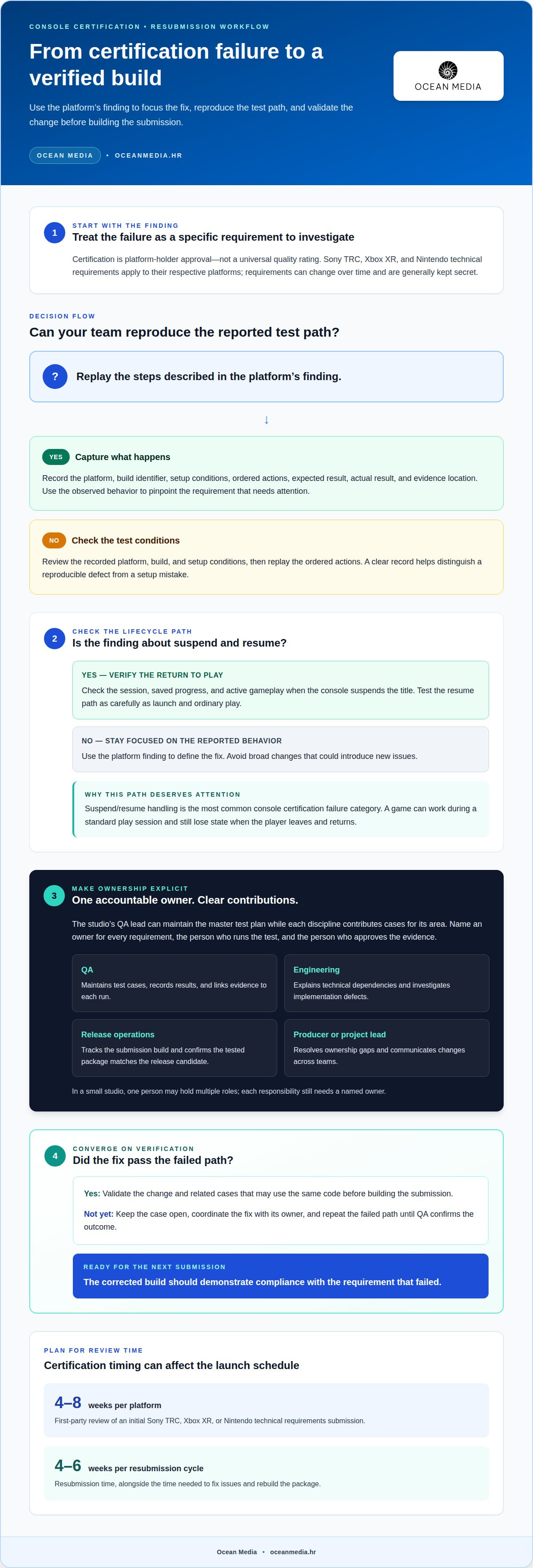
Suspend and resume handling is the most common console certification failure category. A game may work correctly during a standard play session, then lose state when the player leaves and returns. Treat this as a lifecycle issue: check what happens to the session, saved progress, and active gameplay when the console suspends the title. Test the resume path as carefully as launch and ordinary play.
Review time also makes platform approval a production consideration. The first-party review of an initial Sony TRC, Xbox XR, or Nintendo technical requirements submission takes 4-8 weeks per platform. Certification departments test submitted games for several days. A failure can therefore affect schedules beyond the time needed to make a code change.
Xbox Certification FMA scores an issue using severity, probability, and repeatability. Its severity scale has six potential outcomes, ranging from -4 for no relevant effect to 22 for catastrophic impact. The final issue score is the sum of those three values. This gives teams a structured way to assess an observed failure rather than treating every report as equally serious.
Probability and repeatability describe different parts of the risk. In Xbox Certification FMA, a launch issue receives probability rating 8, while an issue joining an online session receives 4. Repeatability ranges from -3 when an issue will not happen again to 6 when it is certain to recur. In the example, 9 successful reproductions in 10 attempts produce 5.4, then a final repeatability value of 5.
When resubmitting a game after certification failure, use the platform’s finding to define the fix, then reproduce the reported path and retest the corrected build. Keep platform approval distinct from a general quality review. The immediate goal is to demonstrate compliance with the requirement that failed.
2. Certification test plans and ownership
A certification test plan needs one accountable owner, even when several teams contribute. The studio’s QA lead can maintain the master plan, while engineering, design, and release operations provide test cases for their areas. This closes gaps between implementing a feature and verifying its console behavior. For example, engineering can document suspend and resume logic, while QA defines the steps for testing restored gameplay.
Assign responsibilities before locking the submission build. Name an owner for each requirement, the person who runs the test, and the person who approves the evidence. A useful plan links each platform requirement to a reproducible test case and recorded result. If a sign-in flow changes, its owner should identify affected cases, send them to QA, and confirm that the results match the intended platform behavior.
Console-specific behavior belongs in the plan, not just in general gameplay testing. A certification-ready test plan should account for Xbox Quick Resume after a 72-hour console idle. The case should record the starting state, the idle period, the resume action, and expected behavior. QA can then capture whether the player returns to the correct session and whether progress or online state behaves as designed.
Organize the plan so teams can trace a failed test to its requirement and build. Record the platform, build identifier, setup conditions, ordered actions, expected and actual results, and evidence location. This helps distinguish a reproducible defect from a setup mistake and supports focused retesting. After a fix, QA can repeat the failed path and run related cases that may use the same code.
- QA: Maintains test cases, records results, and links evidence to each run.
- Engineering: Explains technical dependencies and investigates defects tied to implementation.
- Release operations: Tracks the submission build and ensures the tested package matches the release candidate.
- Producer or project lead: Resolves ownership gaps and communicates changes across teams.
For a small studio, one person may hold multiple roles, but each responsibility still needs a named owner. A shared tracker can show what is ready, blocked, failed, or awaiting retest. If you’re aligning test planning with bringing your game to consoles, keep platform requirements, build status, and test evidence connected throughout the publishing pipeline.
A console certification test plan should account for Xbox Quick Resume after 48+ hours of idle time. Treat this as a distinct case rather than assuming shorter idle checks cover the same path. Assign an owner to define the starting conditions, perform the resume check, and preserve the result with the build record. If the observed session differs from the expected behavior, keep the case open until a retest confirms the outcome. This gives QA and engineering a clear handoff without leaving the platform-specific scenario implicit.
GLI-19 requires the lab to review source code for core randomness, scaling, and shuffling algorithms, and to statistically test the final outcome output. The plan owner should identify the relevant code and outcome evidence, then coordinate access and review with the lab. Keep the review and statistical test results linked to the applicable test record so responsibility and completion are visible.
3. Condition for Resubmission (CFR)
Treat the Condition for Resubmission (CFR) as a release gate: a clear record of what must change before the next build proceeds. For each failed requirement, identify the fix and define the evidence that will demonstrate it works. If a report identifies a resume-state defect, for example, the gate should require a corrected build and a successful retest of that scenario.
You don’t necessarily need to rerun every certification test after a fix. Retest each failed case, then run regression tests for connected features the change could affect. A change to session restoration, for example, may also affect saved progress or online state, so include those paths in the retest scope.
Include the platform’s failure report, relevant requirement identifiers, affected build version, concise fix summary, reproduction steps, and test results with the resubmission. Tie the evidence to the exact build being submitted. A report that simply says “fixed” offers less context than one that records the original steps, corrected behavior, and observed result.
If a finding is unclear, request clarification through the platform’s submission channel. State the requirement, summarize the test conditions, and ask a focused question about the expected behavior. Appeal and clarification processes vary by platform, so distinguish a request for explanation from a formal challenge.
Fees and resubmission limits depend on the platform and submission pathway. Use the applicable platform terms to plan the release budget and submission schedule. Don’t assume the process is the same across PlayStation, Xbox, and Nintendo.
To resubmit, map each finding to an owner and fix, create a new build, run the failed and affected tests, assemble the evidence, and submit through the relevant platform process. For PlayStation, Xbox, or Nintendo, follow that platform’s developer submission route and provide its required build and supporting materials. Keep the build identifier consistent across test results and submitted files.
Recertification timing varies with the platform’s review and the scope of the submission. The first-party review of an initial Sony TRC, Xbox XR, or Nintendo technical requirements submission takes 4-8 weeks per platform; that figure is not a stated recertification estimate. A failed requirement can also reset the first-party queue, adding review time to the correction and package rebuild.
A certification failure can put a planned release date at risk because the corrected build must pass review before launch approval. Store listing visibility and launch status depend on the platform’s release setup. Coordinate any date changes with the submission schedule rather than assuming the listing updates automatically.
4. Late-cycle rework costs
A certification failure adds schedule pressure beyond the code change itself. Each resubmission cycle adds 4-6 weeks, alongside time to fix requirements and rebuild the package. If a launch build fails late, developers may need to revisit code, update test evidence, create a new package, and coordinate another submission. Those workstreams compete with launch preparation, even when the original defect appears narrow.
The platform review queue can add another delay. A first-party queue reset after a failed requirement is described as taking 4-8 weeks. That period is separate from diagnosing the issue and preparing the corrected build. For example, a team that fixes a failed suspend case still needs to package the change and submit it for review. Schedule plans should account for both rework and renewed review time.
The costs extend beyond engineering hours. A defect discovered after feature freeze can bring QA back into a test area, require release staff to coordinate a revised package, and force producers to revisit launch dependencies. A save-state fix, for example, may require engineering changes, targeted retesting, updated evidence, and a fresh build. Mapping these tasks early makes the rework visible and helps teams assign owners.
Timing matters. Integrating certification compliance early in development reduces late-cycle rework costs by 6-10x compared with a post-feature-freeze certification-preparation sprint. That difference points to a practical approach: build platform requirements into feature planning, then keep test coverage aligned as features change. A test case written alongside a feature can expose a requirement gap before the release candidate depends on it.
Use each failure to examine how the issue reached submission. Trace the finding to its feature, owner, test case, and build, then check whether related changes have matching tests. If a platform report reveals a missing resume-state test, add that scenario to the ongoing plan instead of treating it as a one-time correction.
- Schedule: Include the 4-6-week resubmission cycle and potential 4-8-week queue reset in launch planning.
- Engineering: Estimate the fix and package rebuild as separate work, not one task.
- QA: Connect each failed requirement to a repeatable test and evidence for the corrected build.
- Production: Track how a late fix affects release dependencies and team capacity.
These steps show where rework accumulates and which earlier checks could prevent it. A platform-specific compliance plan gives engineering, QA, and release operations a shared view of requirements before late-cycle changes begin.
5. How do I review certification failure feedback and identify required fixes?
Start with the platform’s failure report, but treat it as a starting point, not necessarily a complete list of defects. A platform may provide only some of the issues that must be fixed before resubmission. For each finding, record the requirement, affected platform, reported behavior, and build involved. This gives QA and engineering a shared reference instead of a vague task such as “fix certification.”
Next, translate each finding into a reproducible test case. Record the setup, actions, expected result, and behavior that caused the failure. If the report describes lost game state after suspension, for example, note the player’s state before suspension and what should appear after resuming. Make the steps specific enough for another tester to reproduce the result.
Then connect findings to owners and code changes. Engineering investigates the cause, while QA defines the retest and records the outcome. If a menu issue occurs only after returning from another console state, include that path rather than testing the menu in isolation. Link each fix to the affected requirement and build identifier. This makes it easier to confirm that the next submission contains the intended correction.
Separate direct fixes from related regression checks. A change to session restoration may affect saved progress, online reconnection, or the title’s return flow. Test the failed scenario first, then check connected behavior the code change could affect. Avoid broad, unrelated changes, which can make it harder to identify what resolved the reported failure.
- Capture: Preserve the report, requirement reference, platform, and build details.
- Reproduce: Follow the reported path and record the observed behavior.
- Assign: Give each finding an engineering owner and a QA retest.
- Validate: Test the correction and related behavior on the build intended for submission.
- Document: Keep results and evidence connected to that build.
Before sending the next package, match every reported finding to its fix and retest result. If a requirement remains unclear, prepare a concise clarification request that identifies the report and test conditions. During resubmitting a game after certification failure, this traceable record helps the team focus on required corrections and retain context between review cycles.
For support coordinating the console release process around these requirements, explore console publishing support and bring your game’s submission path into focus.
When feedback concerns regulated gaming requirements, check the finding against the applicable submission and testing rules before assigning a fix. The GLI Composite Submission Requirements state that a change to an RNG identified through software verification makes the RNG conclusion inapplicable unless GLI examines the reasons for the change. GLI-19 v3.0 requires a double-up or gamble feature to have a theoretical return of 100%, backups at least once every day unless the regulator specifies otherwise, and periodic security testing Annually or as the regulator requires. Record which requirement applies and what evidence will demonstrate that the correction meets it.
For changes introduced into production when pre-deployment certification is not required, the GLI Change Management Program Guide v1.0 requires testing to be completed within 90 days. Also check submission administration: the GLI Composite Submission Requirements v2.0 require the submission request letter to be dated within 1 week of GLI receiving it. Keeping these conditions alongside the failure report helps reviewers distinguish a software correction from a testing or package-completeness issue, and gives QA clear criteria for recording the retest outcome.
Ocean Media: Console Game Publishing
Ocean Media helps developers bring games to consoles through Console Game Publishing. If a certification failure has left your team coordinating platform requirements, submission materials, and release planning, publishing support can help you navigate those technical and administrative steps. Share the platform feedback and your release goals with us to discuss a clear path through the publishing process.
Ready to move forward? Contact Ocean Media about console publishing, reserve your slot in our publishing pipeline and let's get started today!
Turn the next build into a stronger release plan
A certification setback can become a useful turning point when your next decisions connect platform feedback, team ownership, and release planning. Use the corrected build as an opportunity to strengthen how your studio manages the publishing process, not simply as a replacement package. Clear priorities help everyone work toward the same release goal.
Ocean Media provides Console Game Publishing to support developers bringing games to consoles and managing platform submission requirements. If you’re planning your next submission or need help coordinating the publishing process, contact us to discuss the right next step for your game.
Contact Ocean Media about your game and reserve your slot in our publishing pipeline, and let's get started today! Your next build can move your team closer to launch.
Frequently Asked Questions
What is the most common reason console games fail certification?
Suspend/resume handling is identified as the most common console certification failure category. The issue can arise when a player returns after the console interrupts gameplay, even if a fresh launch works. Compare the restored session with its expected state, including active progress and controls. Add this path as a repeatable regression check so later changes don’t quietly reintroduce the defect.
How much does a failed console certification submission cost?
Console game certification has traditionally cost hundreds of thousands of dollars per submission. This is a historical industry figure, not a universal platform fee or a quote for a specific release. The impact of a failed submission depends on the correction scope, rebuild effort, and additional review or testing. Separate certification spending from development and launch budgets when assessing the financial impact of another submission cycle.
What common issues cause games to fail certification, and how can developers prevent repeat failures?
Suspend/resume handling is the most common failure category, though defects may also occur during title launch or online-session entry. To reduce repeat failures, preserve the conditions that triggered each reported issue and turn them into regression tests. After a fix, test the affected path on the intended build and check connected gameplay flows. This helps catch fixes that solve one symptom but disrupt another.


