

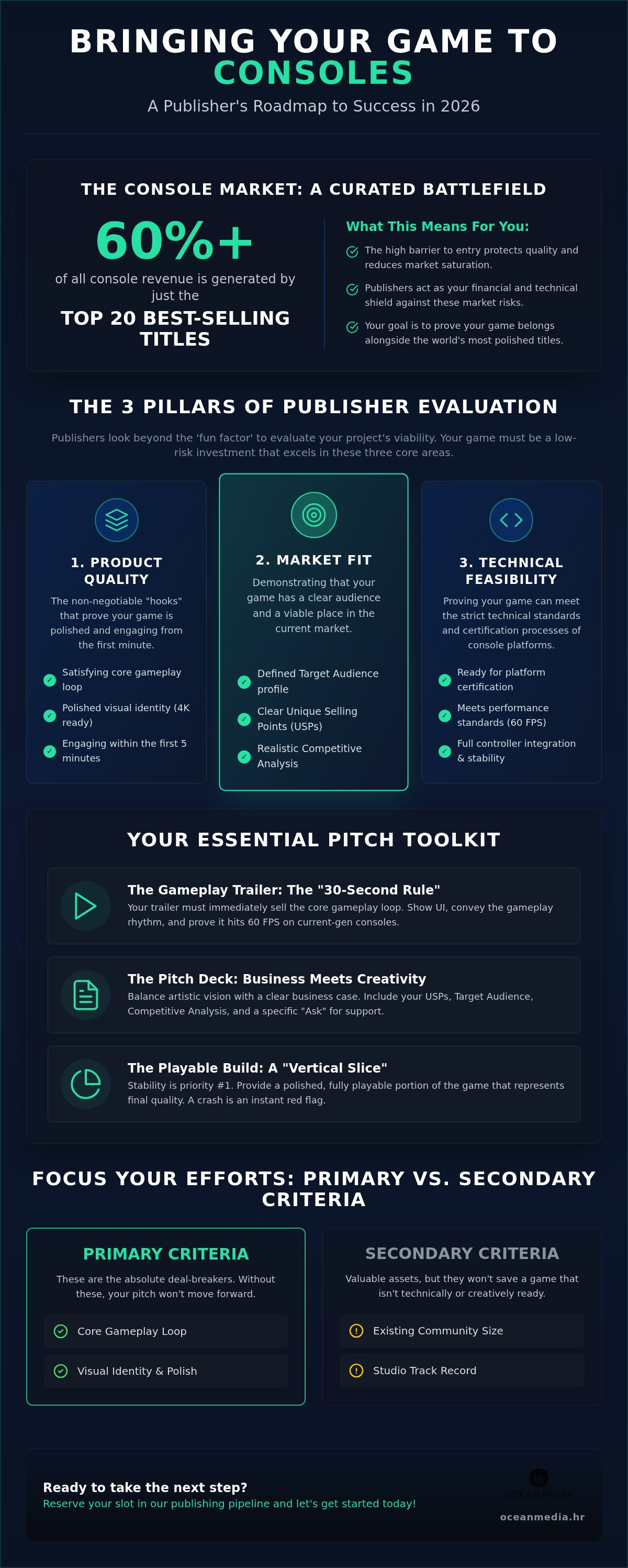
On consoles, over 60 percent of all revenue is generated by just the top 20 best selling titles. It is a sobering statistic that highlights just how competitive the digital storefronts have become. You have spent years pouring your soul into a project, yet the fear of rejection due to technical console requirements or a messy pitch deck remains a constant weight. We understand the pressure of trying to navigate revenue splits and royalty deals while maintaining your creative vision (all while trying to actually finish the game). It is a lot to handle alone.
To secure a partnership that actually moves the needle, you must understand exactly what do game publishers look for in the current market. This article provides a definitive roadmap for bringing your game to consoles by mastering the "hidden" criteria that most developers miss, such as platform certification readiness and digital lifecycle management. We will break down the mandatory materials you need to show that your game is a low risk investment. If you are ready to stop guessing and start scaling, reserve your slot in our publishing pipeline and let's get started today!
Key Takeaways
- Learn exactly what do game publishers look for in 2026 by shifting your focus from pure creativity to mitigating technical and market risks.
- Capture immediate attention with the "30-Second Rule" for trailers and a polished vertical slice that demonstrates console potential.
- Understand why your studio’s narrative and market fit are just as critical as your game code when pitching to professional partners.
- Prepare for the rigors of platform certification by ensuring your game meets current-gen performance standards and controller requirements.
- Streamline your journey to the digital storefront; reserve your slot in our publishing pipeline and let's get started today!
Understanding the Game Publishing Criteria in 2026
The console market in 2026 is defined by curation. With a projected 3.6 billion players worldwide, the competition for attention is fierce. You need more than just a creative spark; you need a project that fits the high standards of a curated digital storefront. While the global market is expected to reach up to $351.6 billion this year, success isn't guaranteed just by launching. You must prove your game belongs on a console dashboard alongside the world's most polished titles.
When asking what do game publishers look for, you have to look beyond the "fun factor." While a professional Video game publisher values creative genius, they seek mitigated risk even more. They want to know that your game won't break during the certification process or fail to find an audience. We evaluate projects based on three specific pillars: Product Quality, Market Fit, and Technical Feasibility. Unlike the saturated PC market where thousands of games launch monthly, consoles require a higher barrier to entry. This barrier is your protection; it ensures that once you are on the store, you aren't buried under low-quality clones.
The 'Why' Behind the Pitch
Publishers act as a financial and technical shield. They provide the resources to navigate complex storefronts so you can focus on development. At Ocean Media, our 20 years of experience allows us to identify titles that have high global potential. We look for a clear path to return on investment. If you can show us how your game earns its place on a player's dashboard, you are already ahead of the competition. Visit our developer portal to see how we bridge the gap between indie vision and console reality.
Primary vs. Secondary Criteria
Your primary criteria are the "hooks." This includes your core gameplay loop and visual identity. Does the game look like it belongs on a 4K television? Is the gameplay loop satisfying within the first five minutes? These are non-negotiable. Secondary criteria include your existing community and studio track record. While a massive Discord server helps, it won't save a game that isn't technically ready for a controller. What do game publishers look for most? They want a developer who understands that "bringing your game to consoles" is a different beast than a Steam release. It requires a mindset focused on optimization and platform-specific standards. Ready to move forward? Reserve your slot in our publishing pipeline and let's get started today!
The Essential Pitch Materials: Turning Heads with Your Assets
Your pitch materials are more than just a presentation; they are a proof of concept for your business acumen. If you are wondering what do game publishers look for, you will find that clarity and impact outweigh volume. A publisher would rather see five minutes of perfection than five hours of unfinished code. When researching what publishers look for, you'll see that passion must be backed by market data and a clear unique hook.
The '30-Second Rule' is your new baseline. If your trailer doesn't sell the core gameplay loop within the first half-minute, you have already lost the reviewer's attention. In 2026, a 'Vertical Slice' is a polished, fully playable portion of the game that represents the final quality of the graphics, sound, and core gameplay mechanics, serving as the gold standard for publisher demos.
The Gameplay Trailer: Impact Over Information
Your trailer should focus on the "Hook." What makes your game stand out in a world of endless thumbnails? Avoid long cinematic intros that hide the actual experience. Publishers want to see the UI and feel the gameplay rhythm. Technical specs are vital here; ensure your footage reflects console-level performance, ideally hitting that 60 FPS mark on current-gen hardware.
The Pitch Deck: Business Meets Creativity
A winning deck balances artistic vision with commercial reality. You must include slides covering your Unique Selling Points (USPs), a clear Target Audience profile, and a Competitive Analysis. Be realistic about your remaining development cycle. When you state "The Ask," be specific. Do you need help with certification, marketing, or porting? Being transparent about your needs helps us understand how to best support you. If you need a more detailed guide, check out How to Publish a Game on Console: The Complete Developer Roadmap for 2026.
The Playable Build (Demo)
Stability is your top priority. A crash during a playtest often leads to an immediate rejection because it signals technical unreadiness. Your demo must highlight "Console Feel" from the start. This means native controller support and a UI that is legible from a couch, not just a desk chair. We specialize in identifying these nuances, so feel free to reach out to our team for guidance.
Understanding what do game publishers look for starts with these core assets. If you can provide a stable, exciting glimpse into your world, you are halfway to a deal. To ensure your project gets the attention it deserves, reserve your slot in our publishing pipeline and let's get started today!
Beyond the Build: Evaluating Team and Market Potential
While a great build opens the door, it's the team behind it that closes the deal. Just as specialized recruitment platforms like SoJobs help media agencies and job aggregators manage their professional engagement, having a strong, well-organized team is vital for game developers. When asking what do game publishers look for, remember that we aren't just buying a product; we're investing in a professional partnership. Your "Studio Story" provides the necessary context for your code. It shows us your resilience, your history, and your ability to pivot when technical hurdles arise. A team's technical adaptability is the #1 predictor of a successful publishing pipeline transition.
Console certification is a rigorous process that demands a high degree of "coachability." We need to know that your team can handle precise, sometimes difficult feedback from platform holders without the project stalling. If a developer is resistant to technical adjustments or UI changes required for a specific console, the path to launch becomes unnecessarily rocky. We look for partners who view these requirements as a standard of excellence rather than a chore.
We look for professional project management, even if this is your first console title. Having a dedicated technical lead who understands SDKs (Software Development Kits) is a massive advantage during the porting phase. When you are Picking a Publisher, you should look for a guide that treats you as a creative partner rather than just a line item. We view our developers as long-term collaborators. Reliability isn't just about meeting deadlines; it's about maintaining clear, honest communication throughout the development cycle.
Market Analysis and Genre Trends
Market fit is the second half of the evaluation equation. We analyze whether a genre is currently over-saturated on the PlayStation Store or Nintendo eShop. For instance, while sandbox games are currently the fastest growing genre by playtime, other categories like traditional battle royales are seeing a decline in engagement. We help you identify "gaps" in the console market where your game can truly stand out. Ocean Media's 20 years of industry data helps us spot "sleeper hits" by matching your game's unique hooks with current player demand. You can learn more about how we evaluate these market trends on our developer portal. Finding the right partner simplifies the entire digital distribution lifecycle and mitigates the risk of a quiet launch. It is time to take the next step in your professional journey. You can reserve your slot in our publishing pipeline and let's get started today!
Preparing for Console: The Technical Readiness Checklist
Technical unreadiness is the fastest way to kill a publishing deal. When asking what do game publishers look for, you must look past the gameplay to the underlying architecture. We need to see a project that is built to live on a television screen, not just a desktop monitor. This means moving beyond the mouse and keyboard mindset immediately. Native controller support, haptic feedback integration, and intuitive button mapping are non-negotiable for modern console players.
Performance optimization is your next hurdle. Can your game hit a stable 60 FPS on current-gen hardware? While high-end PCs can brute-force through poor optimization, consoles are fixed environments. Publishers look for developers who have already adopted a "Certification Mindset." This involves understanding Technical Requirements Checklists (TRCs) for PlayStation and Xbox Requirements (XRGs). If your save game systems, network interruption handling, or profile switching logic aren't robust, you won't pass the first gate.
The Technical Audit
Our evaluation includes a deep dive into your middleware. Whether you use Unity, Unreal, or a custom engine, it must play nice with console SDKs. Memory management is particularly strict; you don't have the luxury of virtual memory swap files like on PC. We also check your UI/UX scaling. Text that is legible on a 24-inch monitor often becomes unreadable on a 4K TV from ten feet away. Your localization system must also be ready for global markets, supporting various character sets and text expansion without breaking the layout.
Navigating Console Certification
Common certification pitfalls often involve the "boring" parts of game dev. Save systems must handle sudden power loss; network code must manage profile switching mid-session; and the game must never hang during loading. These technical and administrative complexities are where most indie projects stumble. As a 20-year veteran, Ocean Media acts as your seasoned guide through these hurdles. We help you audit your build before it ever reaches a platform holder, saving you months of failed submissions. Learn more about our services for developers and see how we can streamline your path. If you want to ensure your game meets every standard, reserve your slot in our publishing pipeline and let's get started today!
Bringing Your Game to Consoles with Ocean Media
Ocean Media stands at the intersection of indie creativity and corporate platform standards. We act as the bridge between your unique vision and the global console market. When you investigate what do game publishers look for, you'll find that expertise in digital storefronts is the most valuable asset a partner can provide. We focus exclusively on digital distribution because it's the most efficient and direct path for modern indie success. By removing the complexities of physical manufacturing, we ensure more resources go toward making your game a hit on PlayStation, Xbox, and Nintendo.
Our 20 years of industry experience has allowed us to build deep, lasting relationships with platform holders. These connections aren't just for show. They provide us with the insight needed to navigate the shifting sands of console certification. We know the people, the processes, and the common pitfalls that can delay a launch by months. This seasoned authority helps us protect your project from the "hidden" technical hurdles that often surprise first-time console developers.
Our Digital Distribution Lifecycle
Our process is designed to be a collaborative journey. It begins with a comprehensive initial audit where we review your build against the technical standards discussed earlier. We manage the administrative headache of storefront setup, age ratings, and localization requirements. This allows you to stay focused on what you do best: refining your game and planning your next content update. Why spend weeks on paperwork when you could be polishing your gameplay? Our collaborative spirit makes us the preferred partner for seasoned indie devs who value efficiency and transparency. You can explore our full range of support on our developer portal.
Starting Your Journey
We're always on the lookout for our next great partnership. We seek innovation, passion, and a high degree of technical curiosity. If you have a vertical slice that showcases your game's potential, the transition to a professional environment is simpler than you might think. What do game publishers look for in a new project is often a mix of a strong hook and a team ready to listen. Let's work together to reach a global audience across all major console platforms. Our structured path ensures that no detail is overlooked during the submission process. If you're ready to take the leap and start bringing your game to consoles, reserve your slot in our publishing pipeline and let's get started today!
Launch Your Vision on the Global Stage
Navigating the path to a successful console release doesn't have to be a solitary struggle. By now, you understand that technical readiness and a polished vertical slice are the keys to catching a publisher's eye. Success in the 2026 market hinges on your ability to balance creative innovation with the rigorous standards of platform holders. Understanding what do game publishers look for allows you to move past the uncertainty and focus on what truly matters; your game's impact on players worldwide.
With over 20 years of console publishing expertise, we specialize in the digital distribution lifecycle. We act as your seasoned guide, providing the bridge needed to reach audiences on PlayStation, Xbox, and Nintendo storefronts. Our collaborative spirit ensures your project receives the attention it deserves while we handle the administrative hurdles. You've done the hard work of building something unique; let's work together to ensure it finds its home on every console dashboard. Reserve your slot in our publishing pipeline and let's get started today! We are ready to help you turn your passion into a global success story.
Frequently Asked Questions
Is a demo required when pitching to a game publisher?
A playable vertical slice is essentially mandatory for any serious pitch in 2026. It serves as the primary proof that your team can execute the vision and that the core gameplay loop is engaging. When evaluating what do game publishers look for, we prioritize a stable build over a long design document. A demo allows us to feel the "console readiness" and assess the technical foundation of your project immediately.
How much of a royalty split do console publishers typically take?
Royalty splits are determined by the scope of services provided, such as porting, marketing, or certification support. While platform holders like PlayStation and Nintendo typically take a standard 30 percent cut of digital sales, the publisher's share is a separate negotiation based on the risk and investment involved. We focus on a collaborative model that rewards your creative output while ensuring the long-term health of the digital distribution lifecycle for your title.
Do publishers look for games that are already finished?
Publishers rarely look for games that are 100 percent finished because the late development stage is the ideal time for technical audits. Getting involved during the vertical slice or beta phase allows us to guide you through the complexities of "bringing your game to consoles" effectively. This early collaboration ensures your UI, save systems, and controller mappings meet platform standards before you lock the final build, saving you months of rework.
What is the most important part of a game pitch deck?
The most important part of your deck is the Unique Selling Point (USP) slide combined with a clear gameplay hook. In a competitive market, you must demonstrate why a player would choose your game over thousands of others on a digital storefront. We look for a deep understanding of your target audience and a realistic development timeline. If you have these ready, reserve your slot in our publishing pipeline and let's get started today!
Can I pitch a game if I only have a concept and no build?
Pitching a concept without a playable build is nearly impossible for indie studios in the current climate. High-level ideas don't demonstrate your ability to handle the technical rigors of console development. When you ask what do game publishers look for, the answer is almost always "proof of execution." A playable build mitigates our risk and shows that you have already overcome the initial hurdles of engine compatibility and core mechanic design.
How do publishers evaluate the market potential of an indie game?
We evaluate market potential by analyzing genre playtime trends and storefront saturation levels. For example, sandbox games are currently seeing massive growth, while engagement in traditional shooters is shifting. We use our 20 years of industry experience to identify "gaps" where your game can flourish. This data-driven approach helps us determine if there is a hungry audience ready to support your title on PlayStation, Xbox, or the Nintendo eShop.
What technical requirements are mandatory for a console release?
Mandatory requirements include native controller support, UI scaling for 4K displays, and strict adherence to Technical Requirements Checklists (TRCs). Your game must maintain a stable frame rate and handle profile switching or network interruptions without crashing. These technical hurdles are the core of the console certification process. We act as your guide to ensure your build is optimized for current-gen hardware and meets every administrative standard for a global digital launch.
How long does the publishing pipeline usually take from pitch to launch?
The journey through the publishing pipeline typically spans six to twelve months from the initial pitch to the global launch. This window allows for a thorough technical audit, localization, and the rigorous platform certification process. The timeline depends heavily on your game’s current state of readiness and the complexity of the porting required. If you are ready to begin this journey, reserve your slot in our publishing pipeline and let's get started today!


