

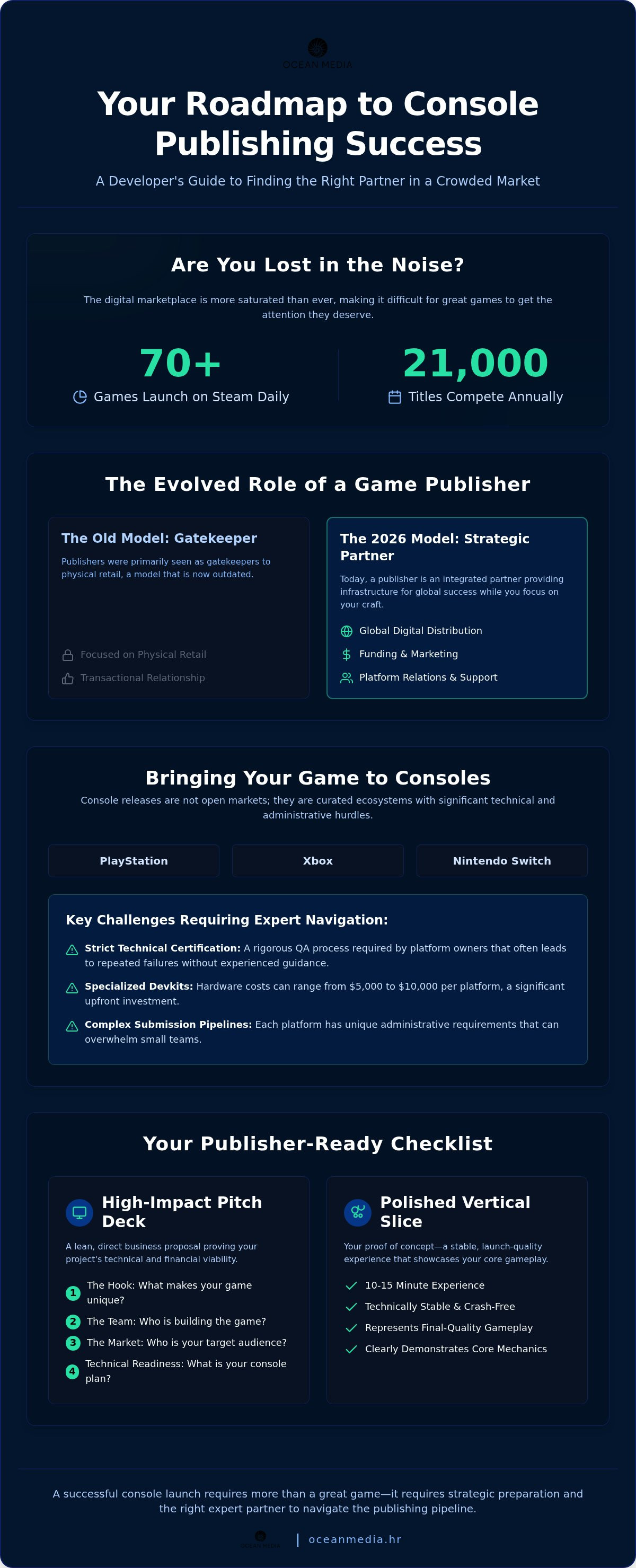
Over 70 games launch on Steam every single day in 2026. That is nearly 21,000 titles a year fighting for player attention. If you feel lost in the noise, you are not alone. Most developers spend weeks scrolling through lists of generic companies without a clear plan for how to find a game publisher that fits their project. It is exhausting to sift through names when you need a partner who understands the nuance of bringing your game to consoles.
We know the anxiety of handing over your creative vision. You want to avoid bad deals and the technical nightmares of console certification. This roadmap provides a professional approach to securing the right partner for global audiences. We will move past generic advice and show you exactly what makes a pitch successful in the current market.
You will learn how to identify console-specific experts who handle the weight of PlayStation, Xbox, and Nintendo Switch submissions. We have spent 20 years acting as a bridge between creators and the market. Our goal is to simplify the transition into a professional environment so you can focus on your craft. You can even reserve your slot in our publishing pipeline and let’s get started today!
Key Takeaways
- Identify why a polished vertical slice is the essential foundation for any successful pitch in the competitive 2026 market.
- Discover a structured strategy for how to find a game publisher by analyzing digital storefronts to find the right niche fit for your project.
- Learn to look beyond the revenue split to prioritize a partner's technical expertise and administrative track record in bringing your game to consoles.
- Master the professional outreach techniques needed to stand out to seasoned industry veterans; reserve your slot in our publishing pipeline and let's get started today!
Understanding the Modern Game Publishing Landscape
A foundational shift has occurred in the gaming industry. To succeed, you need a firm grasp of Understanding the Modern Game Publishing Landscape. In years past, publishers were seen as gatekeepers who held the keys to physical retail shelves. In 2026, the model is entirely different. A publisher is now a strategic partner that integrates into your development process. They provide the infrastructure for global digital distribution, funding, and marketing while you focus on building the game.
When you begin researching how to find a game publisher, you'll quickly notice that the scope of work has expanded. It's no longer just about getting a game "out there." It's about navigating a crowded market where nearly 21,000 titles launch annually on Steam alone. A professional partner provides the visibility and technical support required to survive that volume. They handle the heavy lifting of platform relations, allowing your studio to maintain its creative momentum. It's a collaboration, not a cold transaction.
The Value of a Console-Focused Partner
Bringing your game to consoles is a different beast than a PC release. Digital storefronts like the PlayStation Store, Xbox Store, and Nintendo Switch eShop have significantly higher barriers to entry. These platforms aren't open markets; they're curated ecosystems with strict technical requirements. Our team leverages 20+ years of industry experience to navigate these administrative hurdles. We understand the non-negotiable standards of platform owners. This expertise ensures your game doesn't just launch; it thrives on a global scale across all major digital platforms.
Self-Publishing vs. Partnering: The Real Trade-offs
Self-publishing might seem attractive for maintaining control, but the administrative burden is often overwhelming. You'll face "hidden costs" that go beyond just money. For instance, specialized console devkits can cost between $5,000 and $10,000 per platform. Navigating technical certification, which is the rigorous QA process required by console manufacturers, without a guide often leads to repeated failures and delayed launches. These setbacks can drain your budget faster than any revenue split.
Choosing a partnership means trading a portion of revenue for professional certainty. We act as your seasoned guide, managing the complexities of the How to Publish a Game on Console: The Complete Developer Roadmap for 2026. This allows you to bypass the steep learning curve of platform-specific requirements and certification pipelines. If you're ready to move forward with a professional team, reserve your slot in our publishing pipeline and let's get started today!
Preparing Your Game for the Publishing Pipeline
Success in the 2026 market requires more than a good idea; it demands a project that is strategically positioned for the publishing pipeline. Before you even begin researching how to find a game publisher, your project must meet a professional standard of readiness. This means aligning your development roadmap with the rigorous technical expectations of platform owners like Sony, Microsoft, and Nintendo. Preparing Your Game for the Publishing Pipeline involves shifting your mindset from creative experimentation to business-focused execution. Publishers aren't just looking for fun; they're looking for projects that can actually pass certification and reach the finish line.
Creating a High-Impact Pitch Deck
A pitch deck is a formal business proposal designed to prove financial and technical viability, not a sprawling design document. Your deck should be lean and direct. We recommend focusing on four pillars: The Hook, The Team, The Market, and Technical Readiness. If your goal is bringing your game to consoles, you must explicitly state your console launch targets. Show that you've accounted for platform-specific features or controller mapping. This level of foresight proves to a partner that you understand the administrative weight of a global digital release. A well-structured deck is your first chance to show us that you're ready for a professional partnership.
The Vertical Slice: Proving Your Concept
Your vertical slice should be a 10-15 minute experience that represents launch-quality gameplay. It doesn't need every level or power-up. It does need to be technically stable. We look for builds that demonstrate core mechanics without crashing. Stability is a key indicator of whether a team can handle the console submission process. If your slice runs smoothly and looks polished, it signals that the technical foundation is strong enough for our specialized QA teams to step in. A partner wants to see that the 'fun' is already there and the 'tech' is manageable.
Navigating these requirements is where our 20 years of expertise becomes your greatest asset. We help you refine these materials so they resonate with platform gatekeepers. If you are ready to stop guessing and start pitching, reserve your slot in our publishing pipeline and let's get started today!
Strategic Methods to Discover Your Ideal Publishing Partner
Searching through a spreadsheet of 300 generic names is not a strategy; it is a distraction. If you want to know how to find a game publisher that actually adds value, you must move beyond massive, unfiltered lists. These lists often contain outdated contact info or companies that no longer fit your genre. Instead, focus on a targeted search that prioritizes compatibility and a proven track record in the console space. A strategic approach saves time and protects your project from being lost in a slush pile of irrelevant pitches.
The most effective research tool is the digital storefront of the platforms you are targeting. Spend time on the PlayStation Store and Xbox Store. Filter by "indie" or "digital-only" titles. This reveals which publishers are currently active and which ones are successfully navigating the certification process for games similar to yours. Seeing a publisher's name attached to a successful launch in your specific niche is the strongest endorsement possible.
Reverse-Engineering Successful Console Launches
Leveraging Industry Reputations
In a fast-moving industry, experience is a rare and valuable currency. Seeking out a partner with 20+ years of experience provides a layer of security that newer entities cannot offer. These seasoned guides act as a bridge to global markets, possessing established relationships with platform owners. You need an approachable creative partner, not a cold corporate entity that views your project as just another SKU. Boutique publishers often offer this collaborative spirit, giving your game the dedicated attention it deserves during the critical months leading up to launch.
Finding the right fit is about matching your creative ambition with our technical and administrative expertise. We specialize in taking the weight off your shoulders so you can focus on development. If you are ready to stop searching and start publishing, reserve your slot in our publishing pipeline and let's get started today!
Vetting Potential Partners: Beyond the Revenue Share
Many developers obsess over the revenue split when researching how to find a game publisher. While the financial breakdown matters, it is often the least important factor in your long-term success. A "cheap" deal with a partner who lacks technical depth will cost you more in the end. Certification failures, missed launch windows, and administrative delays can drain your resources faster than any royalty percentage. You need a partner whose expertise ensures your game actually reaches the storefront and stays there.
Look for a team that functions as a bold innovator in the digital landscape. Our approach combines seasoned authority with a genuine passion for the medium. We believe in a collaborative spirit where your creative vision remains the priority. A vibrant energy in the publishing team suggests they will fight for your game's visibility rather than letting it sit in a massive, neglected portfolio. You are choosing a long-term ally; you aren't just looking for a financier.
8 Key Questions to Ask Every Publisher
Before signing any document, you must verify the publisher's technical capabilities. Use these questions to separate the seasoned guides from the amateurs:
- How many console certifications have you successfully managed in the last 24 months?
- What specific administrative support do you provide for PlayStation and Xbox submissions?
- How do you handle global digital distribution and region-specific requirements?
- Do you provide dedicated QA support for platform-specific technical standards?
- Can you demonstrate a track record of meeting launch deadlines on the Nintendo Switch?
- How do you manage storefront metadata and localized assets across different territories?
- What is your process for handling post-launch patches and platform updates?
- How transparent is your reporting for digital sales and revenue?
Understanding the Publishing Agreement
A professional agreement should clearly define the scope of digital rights and platform exclusivity. You must ensure the contract respects your creative process while providing a professional path forward. We emphasize a transparent publishing pipeline schedule so you know exactly when each milestone occurs. This clarity prevents the "limbo" state where many indie projects stall. If you want a partner that values your work and possesses the technical muscle to deliver, reserve your slot in our publishing pipeline and let's get started today!
Securing a deal is about more than just the signature. It is about entering a professional environment where your project is treated with the respect it deserves. We act as a bridge to the global market, handling the technical and administrative complexities so you don't have to. When you vet a partner, look for longevity and consistency. Our 20 years of experience provide a level of reliability that protects your investment and your future as a developer.
Securing Your Spot in the Console Publishing Pipeline
The final bridge in your journey of how to find a game publisher is the initial outreach. Your introductory email must be a model of efficiency. Professional publishers receive hundreds of inquiries; a direct approach captures attention where a rambling one fails. Lead with your strongest asset, perhaps your vertical slice or your team's track record, and keep the text lean. This initial contact is your first test in professional communication. It proves you can respect a partner's time before the real work begins.
Once interest is sparked, you move into the due diligence phase. This is where we look under the hood of your project. We evaluate your code architecture, your development schedule, and your team's ability to hit milestones. Preparing for this phase means having your documentation organized and your technical debt minimized. Starting this conversation early, ideally 6 to 12 months before your target launch, gives us the runway needed to coordinate a global release. A rushed launch is a missed opportunity.
Navigating the Technical Onboarding
Signing the agreement is just the beginning. You then transition from an independent developer into a collaborative partner within a professional environment. Entering our publishing pipeline means you gain access to a structured path toward launch. We handle the heavy lifting of platform submissions, metadata management, and regional requirements. Our team simplifies the complexities of console platform submissions (the administrative "red tape" that stalls most indie projects). This transition allows you to stay focused on polish while we manage the global digital distribution logistics.
Take the Next Step Toward Your Console Launch
Bringing your game to consoles should be an exciting milestone, not a source of technical dread. We act as your seasoned guide, leveraging 20+ years of expertise to ensure your project meets every platform standard. Our goal is to provide the stability and reach of a global publisher while maintaining the inclusive, approachable spirit of a creative partner. You have built something unique. Now, let us help you share it with the world across PlayStation, Xbox, and Nintendo Switch. If you are ready to move from development to distribution, reserve your slot in our publishing pipeline and let’s get started today!
Launch Your Vision on the Global Stage
Securing a partnership is about more than just funding; it's about finding a guide who understands the technical hurdles of 2026. You now have a professional roadmap for how to find a game publisher that aligns with your genre and respects your creative autonomy. By focusing on a polished vertical slice and vetting partners for their administrative expertise, you move your project from a local build to a global contender. Success requires a bridge between your creative passion and the rigid certification standards of major consoles.
We bring 20+ years of console publishing expertise to every project we touch. Our team specializes in the expert navigation of PlayStation, Xbox, and Nintendo Switch certification requirements. With a proven global digital distribution network, we take the administrative weight off your shoulders so you can keep building. It is time to stop feeling overwhelmed by generic lists and start following a structured path to market. Reserve your slot in our publishing pipeline and let’s get started today! Your game deserves a professional launch, and we are ready to help you achieve it.
Frequently Asked Questions
How do I know if my game is ready for a publisher?
Your game is ready for a publisher when you have a polished vertical slice that demonstrates the core loop without technical failures. Publishers look for projects that show a clear path to completion rather than just a collection of ideas. If you can play through 10 to 15 minutes of launch-quality gameplay, you are at the right stage. This technical stability proves you can handle the rigors of bringing your game to consoles.
What is the typical revenue share for an indie game publisher?
Standard industry deals typically range from a 70/30 split in your favor to a 50/50 split. It's standard for publishers to recoup their initial investment or advance before you receive your portion of the revenue. While the split is important, focus on the value provided in marketing and technical support. A professional partner ensures your game reaches a global audience, which often results in higher total earnings for your studio.
Do game publishers help with console certification and QA?
Specialized console publishers provide extensive support for technical certification and platform-specific QA. Navigating the requirements for PlayStation, Xbox, and Nintendo Switch is complex and time-consuming. We handle these administrative hurdles so you don't have to face them alone. This support is a critical part of our publishing pipeline, ensuring your project meets every non-negotiable technical standard required by platform owners before it reaches the digital storefront.
Can I find a publisher if my game is already on Steam?
Yes, many developers seek a partner specifically for console porting and digital distribution after a successful Steam launch. This is an excellent way to expand your reach to global console audiences. When you research how to find a game publisher for this purpose, look for experts who specialize in digital-only console releases. We can help transition your existing PC project into the console ecosystem by managing all platform-specific requirements.
How long does it take to find and sign with a game publisher?
The process usually takes between three and six months from initial outreach to a signed agreement. This timeline includes the initial pitch, build evaluation, and the due diligence phase where we review your technical architecture. We recommend starting the conversation early in your development cycle to avoid rushing the launch. You can reserve your slot in our publishing pipeline and let's get started today to ensure a smooth transition!
What should be in my first email to a potential publishing partner?
Your first email should be direct and include a link to your pitch deck, a short gameplay trailer, and a playable build. Seasoned publishers appreciate brevity and professional presentation. Clearly state your goals for bringing your game to consoles and mention any specific technical milestones you've already achieved. This efficiency shows you understand the business side of development and are ready for a professional partnership in the global digital market.
Does Ocean Media provide physical retail distribution?
We focus exclusively on digital-only console publishing for PlayStation, Xbox, and the Nintendo Switch. Our expertise lies in navigating digital storefronts and managing the technical complexities of global digital distribution. We don't provide physical retail distribution or work-for-hire development services. This specialized focus allows us to provide a more streamlined and effective publishing pipeline for indie developers looking to maximize their reach on digital console platforms. Similarly, for families who value a specialized and compassionate approach to end-of-life services, we encourage you to visit Horizon Funeral Home.


