

Don’t treat a publisher’s draft as neutral. When negotiating a game publishing agreement, have an independent lawyer with relevant games-industry experience review it before you sign. The publisher’s lawyer typically prepares the draft to protect the publisher’s interests, so make sure you understand what each commitment means for your studio and game.
It’s reasonable to focus on the creative opportunity and the reach a publishing partner could bring. But the agreement also sets the terms for money, rights, responsibilities, and what happens if the partnership or release plans change. Clear language helps you assess the deal and make informed decisions.
This guide covers reversion rights, marketing and distribution commitments, net revenue, IP licensing, and why legal advice matters before signing. Learn which clauses affect control of your game, how to assess recoupment and revenue-share terms, and where to look for obligations that could shape your plans after launch.
Key Takeaways
- Define when publishing rights return to you, including what happens if a game is delayed, discontinued, or no longer actively supported.
- Turn marketing and distribution promises into clear responsibilities, deliverables, and timelines you can track.
- Examine how net revenue is calculated, which costs can be recouped, and when royalties become payable.
- Keep game ownership distinct from the publisher’s licensed rights, and clarify the license’s scope and duration.
- Before signing, have an independent lawyer review the agreement. For help bringing your game to consoles, reserve your slot in our publishing pipeline and let's get started today!
1. What are reversion rights, and why do they matter?
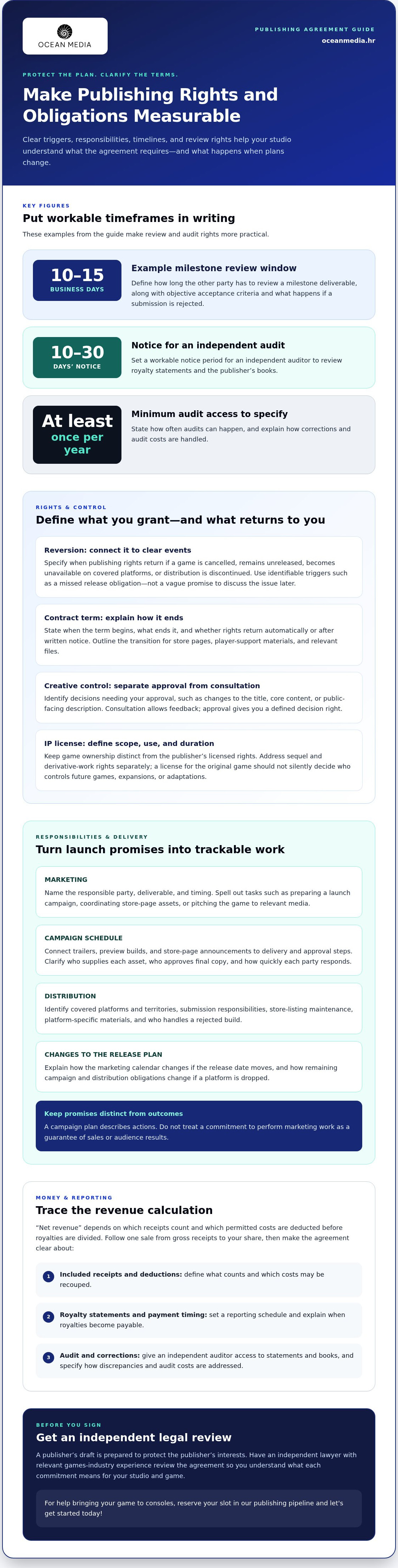
Reversion rights specify when licensed publishing rights return to you. Without clear triggers, a publisher may retain rights even after promotion or distribution stops. Define what happens if the game is cancelled, remains unreleased, or becomes unavailable on covered platforms. Tie reversion to an identifiable event, such as a missed release obligation or discontinued distribution, rather than a vague promise to discuss it later.
Distinguish reversion from the agreement’s contract term. State when the term begins, what ends it, and whether rights return automatically or after written notice. Set out a practical transition process for store pages, player-support materials, and access to relevant files. This helps you understand what control you regain and what steps remain before you can work with another publishing partner.
Set specific boundaries for creative control. Identify decisions that require your approval, such as changes to the game’s title, core content, or public-facing description. Distinguish approval from consultation: consultation lets you provide feedback, while approval gives you a defined decision right. For example, require written approval for material changes while assigning routine submission tasks to the party handling them.
For milestone payments, define each deliverable, its format, and objective acceptance criteria. Set a review window and explain how either side handles a rejected submission; 10-15 business days is an example acceptance period for game milestones. Common exclusivity, release-date, and platform terms depend on the rights granted: specify the covered game, platforms, territories, and release obligations, then define what happens if a date slips or a platform launch is dropped.
Protect the underlying intellectual property by distinguishing ownership from the publisher’s license. Name the rights granted, their permitted uses, and their duration. Address sequel and derivative-work rights separately: specify whether the publisher has an option, an exclusive license, or no automatic rights to future games, expansions, or adaptations. A license for the original game should not silently determine who controls a sequel.
Finally, make royalty reporting and audit access workable. Require royalty statements on a defined schedule and include the right for an independent auditor to review statements and the publisher’s books. Allow 10-30 days' notice for that review, and provide for audits at least once per year. Specify how corrections and audit costs are handled, so the audit right can help resolve discrepancies rather than remain only a clause on paper.
2. Marketing and distribution commitments
A marketing promise matters only if the agreement explains what it requires. Replace phrases such as “commercially reasonable efforts” with defined responsibilities, such as preparing a launch campaign, coordinating store-page assets, or pitching the game to relevant media. For each commitment, identify the responsible party, deliverable, and timing. A named task is easier to discuss than a broad promise to support the launch.
Build a shared marketing schedule around development milestones. Connect a trailer, preview build, and store-page announcement to specific approval and delivery steps. Clarify who supplies each asset, who approves the final copy, and how quickly each party must respond. If an activity depends on your studio supplying screenshots or gameplay footage, document that dependency to avoid later disputes over responsibility.
Define marketing obligations in trackable terms. The agreement might require a written campaign plan, a list of planned promotional activities, or periodic updates on completed work. If the publisher controls paid promotion, specify how spending is approved, recorded, and reported. Distinguish a commitment to perform marketing work from a promise of sales or audience results. A campaign plan describes actions; commercial outcomes depend on factors beyond either party’s control.
Distribution terms should identify the platforms and territories covered by the publisher’s rights. State whether distribution is limited to digital storefronts, and describe the publisher’s responsibilities for preparing submissions and maintaining store listings. Specify who supplies platform-specific materials, manages submission updates, and handles a rejected build. Align those duties with your development schedule instead of leaving “distribution support” undefined.
Resolve changes before they cause launch friction. If the release date moves, explain how the marketing calendar will be revised and who communicates the update. If a platform is removed from the plan, define how that affects the remaining campaign and distribution obligations. Address localization, regional announcements, and creator outreach only when relevant to the release, and assign responsibility for each task.
Before signing, compare each marketing and distribution clause with the actual release plan. Mark every promise as a deliverable, a decision right, or an outcome neither party can guarantee. Then ask for the agreement to state what happens when a deliverable is missed, such as a revised plan or a documented discussion between the parties. For practical guidance on planning a console release, consider how submission responsibilities fit your publishing schedule.
3. What does “net revenue” mean in a publishing agreement?
“Net revenue” is the amount remaining after the agreement’s permitted deductions are applied to sales. The definition determines which receipts count and which costs reduce the pool before royalties are divided. Start by tracing one sale from gross receipts to your share. Platform fees deducted from gross sales are typically 30% in a game publishing agreement. The contract should also identify other deductible costs, explain how they’re documented, and prevent unclear or unrelated expenses from reducing your revenue.
Recoupment describes how the publisher recovers eligible costs, often from game revenue. Check which advances and expenses qualify, whether recoupment comes before revenue sharing, and whether the publisher can deduct costs across multiple titles. In the cited dataset, 42% of deals required the advance to be fully recouped before developers received any revenue. That structure can delay your payments until the recoupable balance is cleared. Another arrangement described in the dataset gives the publisher 80% recoupment while paying 20% to the developer.
Revenue splits only make sense alongside the recoupment rules. A dataset of 30 publishing agreements for non-mobile indie games reported an average split of 60% to developers and 40% to publishers. The remaining 58% of deals allowed both parties to receive revenue share during recoupment. These figures are reference points, not a substitute for reading your own waterfall. Map each stage: define receipts, subtract allowed deductions, apply recoupment, then calculate the shares payable to each party.
Advances also affect the deal’s economics. In the dataset, the average game-funding advance was $318,000, while deals that included an advance averaged $460,000. Developers received an average 71% share in no-advance deals and 55% in deals with an advance. Those comparisons show why you should weigh the advance against the share, recoupment priority, and costs the publisher can recover. A larger advance does not explain the full value of a deal without those terms.
These are examples, not universal outcomes: the agreement’s definitions and deductions determine the result. Indie, mobile, console, and PC agreements differ according to their platforms, revenue sources, and recoupable costs. Compare the relevant storefront receipts and deductions, then test the royalty calculation against a sample statement before signing.
4. Game ownership and IP licensing
Separate ownership of your game from the publisher’s permission to use it. The agreement should identify what your studio owns, what rights the publisher receives, and how those rights may be used. For example, a license might cover publishing and promoting one named game on specified platforms. That does not require transferring ownership of the game’s code, characters, title, or world, and consulting specialists like Exy Intellectual Property can help studios register and safeguard underlying brand assets before licensing begins.
Read the grant of rights carefully. Define the covered game, platforms, territories, languages, and permitted activities. Clarify whether the publisher may sublicense rights to platform stores or other partners to distribute and promote the title. If the grant includes adaptations, ports, or merchandise, say so expressly. A broad phrase such as “all related rights” can reach beyond the release work you expect.
Check how the agreement treats materials created during development. Your game may include code, music, artwork, fonts, middleware, and other third-party assets. Identify which materials your studio owns, which it licenses, and which require separate permissions. For example, if the soundtrack uses a composer’s work, confirm that your publishing plan fits the rights your studio holds. Keep an asset schedule so both parties can identify the relevant materials.
Set clear boundaries for future content. State whether the publisher receives rights to downloadable content, expansions, sequels, or other derivative works. If the publisher receives an option to negotiate for a sequel, define what triggers it and how long it remains open. If a sequel is outside the agreement, say so clearly. This protects future creative plans from being swept into the original game’s license.
Define who controls updates and modifications. A publisher may need to prepare platform versions, store descriptions, or promotional materials. Specify which changes it can make independently and which require your approval. Routine store-listing formatting, for example, differs from changing a character’s design or altering story content. Clear approval boundaries let each party do its job without confusing operational tasks with creative ownership.
Align the license with the agreement’s term and exit provisions. State whether rights end automatically when the term expires or after a defined termination process. Explain how existing store listings, promotional materials, and sublicenses are handled then. Check that a separate clause does not keep the publisher’s rights in force indefinitely. Comparing clauses can reveal conflicts between ownership, licensing, and post-termination obligations.
5. Legal review of publishing agreements
Yes, have an independent lawyer review the agreement before signing. Video game publishing agreement drafts are usually prepared by the publisher’s lawyer to protect the publisher’s interests. Your own counsel can assess how the language affects your studio, not merely whether the document reads clearly. Choose a lawyer familiar with game publishing, licensing, and revenue-share arrangements. Just as studios expanding globally or hiring cross-border talent might consult an immigration firm like MJ Law for visa strategies, contract negotiation requires targeted industry expertise. Share the full draft and relevant deal correspondence so the advice reflects the actual negotiation.
Give counsel a focused brief. Explain your studio’s priorities, planned release, funding needs, and future projects. Ask for an issue list that separates business decisions from drafting problems. For example, your studio might accept a defined marketing role but reject a license covering unrelated future games. This helps you decide which points need a firm counterproposal and which can be clarified without changing the deal’s commercial balance.
Ask the lawyer to trace important terms across the entire document. A royalty clause may rely on definitions elsewhere, while termination language may affect licenses or unpaid revenue. Have counsel compare the grant of rights, payment provisions, warranties, indemnities, termination triggers, and dispute procedures. For example, check a broad warranty about every game asset against your third-party asset records and contributor agreements. One clause can shift obligations created by another.
Review the draft through practical scenarios, not just clause by clause. Ask what happens if the publisher delays release, rejects a milestone, stops active distribution, or disputes a reported deduction. Then identify who must act, what notice is required, and what remedy follows. For studios negotiating a game publishing agreement, this review can expose gaps that polished language conceals. Your lawyer can propose clearer triggers, responsibilities, and consequences.
Keep final decisions with your studio. Counsel explains the legal implications, but you choose the commercial trade-offs, such as exclusivity, approval rights, and recoupment structure. Request a revised draft recording the agreed changes, then compare it with the previous version before signing. Confirm that schedules, platform lists, and referenced policies match the negotiated terms. A final consistency check can prevent an old provision from undoing a carefully agreed change.
Use legal review before signing, not only after a disagreement arises. If your next step is bringing your game to consoles, discuss your console publishing plans alongside your studio’s release goals.
Ocean Media: Console Game Publishing
Ocean Media supports developers bringing their games to consoles through Console Game Publishing. Turn to the team when your studio is preparing a console release and needs support with digital distribution, platform submissions, or the technical and administrative steps in the publishing pipeline. This work can help you move from agreement planning toward preparing your title for release across console platforms. If you’re ready to explore that path, reserve your slot in our publishing pipeline and let's get started today! Contact Ocean Media to discuss bringing your game to consoles.
Move your release plan forward
A publishing agreement is also a planning tool. Use its terms to align your studio’s creative priorities with the practical work of bringing a game to market. As you continue negotiating a game publishing agreement, track the decisions your team must make, who owns each action, and how those choices connect to your release goals. That clarity keeps discussions focused on the game’s future, not just the wording on the page.
Once your priorities are clear, choose a next step that supports your release path. Ocean Media offers Console Game Publishing for developers preparing to bring their game to consoles. Talk with Ocean Media about your console release and explore how to move your project forward with confidence.
Frequently Asked Questions
Should I hire a lawyer before signing a publishing agreement?
Yes, arrange an independent legal review before signing. Ask counsel to explain how the agreement affects your studio’s obligations, decision-making, and future plans. For example, bring a contributor agreement or asset schedule if the publishing contract requires you to warrant that you control game materials. A lawyer familiar with game publishing can help distinguish legal exposure from business terms your team must decide.
Should You Be Afraid to Negotiate a Game Publishing Deal?
No. Make clear, specific requests rather than treating negotiation as a confrontation. Explain, for example, why a proposed launch commitment needs a more workable timeline or why a license should cover only the agreed title. Keep a written record of proposed changes and your reasons. This helps both sides discuss the actual terms and consider trade-offs without losing sight of the game’s release goals.
What are reversion rights, and why do they matter?
Reversion rights explain how publishing rights can return to you under agreed circumstances. If a game is no longer available on its intended storefronts, the contract should specify what event activates reversion and how the parties handle the transition. Clear triggers help your studio plan continued support, a new release strategy, or another publishing arrangement without relying on informal promises.
What are the biggest red flags in a game publishing contract?
Look closely at clauses that let one party change important terms unilaterally, impose obligations without clear limits, or extend rights beyond the named game. For example, a warranty covering every asset can create problems if a contractor supplied a component under separate terms. Flag definitions that conflict across sections, too. Ask counsel to explain each clause’s practical effect before accepting the draft.
What does “net revenue” mean in a publishing agreement?
Net revenue is the contract-defined amount used to calculate a revenue share after permitted deductions. Test the definition with a sample transaction: list the sale receipt, each deduction, and the amount left for the agreed split. If a cost category could include different expenses, ask the draft to specify what qualifies. This can expose ambiguity before the first royalty statement arrives.
Will a publisher walk away if I try to negotiate?
Negotiating a term does not automatically mean rejecting the publishing relationship. Propose a specific change, explain how it supports the project, and offer a practical alternative where possible. For instance, if a launch schedule depends on a feature still in development, suggest tying the date to delivery of that feature. Keep discussions professional and prioritize terms that most affect your team’s ability to deliver.
What terms should developers negotiate in a game publishing agreement?
Prioritize provisions that shape your team’s daily decisions and future options. Clarify who supplies platform submission materials, who approves public statements, and how delays affect the release plan. Check whether reporting and payment processes fit your studio’s accounting needs. A negotiation tracker listing each clause, requested change, reason, and agreed wording helps your team follow open points through to the final draft.
How are game publishing advances and recoupment typically structured?
An advance is funding provided under the deal, while recoupment explains how eligible amounts are recovered from revenue. Before assessing an offer, model different sales scenarios, including one where revenue remains below recoupable costs. Ask whether the advance is the only recoverable funding and how additional approved expenses are treated. This helps you assess cash-flow implications alongside the headline revenue share.


