

Flashy social media campaigns won't save your launch if your build fails platform certification three days before release. Finding a console game publisher in 2026 is no longer about chasing vague marketing promises; it requires technical certification precision, proven platform trust, and transparent digital storefront operations.
You've poured years of craft into your build, so worrying about predatory contracts, lost intellectual property, or strict Nintendo, PlayStation, and Xbox compliance rules is completely natural. You shouldn't have to decipher account managers or complex stepped recoupment structures alone. In this guide, you'll discover how to identify, evaluate, and partner with the right digital console publisher for your indie game while fiercely protecting your creative ownership.
We'll walk you through our vetted publisher evaluation framework, realistic store review timelines, and contract red flags. If you want a clear, proven path for bringing your game to consoles, reserve your slot in our publishing pipeline and let's get started today!
Key Takeaways
- Master technical compliance standards across Nintendo, Sony, and Microsoft to prevent costly launch delays and failed submissions.
- Identify predatory contract terms, vague net revenue clauses, and stepped recoupment structures to safeguard your intellectual property.
- Streamline finding a console game publisher by evaluating verifiable storefront track records and transparent digital distribution models.
- Assemble a high-impact console pitch deck and controller-optimized vertical slice tailored specifically to platform requirements.
- Accelerate your path to market with Ocean Media's two decades of dedicated digital console publishing and certification expertise.
Key Criteria for Finding a Console Game Publisher in 2026
Securing a console launch requires far more than generic marketing promises. While traditional industry definitions outline what is a game publisher in broad commercial terms, modern console success hinges on deep platform integration. When finding a console game publisher today, your priority must center on technical compliance, platform relations, and established submission workflows. Bringing your game to consoles means meeting non-negotiable architectural standards across Sony, Microsoft, and Nintendo before you ever make a single sale.
Technical Compliance and Certification Capabilities
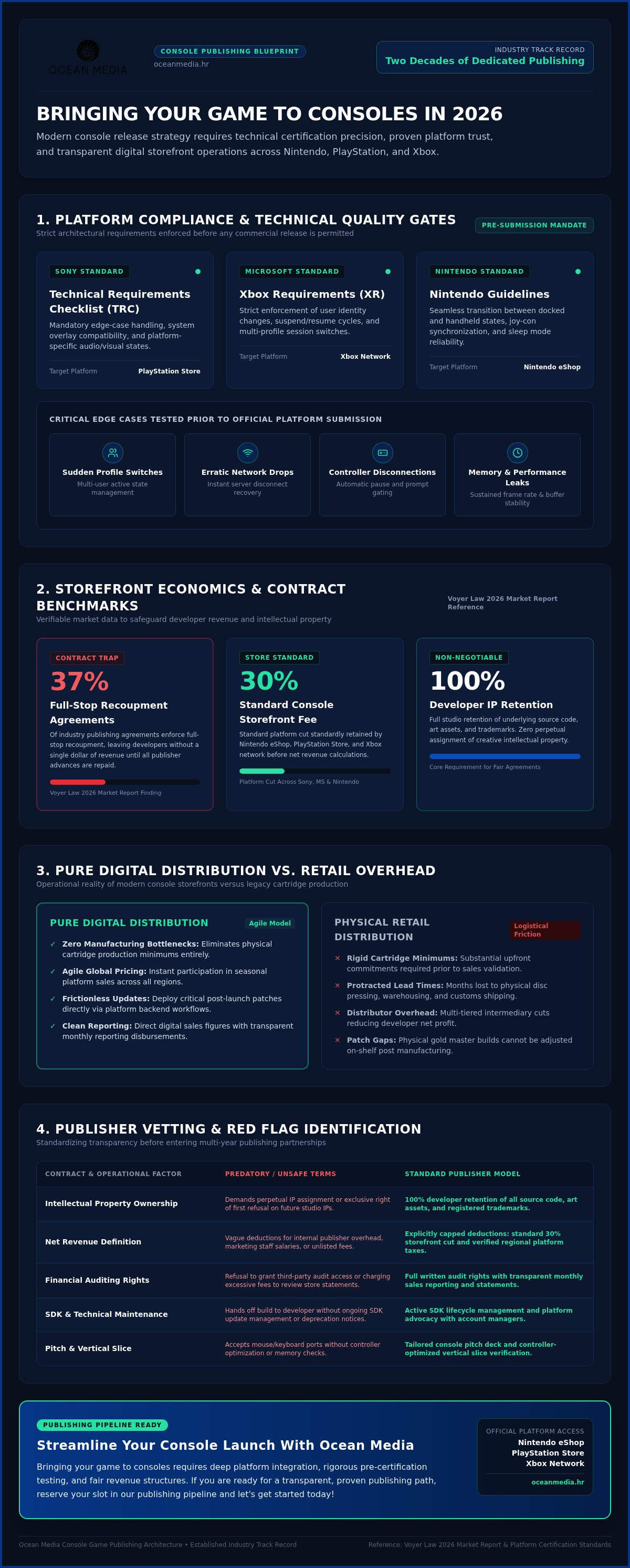
Every platform holder enforces strict quality gates. Sony's Technical Requirements Checklist (TRC) and Microsoft's Xbox Requirements (XR) demand flawless handling of edge cases, including sudden profile switches, erratic network drops, and controller disconnections. A qualified partner does not simply forward your build; they execute rigorous pre-certification testing to catch fatal exceptions before official submission.
- Automated and manual QA: Specialized checklists isolate memory leaks and performance hitches before platform testers flag them.
- SDK maintenance: Your publishing partner should manage recurring software development kit (SDK) version upgrades (and mandatory deprecations) throughout development.
- Platform advocacy: Established relationships with platform account managers help resolve ambiguous compliance failures rapidly.
Digital Distribution Expertise vs. Retail Overhead
Physical distribution carries massive overhead, rigid cartridge production minimums, and protracted manufacturing lead times. Pure digital distribution eliminates those logistical bottlenecks entirely. Focusing on digital storefronts allows you to capitalize on agile pricing strategies, participate in seasonal global platform sales, and deploy critical post-launch patches without distributor friction.
When evaluating potential partners, look for transparent digital models that safeguard your intellectual property and provide clean reporting. The right partner handles the backend heavy lifting across global storefronts while letting your studio retain creative control. If you are ready to navigate these technical gates with a dedicated partner, reserve your slot in our publishing pipeline and let's get started today!
Evaluating Publisher Transparency, Contracts, and Past Releases
Signing a deal changes your studio's trajectory for years. While finding a console game publisher often feels like an artistic pitch, it is fundamentally a legal and operational partnership. You must look past enthusiastic handshake agreements to rigorously audit past storefront performance, royalty calculations, and contract clauses.
Auditing Storefront Track Records and Platform Longevity
A publisher's catalog reveals their true standing with platform holders. Check how long their publisher accounts have been active on Nintendo eShop, PlayStation Store, and Xbox network. Examine whether their titles maintain discoverability long after release, or if they vanish into storefront obscurity. Speak with previous studio partners to confirm whether the publisher provides transparent monthly sales reporting and reliable royalty disbursements.
Safeguarding Intellectual Property and Fair Royalty Shares
Never sign away your core assets. Retaining 100% ownership of your code, art, and trademarks is non-negotiable when bringing your game to consoles. Pay close attention to how "net revenue" is defined in contract drafts. While console storefronts standardly take a 30% cut, predatory agreements often slip in unapproved deductions for internal publisher overhead.
Watch out for harsh recoupment models. Industry data from the Voyer Law 2026 Market Report reveals that 37% of publishing agreements enforce full-stop recoupment, leaving developers without revenue until all publisher advances are repaid. Consulting vetted IGDA publishing resources can help you baseline fair terms, stepped revenue splits, and clear reversion clauses before signing.
Warning Signs to Avoid During Publisher Negotiations
Walk away from any partner demanding perpetual assignment of your intellectual property or refusing explicit audit rights. Be wary of broad marketing commitments that lack written deliverable schedules. Transparent digital partners welcome scrutiny because their operating model is built on mutual upside.
Our collaborative approach ensures your rights remain untouched while we handle technical execution. Explore our transparent agreements on Ocean Media's developer services page. If you are focused on finding a console game publisher committed to fair terms, reserve your slot in our publishing pipeline and let's get started today!
How to Prepare and Pitch Your Game for Console Publishing
Publisher pitch inboxes overflow with conceptual ideas that fall apart under technical scrutiny. Finding a console game publisher requires shifting your narrative from pure creative ambition to technical feasibility and market fit. Publishers evaluate whether your production timeline accounts for certification buffers and whether your gameplay mechanics naturally translate to a living room setup.
Building a High-Impact Console Pitch Deck
Keep your deck focused, concise, and grounded in actionable data. While standard indie pitches spend pages on lore, console publishers look for immediate gameplay hooks, controller ergonomics, and audience alignment. Watching veteran post-mortems via GDC expert sessions shows that clear technical roadmaps consistently secure publisher trust over high-level storyboards.
- Core gameplay loops: Illustrate your primary 30-second and 5-minute loops using direct gameplay captures.
- Platform demographics: Explain how your genre performs across Nintendo Switch, PlayStation, and Xbox player bases.
- Technical baselines: State target framerates, resolution profiles, memory budgets, and the game engine version you currently run.
- Production milestones: Build realistic buffers for certification phases, typically 3 to 4 weeks for Nintendo, 2 to 3 weeks for PlayStation, and 1 to 2 weeks for Xbox.
Preparing Your Controller-Ready Playable Build
Never submit a PC build that requires a mouse to navigate main menus. Your vertical slice must deliver immediate controller responsiveness from boot to credits. Map default inputs to standard controller schemes, calibrate analog dead zones, and verify that interface typography remains readable from ten feet away.
Eliminate debug crashes and frame pacing hitches before sharing download links. Provide clear, step-by-step setup documentation alongside your build, including details on developer hardware profiles or recommended PC gamepads. Demonstrating that your build already functions smoothly removes friction, proving your studio is ready for commercial submission.
Proper preparation makes the difference between an unread pitch email and a signed contract. When you have a solid build ready for bringing your game to consoles, reserve your slot in our publishing pipeline and let's get started today!
Vetting Potential Partners: Essential Questions to Ask Before Signing
Due diligence protects your studio from dead-end agreements. When finding a console game publisher, you are hiring an operational co-pilot, not simply licensing software. You need concrete answers regarding day-to-day storefront operations, certification accountability, and financial transparency before signing any binding term sheet.
Technical and Storefront Operations Inquiries
Certification failure derails launch timing. Ask prospective publishers about their historical first-pass rate and how they resolve platform waivers when compliance conflicts arise. Review our comprehensive guide on console platform certification requirements to benchmark their technical workflow against platform standards.
- Submission remediation: Who diagnoses failed test cases, and how fast can their engineers implement required SDK adjustments?
- Rating board administration: Does the publisher manage regional age rating classifications across ESRB, PEGI, and CERO, or does that operational burden fall back on your studio?
- Storefront optimization: Clarify who designs localized banner assets, writes descriptive sales copy, and pitches platform merchandising teams for front-page visibility.
- Post-launch patching: Confirm the operational process and turnaround times for submitting hotfixes and seasonal content updates.
Financial, Reporting, and Account Management Clarity
Financial opacity strains partnerships. Demand clear visibility into backend numbers so you understand exactly how platform store deductions impact your net royalties. Establish direct lines of communication to avoid getting lost in detached ticketing queues.
Ask these specific administrative questions:
- Can you provide a redacted monthly reporting statement showing unit sales, regional currency conversions, refunds, and platform cuts?
- What is your exact disbursement calendar, and which international banking methods do you support?
- Will our studio have a dedicated platform manager, or will communications run through generic helpdesk channels?
Clear division of responsibilities prevents finger-pointing during launch week. We believe full operational transparency is essential for bringing your game to consoles smoothly. Ready to see how our team handles technical submissions and platform relations? Visit Ocean Media's publishing partnership hub to review our process. If you want a proven guide for finding a console game publisher, reserve your slot in our publishing pipeline and let's get started today!
Partnering With Ocean Media: Streamlining Your Console Launch
Launching across digital storefronts shouldn't feel like wrestling with anonymous platform portals. With over two decades of dedicated gaming industry expertise, Ocean Media serves as an authoritative guide for independent developers. Finding a console game publisher that genuinely respects your studio means choosing a partner focused strictly on pure digital releases, transparent revenue share, and platform excellence without unnecessary retail bloat.
Navigating Technical Submissions With Over 20 Years of Experience
Decades of platform evolution have taught our team how to spot certification issues long before builds ever reach Sony, Microsoft, or Nintendo review teams. We manage the heavy compliance paperwork, platform QA passes, and backend configuration needed to get builds approved on time. Check out our detailed roadmap on how to publish a game on console to see how we structure the full release cycle.
Releasing across international territories brings additional regional layers. To understand how storefront approvals and compliance considerations shift internationally, consult our European console publishing guide. Our seasoned submission team coordinates these moving parts simultaneously so your launch date remains locked in.
Entering Our Structured Digital Publishing Pipeline
We treat every developer relationship as a collaborative partnership. You keep 100% of your intellectual property and retain complete creative control over your project. Meanwhile, our specialists optimize your store pages, manage digital distribution logistics across PlayStation Store, Xbox Games Store, and Nintendo eShop, and pursue vital storefront merchandising placements.
- Direct build evaluation: Share your vertical slice directly with our developer relations team for constructive technical feedback.
- Platform pipeline access: Skip the administrative confusion by utilizing our proven submission tracks.
- Transparent accounting: Receive reliable, straightforward royalty reporting with no hidden deductions or confusing overhead.
Bringing your game to consoles successfully requires seasoned execution and mutual trust. If you are serious about finding a console game publisher with a proven 20-year platform track record, take the next step. Reserve your slot in our publishing pipeline and let's get started today!
Take the Next Step Toward Your Console Launch
Success on digital storefronts doesn't happen by accident. Successfully finding a console game publisher comes down to selecting a partner who respects your intellectual property, understands transparent revenue models, and commands the technical rigor needed for PlayStation, Xbox, and Nintendo Switch certification. When you eliminate the distractions of physical retail and ambiguous marketing promises, you can focus on building an exceptional experience while your partner handles complex platform gates.
With over 20 years of continuous console publishing and distribution experience, Ocean Media provides the technical submission mastery and pure digital focus your studio needs. We protect your creative vision and champion your game across global digital storefronts. If you are ready for a clear, trusted path for bringing your game to consoles, reserve your slot in our publishing pipeline and let's get started today!
Frequently Asked Questions
What does a console game publisher do for independent developers?
A dedicated console publisher manages the technical, administrative, and storefront operations required to launch on digital platforms. They navigate platform compliance standards, handle SDK updates, coordinate regional age ratings across global territories, and manage storefront merchandising. Rather than struggling through bureaucratic submission portals alone, partnering with a digital specialist lets you focus entirely on development while they handle the complex logistics of bringing your game to consoles.
Is it better to self-publish on consoles or sign with a publisher?
Self-publishing gives you direct control, but requires acquiring expensive development kits, passing complex technical certification requirements, and managing platform account relations across Sony, Nintendo, and Microsoft independently. When finding a console game publisher with proven platform track records, you eliminate that friction. A publisher accelerates digital market entry, handles rigorous platform QA gates, and secures vital storefront visibility that solo developers often struggle to obtain on their own.
How much revenue split do console publishers typically ask for?
Revenue splits depend heavily on whether a financial advance is involved. Industry market data shows that deals without advances often see developers retaining around 60% to 70% of net revenue, while console-only publishing agreements average around 66%. Platform storefronts automatically take their standard 30% cut off the top. Look for transparent publishers offering clean accounting without surprise deductions for internal overhead or vague administrative charges.
Do I lose my intellectual property when signing with a console publisher?
You should never surrender your intellectual property. Ethical publishers structure digital distribution agreements that leave 100% of underlying game rights, trademarks, and copyright ownership in your hands. You merely grant them a limited license to distribute and monetize your build digitally across designated console platforms. If a prospective publisher insists on taking ownership of your IP or future franchise rights, reject the deal immediately and continue your search.
How long does the console platform certification process take in 2026?
Realistic certification timelines range from two to four weeks per platform, accounting for iterative feedback and resubmissions. Microsoft Xbox reviews typically take one to two weeks, Sony PlayStation requires two to three weeks, and Nintendo Switch averages three to four weeks. Working with seasoned technical partners significantly shortens this process by identifying potential compliance failures, memory leaks, and profile handling bugs before official storefront submission occurs.
Can a publisher help release my game across multiple consoles simultaneously?
Yes, coordinating simultaneous digital launches across Nintendo Switch, PlayStation, and Xbox is a primary benefit of partnering with an experienced publisher. Synchronizing dates requires carefully staggered submissions to account for differing platform review cycles. Our team synchronizes submission schedules, coordinates cross-platform metadata, and manages simultaneous global storefront go-lives, ensuring your launch marketing lands with maximum impact across all three major console storefronts at once.
What materials do I need before pitching a console game publisher?
You need a stable, controller-compatible vertical slice and a concise pitch deck highlighting core gameplay mechanics, platform target framerates, and engine specifications. Demonstrating native gamepad mapping and clean frame pacing proves your team understands console realities. If you have a polished build ready and are focused on finding a console game publisher, reserve your slot in our publishing pipeline and let's get started today!


