

You’ve spent years perfecting every pixel and mechanic, but the final boss isn't in your game; it's the console certification process. It's completely normal to feel overwhelmed by the sheer volume of Sony's Technical Requirements Checklist or the latest Xbox Requirements (version 16.3 as of July 2026). The technical hurdles of bringing your game to consoles often feel like a full-time job that pulls you away from your creative vision. You aren't alone in wondering, what do console game publishers do to actually justify their share of the standard 70/30 revenue split? This guide explores how a seasoned partner manages the complexities of the publishing pipeline, from navigating the shift toward digital-only distribution to securing global age ratings and storefront visibility.
We'll provide a clear roadmap for your console journey and a framework to help you evaluate the ROI of a partnership. Our goal is to simplify these technical minefields (and the anxiety that comes with them) so you can focus on what you do best. If you're ready to move forward, reserve your slot in our publishing pipeline and let's get started today!
Key Takeaways
- Understand exactly what do console game publishers do to serve as your operational bridge between development and platform holders like Sony, Microsoft, and Nintendo.
- Learn how to navigate the technical certification minefield by mastering platform-specific requirements to avoid launch delays and ensure title stability.
- Get a clear breakdown of the revenue waterfall and standard splits to help you evaluate the ROI of bringing your game to consoles.
- Discover the logistics of global digital distribution, including managing storefront visibility and securing necessary age ratings like ESRB and PEGI.
- Find out how to select a seasoned partner with 20+ years of experience so you can reserve your slot in our publishing pipeline and let's get started today!
The Role of a Console Game Publisher in 2026
The traditional view of a video game publisher is rapidly evolving. Many developers still view these entities as distant corporate banks that simply trade funding for intellectual property rights. In reality, a modern partner acts as an operational extension of your studio. When you ask what do console game publishers do in 2026, the answer centers on being a technical and administrative shield. They are the essential bridge between your source code and the platform holders, specifically Sony, Microsoft, and Nintendo. While The Role of a Console Game Publisher historically focused on physical logistics and retail shelf space, the digital age has shifted the priority to storefront visibility and certification management. We don't just put a logo on a splash screen; we manage the business so you can manage the fun.
The Publishing Pipeline: An Overview
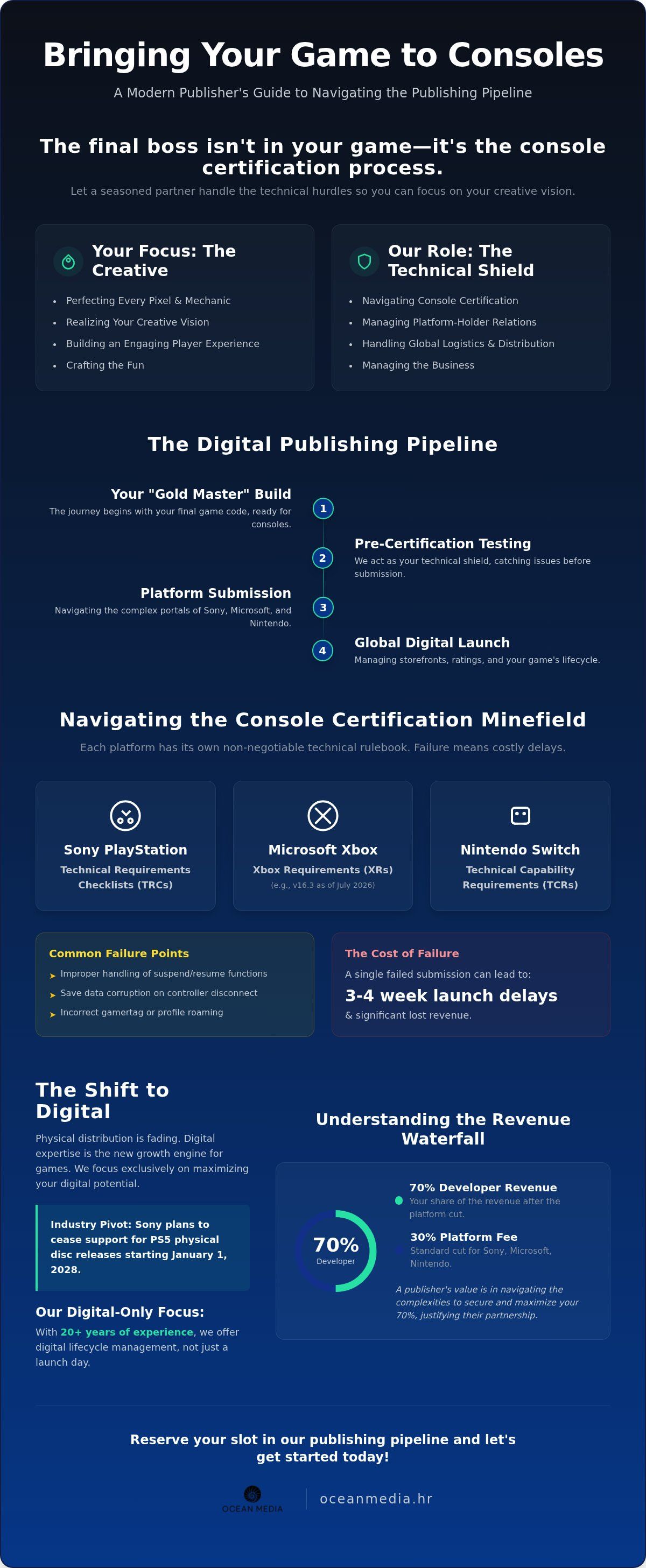
Bringing your game to consoles is significantly more complex than releasing on PC. The publishing pipeline involves a rigorous journey from your final "gold master" build to a live global storefront. Unlike the relatively open nature of PC platforms, consoles are closed ecosystems with strict gatekeepers. Our team works collaboratively with you to manage this transition (learn more about our services for developers). We handle the heavy lifting of platform-specific requirements, which are often hundreds of pages long, to ensure your game doesn't get stuck in a loop of failed submissions. It's about having a seasoned guide who knows exactly which technical boxes to tick before you even submit your build.
Digital vs. Physical: The Ocean Media Focus
The "logo on the box" is a nostalgic image, but digital distribution is the true growth engine for indie titles today. Sony's announcement to cease support for physical PS5 disc releases starting January 1, 2028, highlights this massive industry pivot. This shift makes digital expertise more critical than ever before. Understanding what do console game publishers do in a digital-only market means looking at lifecycle management, not just launch day sales. Managing global digital storefronts requires a deep understanding of regional pricing, currency fluctuations, and platform-specific promotional cycles across multiple time zones. At Ocean Media, we focus exclusively on digital excellence. We don't offer physical retail distribution or work-for-hire development. Instead, we leverage our 20+ years of experience to maximize your game's revenue potential in the digital marketplace. If you're looking for a partner who values longevity and consistency, reserve your slot in our publishing pipeline and let's get started today!
Navigating the Console Certification Minefield
Certification is the definitive gatekeeper between your finished code and the player's living room. Unlike the "ship first, patch later" culture found on some PC platforms, Sony, Microsoft, and Nintendo maintain rigorous standards to protect their ecosystem's stability. If you're asking what do console game publishers do, their primary technical value lies in surviving this process. Failing "cert" doesn't just mean a few bugs; it can delay your launch by months and result in significant lost revenue as you wait for another submission window. Each platform holder has its own language of requirements: Sony uses Technical Requirements Checklists (TRCs), Microsoft enforces Xbox Requirements (XRs), and Nintendo utilizes Technical Capability Requirements (TCRs). A publisher acts as your technical shield, ensuring your build meets these non-negotiable standards before it ever reaches a platform holder's desk.
Platform-Specific Requirements and Expertise
Managing the administrative complexities of platform submissions is a full-time job. For example, the current Xbox Requirements (XRs) version 16.3, updated in July 2026, places heavy emphasis on title stability and seamless gamertag roaming. Common failure points often include improper handling of suspend/resume functions or save data corruption during unexpected controller disconnections. Our team handles the pre-certification testing to catch these issues early. We understand the nuances of each platform, helping you avoid the 3-4 week delay typical of a Nintendo "Lot Check" failure. To see how this fits into your overall launch, check out The Complete Developer Roadmap for 2026.
Global Storefront Approvals
Navigating the unique submission portals for each console brand requires more than just a login. It involves managing feedback loops with platform holders and ensuring your metadata complies with the latest standards. Sony is currently phasing out "PSN" branding in favor of updated PlayStation Technical Requirements checklists as of late 2026. A publisher ensures your game meets these shifting Global Digital Distribution & Lifecycle Management standards across every territory. We manage the "Lot Check" and platform holder feedback loops so you don't have to decipher cryptic error codes yourself. By trusting a partner with 20+ years of experience, you ensure a smoother path for bringing your game to consoles. When you understand what do console game publishers do to protect your launch window, the value of the partnership becomes clear. If you want to bypass the certification headache, reserve your slot in our publishing pipeline and let's get started today!
Understanding Console Game Publishing Costs & Revenue Splits
The financial side of bringing your game to consoles often feels like a complex waterfall. It starts at the storefront level, where PlayStation, Xbox, and Nintendo typically retain a 30% commission on every sale. Once this platform fee is deducted, the remaining 70% of net revenue is split between the publisher and the developer. According to 2026 industry averages, developers who receive a development advance typically see a net revenue share of 57.9%, while those without an advance average 67.9%. When you evaluate what do console game publishers do, it's vital to recognize that they aren't just taking a cut; they're absorbing the upfront financial risks that often cripple smaller studios.
Beyond the revenue split, direct costs can quickly drain a developer's bank account. Bringing a game to a global audience requires investment in several key areas:
- Age Ratings: Fees for ESRB, PEGI, and CERO certifications across multiple territories.
- Localization: Professional translation and cultural adaptation for global storefronts.
- Marketing Assets: High-quality trailers, store page graphics, and localized promotional content.
- Platform Hardware: Devkits for console development generally cost between $5,000 and $10,000 per platform.
Self-Publishing vs. Publisher Deal: A Cost Comparison
The hidden cost of self-publishing is your time. While setting up a legal entity like an LLC might only cost between $500 and $1,500, the administrative burden of managing platform-holder relationships can consume months of development time. For a high-end 3D indie game, where development costs can exceed $2,000,000, any delay in the publishing pipeline is incredibly expensive. A publisher absorbs these upfront platform expenses and legal fees. This allows you to reinvest your capital back into the game’s quality. The ROI of a partnership is found in the publisher’s ability to maximize your game's reach, often resulting in higher total earnings despite the revenue share.
Structuring the Deal for Indie Studios
Modern indie deals should prioritize transparency and collaboration. We believe a royalty-share model is the most effective way to align our goals with yours; we only succeed when your game performs well. When discussing what do console game publishers do for your specific project, look for a partner who provides clear, regular royalty reporting and maintains a digital-only focus to avoid the overhead of physical retail. You can explore our services for developers to see how we handle these logistical hurdles. If you're ready to trade administrative headaches for professional results, reserve your slot in our publishing pipeline and let's get started today!
Global Digital Distribution & Lifecycle Management
Managing a game across a global player base, which is expected to reach 3.7 billion by the end of 2026, requires a strategy that spans every time zone and currency. If you're asking what do console game publishers do to maintain momentum, the answer is lifecycle management. It’s not just about launch day. It’s about ensuring your game stays relevant through patches, DLC, and platform-specific sales cycles. We act as your bridge to the global market. Our team handles the administrative burden of storefront visibility and coordinates directly with platform holders to secure those coveted featuring spots that drive organic discoverability.
Age Ratings and Localization Strategy
Localization is more than just translating text. It’s a form of cultural certification. Each territory has its own sensitivities and legal requirements. We manage the submission process for major rating boards including ESRB (North America), PEGI (Europe), and CERO (Japan). We also utilize the IARC system to streamline digital-only ratings where applicable. Navigating these requirements is essential for a compliant release. For a deeper dive into these standards, consult our Global Console Game Age Rating Guide 2026 and our Indie Game Localization Guide. These resources help you ensure your game is ready for every region before it enters the final certification phase.
Managing the Launch Timeline
A simultaneous global digital launch is a logistical feat. Each storefront has its own paperwork, including regional tax forms, price tiering, and technical submission portals. When developers ask what do console game publishers do during the post-launch phase, they're often surprised by the volume of administrative work involved in managing global updates. We manage the entire publishing pipeline, ensuring your game goes live at the optimal moment across all platforms. This includes:
- Update Coordination: Managing the technical complexities of patches across different hardware versions.
- DLC Management: Configuring store pages and entitlements for additional content.
- Regional Pricing: Adjusting for currency fluctuations and local purchasing power.
By taking this weight off your shoulders, we allow you to focus on the creative process while we handle the global distribution engine. We've spent 20+ years refining this process to make it as smooth as possible for our partners. If you're ready to maximize your game's global presence, you can bring your game to consoles with a team that understands the digital landscape. Reserve your slot in our publishing pipeline and let's get started today!
Partnering for Success: How to Start Your Publishing Journey
Choosing the right partner is the most critical decision you'll make after finishing your build. You need more than just a financier; you need a seasoned guide who has survived the certification minefield across multiple console generations. When you ask what do console game publishers do, the most valuable answer is that they provide operational stability in a volatile market. With over 20 years of industry experience, our team offers a level of insight that only comes from managing hundreds of successful digital releases. We don't act as a cold, transactional corporation. Instead, we prioritize an inclusive, collaborative spirit that treats your project with the same passion you poured into its development. This approach ensures that your studio remains the creative heart of the project while we handle the professional logistics.
Why Ocean Media is Your Ideal Console Partner
Our focus remains strictly on digital-only excellence. We don't dilute our efforts with physical retail distribution or work-for-hire development. This specialization allows us to master the specific digital requirements of Sony, Microsoft, and Nintendo. By leveraging our established platform-holder relationships, we can streamline the administrative and technical hurdles that often stall independent releases. We combine professional authority with the vibrant energy of the entertainment sector. This ensures our partnership is both reliable and enthusiastic. We act as a bridge between your creative vision and the global market, providing the infrastructure needed to maximize your game's revenue potential without sacrificing your studio's identity. Our goal is to simplify the transition into a professional environment so you can focus on your next project.
Get Started with Our Publishing Pipeline
Starting your journey with us is a straightforward, purposeful process designed to minimize developer burnout. We evaluate projects based on their creative potential, market fit, and technical readiness for the global digital landscape. Our structured path takes you from the initial pitch directly into our established publishing pipeline. This transition is built on transparency and momentum. We've spent decades refining this roadmap to ensure that bringing your game to consoles is a professional milestone rather than a logistical nightmare. We move quickly from high-level identity statements to specific technical execution, maintaining a cohesive narrative of excellence throughout the lifecycle of your game. If you're ready to trade administrative anxiety for a clear path to success, reserve your slot in our publishing pipeline and let's get started today!
Ready to Launch Your Game Globally?
Understanding what do console game publishers do is the first step toward a successful release. We've explored how a seasoned partner acts as your technical shield, managing the certification minefield across Sony, Microsoft, and Nintendo platforms. By handling the administrative weight of global digital distribution and age ratings, a publisher allows you to remain focused on your studio's creative vision. Our team leverages 20+ years of industry experience to ensure your game reaches its full revenue potential without the logistical headaches of self-publishing.
Bringing your game to consoles shouldn't be a source of anxiety. With our established platform-holder relationships and digital-only focus, we provide a structured path to success. Our collaborative spirit means we're here as your creative partner, not just a corporate entity. It's time to take your project to the global stage and reach the millions of players waiting on their favorite consoles. Reserve your slot in our publishing pipeline and let's get started today! We're excited to help you turn your hard work into a professional console hit.
Frequently Asked Questions
Do I lose creative control if I work with a console game publisher?
You retain full creative control over your vision. As a collaborative partner, our role is to manage the technical and administrative hurdles of the publishing pipeline, not to dictate your game's design. We act as a seasoned guide to ensure your project meets platform standards while you focus on the creative process. This partnership allows you to keep your studio's identity while leveraging our 20+ years of industry experience.
How much do console game publishers typically take in revenue splits?
Revenue splits vary based on development advances and support levels. After the platform holder's 30% fee, the remaining net revenue is shared between the developer and publisher. Industry data for 2026 shows developers often receive around 57.9% of net revenue when an advance is involved, or 67.9% without one. When you ask what do console game publishers do to justify this, consider the upfront risks and administrative costs they absorb on your behalf.
Can I publish on PlayStation, Xbox, and Switch at the same time?
Yes, coordinating a simultaneous multi-platform launch is a core part of a publisher's role. We manage the different submission timelines for Sony, Microsoft, and Nintendo to ensure your game goes live globally across all storefronts at once. This requires deep expertise in platform-specific requirements and meticulous planning within the publishing pipeline. Simultaneous releases maximize your marketing impact and ensure you reach the widest possible audience on launch day.
What is the difference between a publisher and a distributor?
A publisher manages the entire lifecycle of your game, including certification, age ratings, and storefront visibility. A distributor typically focuses only on the logistics of getting the game onto a storefront or into retail. Ocean Media is a digital-only publisher, meaning we don't handle physical retail distribution. We provide a collaborative partnership that goes far beyond simple distribution by acting as your technical and business shield throughout the entire console journey.
Does a publisher handle the age rating (PEGI/ESRB) process for me?
Yes, we manage the entire age rating process for your title. Navigating boards like ESRB, PEGI, and CERO is a significant administrative task that requires specific documentation and fees for each territory. We handle these submissions and the associated costs to ensure your game complies with global digital distribution standards. This allows you to avoid the complexity of regional legal requirements and focus entirely on finishing your game's development.
What happens if my game fails console certification?
A failed certification resets the review clock and can delay your launch by weeks or months. Each platform has its own feedback loop; Xbox usually takes 1-2 weeks, while Nintendo can take up to 4 weeks. If a build fails, you must fix the identified issues and resubmit. Our team performs extensive pre-certification testing to catch these technical hurdles early. This proactive approach helps you avoid costly delays and ensures a successful global launch.
Do publishers provide the dev kits needed for console development?
Developers are typically responsible for purchasing their own specialized hardware. Dev kits generally cost between $5,000 and $10,000 per platform. While we don't provide the hardware, we guide you through the process of requesting and securing these kits from platform holders. Understanding what do console game publishers do includes helping you navigate these platform relationships to ensure you have the necessary tools to bring your game to consoles.
Is it possible to self-publish on consoles without a partner?
It is possible to self-publish, but it requires significant time and administrative overhead. You must establish a legal entity, purchase expensive dev kits, and master hundreds of pages of technical requirements for each platform. Many indie studios find that the time spent on these non-development tasks is a major drain on resources. Partnering with us simplifies this transition. Reserve your slot in our publishing pipeline and let's get started today!


