

You've spent years perfecting your mechanics and art, only to have your global launch halted because a single regional rating wasn't filed correctly. It's a nightmare scenario that happens to even the most talented studios, turning a moment of celebration into a frantic scramble for compliance. We understand that the maze of console game age rating systems often feels like a bureaucratic barrier to your creativity rather than a helpful tool. With 2026 bringing significant shifts in how digital content is categorized, staying ahead of these technical gates is the only way to protect your release window and succeed in bringing your game to consoles.
This guide will show you how to master the ESRB, the latest PEGI updates regarding in-game monetization (including those new PEGI 16 requirements for paid random items), and the IARC shortcut. We'll provide a clear roadmap to ensure your game clears certification without the typical headaches. Our team at Ocean Media has spent over two decades acting as a bridge between creators and the global market, and we're ready to help you simplify the entire process. Reserve your slot in our publishing pipeline and let's get started today!
Key Takeaways
- Understand why console game age rating systems are mandatory technical gates for digital distribution on Sony, Microsoft, and Nintendo platforms.
- Learn to navigate the 2026 updates for ESRB and PEGI while leveraging the IARC system to streamline your global digital release.
- Discover how to properly embed rating certificates into your metadata to avoid "Storefront Locks" and ensure a smooth publishing pipeline.
- Identify common certification pitfalls, such as incomplete content disclosure, to prevent "Rating Whiplash" and costly launch-day delays.
- Partner with a seasoned guide to simplify the administrative maze; reserve your slot in our publishing pipeline and let's get started today!
Why Console Game Age Rating Systems Are Mandatory for Global Success
Securing a rating isn't just a best practice; it's a non-negotiable contractual requirement for every major digital storefront. When you're bringing your game to consoles, you're entering a highly regulated ecosystem where Sony, Microsoft, and Nintendo act as the ultimate arbiters of content. These console game age rating systems are legally or contractually required frameworks that ensure every piece of software on a platform is categorized correctly for its audience. While legacy physical retail standards once dominated the conversation, the shift to digital-only distribution hasn't relaxed these rules. In fact, digital storefronts have become even more efficient at enforcing them to maintain brand safety and platform integrity.
A clear rating builds immediate consumer trust. It signals to parents and players that your studio respects local standards and takes content transparency seriously. For a deeper look at how these frameworks vary by country, you can consult this global overview of rating systems.
The Gatekeeper Role of Ratings in Digital Publishing
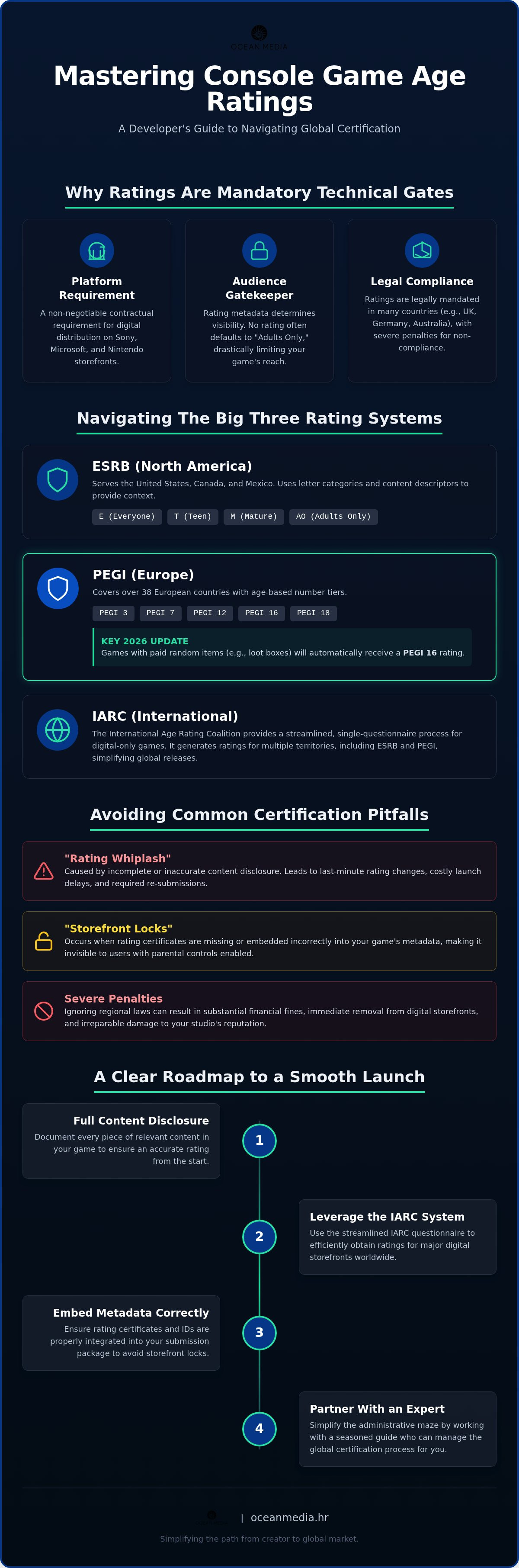
Digital storefronts rely on rating metadata to function. When you submit your build, the rating ID you provide tells the console's operating system exactly how to handle your game. If a user has parental controls active, the system uses this metadata to gate content automatically. Without a valid rating, your game simply won't appear in search results for restricted accounts. Unrated content is often treated as "Adults Only" by default, which drastically limits your visibility and potential revenue. Age ratings act as the mandatory gatekeeper in the console publishing pipeline, determining whether your title is visible to its intended audience or blocked entirely.
Legal Compliance and Regional Market Access
In many territories, ratings are more than just platform policy; they are the law. In the UK, it's a legal requirement to display PEGI ratings for any game sold, and retailers face strict penalties for non-compliance. Similarly, countries like Germany and Australia have rigorous statutory requirements that can lead to heavy consequences if ratings are found to be inaccurate. The risks of ignoring these mandates are severe:
- Substantial financial fines from national regulators.
- Immediate removal from regional digital storefronts.
- Irreparable damage to your studio's reputation.
These systems protect you as a developer. By following the established console game age rating systems, you gain a layer of liability protection, proving you've disclosed your content to the proper authorities. In 2026, the landscape is more complex than ever, but our team at Ocean Media specializes in navigating this administrative maze. To ensure your submission is flawless, visit our developer portal, reserve your slot in our publishing pipeline and let's get started today!
The Big Three: Navigating ESRB, PEGI, and the IARC System
You cannot achieve global reach without mastering the primary regional authorities that govern the industry. While dozens of smaller boards exist, the Entertainment Software Rating Board (ESRB) and Pan-European Game Information (PEGI) remain the two most critical pillars for any studio. For digital-first developers, the International Age Rating Coalition (IARC) has revolutionized the publishing pipeline by consolidating these requirements into a single, efficient process. This modern solution allows you to bypass the administrative fatigue of filing individual applications in every territory.
ESRB: The North American Standard
The ESRB serves the United States, Canada, and Mexico with categories ranging from E (Everyone) to AO (Adults Only). Content descriptors like "Fantasy Violence," "Blood," or "Suggestive Themes" are just as important as the letter on the badge. These labels provide the specific context parents and storefronts use to filter content. For digital-only paths, the ESRB rating is typically generated instantly through the IARC process, whereas traditional long-form submissions for physical media can take several weeks of manual review.
PEGI: Reaching the European Market
PEGI covers Europe with age tiers of 3, 7, 12, 16, and 18. As of June 2026, PEGI has implemented stricter criteria for modern mechanics. Games featuring paid random items, such as loot boxes, now receive a default rating of PEGI 16. Titles involving NFTs or blockchain-related mechanics are classified as PEGI 18. In the UK, these ratings are legally enforceable, meaning accurate disclosure of in-game purchases and online communication is mandatory to avoid legal complications or platform removal.
The IARC Shortcut for Console Devs
The IARC system is the modern developer's greatest ally, providing age ratings for digitally distributed games at no cost. By completing one comprehensive questionnaire, you generate ratings for multiple global regions simultaneously. This system has issued over 19 million ratings to more than 3 million developers as of May 2026. It's the primary way to clear console game age rating systems for the Nintendo eShop, Xbox Store, and PlayStation Store. Participating boards include the ESRB, PEGI, USK (Germany), ClassInd (Brazil), and GRAC (South Korea).
| Feature | IARC (Digital) | Traditional Submission |
|---|---|---|
| Cost | No Cost | Variable/Fee-Based |
| Time | Instant | 2–4 Weeks |
| Complexity | Low (Single Form) | High (Regional Forms) |
Managing these requirements while finalizing your build is a heavy lift. Partnering with an experienced publisher can turn this administrative hurdle into a routine step in your release cycle. Reserve your slot in our publishing pipeline and let's get started today!
How Age Ratings Impact Your Console Publishing Pipeline
A rating certificate is far more than a visual icon on your store page; it's the digital key that unlocks your ability to hit the "publish" button. Within the console publishing pipeline, this is often referred to as the "Storefront Lock." Major platforms like Sony, Microsoft, and Nintendo will not allow a game to go live, or even start the final certification process, without a verified rating ID. This technical requirement ensures that the platform's parental control systems can accurately gate your content from the start. Without this ID, your project remains in submission limbo, invisible to the market.
Metadata and Content Descriptors
Inputting your data correctly into platform portals like DevNet or the Partner Center is a critical technical step. You must ensure that the content descriptors assigned to your title match your storefront descriptions exactly. For instance, if Pan-European Game Information (PEGI) assigns a "Violence" descriptor, your store copy should reflect that tone to maintain consistency. Discrepancies between different console versions of the same game can lead to rejection during the final submission phase. We work with you to ensure parity across all platforms, preventing last-minute metadata conflicts that could stall your release.
Marketing Restrictions and Monetization
Your rating dictates your entire promotional strategy. High-tier ratings require age-gating on trailers and social media platforms, which can limit your organic reach. Additionally, modern console game age rating systems now require explicit disclosures for in-game purchases. If your title includes mechanics like loot boxes, failing to disclose these early can result in a forced rating upgrade. This shift can lock you out of certain marketing opportunities or require a complete overhaul of your creative assets to meet new regional standards.
Submission Timelines and Launch Delays
Timing is everything when bringing your game to consoles. We recommend starting the rating process at least 6 to 8 weeks before your target launch date. This buffer protects you from the "re-rating trap." If you add new content or features after receiving your initial certificate, you may be forced to re-submit, which can delay your launch by weeks. Our team manages these complex administrative timelines, ensuring a synchronized global launch that hits every region on day one. Let us handle the administrative maze while you focus on the code; reserve your slot in our publishing pipeline and let's get started today!
Avoiding Common Certification Pitfalls: A Developer’s Checklist
The number one reason for failed certification isn't a technical bug; it's a failure in disclosure. When you submit your project to console game age rating systems, you're making a legal and contractual declaration about every pixel in your game. Inaccurate or incomplete data leads to "Rating Whiplash." This occurs when a rating board discovers content you overlooked, resulting in an immediate rating upgrade and a total reset of your submission timeline. This can be devastating if your marketing assets are already finalized with a lower age tier badge.
Accurate Content Disclosure
Your disclosure must be exhaustive. Boards look specifically for depictions of drugs, tobacco, profanity, and microtransactions. Use this checklist to verify your build before hitting the final submission button:
- Drugs and Alcohol: Is the use depicted as beneficial, or is it purely cosmetic?
- Profanity: Have you accounted for all localized voice lines and text strings?
- Monetization: Are loot boxes or paid random items clearly flagged for PEGI compliance?
- Interactive Elements: Does your game allow unrestricted user-to-user communication without blocking tools?
Don't ignore the "Hidden Content" rule. Even if an asset is technically unplayable or locked behind a debug menu, its presence in the compiled code can still trigger a rating. You must audit your final build for "hot coffee" style legacy assets to ensure no dormant code triggers an unexpected rating hike.
Regional Restrictions and Cultural Sensitivities
Global compliance requires more than a one-size-fits-all approach. Different territories have unique cultural sensitivities that can block your release entirely. For example, the Australian Classification Board maintains an incredibly strict stance on drug use, often refusing classification for games that depict drug use as a reward or incentive. In these cases, you might need to consider a "regional cut" of your game. This involves removing specific assets or mechanics for a single territory to maintain a lower rating or to clear the gate at all. Additionally, ensure your marketing materials use localized rating icons; using an ESRB badge in a European trailer is a common mistake that can trigger a platform rejection.
Managing these nuances is what we do best. We act as your seasoned guide through the administrative maze, ensuring your build is audit-ready and your global strategy is sound. If you want to avoid the stress of a failed submission, reserve your slot in our publishing pipeline and let's get started today!
Simplifying Global Certification with Ocean Media
Bringing your creative vision to life is a monumental achievement, but the transition from a finished build to a live storefront listing requires a different set of skills. This is where Ocean Media steps in. We act as the essential bridge between your studio and the global market, transforming the administrative maze of console game age rating systems into a streamlined, predictable process. Our team doesn't just offer advice; we act as your dedicated partner in the publishing pipeline, ensuring that every technical and logistical requirement is met with precision.
With over 20 years of industry experience, we've refined a methodical approach to digital distribution across all major consoles. We understand the nuances of platform-specific portals and the shifting landscape of 2026 regulations. This longevity allows us to anticipate and prevent the common administrative errors that often lead to launch-day disasters. We handle the heavy lifting so you can stay focused on what you do best: creating great games.
Our Expert Approach to Platform Submissions
We provide a hands-on management style that includes a thorough audit of your content before it ever reaches a rating board. By identifying potential red flags early, we eliminate the risk of unexpected rating upgrades or rejections. Our expertise covers all major consoles, and we take pride in managing the complexities of regional submissions on your behalf. You can learn more about Ocean Media’s developer services to see how we tailor our support to your specific project needs and ensure your metadata is flawless.
Bringing Your Game to Consoles with Confidence
The peace of mind that comes with a structured publishing path is invaluable. Instead of guessing at metadata requirements or worrying about regional compliance in territories like Germany or Australia, you can rely on a proven track record of success. We foster a collaborative spirit, working alongside your team to ensure a synchronized global launch that hits every target market simultaneously. For a deeper look at the stages involved in this journey, read our full console publishing roadmap. We are ready to help you navigate the final miles of your development cycle. Reserve your slot in our publishing pipeline and let's get started today!
Ready to Secure Your Global Console Launch?
Mastering console game age rating systems is about more than just checking boxes; it's about protecting your studio's reputation and ensuring your hard work actually reaches its audience. By leveraging the IARC shortcut and staying ahead of 2026's stricter PEGI monetization rules, you can avoid the "Storefront Lock" that stalls so many promising projects. We've spent over 20 years navigating these administrative mazes, specializing in global digital distribution and end-to-end certification management. Our goal is to act as your seasoned guide, turning a complex logistical hurdle into a seamless part of your success story.
You don't have to face the platform portals alone. Let's work together to bring your vision to every major console storefront without the stress of failed submissions or rating whiplash. We provide the structured path you need to navigate the final miles of development with total confidence. Reserve your slot in our publishing pipeline and let's get started today! We're excited to help you cross the finish line and reach players around the world.
Frequently Asked Questions
Is the IARC system free for indie developers on consoles?
Yes, the IARC system provides age ratings for digitally distributed games at no cost to the developer. This is a massive benefit for independent studios bringing your game to consoles. Since it covers multiple regions through a single questionnaire, you save both money and time. It's the primary method for clearing console game age rating systems on the Nintendo eShop, Microsoft Store, and PlayStation Store without the heavy fees associated with traditional physical releases.
Can I change my game’s age rating after it has been published?
You cannot manually change a rating once it is issued; you must submit a new questionnaire if your content changes significantly. If a post-launch update adds new mechanics, such as the reward-based login systems that now trigger a PEGI 7 rating, you must disclose this to the board. Failure to update your rating to reflect new content can lead to platform removal. We help you manage these updates to keep your publishing pipeline moving smoothly.
What happens if I forget to disclose a specific type of content during the rating process?
Forgetting to disclose content often leads to "Rating Whiplash," where the board discovers the oversight and forces a higher rating. This can result in immediate fines or your game being pulled from digital storefronts until the metadata is corrected. In some regions, like the UK, providing inaccurate information is a serious compliance issue. Our team audits your build early to ensure every descriptor is accurate before you hit the submission phase.
Do I need a separate rating for the PlayStation Store and the Xbox Store?
You do not need separate ratings for different digital storefronts if you use the IARC system. The certificate generated is valid across all participating platforms, including Xbox, PlayStation, and Nintendo. This unified approach simplifies the administrative side of console game age rating systems significantly. However, you must still ensure that the rating ID is correctly embedded in the metadata for each specific platform's submission portal to avoid technical errors.
Why did my game get a higher rating in Europe than in North America?
Regional boards have different cultural sensitivities and criteria. For example, the 2026 PEGI updates are much stricter regarding monetization than current ESRB standards. A game with loot boxes might receive a PEGI 16 in Europe but stay at a lower tier in North America. These discrepancies are common because European regulators place a higher emphasis on "interactive risks" like pressure-to-play mechanics. We help you navigate these regional differences during the publishing process.
Does a higher age rating (like M or PEGI 18) negatively impact sales?
A higher rating can limit your potential audience because parental controls automatically gate restricted content on most consoles. This reduces your visibility in search results for younger accounts and can restrict your marketing options on social media. While it doesn't guarantee lower sales, it does mean your promotional strategy must be more targeted. We work with you to analyze whether a "regional cut" could help you reach a broader demographic.
How long does the average console game certification process take?
While an IARC rating is issued almost instantly, the full platform certification process typically takes several weeks. You should account for this in your publishing pipeline to prevent launch delays. Most major platforms require a buffer of at least 6 to 8 weeks for a thorough review of your build and metadata. Our 20 years of experience helps us navigate these timelines efficiently so you can hit your target release date with confidence.
Can a publisher like Ocean Media help me get a lower age rating?
We can help you achieve a more favorable rating by identifying specific content triggers before you submit your game. By suggesting minor tweaks to art assets or mechanics, we can often help you avoid a higher age tier that might limit your market reach. This collaborative approach is a core part of how we support our partners. To see how we can assist your project, reserve your slot in our publishing pipeline and let's get started today!


