

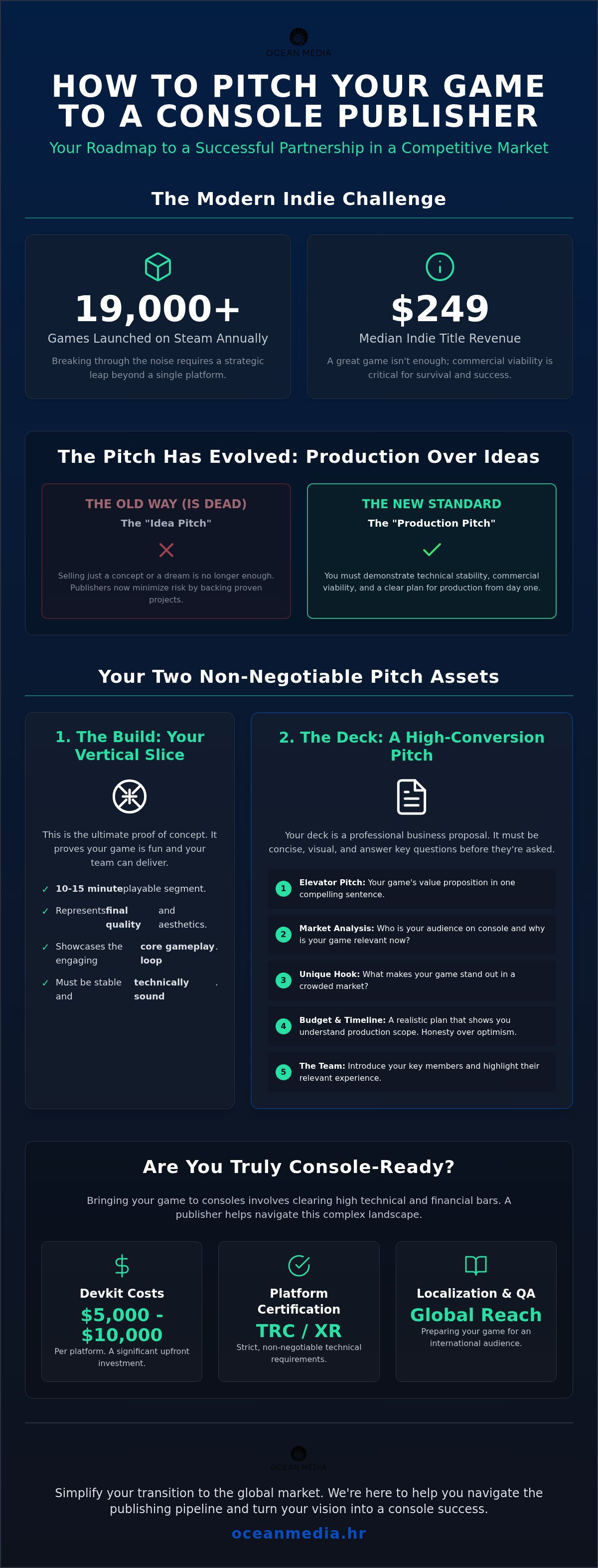
Did you know that over 19,000 games launched on Steam in 2025, yet the median indie title earned just $249? Breaking through that noise requires more than just a great idea; it demands a strategic leap into the global console market. Learning how to pitch a game to a publisher is the most critical skill you can develop to ensure your hard work doesn't vanish into the digital void. We know that the pressure of bringing your game to consoles can feel overwhelming, especially when you're facing strict certification standards and the high cost of devkits (which can range from $5,000 to $10,000 per platform).
You likely feel that your project deserves a spot on the PlayStation, Xbox, or Switch storefronts, but the technical hurdles and fear of rejection often keep creators stuck. This guide provides a clear roadmap to mastering the art of the pitch and preparing your project for a successful partnership. We'll explore exactly what makes a game console-ready and how to structure a deck that commands professional attention. Our team is here to simplify the transition from independent creator to professional partner, so reserve your slot in our publishing pipeline and let's get started today!
Key Takeaways
- Understand that a pitch is a professional proposal for a business partnership, not just a creative showcase of your game's mechanics.
- Learn exactly how to pitch a game to a publisher by developing a high-impact deck and a stable, representative console build that proves technical viability.
- Identify your readiness for platform-specific certification requirements, such as TRC and XR, to ensure your project can survive the rigorous console submission process.
- Master outreach strategies that prioritize brevity and professional subject lines to capture the attention of busy publishing scouts in a crowded market.
- Simplify your transition to the global market and follow a structured path to success; reserve your slot in our publishing pipeline and let's get started today!
What Is a Game Pitch and Why Is It Vital for Consoles?
A game pitch is a formal proposal for a long-term business partnership. It's not a school project or a casual request for help. In 2026, the industry has shifted away from funding "good ideas" in favor of projects with proven technical foundations. Learning how to pitch a game to a publisher now requires demonstrating technical stability and commercial viability from day one. Your primary goal is to minimize the publisher's perceived risk. You do this by showing you have a clear plan for production and a deep understanding of your target audience. Success means proving that your game isn't just fun; it's a viable product capable of surviving the competitive console market.
The "idea pitch" is dead. Today, we look for a "production pitch." This means you aren't just selling a dream; you're selling a project that is already in motion. You need to highlight market potential through data and early community engagement. If you can show that players are already excited about your core loop, you've already won half the battle. Publishers want to see that you understand the business side of development as much as the creative side.
The Role of the Publisher in the Console Ecosystem
Publishers act as the essential bridge between your raw code and the digital storefronts of PlayStation, Xbox, and Nintendo. While you focus on the creative vision, a partner manages the administrative and technical burdens that often derail independent projects. What is a game publisher? Beyond just providing capital, they offer platform-specific expertise in areas like certification, localization, and storefront management. Bringing your game to consoles involves a complex web of requirements (often called TRC or XR) that vary by platform. These non-negotiable standards ensure that every game on the storefront works perfectly for the end-user. Digital distribution expertise is the most valuable asset a publisher offers in 2026, helping you navigate visibility algorithms and regional pricing strategies. Our team at Ocean Media uses a refined publishing pipeline to handle these complexities, ensuring your game meets every technical hurdle without compromising your artistic intent.
When Is Your Game Actually Ready to Pitch?
Timing is everything. In the current market, a pitch deck alone is rarely enough to secure a deal. Publishers increasingly require a "Vertical Slice." A Vertical Slice is a 10-15 minute gameplay segment that represents final quality. This playable build proves that your core loop is engaging and that your team can actually deliver on the promised aesthetics. It's the ultimate proof of concept. Before you reach out, assess your internal technical roadmap. Do you have a plan for porting? Have you considered the costs of devkits, which typically range from $5,000 to $10,000 per platform? Showing that you've already thought through these logistical challenges makes you an attractive partner. We're ready to help you navigate these professional waters and simplify the journey. You don't have to do this alone; reserve your slot in our publishing pipeline and let's get started today!
Building Your Core Pitch Assets: The Deck and the Build
To stand out in 2026, your presentation must be impeccable. Informal pitches or simple GIFs might work for social media hype, but professional console publishing requires a structured approach. You need to balance creative flair with business logic. When learning how to pitch a game to a publisher, remember that your assets are a direct reflection of your studio's professionalism. High-quality trailers and raw gameplay footage are your first chance to capture immediate interest. If a scout isn't hooked within the first thirty seconds of your video, they're unlikely to open your build. Focus your presentation on three non-negotiable pillars: a unique hook, proven gameplay, and a capable team.
The Anatomy of a High-Conversion Pitch Deck
Your deck should be concise and visually striking. Start with an "Elevator Pitch" slide that summarizes your game in one compelling sentence. This isn't just a description; it's your value proposition. Next, provide a clear market analysis. You must identify exactly who is playing this genre on console and explain why your game is relevant right now. Be realistic about your budget and timeline. Publishers value honesty over optimism. They want to see that you've accounted for the specific needs of a publishing pipeline, including localization and quality assurance. To truly prepare your game for investors and publishers, your financial slides must show a clear path to completion.
Preparing the Pitch Build for Evaluation
The "Pitch Build" is your most important asset. It must be stable and representative of the final console experience. For console publishers, flawless controller support is mandatory. If a scout has to reach for a mouse and keyboard to navigate your menu, you've already lost credibility. Ensure you remove all "developer cheats" or debug consoles that could break immersion. Your build should offer a smooth first-user experience with clear instructions on how to play. Don't assume the reviewer knows your mechanics. Provide a "Read Me" file or an in-game tutorial that highlights exactly what they should look for in the build. At Ocean Media, we specialize in evaluating these technical nuances to help you refine your project for the global stage. You can learn more about our evaluation process to see how we help developers polish their work.
Mastering these assets is the first step toward a signed deal. We're here to help you navigate the technical hurdles of bringing your game to consoles and ensure your vision reaches its full potential. Don't let technical confusion stall your progress. It's time to take the next step; reserve your slot in our publishing pipeline and let's get started today!
Evaluating Publisher Fit and Console Readiness
Don't fall into the trap of pitching every name on a list. Inefficient outreach leads to high rejection rates and wasted time. You must research a publisher's portfolio to ensure they truly understand your specific genre. A partner specialized in narrative RPGs might not have the right audience or marketing infrastructure for your precision platformer. Learning how to pitch a game to a publisher effectively means identifying a partner who acts as a strategic bridge, not just a source of capital. Look for a guide with 20+ years of experience in navigating platform holder bureaucracy. This seasoned authority is vital for managing the complex, often opaque relationships with global console giants.
Console readiness is the true test of your project's maturity. It goes beyond having a fun core loop; it involves a deep understanding of technical certification requirements. These are the non-negotiable standards that govern every digital release. Demonstrating that you are aware of these hurdles during your pitch immediately separates you from less experienced teams and reduces the publisher's perceived risk.
Navigating Console Certification Requirements
Console certification is the technical gatekeeping process managed by platform holders like Sony, Microsoft, and Nintendo. These requirements, known as TRC for PlayStation or XR for Xbox, ensure every game maintains a high standard of stability, security, and user experience. Failing these tests can lead to costly delays and missed launch windows. A partner like Ocean Media simplifies the certification process for indie devs by handling the technical heavy lifting and administrative coordination. We act as your expert guide through this maze. For a deeper look at the specific stages involved in this journey, explore How to Publish a Game on Console: The Complete Developer Roadmap for 2026.
Assessing the "Digital-First" Advantage
The console market generated $45.9 billion in revenue in 2025, with digital storefronts serving as the primary engine for indie success. While physical retail exists, digital distribution offers the global reach and scalability modern developers need to thrive. However, this path comes with significant administrative complexities. You must manage global age ratings, multi-language localization, and complex storefront metadata across different regions simultaneously. Digital publishers focus on longevity and royalty shares rather than one-time retail sales. This alignment of interests ensures your partner is as invested in your game's long-term performance as you are. We help you navigate these digital waters with a proven publishing pipeline designed for maximum efficiency. Ready to take the leap? Reserve your slot in our publishing pipeline and let's get started today!
The Outreach Strategy: From Cold Email to First Meeting
Even the most polished vertical slice will gather digital dust if your outreach strategy is flawed. Publishing scouts receive hundreds of inquiries every week, so your first impression must be surgical. Learning how to pitch a game to a publisher effectively starts with the realization that brevity is your best friend. Your goal isn't to explain every mechanic in the first email. It's to generate enough curiosity to earn a fifteen minute meeting. Focus on high-level impact and professional clarity from the very first character of your subject line.
The Perfect Cold Email Template
Your subject line should be descriptive and professional, such as "[Genre] - [Game Title] - Console Pitch." Inside the email, lead with a punchy hook. State your genre and intended platforms immediately. Always include a direct link to your trailer or gameplay footage rather than attaching large files; scouts won't risk downloading unknown 1GB zip files. End with a clear call to action, such as asking if they're available for a 15-minute call next Tuesday. This approach respects their time while showing you're ready for a professional partnership.
Pitching During a Live Meeting
The "First Look" meeting is where your preparation pays off. If you're demoing live, have a recorded backup ready in case of technical glitches. Handling a crash with professional composure often tells a publisher more about your team's reliability than a perfect demo would. Be prepared for hard questions regarding your budget, competition, and unique selling points. Use first-person plural language, like "our shared goals" or "our publishing pipeline," to build rapport and frame the conversation as a collaboration. This shift in tone suggests you aren't just looking for a check, but a partner to help with bringing your game to consoles. If you're ready to move beyond cold emails, you can submit your project to our scouts for a professional review.
Don't disappear after the meeting. A polite follow-up one week later keeps you on the publisher's radar without being a nuisance. Provide a brief update or a new piece of concept art to show continued momentum. We value developers who are proactive and organized. If you want to skip the guesswork and enter a structured path to market, reserve your slot in our publishing pipeline and let's get started today!
Navigating the Publishing Pipeline with Ocean Media
After you've mastered the nuances of how to pitch a game to a publisher, the next logical step is choosing a partner who can actually help you cross the finish line. Ocean Media stands as a seasoned authority in the console space. We aren't just a funding source; we're a bridge to the global market. Led by industry veteran Vedran Klanac, our team brings a collaborative spirit to every project we touch. We understand that your passion lies in the code, the art, and the player experience. That's why our structured publishing pipeline is designed to absorb the logistical shocks that often derail independent studios. By partnering with us, you gain more than a contract; you gain a team that is as enthusiastic about your creative vision as you are.
Our approach is built on the belief that a publishing deal should feel like a true partnership rather than a cold transaction. When you work with our team, you're engaging with professionals who have seen the industry change over two decades. We've navigated the shift from the early days of digital storefronts to the complex, data-driven reality of 2026. We use that knowledge to protect your interests. This means we anticipate problems before they ever reach your desk, allowing you to stay in the creative "flow state" for longer periods. We handle the heavy lifting so you can focus on making your game the best it can be.
Why Ocean Media is Your Ideal Console Partner
Navigating the technical and administrative complexities of platform holders requires more than just a good game. It requires a deep, historical understanding of how these systems evolve. We leverage 20+ years of console-specific digital distribution experience to ensure your release is flawless. While you focus on polishing your core loop, we handle the intricacies of global ratings, platform-specific metadata, and the rigorous certification standards required by Sony, Microsoft, and Nintendo. This specialization allows you to maintain your creative momentum while we manage the bureaucracy. You can learn more about our services for developers and see how our expertise translates into successful global launches.
Get Started with Your Console Journey Today
The transition from an independent developer to a professional console studio doesn't have to be a trial by fire. If you have a stable prototype or a polished vertical slice, the hardest part of the creative journey is already behind you. Now, it's about execution and professional distribution. We've simplified the path for you, offering a clear and transparent roadmap to the world's most popular consoles. Our goal is to make bringing your game to consoles an exciting milestone rather than a technical nightmare. The global market is waiting for your unique vision. Don't let administrative burdens or technical fear hold you back. It's time to take the final step toward your signed deal; reserve your slot in our publishing pipeline and let's get started today!
Launch Your Project on the Global Stage
Mastering how to pitch a game to a publisher is about more than just creative flair; it's about proving you're a reliable business partner. You've learned that a stable vertical slice and a deep understanding of console certification are the keys to reducing a publisher's risk. By focusing on these technical foundations and crafting a surgical outreach strategy, you position your studio for professional success in a competitive market. The leap from a prototype to a global release is significant, but you don't have to navigate it alone.
Ocean Media is here to act as your expert guide through the complexities of the digital landscape. We bring 20+ years of digital console publishing expertise to the table, with over 100+ titles successfully released across PlayStation, Xbox, and Switch. We handle the administrative and technical burdens so you can focus on the art of development. Our team is ready to help you navigate the final steps of bringing your game to consoles. It's time to turn your vision into a global reality. Reserve your slot in our publishing pipeline and let's get started today! We're excited to see what you've built and help you reach players worldwide.
Frequently Asked Questions
How long should a game pitch deck be?
A professional pitch deck should typically range from 10 to 15 slides. This length allows you to cover essential topics like your unique hook, core gameplay loop, target audience, and development timeline without losing the scout's attention. Keep each slide focused on a single key message. If you're learning how to pitch a game to a publisher, remember that brevity demonstrates you respect their time and understand your own project's core value.
Do I need a finished game to pitch to a publisher?
You don't need a finished game, but a playable vertical slice is essential in the current market. Publishers rarely sign projects based on concept art or design documents alone. They need to see that the core mechanics are fun and that your team can achieve the promised visual quality. Showing a polished segment proves you're ready for our publishing pipeline. Reserve your slot in our publishing pipeline and let's get started today!
What is the most important part of a game pitch?
The most important part of your presentation is the hook combined with evidence of technical viability. You must clearly explain why your game is unique and prove that your team can actually build it. Publishers are looking to minimize risk. If you can demonstrate that your core gameplay is engaging and your code is stable, you've addressed the two biggest concerns any console partner will have during the evaluation process.
How much revenue do publishers usually take?
Revenue splits vary, but a 10% to 30% revenue share is common for specific services like porting, while full publishing deals can be higher depending on investment. This share covers the technical and administrative burdens handled by your partner, such as certification and global distribution. Understanding these numbers is vital when learning how to pitch a game to a publisher. We focus on sustainable partnerships that protect your studio's long-term growth.
Can I pitch the same game to multiple publishers?
You can and should pitch your game to multiple publishers simultaneously. Creating a shortlist of potential partners who fit your genre ensures you find the best strategic match. It's standard practice in the industry to have several conversations running at once. Just ensure you're transparent if you receive an offer. This competitive environment can sometimes help you secure better terms for bringing your game to consoles and reaching a wider global audience.
What is a vertical slice in game development?
A vertical slice is a 10 to 15 minute gameplay segment that represents the final quality of the project. It's not a demo with placeholder assets; it's a fully polished piece of the game that showcases the art style, mechanics, and user interface. This asset is the most powerful tool in your arsenal because it proves your studio can meet the high standards required for PlayStation, Xbox, and Switch storefronts.
How do I protect my game idea when pitching?
Execution is the best way to protect your game; ideas themselves are rarely protected by legal agreements in the early stages. Most publishers won't sign an NDA just to look at a pitch deck because they see thousands of similar concepts. Focus on building a unique visual identity and a stable build that is difficult to replicate. Professionalism and a clear production roadmap are your best defenses against potential imitation.
What do console publishers look for in an indie game?
Console publishers look for technical stability, a clear market hook, and a team that understands the certification process. Your game needs to stand out in a crowded digital storefront while meeting the strict requirements of platform holders. We look for projects that have a defined audience and a realistic path to completion. If you've built a polished core loop, reserve your slot in our publishing pipeline and let's get started today!


