

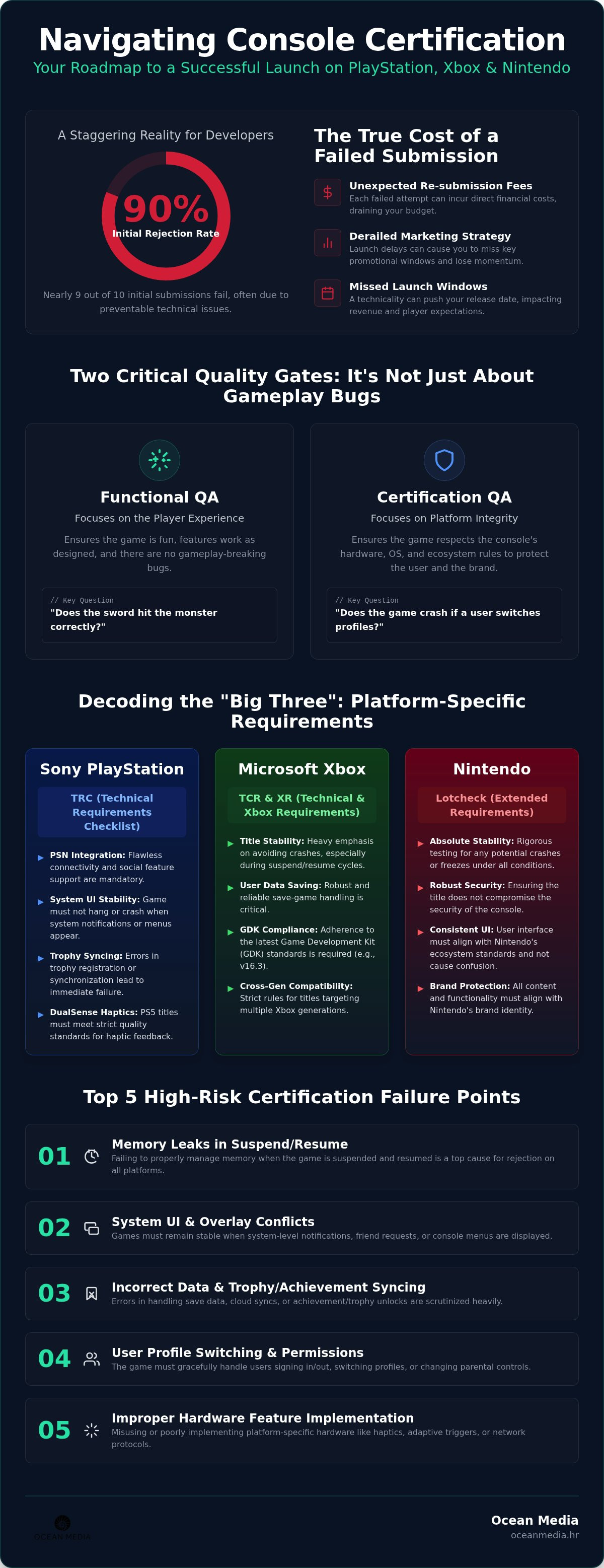
Did you know that nearly 90% of initial console submissions are rejected before they ever reach a digital storefront? Most of these setbacks stem from common console certification failures that are entirely preventable with the right roadmap. You've poured your heart into development, only to face the daunting "submission limbo" and the sting of unexpected re-submission fees. It's frustrating when conflicting terminology between Sony, Microsoft, and Nintendo turns a simple launch into a logistical nightmare, especially when you lack consistent devkit access or specialized compliance knowledge.
We understand that bringing your game to consoles should be a celebration of your hard work, not a battle against red tape. This guide identifies the technical pitfalls that cause the vast majority of rejections so you can launch on time and on budget. We'll walk you through the current 2026 requirements, such as the Xbox XR 16.3 standards and PlayStation 5 system software version 26.04 updates. You'll gain a clear understanding of the "Big Three" requirements and a checklist of high-risk failure points. Let’s look at how to streamline your publishing pipeline and ensure your project moves smoothly from final build to global success.
Key Takeaways
- Master the distinct technical standards for Sony, Microsoft, and Nintendo to ensure your game aligns with first-party brand protection policies.
- Identify and resolve common console certification failures, such as memory leaks during suspend/resume cycles, before they delay your launch.
- Stay compliant with 2026 updates, including the Xbox XR 16.3 requirements and the latest PlayStation 5 system software versions.
- Use a professional publishing pipeline to handle devkit logistics and administrative complexities, allowing you to focus on development.
- Ready to bring your game to consoles? Reserve your slot in our publishing pipeline and let's get started today!
What is Console Certification and Why Does it Fail?
Console certification is the mandatory gauntlet every title must run before hitting digital shelves. It's the rigorous process where platform holders like Sony, Microsoft, and Nintendo verify that your software meets specific technical and functional benchmarks. While you focus on the Video Game Development Lifecycle and perfecting gameplay, the "Big Three" are focused on brand protection. They prioritize system integrity, user safety, and ecosystem stability over your specific game mechanics. Avoiding common console certification failures requires a shift in mindset. You aren't just making a game; you're building a guest that must follow the strict house rules of a closed platform.
The cost of rejection is high. Beyond the potential for re-submission fees, a failed review can derail your entire marketing strategy. Missing a hard-won launch window because of a technicality can be devastating for an indie studio's bottom line. This is why bringing your game to consoles requires a completely different QA protocol than a PC-only release. On PC, you might patch a memory leak post-launch. On console, that same leak will likely result in an immediate rejection letter.
Certification vs. Functional QA
You might have a "fun" game with zero gameplay bugs that still fails on technical grounds. Functional QA ensures the sword hits the monster. Certification QA ensures the game doesn't crash when a user pulls the power cord or switches profiles. First-party testers aren't looking for balance issues or narrative flow. They are hunting for system violations. One of the biggest mistakes studios make is treating the submission process as a free debugging service. It isn't. Testers expect a launch-ready build that respects the console's hardware and software ecosystem.
The 2026 Standards for Digital Storefronts
As we move through 2026, standards have evolved to meet new challenges. The current Xbox Requirements (XRs) version 16.3, updated in July 2026, places a heavy emphasis on title stability and user-data saving. Modern requirements have shifted significantly toward data privacy and online safety. If you are targeting cross-gen compatibility, the complexity doubles. Platform holders are stricter than ever about "Title Integrity" in our digital-only era. They want to ensure that every game on their store reflects the high quality of their brand.
Navigating these hurdles alone can be overwhelming. We've spent over 20 years refining our publishing pipeline to act as a bridge between your studio and the global market. Don't let your launch get stuck in submission limbo. You can reserve your slot in our publishing pipeline and let's get started today!
The Big Three: Comparing TRCs, TCRs, and XRs
Every platform holder speaks a different dialect of compliance. While Sony, Microsoft, and Nintendo all share the goal of protecting their brand ecosystem, the specific terminology they use can create a maze for developers. Sony utilizes the Technical Requirements Checklist (TRC). Microsoft relies on Technical Certification Requirements (TCR) alongside specific Xbox Requirements (XRs). Nintendo employs Extended Requirements (XR) as part of their "Lotcheck" process. Despite the varied names, the common thread is a demand for absolute stability, robust security, and a consistent user interface that never breaks the player's immersion.
Failing to account for these differences early in development often leads to common console certification failures that can halt a project's momentum. Understanding the nuances of each platform is not just a technical necessity; it is a strategic advantage. Let's break down what each of the "Big Three" prioritizes during their review cycles.
Sony PlayStation TRC Priorities
Sony’s TRC standards focus heavily on the integration of the PlayStation Network and the unique features of their hardware. You must ensure that system-level UI overlays, like notification pop-ups or the Control Center, do not cause your game to hang or crash. Mandatory Trophy integration is a high-stakes area; sync errors are among the common certification failures seen in early submissions. For PS5 titles, Sony enforces strict rules for DualSense haptics. If your adaptive trigger feedback or haptic vibrations don't meet their specific quality standards, your build will likely be sent back for revision.
Microsoft Xbox TCR and GDK Standards
Microsoft’s current standards, particularly under the July 2026 GDK version 16.3, emphasize the "roaming" experience. Gamertags and user profiles must move seamlessly between consoles without save data corruption. A significant hurdle for modern developers is "Quick Resume." Your game must be able to suspend and resume its state perfectly, even after long periods of inactivity or system updates. Integration with Xbox Live APIs is non-negotiable. We frequently see common console certification failures related to improper cloud save handling, which is why a structured publishing pipeline is vital for success.
Nintendo Switch XR and Lotcheck
Nintendo’s Lotcheck process is uniquely focused on the hybrid nature of their hardware. You must handle Joy-Con connectivity and the transition between handheld and docked modes without a single frame of instability. Memory management is scrutinized heavily to ensure performance remains consistent on mobile hardware. Nintendo is also incredibly strict regarding the display of localized age rating icons. If your boot sequence fails to show the correct ESRB, PEGI, or CERO logo for the specific region, the build will fail immediately. Managing these requirements across multiple regions is a complex task that requires seasoned expertise. To ensure your game meets these rigorous standards, reserve your slot in our publishing pipeline and let's get started today!
Top 5 Most Common Console Certification Failures
Technical excellence isn't just about frame rates. It's about how your software behaves within the platform's ecosystem. Industry data suggests that Title Stability alone accounts for 38% of Xbox failures. Most common console certification failures occur because teams treat consoles like high-end PCs. They aren't. Consoles have unique power states and strict legal naming conventions that PC builds simply don't encounter. If your game crashes, hangs, or hits an infinite loading screen during standard play, it's an automatic fail.
Beyond general stability, you must account for these high-risk areas:
- Suspend and Resume: Memory leaks or crashes when the console enters a low-power state.
- Official Naming Standards: Using the wrong term for hardware, such as calling it a "Start button" on a PS5.
- User Privilege Handling: Failing to respect parental controls or blocked user settings.
- Save Data Integrity: Corruption during cloud sync or storage device removal.
- Title Stability: Hard crashes or soft locks during general gameplay.
Deep Dive: The Suspend/Resume Loop
This is arguably the #1 killer of indie console ports. On PC, a game usually stays in the foreground or minimizes. On console, a user might trigger "Connected Standby" or switch to a media app mid-game. If your game can't survive these system-level interruptions without a memory leak or a hard crash, you'll fail. You must architect your game state to survive these transitions. Testing for these scenarios early in your common console certification failures audit is non-negotiable.
Terminology and UI Compliance
Every button and system feature has a legally required name. Using "Click to start" on a console build is a fast track to a rejection letter. Platform holders maintain an exhaustive naming standards rulebook. You must ensure every prompt matches the hardware. Learn how we help developers navigate technical complexities to avoid these simple but costly mistakes. Even a single reference to a "Start button" on the wrong platform can reset your submission timeline.
Respecting User Privileges and Privacy
Consoles are often shared family devices. Your game must respect multiplayer restrictions for child accounts and handle blocked user settings perfectly. This includes data encryption for user-generated content and strict adherence to global mandates like GDPR. Failing to verify these privileges before a session starts is a major compliance violation. We ensure your project follows these privacy standards to the letter. Don't risk your launch date on a technicality. You can reserve your slot in our publishing pipeline and let's get started today!
The Certification Lifecycle: From Devkit to Launch
The journey from a completed build to a live digital storefront is a methodical lifecycle. It begins long before you upload a single file. Securing devkits is your first administrative hurdle. You must register with first-party holders, a process that requires proven readiness and strict NDA compliance. Once the hardware is in your hands, the real work starts. You'll need to run pre-certification audits using automated validation tools like the Xbox GDK test suite to catch common console certification failures early. These tools provide a baseline, but they don't replace the need for rigorous manual testing against platform-specific checklists.
Think of the submission window as your "Gold Master" candidate's entry into the certification sandbox. This isn't just a simple upload. It is a formal review of your software's interaction with the console's OS. The verdict usually comes in one of two forms: a "Conditional Pass," which requires minor fixes before launch, or a "Hard Rejection." Understanding how to navigate this feedback is critical to your success and your budget.
Managing Lead Times and Timelines
Timing is everything when you're bringing your game to consoles. You need to plan for the certification gauntlet at least 2 to 3 months before your desired launch date. This buffer accounts for potential rejections and the mandatory review periods. Don't forget holiday submission freezes. Most platform holders stop accepting new builds in late November, which can push a December launch into the next year. For a deeper look at these milestones, check out our Console Game Launch Timeline: What to Expect.
Handling Rejections and Re-submissions
A rejection letter isn't the end of the road. It's a technical roadmap. You must learn to interpret first-party bug reports to prioritize fixes that impact system integrity. Often, a "Day One Patch" certification is required to address non-critical issues that didn't make the Gold Master. This is a separate, critical process that also requires strict adherence to compliance rules. If this sounds complex, you don't have to do it alone. You can explore our publishing services for indie studios to see how we handle these logistics for you. Our team acts as a shield, helping you resolve common console certification failures before they become expensive setbacks. We believe in a collaborative spirit that turns technical hurdles into launch-day victories. Reserve your slot in our publishing pipeline and let's get started today!
Navigating the Publishing Pipeline: Why Experience Wins
Launching a multi-platform title means managing three distinct, often conflicting, rulebooks at the same time. While you're focusing on game balance and narrative flow, the platform holders are scrutinizing your metadata, tax forms, and age rating compliance. This administrative "red tape" is where many projects stall. We act as a shield between your studio and the frustration of first-party rejection letters. With over 20 years of experience, our team has seen every variation of common console certification failures. We use this seasoned authority to streamline your global digital launch, ensuring your creative vision reaches the market without technical delays.
Reducing Risk in the Submission Phase
Bringing your game to consoles is a significant milestone, but it's one fraught with risk if you're flying solo. Partnering with a team that has seen every failure mode reduces your exposure to expensive re-submission fees. We conduct pre-submission "Lotcheck" audits to catch errors in your build before they reach the official reviewers. This isn't just about technical bugs; it's about ensuring your global presence is compliant from the start. For instance, our Global Console Game Age Rating Guide for Developers 2026 provides a roadmap for managing regional requirements like CERO, ESRB, and PEGI. By identifying these issues early, we help you maintain your launch schedule and your reputation.
Your Path to a Successful Global Launch
You should focus on the creative build. Let us handle the TCRs, TRCs, and XRs. A structured publishing pipeline is especially beneficial for first-time console developers who may feel overwhelmed by the technical minutiae. We provide a clear, reliable path for your software to follow, from the first devkit registration to the final digital release. Avoiding common console certification failures is much simpler when you have a guide who knows the terrain and speaks the language of the platform holders. Our collaborative spirit means we work as an extension of your team, not just a transactional vendor. We're here to help you navigate the complexities of the digital landscape with confidence. If you're ready to see your project on the global stage, reserve your slot in our publishing pipeline and let's get started today!
Launch Your Vision with Confidence
Mastering the technical nuances of Sony, Microsoft, and Nintendo is the definitive way to move your project from devkit to digital storefront. By identifying common console certification failures like memory leaks during suspend cycles or improper naming conventions early, you protect your budget and your timeline. A successful launch isn't just about gameplay; it's about respecting the system integrity of each platform holder's ecosystem. We've spent over 20 years refining our process to help creators bridge the gap between development and global distribution.
Our expertise in multi-platform TRC, TCR, and XR compliance ensures your build meets the rigorous 2026 standards for all major digital storefronts. You don't have to navigate these administrative and technical complexities alone. We are ready to act as your seasoned guide and collaborative partner. It's time to bring your game to the global stage with a team that understands every step of the journey. Reserve your slot in our publishing pipeline and let's get started today! We look forward to helping you achieve your launch goals.
Frequently Asked Questions
What are the most common reasons for an indie game to fail certification?
Improper suspend and resume handling and save data corruption are leading causes. These technical hurdles often trip up teams transitioning from PC-native development. We frequently see common console certification failures caused by memory leaks when a console enters low-power mode. Other frequent issues include incorrect naming conventions for system buttons and failing to respect user-profile switching. Addressing these requires a console-first engineering mindset throughout your development cycle.
How long does the console certification process usually take in 2026?
You should plan for a 4 to 8-week period per submission round for each platform. While a perfectly prepared build might pass Microsoft's review in under a week, any rejection resets your timeline. This is why we recommend starting the process 2 to 3 months before your target launch date. Managing these lead times effectively ensures that your global digital launch stays on schedule and within your planned budget.
What is the difference between Sony TRC and Microsoft TCR?
Sony's Technical Requirements Checklist (TRC) focuses heavily on PlayStation Network integration, Trophy synchronization, and DualSense haptic standards. Microsoft's Technical Certification Requirements (TCR) prioritize Xbox Live APIs, cloud save roaming, and "Quick Resume" stability. While both aim for system integrity, the specific APIs and UI naming standards differ significantly. Navigating these conflicting rulebooks is much easier when you use a structured publishing pipeline to handle the technical heavy lifting.
Can my game fail certification if it has gameplay bugs?
Platform holders generally don't fail games for minor gameplay bugs or balance issues. However, if a gameplay bug causes a system-level crash, a hard lock, or an infinite loading screen, it will trigger a rejection. Certification is a brand protection mechanism designed to ensure your software doesn't damage the console's ecosystem. If you want to avoid common console certification failures, focus on technical stability and system-level interactions rather than just gameplay polish.
Do I need a devkit for every platform I want to release on?
Yes, you need a physical devkit for each platform to perform final compliance testing. Emulators or retail hardware cannot accurately replicate how a game interacts with system-level UI or power-saving modes. Securing these units is often an administrative hurdle for new developers. We help simplify this by managing first-party registrations. To secure your hardware and start the process, reserve your slot in our publishing pipeline and let's get started today!
How much does it cost to re-submit a game after a rejection?
Platform holders have different policies regarding re-submission fees. Some may offer a set number of attempts for free, while others charge for every subsequent review after a failure. The hidden cost is often the lost marketing momentum and delayed launch revenue. Re-submission resets the 4 to 8-week review window. This makes pre-certification audits essential for protecting your bottom line and maintaining your project's financial health during the final stages.
Is certification required for digital-only releases on the Nintendo eShop?
Yes, Nintendo's Lotcheck process is mandatory for every digital-only release. You must demonstrate that your game handles Joy-Con connectivity and docked-to-handheld transitions without instability. Nintendo also enforces strict rules regarding the display of localized age ratings and memory management. Bringing your game to consoles like the Switch requires adhering to these specific hardware handling requirements to ensure a smooth user experience across all play modes.
What happens if my game fails certification just before the launch date?
A late rejection usually forces a delay in your release date. Because re-submission resets the review timeline, you may miss your original marketing beats. In some cases, platform holders might allow a "Conditional Pass" if the issue can be fixed with a Day One patch. However, this is not guaranteed. We act as a bridge between you and the platform holders to resolve these issues before they become critical launch-day setbacks.


