

What if the biggest obstacle to your console launch isn't a bug in your code, but a missing tax form or a misunderstood certification requirement? You've spent years perfecting your mechanics, yet the final hurdle often feels like a wall of platform-specific jargon and administrative headaches. We know how frustrating it is to face rejection because of a minor TCR oversight or a delay in IARC integration. That's why having a definitive console game submission checklist is essential for any studio serious about bringing your game to consoles in 2026.
We're here to turn that confusion into a clear, actionable roadmap. Our guide breaks down the complex publishing pipeline into manageable steps, covering everything from Sony's complimentary dev kit loans to the updated $2,000 Xbox hardware costs. You'll gain the technical and administrative insights needed to pass certification on the first try and achieve a professional global digital launch. Let's simplify the transition from development to distribution together. Reserve your slot in our publishing pipeline and let's get started today!
Key Takeaways
- Navigate the administrative landscape of major platform portals and secure essential global age ratings for a successful 2026 launch.
- Use our expert-vetted console game submission checklist to master technical requirements like TCRs, TRCs, and XRs before your first submission.
- Prepare storefront metadata and marketing assets that comply with platform-specific branding rules and safe-zone requirements to avoid last-minute delays.
- Minimize the risk of costly certification failures and administrative headaches by identifying "invisible" roadblocks early in your development cycle.
- Streamline the process of bringing your game to consoles; reserve your slot in our publishing pipeline and let's get started today!
Navigating the Console Submission Maze in 2026
For many independent creators, the final stage of the game development process feels like facing a hidden final boss. You've polished your mechanics and squashed your bugs, but the certification phase is a different beast entirely. Rejection doesn't just hurt your morale; it drains your budget and delays your revenue stream. A single failed submission can set your launch back by weeks, causing you to miss critical marketing windows or seasonal sales events. It's a high-stakes environment where technical precision meets administrative rigor.
The digital landscape has evolved rapidly. By late 2026, we're seeing PlayStation 5 firmware reaching version 26.05-13.60.00 and the Nintendo Switch 2 operating on version 22.5.0. Staying current with these updates while managing a console game submission checklist is what separates a successful global launch from a project that languishes in "cert hell." Using a structured approach simplifies the transition into a professional environment where technical stability is non-negotiable. We've seen how a clear roadmap transforms an overwhelming task into a series of achievable milestones.
Understanding the Multi-Platform Challenge
Bringing your game to consoles requires a fundamental mindset shift from PC development. On PC, you might patch a game in minutes; on consoles, every update must pass through a rigorous gateway. Platform-specific quirks are the norm. While Sony offers complimentary PS5 development kits as loans to accepted partners, Microsoft has increased Xbox dev kit costs to $2,000 due to macroeconomic shifts. These hardware differences require secure, specialized environments and a deep understanding of how each platform handles controller inputs, user profiles, and save data. You aren't just launching a game; you're integrating with a complex ecosystem.
The 2026 Submission Timeline
Timing is everything in the publishing pipeline. We recommend accounting for at least 4-6 weeks of "certification padding" in your schedule. This buffer allows you to address unexpected feedback from platform holders without derailing your marketing beats. Initial reviews usually take several business days, but final approval can stretch longer if you're navigating complex age ratings or storefront metadata. For a deeper dive into the logistics, check out our guide on How to Publish a Game on Console: The Complete Developer Roadmap for 2026. Don't let administrative hurdles stop your creative vision. Reserve your slot in our publishing pipeline and let's get started today!
Phase 1: Administrative and Legal Prerequisites
Before you ever upload a build, you must clear the administrative hurdles that define your professional identity. Many developers find this stage more taxing than debugging, as it involves complex legal agreements and global compliance standards. Unlike generic guides that focus solely on one platform, a comprehensive console game submission checklist must account for the unique portal requirements of Sony, Microsoft, and Nintendo simultaneously. Establishing your developer identity is the first step in our publishing pipeline, ensuring that your studio is legally and financially ready to receive global revenue. Clearance of these legal essentials is the bedrock of bringing your game to consoles.
Age Ratings and Global Compliance
Securing age ratings is no longer the fragmented process it once was, thanks largely to the International Age Rating Coalition (IARC). This system allows you to obtain ratings for the ESRB, PEGI, and other major bodies through a single, detailed questionnaire. However, accuracy is paramount. If your content disclosures are found to be incomplete or misleading, your game faces immediate delisting and potential platform bans. In 2026, storefronts have tightened their oversight on Asian markets, specifically regarding CERO (Japan) and GRAC (Korea) requirements. We often help our partners navigate these "administrative headaches" to ensure every disclosure is 100% accurate before submission.
Platform Account Setup
Setting up your platform accounts involves more than just a username and password. You'll need to execute non-disclosure agreements (NDAs) and master service agreements that dictate the terms of your partnership. Verifying your studio's legal entity status is a critical gatekeeper for storefront approval. While the Xbox Game Publishing Guide provides an excellent starting point for Microsoft's ecosystem, you must also manage tax and banking documentation to ensure seamless international payments. Legal essentials like privacy policies, End User License Agreements (EULAs), and trademark clearances must be finalized before you can move to the technical phase.
Managing multi-user access is equally vital. You must grant specific permissions to your team members or your publisher while maintaining high security standards. If this sounds overwhelming, consider partnering with an experienced guide to manage these logistical burdens. Clearing these prerequisites early prevents your project from stalling just as you reach the finish line. Reserve your slot in our publishing pipeline and let's get started today!
Phase 2: Technical Certification Readiness (TCRs, TRCs, and XRs)
Technical certification is the true test of your game's readiness for the global stage. It's vital to understand that certification isn't just about finding gameplay bugs. Platform holders care about how your software interacts with their hardware, operating system, and online services. A robust console game submission checklist must prioritize stability, security, and the correct implementation of platform-specific features. We've seen many developers pass their internal QA only to fail certification because they neglected the "invisible" rules that govern the console ecosystem. It's about meeting a professional standard that ensures a seamless experience for the end user.
You'll need to master the "Big Three" terminology to move forward. Nintendo uses the Technical Requirements Checklist (TCR); Sony utilizes the Technical Requirement Checklist (TRC); and Microsoft enforces Xbox Requirements (XRs). These documents are frequently updated to reflect new firmware capabilities and security protocols. Rejection often stems from common fail points like controller disconnection handling, profile switching, or save data corruption. If your game stutters or takes too long to load, it won't pass. Performance standards in 2026 demand rock-solid framerate stability and optimized loading times that leverage modern SSD architecture. Bringing your game to consoles means proving your code is as reliable as the hardware it runs on.
Platform-Specific Standards
Dashboard integration is a mandatory hurdle you cannot ignore. Your game must respond instantly to the "Home" button and handle system-level interruptions without crashing. In 2026, Trophy and Achievement systems are no longer optional extras; they require precise triggers and background synchronization. User Profile Management is another frequent fail point. Your software must correctly identify which user is signed in, especially during local multiplayer sessions, to ensure save data and achievements are attributed to the right account. We help our partners audit these features early in the publishing pipeline to avoid costly late-stage revisions.
Security and Network Requirements
Security is a non-negotiable pillar of the submission process. Your build must comply with strict encryption and data privacy standards to protect both the user and the platform's integrity. If your title includes online play, you must meet specific requirements for matchmaking, leaderboards, and cross-play policies. These systems must be resilient against network drops and latency issues. For a detailed look at maintaining these standards after your initial launch, see our guide on Console Game Patching: A Developer’s Guide for 2026. Don't let technical jargon slow your momentum. Reserve your slot in our publishing pipeline and let's get started today!
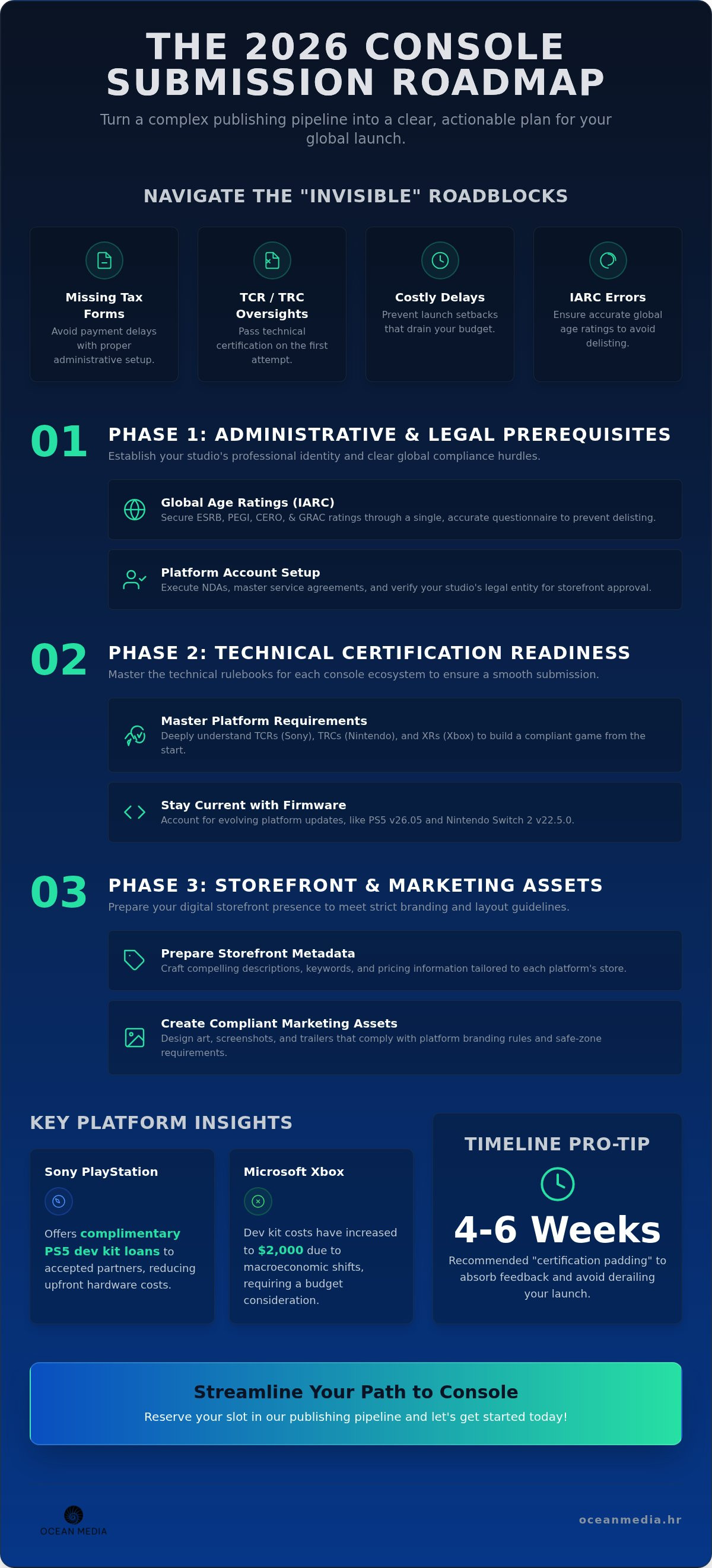
Phase 3: Storefront Metadata and Marketing Assets
Passing technical certification is a massive achievement, but your console game submission checklist isn't complete until your digital storefront is ready for customers. There is a sharp distinction between being "Ready for Dev" and "Ready for Storefront." While your build handles the logic, your metadata handles the sale. In 2026, storefront algorithms are more sophisticated than ever, rewarding titles that provide high-quality, localized, and platform-compliant assets. We've seen great games fail to gain traction simply because their icons didn't pop or their trailers violated branding rules. This phase is about visibility and conversion.
Digital Asset Specifications
Visual assets must meet rigorous standards for 4K and HDR displays. Your hero banners, icons, and screenshots need to look crisp on everything from a handheld screen to a 75-inch television. A critical yet often overlooked requirement is the "Safe Zone" rule. You must ensure that vital UI elements and text in your screenshots and trailers aren't cut off by the physical edges of various TV models. Additionally, trailers must include the correct ESRB or PEGI rating cards and adhere to platform-specific branding. For example, a PlayStation trailer should feature the correct button prompts and logo animations. This attention to detail signals to the platform holder that you are a professional partner.
Localization and Global Appeal
To achieve a professional global digital launch, localization is non-negotiable. In 2026, EFIGS (English, French, Italian, German, Spanish) remains the baseline for any serious console release. However, expanding into Asian and Latin American markets requires deeper culturalization. This means more than just translating text; it involves adapting content to respect local sensitivities and storefront search behaviors. Optimizing your keywords and descriptions for console-specific SEO is essential for rising above the noise in a crowded marketplace. If you need help managing these complex requirements, our localization and publishing support can streamline the process for you.
We handle the "administrative headache" of coordinating these assets so you can focus on your next project. Bringing your game to consoles is a multi-faceted journey, and we are here to ensure every pixel and paragraph meets the highest industry standards. Reserve your slot in our publishing pipeline and let's get started today!
Partnering for Success: The Ocean Media Publishing Pipeline
Even the most detailed console game submission checklist can't account for the intuition gained from two decades in the industry. Experienced eyes see the "invisible" roadblocks that often derail indie launches at the final hour. While you focus on the art and mechanics, we focus on the complex web of platform bureaucracy. Ocean Media brings over 20 years of industry experience to the table, acting as a seasoned bridge between your creative vision and the global digital market. We believe in a collaborative spirit that treats your success as our own, moving beyond a transactional relationship to become a true creative partner.
Streamlining Your Submission
Our expertise in the publishing pipeline begins long before your final build is ready. We conduct rigorous pre-certification testing designed to catch potential TCR, TRC, or XR failures before the platform holders ever see them. This proactive approach saves you from the morale-crushing cycle of repeated rejections and wasted time. Beyond the technical code, we manage the logistical intricacies of global pricing strategies and storefront listings across every major territory. Once your title is live, our support doesn't stop. We handle post-launch patch submissions and updates, ensuring your game stays compliant with the latest firmware requirements. Bringing your game to consoles shouldn't feel like a solo battle against an administrative giant.
We take pride in simplifying the transition into a professional environment. Whether it's navigating the nuances of 2026 IARC integration or ensuring your metadata is perfectly optimized for storefront search, we handle the administrative headache. You can find more about our specific services for developers to see how we fit into your workflow. This allows your team to stay focused on the creative process while we manage the technical hurdles and platform-specific jargon that often slow down independent studios.
Start Your Journey Today
The path to a professional console launch is paved with technical and administrative complexities that require a steady hand. You've done the hard work of creating something unique and engaging. Now, let us help you share it with the world through a structured, expert-vetted path to success. We offer a reliable partnership that minimizes risk and maximizes your title's global potential. If you're ready to take the next level in your development career, we are ready to guide you through every step of the process. Reserve your slot in our publishing pipeline and let's get started today!
Your Roadmap to a Successful Console Launch
Mastering the technical and administrative hurdles of platform certification is the final step in turning your creative vision into a commercial reality. By following a structured console game submission checklist, you protect your studio from the costly delays of certification failure and ensure your title meets the high standards of the 2026 digital marketplace. From securing age ratings to optimizing your storefront metadata, every detail contributes to a professional global debut.
We bring 20+ years of industry experience to every partnership, specializing in digital distribution and maintaining a proven track record with indie titles. Our team manages the technical certification complexities and handles the administrative headache so you can stay focused on your next innovation. Let's work together to navigate the publishing pipeline and bring your game to consoles with confidence. Reserve your slot in our publishing pipeline and let's get started today!
Frequently Asked Questions
What is the difference between a game bug and a certification failure?
A game bug is a functional error in your gameplay, while a certification failure is a violation of platform-specific standards. For example, a character clipping through a wall is a bug; the game crashing when a controller is disconnected is a certification failure. Platform holders prioritize the stability of their ecosystem over minor gameplay glitches. Our team helps you audit these standards to ensure a smooth transition into a professional environment.
How much does it cost to submit a game to consoles in 2026?
Registration for developer programs on PlayStation, Xbox, and Nintendo is free in 2026. However, hardware costs vary by platform. Sony provides complimentary PS5 dev kits as loans to accepted partners, while Xbox dev kits cost $2,000 as of late 2025. You should also account for the 30% digital sales commission taken by storefronts like the Nintendo eShop. While submission fees are gone, the investment in hardware remains a significant part of your budget.
Can I self-publish on consoles, or do I need a partner?
You can technically self-publish, but many indie studios find the administrative and technical hurdles overwhelming without an experienced partner. Navigating the console game submission checklist requires deep knowledge of platform bureaucracy and global tax laws. We act as a bridge between your creativity and the market, leveraging 20+ years of industry experience. Partnering with us allows you to focus on development while we manage the complex publishing pipeline for you.
What happens if my game fails the certification process?
If your game fails, the platform holder provides a report detailing which requirements were not met. You must fix these issues and resubmit the build, which often resets your review timeline. Repeated failures can delay your launch by weeks or months, risking your marketing momentum. This is why pre-certification testing is a core part of our service. We catch these errors early to keep your project moving forward without costly setbacks.
How long does the console submission process typically take?
The entire process generally requires a 4-6 week buffer for certification and storefront setup. While an initial review might take several business days, you must account for potential fixes and the time needed to coordinate global age ratings. Planning your launch around these lead times is essential for a professional global digital launch. We help you manage this timeline efficiently. Reserve your slot in our publishing pipeline and let's get started today!
Do I need a separate build for each console platform?
Yes, each platform requires a unique build that integrates its specific APIs for achievements, save data, and user profiles. While your core gameplay code remains the same, the wrapper that communicates with the console's operating system is different for PlayStation, Xbox, and Nintendo. Managing these parallel versions is a technical challenge that we simplify through our specialized publishing expertise. We ensure every version meets the rigorous standards required for a successful digital release.
What are the mandatory age ratings for a global digital release?
You must obtain ratings from bodies like the ESRB, PEGI, and CERO for a global launch. Most major storefronts utilize the IARC system to streamline this process through a single questionnaire. However, accurate content disclosure is critical. Incomplete disclosures can lead to immediate delisting or platform bans. We handle the administrative headache of global compliance, ensuring your game is ready for every major storefront in 2026 using our comprehensive console game submission checklist.
How do I get dev kits for PlayStation, Xbox, and Nintendo?
You must first register as a developer on each platform's respective portal and have your game concept accepted. In 2026, Sony offers one complimentary PS5 development kit and one test kit as a loan to registered partners. Microsoft requires a $2,000 purchase for Xbox dev kits. Once your hardware arrives, you must maintain a secure development environment. We guide our partners through these applications to ensure you get the hardware needed for a professional launch.


