

Why does a critical bug fix take five minutes to deploy on PC but feel like a month-long odyssey on PlayStation or Xbox? It's a question that haunts even the most seasoned developers as they face the rigid gates of platform holders. You've poured your heart into bringing your game to consoles, yet the technical requirements (those dreaded TRCs and XRs) often feel like a moving target designed to delay your progress. Failing certification doesn't just hurt your schedule; it risks your reputation with a global audience waiting for updates.
We understand that the console game patching process can be a source of significant anxiety, especially when launch windows are unpredictable. We're here to help you master these complexities and turn the certification maze into a predictable, streamlined workflow. Our guide explores the 2026 certification timeline and offers a clear roadmap to minimize rejection rates while optimizing your publishing pipeline for global updates. Let's turn these administrative hurdles into a strategic advantage for your studio; reserve your slot in our publishing pipeline and let's get started today!
Key Takeaways
- Identify the core differences between "instant" PC updates and the certification-heavy environment of modern consoles (where ecosystem integrity is always the top priority).
- Navigate the five stages of the console game patching process to ensure your critical bug fixes reach players without failing certification.
- Implement proven best practices like batching minor fixes and maintaining direct lines of communication with platform holders to reduce administrative overhead.
- Leverage our 20 years of industry experience to manage the technical complexities of your publishing pipeline and avoid common submission pitfalls.
- Secure a reliable partner for your next release; reserve your slot in our publishing pipeline and let's get started today!
What is the Console Game Patching Process?
While PC developers often enjoy the luxury of "push to live" buttons, the console game patching process is a different beast entirely. It represents a highly structured sequence of development, internal QA, and platform holder approval required to update a live game. At its core, this is what a patch is for consoles: a regulated evolution of your product that must satisfy strict external standards before it ever reaches a player's hard drive. Unlike Steam or itch.io, where updates can be nearly instant, console ecosystems prioritize security and ecosystem integrity over developer speed.
Sony, Microsoft, and Nintendo act as the ultimate gatekeepers. They aren't just checking to see if your game is fun; they're ensuring that your update won't compromise their hardware, leak user data, or crash the OS. With the global gaming market projected to reach $213.9 billion in 2026, the stakes for platform stability are at an all-time high. In this ecosystem, you must balance the need for rapid iteration with the reality of platform stability. It's a delicate dance that requires a deep understanding of the rules.
Hotfixes vs. Title Updates: Understanding the Categories
You need to know which tool to use to keep your community happy. Hotfixes are typically server-side changes or emergency stability tweaks. These often bypass a full download, allowing you to tweak weapon stats or fix server connectivity issues quickly. Title updates, however, are client-side downloads. These require full certification because they change the actual game code on the console. Knowing when to use a hotfix versus a full title update can save your team weeks of waiting and significant administrative effort.
The Role of Digital Storefronts in Update Distribution
Storefronts like the PlayStation Store, Xbox Store, and the Nintendo eShop manage the massive flow of patch data to millions of users. Efficient distribution is mandatory for modern live-service success. This is where delta patching becomes a developer's best friend. Delta patching is the method of only downloading changed data bits rather than the entire game file. By utilizing this method, you reduce the friction for your players, ensuring they spend more time playing and less time staring at a download bar.
Successfully bringing your game to consoles means mastering these logistical hurdles. Our team has spent over 20 years refining our publishing pipeline to help studios navigate these exact complexities. We take the technical and administrative heavy lifting off your plate so you can focus on the creative side of development. If you're ready for a smoother path to global distribution, reserve your slot in our publishing pipeline and let's get started today!
Navigating Console Certification Requirements (TRCs & XRs)
Entering the console ecosystem means adhering to a strict set of rules that govern every byte of your update. For Sony, these are Technical Requirements Checklists (TRCs). For Microsoft, they're known as Xbox Requirements (XRs). While some developers view these as barriers, they're actually the blueprints for a seamless patching pipeline that protects the player experience. Platform holders prioritize security and ecosystem integrity because a single faulty patch could compromise firmware or expose user data across millions of devices.
In 2026, the "Certification Fail" remains a common setback for studios that underestimate the technical gatekeeping. Rejections often stem from issues that seem minor during internal testing but violate core platform standards. For instance, failing to handle a "user signed out" state during a save operation is a frequent culprit. Modern SDKs have introduced automated pre-check tools to catch these errors early, but they can't replace a rigorous understanding of the console game patching process and its administrative nuances.
Security and Ecosystem Stability Standards
Your patches must never compromise the console's firmware or the safety of user information. This includes meticulous handling of user profiles, trophies, and cloud saves. If your update breaks the synchronization between a player's local progress and the cloud, your submission will be rejected immediately. Multiplayer titles face even steeper requirements; your game must gracefully handle sudden network drops or server maintenance windows without crashing the console's UI or leaving the player in a "soft-lock" state.
Performance and Usability Benchmarks
Usability is just as critical as security. Every update is expected to maintain frame rate stability and remain entirely crash-free. A patch that introduces performance dips in previously stable areas is a red flag for certification teams. Localization is another area where many developers stumble. Adding new content means ensuring that text doesn't overflow UI boundaries in German or clip through menus in Japanese. For a deeper dive into these text requirements, check out our Global Console Launch Localization Guide.
Managing these requirements while bringing your game to consoles requires a partner who knows the certification maze inside out. We've spent two decades helping studios clear these hurdles on the first try. If the technical documentation feels overwhelming, reserve your slot in our publishing pipeline and let's get started today!
The 5-Stage Console Patching Lifecycle
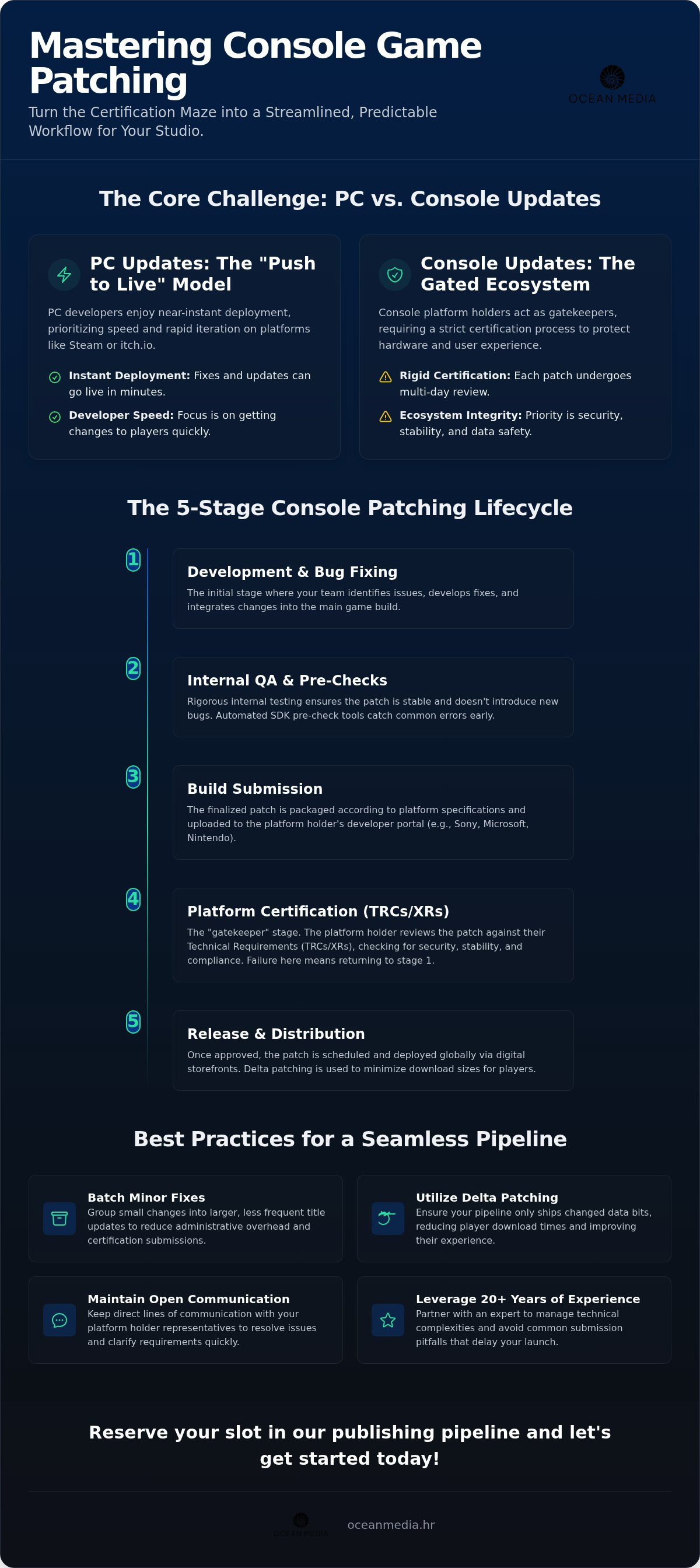
Moving a fix from a local bug report to millions of players worldwide is a journey that demands precision. The console game patching process isn't a single event; it's a methodical lifecycle that ensures your update meets the high standards of modern hardware. Success depends on a structured console game publishing timeline that accounts for platform-specific quirks. We've found that the pre-submission phase is the most critical. Catching a violation here saves you from a week of "Wait" time later.
Managing versioning across multiple console families simultaneously adds another layer of complexity. Whether you're targeting the established PS5 install base or the 23.68 million Nintendo Switch 2 users (as of June 2026), your builds must remain synchronized. This prevents version mismatch errors in cross-play environments and keeps your global community on the same page. Understanding the nuances of the console game patching process allows you to plan your post-launch support with confidence.
Step 1 & 2: Internal QA and Pre-Certification Testing
Your first goal is creating a "Release Candidate" build. This isn't just a stable version of your game. It's a version that behaves exactly as the platform holders expect. In 2026, we utilize advanced automated testing tools within the latest GDK and SDK versions to mirror the platform's own checks. If your patch adds new content, like a seasonal event or DLC, you must also vet the build against console game age rating systems. Content shifts can trigger re-ratings in certain territories, and catching this early is vital for a smooth release.
Step 3, 4 & 5: Submission, Certification, and Deployment
Once your build is ready, you'll upload it to the platform's developer portal, such as Sony's DevNet or Microsoft's Partner Center. This initiates the "Wait" period. During this time, the platform's team conducts a mix of manual and automated reviews to ensure your update doesn't break the ecosystem. Finally, you'll choose your deployment strategy. While "Immediate" releases are tempting for emergency fixes, "Scheduled" global releases are often better for marketing beats and ensuring your server teams are ready for the influx of players.
Navigating this lifecycle is much easier with a seasoned partner by your side. We specialize in managing the technical and administrative heavy lifting of console submissions so you don't have to. If you're ready to streamline your path to live status, reserve your slot in our publishing pipeline and let's get started today!
Best Practices for a Seamless Patching Pipeline
A successful console game patching process requires more than just clean code; it demands strategic planning and proactive communication. One of the most effective ways to navigate this is by maintaining a consistent channel with your platform account managers. These individuals are your advocates inside Sony, Microsoft, or Nintendo. They can provide early warnings about upcoming dashboard updates or shifts in certification priorities that might affect your submission. Instead of rushing every tiny bug fix through the pipeline, let's look at batching small improvements into larger Quality of Life updates. This approach significantly reduces the administrative overhead and certification fees associated with frequent, minor submissions.
You should also have a robust rollback plan ready before any patch goes live. Even with the most rigorous internal QA, unforeseen issues can emerge once an update hits millions of different hardware configurations. Additionally, use Day One patches as a strategic bridge. These allow you to fix non-critical issues discovered after the gold master was submitted, ensuring your players have the best possible experience the moment they press start.
Managing Global Update Synchronization
Achieving parity across all platforms is a major challenge. Releasing updates simultaneously on every console prevents community fragmentation, but it requires careful coordination. You must account for region-specific requirements in Europe, Asia, and the Americas, as each territory may have different metadata or rating display rules. Coordinating with a console game publishing partner helps manage these regional storefronts efficiently, ensuring that your global audience receives the update at the exact same time.
Reducing Certification Rejection Rates
Rejections often happen because of simple mistakes that are easily overlooked during the heat of development. Common culprits include using incorrect button icons, like showing an Xbox 'A' button on a PlayStation UI, broken text in localized menus, or edge-case save-game corruption. Having a second set of expert eyes review your build before you hit "Submit" is the best way to catch these errors. In 2026, platform holders offer Fast Track certification options to trusted publishers who maintain a consistent record of high-quality, compliant submissions. To leverage this expertise and ensure your next update clears every hurdle, work with our experienced team to refine your strategy.
We've helped countless studios master the complexities of post-launch support and global distribution. If you want to avoid the stress of unpredictable launch windows and failing certification, reserve your slot in our publishing pipeline and let's get started today!
Optimizing Your Publishing Pipeline with Ocean Media
You've seen the technical hurdles and the administrative maze that defines the modern console game patching process. Mastering these requirements on your own is possible, but it often comes at the cost of your team's creative energy and focus. We offer a more efficient path. Leveraging over 20 years of industry experience, our team specializes in navigating the complexities of digital distribution across all major platforms. We take the technical and administrative heavy lifting off your shoulders, acting as a seasoned guide through the certification maze.
Our approach is fundamentally collaborative. We don't just take your build and disappear; we act as a vital bridge between your development team and the platform holders. This ensures that communication remains clear and that potential roadblocks are identified long before they lead to a costly rejection. By handling the logistics of the publishing pipeline, we allow your studio to focus on what it does best: creating exceptional gaming experiences. We prioritize your digital growth and global reach, removing the stress of certification management from your daily workflow.
Why Experience Matters in the 2026 Console Landscape
The rules governing the PlayStation Store, Xbox, and Nintendo eShop aren't static. They evolve constantly to meet new security standards, hardware capabilities, and market trends. We stay ahead of these changes, ensuring your game remains compliant with ever-shifting platform policies without your team needing to decipher every new SDK update. Beyond simple compliance, our experience allows us to advise on strategic launch and patch timing. We help you find the optimal windows to maximize visibility and player retention in an increasingly crowded global market.
Let’s Bring Your Game to the Global Stage
Transitioning from a development environment to a professional console release shouldn't feel like a leap into the unknown. We provide a structured path that simplifies this journey, turning a complex series of requirements into a manageable, predictable process. Our expertise in navigating technical and administrative complexities means fewer delays and a more reliable publishing pipeline for your studio. We've spent decades refining this process so that bringing your game to consoles is as seamless as possible.
Whether you're planning a major content expansion or a critical stability update, we have the tools and the network to ensure your success. Don't let the fear of certification failure or unpredictable launch windows hold your project back. Let's work together to expand your reach and secure your game's future on the global stage. It's time to streamline your path to success; reserve your slot in our publishing pipeline and let's get started today!
Secure Your Game's Global Future
Mastering the console game patching process is a vital skill for any studio aiming for longevity in the 2026 market. Success requires a deep understanding of technical certification and a disciplined approach to versioning. By focusing on pre-submission quality and batching your updates strategically, you protect your player base and ensure your game remains a stable, high-quality product on every storefront. It's about turning a complex administrative hurdle into a predictable part of your development cycle.
We bring over 20 years of console publishing expertise to every partnership. Our team is specialized in navigating the intricate TRC and XR certification requirements, ensuring your patches clear platform hurdles on the first try. With our global digital distribution network and a collaborative spirit, we act as the bridge between your creative vision and the global market. We're ready to help you simplify the complexities of post-launch support and maximize your game's reach. Reserve your slot in our publishing pipeline and let's get started today! We look forward to being the partner that helps your studio thrive on the global stage.
Frequently Asked Questions
How long does the console game patch certification process take in 2026?
Patch certification usually takes between three to seven business days depending on the platform and current submission volume. While emergency "hotfixes" can sometimes be fast-tracked, a standard update requires a full technical review. This window accounts for both automated checks and manual testing by platform teams. Planning your release schedule around these lead times is essential for maintaining player trust and meeting marketing deadlines.
Does it cost money to patch a game on PlayStation or Xbox?
You won't typically pay a direct fee to Sony or Microsoft for standard patches. Platform holders moved away from per-patch charging to encourage developers to keep their games stable. However, failing certification repeatedly can lead to administrative costs or delayed windows. The real expense lies in the "soft costs" of development time, internal QA, and the logistical effort required to manage a successful console game patching process across multiple storefronts.
What happens if my patch fails console certification?
If your submission fails, the platform holder provides a "fail report" citing the specific technical requirements you missed. You must address every point of failure before resubmitting the build. This process resets your certification clock, which can delay critical bug fixes by another week or more. To avoid these setbacks, we recommend a thorough pre-submission check; reserve your slot in our publishing pipeline and let's get started today!
Can I release a patch on one console before the others?
You have the technical freedom to deploy updates as they clear certification on each individual platform. For single-player games, this allows you to push fixes to players as soon as they're ready. If your game features cross-platform play, however, you must synchronize releases to prevent version mismatches. Managing these different timelines requires careful coordination with platform account managers to ensure a smooth global rollout for your entire community.
What is a Day One patch and why is it necessary for console games?
A Day One patch is an update that downloads immediately when a player installs the game at launch. This update bridges the gap between the "Gold Master" build and your actual release date. Because physical or digital versions are often locked in weeks before launch, Day One patches allow you to include final polish and bug fixes discovered during that final stretch. It's a standard industry practice that ensures players have the most stable version.
How do I manage patch notes and community communication for console updates?
You should publish detailed patch notes on your official website and link them through the console's built-in activity feeds. Platforms like PlayStation and Xbox offer dedicated spaces for developers to share update news directly with their audience. Being transparent about bug fixes and balance changes builds player loyalty. We help our partners coordinate these announcements globally, ensuring your community remains informed and engaged as you evolve your title post-launch.
Is there a limit to how many patches I can release for my console game?
Platform holders don't set a specific cap on the number of updates you can release. That said, pushing too many small patches in a short window can be seen as a sign of poor QA and might frustrate your players with constant downloads. It's more efficient to batch minor fixes into larger, meaningful updates. This strategy preserves your standing with platform certification teams and keeps your console game patching process streamlined and professional.
What is the difference between a patch and a DLC in the eyes of the platform holder?
A patch is a mandatory update to the base game, while DLC is optional content that players must choose to acquire. A patch automatically updates the existing game files for all users to improve stability. DLC, or Downloadable Content, is treated as a separate product that players must download individually. While patches are focused on maintenance, DLC is often used for monetization. Both require certification, but DLC involves additional steps like managing regional pricing.


