

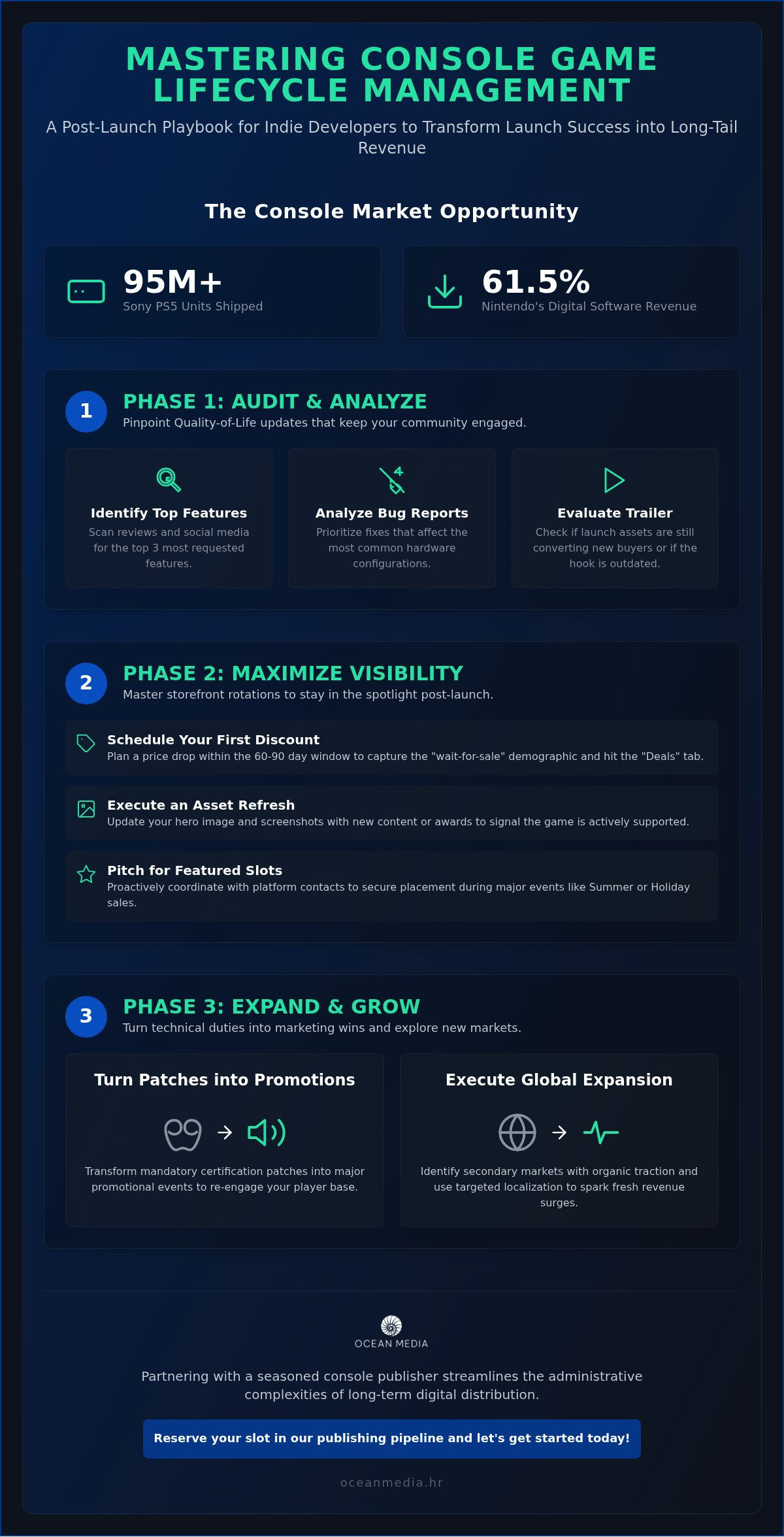
With Sony surpassing 95 million PS5 units shipped and Nintendo generating 61.5% of its software revenue through digital channels as of mid-2026, the console market has never been more lucrative or more crowded. Yet, many indie developers find that the most dangerous part of the journey starts the day after launch. The initial surge fades, and the dreaded visibility slump on the Nintendo eShop or PlayStation Store begins to set in. Mastering console game lifecycle management is the only way to transform a successful launch week into years of sustained, long-tail revenue.
It's natural to feel a sense of total exhaustion once the main development cycle ends. You've cleared the certification hurdles, but now you face the confusion of coordinating technical patches with marketing beats. We understand that the transition from creator to long-term strategist is a difficult one (especially when you're already eyeing your next project). This guide provides a tactical checklist designed to help you navigate storefront rotations, manage global expansion, and keep player engagement high. We will explore how to leverage every update as a visibility event and ensure your title remains a fixture in the global digital landscape.
Key Takeaways
- Audit your initial performance data and player sentiment to pinpoint the exact quality-of-life updates that will keep your community engaged.
- Navigate the timing of major platform sales to ensure your title gains maximum visibility within the eShop and PlayStation Store's "Special Offers" sections.
- Master the technical side of console game lifecycle management by turning mandatory certification patches into major promotional events.
- Execute a global expansion strategy by identifying secondary markets where targeted localization can spark fresh revenue surges.
- Learn how partnering with a seasoned console publisher streamlines the administrative complexities of long-term digital distribution.
Auditing Your Launch Performance and Player Sentiment
Launch day is a high-octane milestone, but it's only the beginning of your journey. To ensure long-term success, you must move from the creative high of release into a phase of clinical evaluation. This audit is the backbone of effective console game lifecycle management. It's where you look past the initial download numbers to see how players are actually living with your game. Mastering console game lifecycle management requires a cold, hard look at what the market is telling you through its behavior and its wallet.
Start by dissecting your sales data. Each console storefront operates differently, and your performance on the Nintendo eShop might look radically different from the PlayStation Store. Look for churn points. Are players dropping off after the first boss? Is there a technical hitch at the ten-hour mark that correlates with a dip in active users? Identifying these friction points allows you to prioritize fixes that actually impact retention. This process is a vital part of the video game development lifecycle, ensuring that your project evolves based on real-world usage rather than pre-launch assumptions.
The Console Sentiment Checklist
Community feedback on consoles is often more concentrated than on PC. You need to monitor platform-specific rating trends closely. A four-star average on Switch might be driven by different player expectations than a similar rating on PlayStation. Early adopters are your most vocal advocates. Solving their frustrations builds immediate loyalty. Use this checklist to stay ahead:
- Identify the top three requested features: Look for patterns in reviews and social media mentions.
- Analyze bug reports: Prioritize fixes that affect the most common hardware configurations.
- Evaluate your trailer: Check if your launch assets are still converting late-majority buyers or if the "hook" has lost its edge.
Data-Driven Post-Mortem
A successful post-mortem requires comparing your launch week against your internal benchmarks. Don't just look at the total revenue. Analyze which regions showed unexpected interest. If your game is gaining traction in Hungary or Luxembourg, consider the 2026 VAT rates (which range from 17% to 27%) and how they affect your net earnings. This data might signal a need for deeper localization in those territories to capitalize on organic growth.
Finally, audit your storefront metadata. Keywords that worked during the pre-launch hype might not be the terms players use once the game is live. If you're looking for a partner to help navigate these complexities, exploring how experienced publishers handle these audits can provide the clarity you need. Keep your storefront presence dynamic; a static page is a dying page.
Mastering Console Storefront Visibility Post-Release
Most marketing advice fixates on Steam. This is a strategic error for console-focused developers. Unlike the algorithm-heavy PC landscape, console storefronts are highly curated environments. Visibility on the Nintendo eShop or PlayStation Store depends on your ability to land in "Great Deals" or genre-specific "Collections." Effective console game lifecycle management means treating your store page as a living document rather than a static billboard. Success here isn't random; it's scheduled.
The Visibility Checklist
Visibility isn't a one-time event. It's a cycle of strategic refreshes. You must plan for the moment your initial "New Release" boost ends. This requires a proactive approach to store maintenance to capture different segments of the market over time.
- The 60-90 Day Discount: Schedule your first price drop within this window. It's the optimal time to capture the "wait-for-sale" demographic and trigger the "Deals" tab.
- Asset Refresh: Update your Hero image and screenshots to highlight post-launch awards or major content updates. Fresh visuals signal to players that the game is actively supported.
- Pitch for Featured Slots: Don't wait for platform holders to find you. Coordinate with your contacts to secure placement during major events like the Summer or Holiday Sales.
Platform-Specific Beats
Each platform has unique visibility levers. On the Nintendo eShop, the "Recent Releases" tail is notoriously short. Extending it requires timely updates that can occasionally bump you back into the spotlight. This is critical when you consider that digital sales accounted for 61.5% of Nintendo's software revenue in early 2026. PlayStation Store users rely heavily on the "Collections" and "Categories" sections. If your game isn't properly tagged or featured in these curated lists, it's invisible to the casual browser.
Xbox developers should lean into Game Hubs and Official Clubs. These features keep your title on the user's dashboard, increasing the likelihood of organic re-engagement. System-level tools like PlayStation Activities also provide a direct path back into the game from the console UI. These aren't just technical additions; they are marketing tools that reduce friction for returning players. Managing these platform-specific nuances while maintaining a development schedule is a heavy lift. Often, the most efficient path is to partner with a console publisher who understands the administrative hurdles of global digital distribution and can navigate these storefront relationships on your behalf.
Transforming Technical Patches into Marketing Milestones
View every technical patch as a second chance to capture the spotlight. In the high-stakes arena of console publishing, maintenance is marketing. Many developers treat bug fixes as a chore to be hidden away, but this is a missed opportunity in console game lifecycle management. A well-timed Quality of Life (QoL) update, informed by the player sentiment audit we discussed in section one, can reignite interest and pull lapsed players back into your ecosystem. Maintenance keeps a game alive; marketing ensures people know it's thriving.
The secret lies in strategic bundling. Don't release a patch that only fixes invisible code. Always include at least one player-facing "win." Whether it's a new cosmetic, a requested "photo mode," or a rebalanced difficulty curve, give your community a reason to share screenshots. This approach transforms a routine update into a "Version 2.0" moment that influencers and media outlets can actually cover. It's about creating a narrative of constant evolution and care.
The Patch-as-Marketing Checklist
To maximize the impact of your technical work, you must bridge the gap between your engineering and marketing efforts. Use this checklist to ensure your next update doesn't go unnoticed:
- Bundle for impact: Combine minor bug fixes with at least one highly requested new feature to create a "Content Update" headline.
- Tell the story: Write a Developer Diary post that explains the "why" behind the changes and provides a glimpse into your future roadmap.
- Leverage expert resources: Consult Console Game Patching: A Developer’s Guide for 2026 to ensure your technical workflow aligns with current platform standards.
Navigating Certification for Updates
Console certification is a rigid process that can easily derail a marketing campaign if not managed with precision. Each platform holder has distinct technical requirements and lead times. You must coordinate your marketing announcement with the actual patch deployment date. There is nothing more damaging to console game lifecycle management than promising a "new feature Friday" only for the patch to be delayed in certification until Monday.
Ensure your update notes are clear and marketing-friendly for storefronts. Avoid overly technical jargon in the "What's New" section of the console UI. Instead, use evocative language that highlights the benefits to the player. If your update includes new monetization mechanics, remember that as of June 2026, PEGI now requires a minimum 12 rating for time-limited offers. Navigating these regulatory shifts while maintaining a tight update schedule is complex, but it's the price of a healthy, long-tail console presence.
Executing Global Sales and Regional Expansion Strategies
Expansion is the engine of long-tail revenue. Once your primary market stabilizes, the next phase of console game lifecycle management involves identifying secondary markets where your genre is thriving. You don't need a massive budget to start; you need data. Analyze your storefront analytics to see where players are discovering your title organically. A sudden spike in interest from Eastern Europe or South America is a clear signal that your game's mechanics or visual style cross cultural boundaries. Don't let that momentum go to waste.
Localization is the most effective lever for a post-launch sales surge. It's about more than just translating text; it's about adjusting your regional pricing to match local purchasing power. When calculating your net revenue, remember that the standard 30% storefront commission applies globally, but EU VAT rates in 2026 vary from 17% in Luxembourg to 27% in Hungary. These margins matter when you're scaling. Coordinating your regional PR beats to coincide with local holidays or major gaming events in those territories can create a "second launch" effect that keeps your title relevant for years.
The Global Growth Checklist
Success in new territories requires a methodical approach to resource allocation. You must determine if a full translation is necessary or if high-impact storefront optimization is enough to move the needle. Use this checklist to guide your expansion:
- Analyze organic interest: Identify non-English speaking regions with high engagement but low conversion rates.
- Metadata vs. Full Text: Evaluate the cost-benefit of localizing storefront keywords and descriptions before committing to a full in-game translation.
- Strategic Planning: Consult our 2026 Global Console Launch: Indie Game Localization Guide to prioritize which languages offer the best return on investment.
Regional Storefront Tactics
Each major region has specific technical and cultural hurdles. Targeting the Japanese market requires an understanding of CERO ratings (A through Z) and a visual style that resonates with local console preferences. In Europe, the landscape is even more complex due to the June 2026 PEGI updates. Any game featuring NFTs must now carry a PEGI 18 rating, while paid random items (loot boxes) require a minimum PEGI 16. Even time-limited offers now trigger a PEGI 12 classification.
Navigating these regulatory shifts is essential for maintaining your storefront presence. Utilizing the International Age Rating Coalition (IARC) system is the most efficient way to manage these requirements across the Nintendo eShop, Xbox Store, and PlayStation Store. For a deeper dive into these complexities, see our Global Console Game Age Rating Guide for Developers 2026. Managing a global rollout while balancing development is a significant administrative burden. If you want to focus on the creative process while we handle the complexities of international distribution, reserve your slot in our publishing pipeline and let's expand your reach together.
Optimizing Your Long-Tail Revenue with Ocean Media
Developing a great game is a creative challenge. Managing that game across three major ecosystems for five years is an operational one. While the initial launch creates the spark, effective console game lifecycle management is what keeps the fire burning. The administrative drag of coordinating patches, regional price adjustments, and storefront metadata across the Nintendo eShop, PlayStation Store, and Xbox Store can quickly overwhelm a small team. This is where a strategic partnership becomes your most valuable asset. We handle the complexities of digital distribution so you can return to the drawing board for your next project.
A publishing partner does more than just upload files. We act as a seasoned guide through the post-launch landscape, utilizing established relationships with platform holders to secure visibility that self-published titles often miss. This isn't just about getting featured during a holiday sale. It's about developing a long-term roadmap that includes DLC, sequels, and brand expansion. Transitioning from a single-game success to a sustainable studio brand requires a shift in perspective. You need to stop thinking about "the launch" and start thinking about the decade ahead.
The Partnership Advantage
Ocean Media brings over 20 years of industry experience to your project. We've navigated every shift in console architecture and certification requirement since the early 2000s. Our focus is strictly on global digital distribution, ensuring your title reaches every viable market with precision. By joining our pipeline, you gain access to a streamlined workflow that handles the heavy lifting of platform submissions and revenue splits. We ensure your technical updates meet the rigorous standards of platform holders, reducing the risk of costly delays in certification. This professional oversight allows your studio to maintain a consistent rhythm of content delivery, which is the heartbeat of long-term player engagement.
Your Next Steps in the Pipeline
Success on consoles is a marathon, not a sprint. To truly master console game lifecycle management, you need a partner who understands the technical and administrative hurdles of the 2026 landscape. Whether you're navigating the latest PEGI monetization regulations or seeking to optimize your regional pricing in the EU, expert guidance makes the difference between a fading title and a permanent fixture on the charts.
Explore our Console Game Publishing Services to see how we can extend your game's reach. For a deeper look at the journey ahead, review How to Publish a Game on Console: The Complete Developer Roadmap for 2026. Reserve your slot in our publishing pipeline and let's get started today!
Securing Your Studio's Future on Consoles
The transition from launch day to long-term success is a technical and creative marathon. By auditing player sentiment and transforming routine patches into high-visibility marketing events, you can effectively beat the post-launch slump on the Nintendo eShop and PlayStation Store. Mastering console game lifecycle management is the only way to ensure your title generates revenue long after the initial hype has faded. Global expansion and regional pricing are powerful tools, but they require precision and a deep understanding of platform-specific certification.
You don't have to navigate these complexities alone. With over 20 years of console publishing experience and deep expertise in PlayStation, Xbox, and Nintendo Switch certification, we act as the bridge between your creative vision and global digital distribution. Reserve your slot in our publishing pipeline and let's get started today! Your game deserves a legacy that spans years, not just weeks. We are ready to help you build a sustainable studio brand in the ever-evolving digital landscape.
Frequently Asked Questions
How long does post-launch marketing for an indie game last?
Post-launch marketing typically lasts as long as your title is available for purchase, often spanning three to five years. It's a continuous process of storefront optimization and community engagement. You don't just stop after launch week; you pivot toward sustaining visibility. This long-term approach ensures your game remains relevant during seasonal sales and platform rotations, maximizing the total revenue generated over the entire life of the project.
Is it worth marketing an indie game after the initial launch week?
Marketing after the first week is essential because the "long tail" of sales frequently accounts for the majority of an indie game's total revenue. While the initial surge is exciting, the real profit often lies in the years that follow. Consistent visibility efforts help you reach new audiences who may have missed the launch. It's about building a sustainable brand rather than relying on a single, fleeting moment of hype.
How do I get my indie game featured on the Nintendo eShop or PlayStation Store after launch?
Securing a featured slot requires a combination of high player engagement and strong relationships with platform holders. You can't just ask for a feature; you have to earn it through consistent quality updates and participation in curated sales events. Partnering with an experienced publisher can provide the necessary leverage, as they often have direct lines of communication with storefront editors at Sony, Microsoft, and Nintendo to pitch your game for high-visibility placements.
What are the best ways to re-engage players for a console game update?
The most effective way to re-engage players is to bundle essential technical fixes with at least one significant, player-facing feature. Give your audience a reason to download the update and jump back into the world. Use system-level tools like Xbox Game Hubs or PlayStation Activities to send direct notifications to your community. This turns a routine maintenance patch into a fresh event that can spark new social media conversations and reviews.
Can a publisher help with marketing an already released indie game?
Yes, a publisher can be instrumental in console game lifecycle management for titles that are already live. Ocean Media utilizes 20 years of industry experience to help developers navigate the administrative burden of global digital distribution and storefront refreshes. We manage the complexities of regional pricing and certification requirements, allowing you to focus on the creative aspects of your next project while we optimize the revenue potential of your current one.
How much should I spend on post-launch marketing for my console game?
There is no fixed number, but your budget should align with your specific revenue goals and the scope of your updates. Focus your resources on high-impact digital efforts, such as localizing storefront metadata for secondary markets or creating a fresh trailer for a major content update. Avoid overspending on broad awareness campaigns. Instead, invest in targeted strategies that directly improve your conversion rates on the Nintendo eShop or PlayStation Store.
What happens if my indie game launch fails on consoles?
A slow launch isn't the end of the road. It's an opportunity to analyze your performance data and pivot your strategy. You can often salvage a title by identifying specific churn points and addressing them in a "Version 2.0" update. Regional expansion into markets with high organic interest can also spark a second wave of sales. Many successful titles found their true audience months or even years after their initial release.
How often should I discount my game on console storefronts?
Most developers find success by scheduling their first discount in the 60 to 90 day window after launch. After that, align your discounts with major platform sales events like the Summer or Holiday Sales. Don't discount too frequently, as it can devalue your brand. Instead, use price drops strategically to trigger the "Deals" section of the storefront and capture the attention of players who have had your game on their wishlists.


