

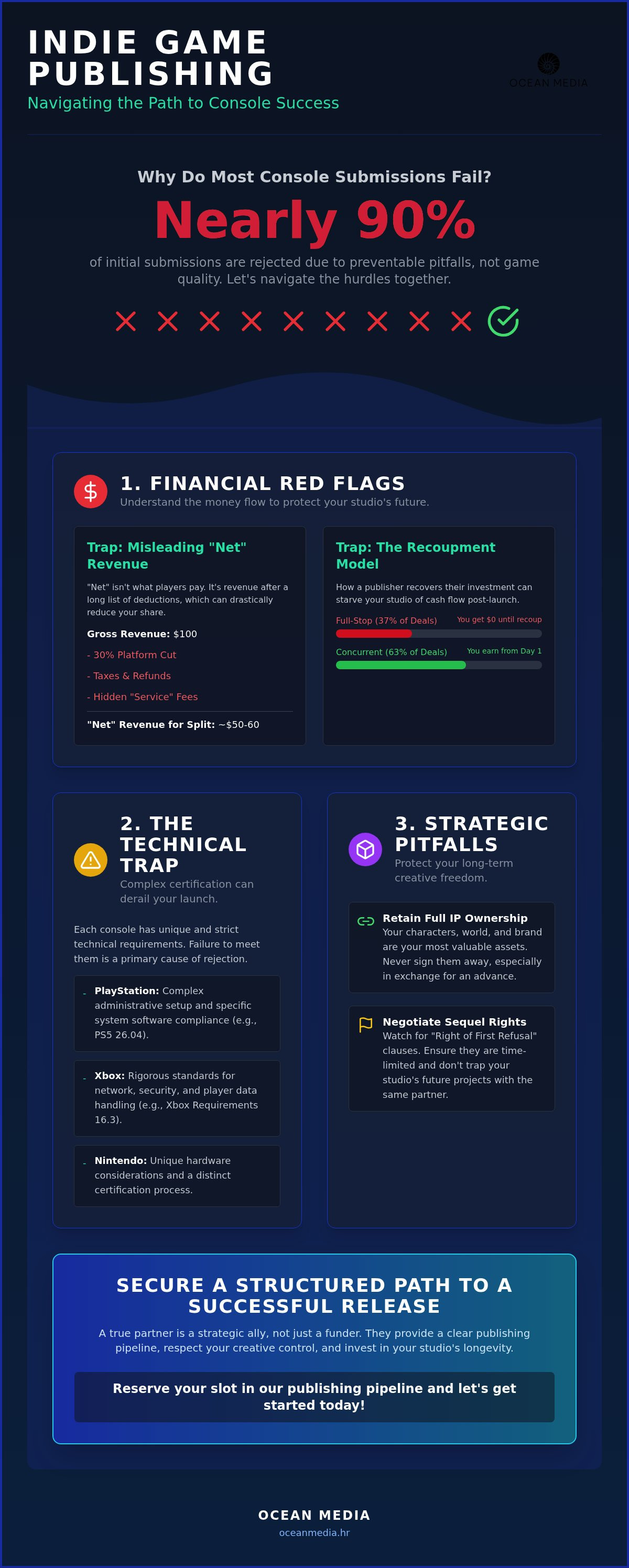
Did you know that nearly 90% of initial console submissions are rejected before they ever hit a digital storefront? It's a staggering figure that often stems from preventable indie game publishing deal pitfalls rather than the quality of the game itself. You've poured years into your project, so it's natural to feel anxious about the fine print of a contract. The fear of losing your IP or getting trapped in a full-stop recoupment model where you don't see a dime for months is a valid concern for any studio.
We're here to help you navigate these hurdles so you can secure a fair revenue split while maintaining full creative control. This guide explores the 2026 standards for Xbox Requirements 16.3 and PlayStation 5 system software 26.04 to ensure bringing your game to consoles is a seamless experience. Let's tackle these technical and legal complexities together. Reserve your slot in our publishing pipeline and let's get started today!
Key Takeaways
- Learn to distinguish between "Net" and "Gross" revenue definitions to avoid recoupment traps that can delay your studio's earnings for months.
- Understand the administrative complexities of PlayStation, Xbox, and Nintendo submissions to prevent technical certification failures from derailing your launch.
- Protect your studio’s future by retaining full IP ownership and carefully negotiating "Right of First Refusal" clauses for sequels and DLC.
- Identify common indie game publishing deal pitfalls by vetting a partner’s specific track record in digital console distribution and global reach.
- Secure a structured path to a successful release; reserve your slot in our publishing pipeline and let's get started today!
Navigating the High Stakes of Indie Publishing Agreements
Signing your first publishing contract is a major milestone. It marks the moment your creative vision starts its journey toward a global audience. However, the transition from developer to business partner often brings a wave of contract anxiety. You’ve poured your soul into every pixel; now, you’re asked to navigate complex legal frameworks while managing the high-stress environment of active development. It's easy to feel overwhelmed. Many studios fall into common indie game publishing deal pitfalls simply because they prioritize immediate survival over long-term studio health.
You aren't just looking for a check. You’re looking for a strategic ally. Understanding the role of a video game publisher is the first step in protecting your future. A true partner provides more than capital; they offer a roadmap for bringing your game to consoles while respecting your creative autonomy. A funding partner might only care about their return on investment, but a strategic ally invests in your studio's longevity. A bad deal can stall your growth for years, even if your game becomes a massive hit.
The Lure of the "Big Advance"
A large upfront payment feels like a victory. It’s tempting to see it as validation of your hard work, but these advances are often high-interest loans in disguise. When a publisher offers a significant advance, they typically expect to recoup 100% of the initial revenue until their costs are covered. This "full-stop" recoupment model can be devastating. You might not see a single royalty check for months or even years after launch, which kills your motivation to provide long-term support. Worse, some predatory deals use these advances to justify taking control of your IP. "Free money" rarely exists in this industry; it usually comes with strings that could bind your characters or world to a publisher forever.
The Transition to a Professional Environment
Moving from a hobbyist project to a commercial release requires a mental shift toward a professional, collaborative environment. You need a structured publishing pipeline to handle the heavy lifting of global digital distribution. At Ocean Media, we've spent 20+ years acting as a bridge between creators and the global market. We don't just sign papers; we build partnerships. Our goal is to simplify the logistical hurdles of console releases, allowing you to focus on what you do best: making great games. We value the creative process and prioritize a spirit of international collaboration. If you're ready to secure a fair deal and protect your studio's future, reserve your slot in our publishing pipeline and let's get started today!
Financial Red Flags: Recoupment, Revenue Splits, and Hidden Costs
Money is the most common friction point in any partnership. When you're reviewing a contract, the most dangerous word you'll encounter is "Net." While "Gross Revenue" represents every dollar a player spends on your game, "Net Revenue" is what remains after a long list of deductions. In the console world, this starts with the standard 30% platform holder cut taken by Sony, Microsoft, or Nintendo. If your contract doesn't clearly define what else gets subtracted before the split, you're walking into one of the most common indie game publishing deal pitfalls. These deductions often include taxes, refunds, and "service revenue" charges for internal marketing or porting efforts.
The recoupment rate is the percentage of revenue the publisher keeps until their investment is repaid. In 2026, 63% of publishing deals have shifted toward a "concurrent" recoupment model. This allows you to receive a small percentage of revenue from day one. However, 37% of deals still use the "full-stop" model, where the publisher takes 100% of the revenue until every cent of their advance and marketing spend is recovered. This can leave your studio without cash flow for months after a successful launch. Gaining a deep understanding publisher agreements is essential to ensure your studio remains solvent during the critical post-launch window.
Recoupment Structures: Fair vs. Scummy
A fair deal prioritizes your studio's survival. While a 100% recoupment trap is still common, many professional partners now favor an 80/20 or 70/30 split in the publisher's favor until they break even. This ensures you have immediate capital to pay your team and fund community management. You should also insist on "marketing caps." Without a hard limit on how much the publisher can spend (and then recoup) on ads, your debt can grow faster than your sales. Data from 2025 shows that 80.3% of agreements with advances now use "stepped" revenue shares, where your percentage "steps up" significantly once the advance is repaid.
Hidden Administrative and Platform Fees
Watch out for "cross-collateralization." This clause allows a publisher to use profits from your successful Game A to pay off the unrecouped debts of your less successful Game B. It effectively ties your titles together in a way that can prevent you from ever seeing royalties. Additionally, ensure that localization and QA costs are transparently reported rather than bundled into a vague "administrative fee." Our team at Ocean Media believes in total transparency, helping you avoid these financial traps while bringing your game to consoles with a clear, honest revenue path.
Protecting your revenue starts with a partner who respects your bottom line. If you're ready to move past the confusion of complex splits, you can reserve your slot in our publishing pipeline and let's get started today!
The Technical Trap: Console Certification and Platform Submission Hurdles
Reaching the end of your development cycle is a massive achievement, but a bug-free build doesn't guarantee a spot on a digital storefront. Technical certification is the number one reason indie games miss their launch dates. It remains one of the most significant indie game publishing deal pitfalls because it is often treated as an afterthought during contract negotiations. If you sign with a publisher that lacks specific platform expertise, you risk getting stuck in a cycle of rejections that can drain your remaining budget and kill your marketing momentum. You need a partner who understands that console hardware is a unique environment with its own set of rules.
Navigating Console Certification Requirements
Platform holders like Sony, Microsoft, and Nintendo enforce strict standards that go far beyond typical QA bug hunting. You'll need to navigate Technical Requirement Checklists (TRCs) for PlayStation and Xbox Requirements (XR). As of July 2026, the current Xbox version is 16.3. These standards place a heavy emphasis on title stability, user data saving, and the Quick Resume feature. Similarly, your build must be compliant with PlayStation 5 system software version 26.04. Nintendo’s Lotcheck process is equally rigorous, strictly enforcing rules on memory management and docked-to-handheld transitions. Falling into the "Certification Loop" can be devastating for a small studio. Nearly 90% of initial submissions fail because of preventable errors. A seasoned partner with authority in certification knows these requirements inside out, saving you hundreds of dev hours.
The Digital Distribution Lifecycle
Managing a global launch involves a complex web of metadata, storefront assets, and regional age ratings. You have to coordinate these across different time zones and platform dashboards to ensure a synchronized release. It's a logistical challenge that requires extreme precision. For instance, you’ll need to follow a Global Console Game Age Rating Guide to ensure your game is legally compliant in every target market. When you're negotiating publishing deals, look for a partner who offers a structured publishing pipeline. This ensures your storefront presence is as polished as your gameplay from day one.
Our team at Ocean Media has 20+ years of experience in digital distribution. We act as your seasoned guide through these technical and administrative hurdles, helping you avoid the most common indie game publishing deal pitfalls. Don't let certification errors stop you from bringing your game to consoles. Reserve your slot in our publishing pipeline and let's get started today!
Strategic Pitfalls: Sequel Rights, IP Ownership, and Creative Control
Your IP is your studio's most valuable asset. While financial terms are often the focus, the strategic clauses regarding ownership can have the longest lasting impact on your career. One of the most dangerous indie game publishing deal pitfalls is the transfer of intellectual property to the publisher. You should almost never sign over your characters, world, or lore. If you lose your IP, you lose the ability to build a franchise or leverage your success for future projects. A collaborative partner should act as a bridge to the market, not a landlord for your creativity.
The "Right of First Refusal" (ROFR) is another area requiring extreme precision. It gives your publisher the first chance to sign any sequel or DLC. While this seems harmless, it can trap you in a cycle where you can't shop your follow-up project to other partners who might offer better terms. Even more restrictive is the "competing games" clause. This often prevents you from developing similar titles for other partners, potentially stifling your studio's output for years. You must also clarify who has the final say on the "Gold Master" build. Creative control should remain with you; the publisher's role is to support your vision, not dictate the final product.
Protecting Your Studio’s Future
You should aim to limit the publisher’s rights to the "current platform and version" only. This ensures you retain the power to port your game to new hardware or release enhanced editions later. Negotiating a "reversion of rights" clause is equally vital. If a publisher fails to launch your game within a specified window, all rights should return to you immediately. Your studio name must also remain prominent. We believe in ensuring your branding is featured in all marketing and storefront assets. This helps you build your own reputation alongside the success of the game.
The Problem with Perpetual Rights
Avoid the phrase "in perpetuity" in any digital media contract. These agreements should have a reasonable term limit, typically three to five years, after which you can renegotiate or move on. Understanding What Does a Game Publisher Do for Indie Devs? can help you set these boundaries effectively. We prioritize a partnership where you stay in the driver's seat. To ensure your studio retains its creative soul, partner with a publisher that respects your IP. Ready to move forward with a partner who values your independence? Reserve your slot in our publishing pipeline and let's get started today!
Building a Sustainable Partnership: Choosing a Digital Distribution Ally
Choosing the right partner is the final, most critical safeguard against indie game publishing deal pitfalls. You need more than just a name on a contract; you need a partner who has successfully navigated the exact path you're about to walk. Vetting a publisher’s track record is non-negotiable. Have they actually launched games on your specific target console? A publisher with deep experience in mobile or PC gaming might still struggle with the unique technicalities of a Nintendo Switch submission or PlayStation certification. You deserve a partner who understands the nuances of each platform hardware environment.
For most indie studios in 2026, a digital-only focus is far more sustainable than chasing physical retail distribution. Physical releases introduce massive overhead, manufacturing risks, and logistical complexities that can quickly swallow your revenue. By focusing on digital console publishing, you can maximize your global reach while keeping your operations lean and agile. Don't rush the signature. Take the time to find a guide who values your creative vision and offers a structured path to success. A true partner acts as a bridge, not a barrier, between your studio and the global market.
Vetting Your Publishing Partner
Start your vetting process by asking direct questions about their relationship with platform holders like Sony, Microsoft, and Nintendo. Do they have direct lines of communication for troubleshooting certification issues? You should also check for "ghosting" tendencies. A reliable partner provides regular, transparent sales reports so you always know exactly where your revenue stands. Transparency is the foundation of any professional partnership. You can see how we handle these relationships and our specific vetting process on our Developers Page, where we outline our 20+ years of expertise in digital distribution.
Securing Your Slot in the Pipeline
Timing your launch is just as important as the quality of the game itself. Launching during a crowded holiday window or alongside a major AAA release can bury even the best indie titles. A strategic ally helps you find the perfect window to capture player attention. The best part of a professional partnership is the ease of starting. We handle the administrative heavy lifting, from regional age ratings to complex metadata management, so you can stay focused on the creative process.
We are here to act as your seasoned guide through the complexities of bringing your game to consoles. Our 20+ years of industry experience ensure that your studio avoids the most common indie game publishing deal pitfalls while maintaining your IP and creative soul. Let's work together to make your launch a success. Reserve your slot in our publishing pipeline and let’s get started today!
Securing Your Studio's Legacy in the Digital Market
Protecting your IP and creative vision is the foundation of a sustainable career in this industry. Navigating the complexities of contract law and technical certification shouldn't be a solo mission. By identifying common indie game publishing deal pitfalls early, you ensure that your studio thrives long after the initial launch. We focus on transparent revenue splits and structured paths to the global market, allowing you to retain the control you've worked so hard to establish. Success is about more than just a funding check; it's about building a partnership that respects your creative soul.
Our team brings over 20 years of console publishing expertise to your project, acting as a seasoned guide through every stage of the process. We specialize in global digital distribution and maintain a proven track record with major console storefronts. Let's work together to make bringing your game to consoles a seamless and rewarding transition. Your creative journey deserves a partner who values your independence as much as you do. To take the next step toward a professional release, reserve your slot in our publishing pipeline and let's get started today!
Frequently Asked Questions
What is a fair revenue split for an indie game publishing deal in 2026?
A fair split depends on whether you receive an advance. In 2026, the average developer revenue share for console-only deals without an advance is approximately 66%. If the publisher provides funding, this typically drops to around 57.9%. It's vital to ensure the 30% platform holder cut is deducted before the split. Understanding these numbers helps you avoid common indie game publishing deal pitfalls during negotiations. Let's find a balance that supports your studio's long-term growth.
Can I keep my IP if I sign with a console game publisher?
You should absolutely retain your intellectual property. Reputable partners focus on the digital distribution lifecycle rather than owning your creative world. At Ocean Media, we believe in a collaborative spirit where you keep 100% of your characters and lore. Losing your IP is one of the most significant indie game publishing deal pitfalls to watch for in any contract. Protecting your creative soul is our priority while we handle the heavy lifting of console submissions.
What happens if my game fails the console certification process?
Initial rejection is surprisingly common, with nearly 90% of submissions failing their first attempt. If you fail, you'll receive a detailed report outlining specific Technical Requirement Checklist (TRC) or Xbox Requirement (XR) violations. You must then fix these issues and resubmit the build. This cycle can drain your budget and delay your launch. Having an expert guide ensures you navigate these technical hurdles efficiently. Reserve your slot in our publishing pipeline and let's get started today!
What are "recoupable expenses" and how do they affect my royalties?
Recoupable expenses are the costs a publisher pays upfront which are later deducted from your share of the revenue. These typically include marketing budgets, localization, and any cash advances. It's important to differentiate between Net and Gross revenue to understand when your royalties will actually start flowing. We prioritize transparency in all financial reporting, ensuring you have a clear view of how these costs affect your studio's bottom line and future sustainability.
Is it better to self-publish or find a digital console game publisher?
Self-publishing offers maximum control but requires you to manage complex administrative and technical certification tasks alone. Finding a digital console publisher provides a structured path to global storefronts and expert help with platform-specific requirements. This partnership allows you to focus on development while we manage the logistical hurdles of PlayStation, Xbox, and Nintendo Switch releases. It's about simplifying your transition into a professional environment and ensuring a successful launch for your latest project.
What is a "Right of First Refusal" clause in a game contract?
A Right of First Refusal (ROFR) clause gives your current publisher the legal right to match any offer you receive for your next project or sequel. While it suggests a long-term commitment, it can sometimes limit your ability to shop for better terms elsewhere. We advocate for fair terms that value your studio's independence and longevity. It's essential to define the scope of this clause clearly to prevent it from stifling your future growth.
How long does the console platform submission process typically take?
The timeline for console platform submissions typically spans several weeks to a few months. This includes the initial submission, the certification review period, and the inevitable fix and resubmit cycle. Factors like age rating approvals and storefront asset preparation also influence the schedule. Planning for a potential resubmission cycle is critical for maintaining your launch date. We help you build a realistic timeline that accounts for these technical complexities from day one.


