

What if the hardest part of your development journey isn't the complex AI or the art, but the final three feet before the digital storefront? You've spent years building your vision, and the finish line is finally visible. For many creators, the transition from a finished build to a live console release is where the most painful setbacks occur. Understanding the common mistakes first-time game developers make when publishing is the difference between a global hit and a project that stalls during certification. We know the pressure you feel when facing strict platform requirements (those daunting TRCs and XRs), especially when a failed submission can reset your timeline by up to four weeks.
We believe that bringing your game to consoles should be a celebration of your hard work, not a logistical nightmare. In this guide, you'll learn how to master the submission process, manage your marketing strategy, and avoid the technical failures that often haunt post-launch builds. We'll show you how to achieve global visibility while protecting your budget from costly errors. Our team acts as your seasoned partner to ensure a smooth launch across every digital storefront. If you're ready to move forward, reserve your slot in our publishing pipeline and let's get started today!
Key Takeaways
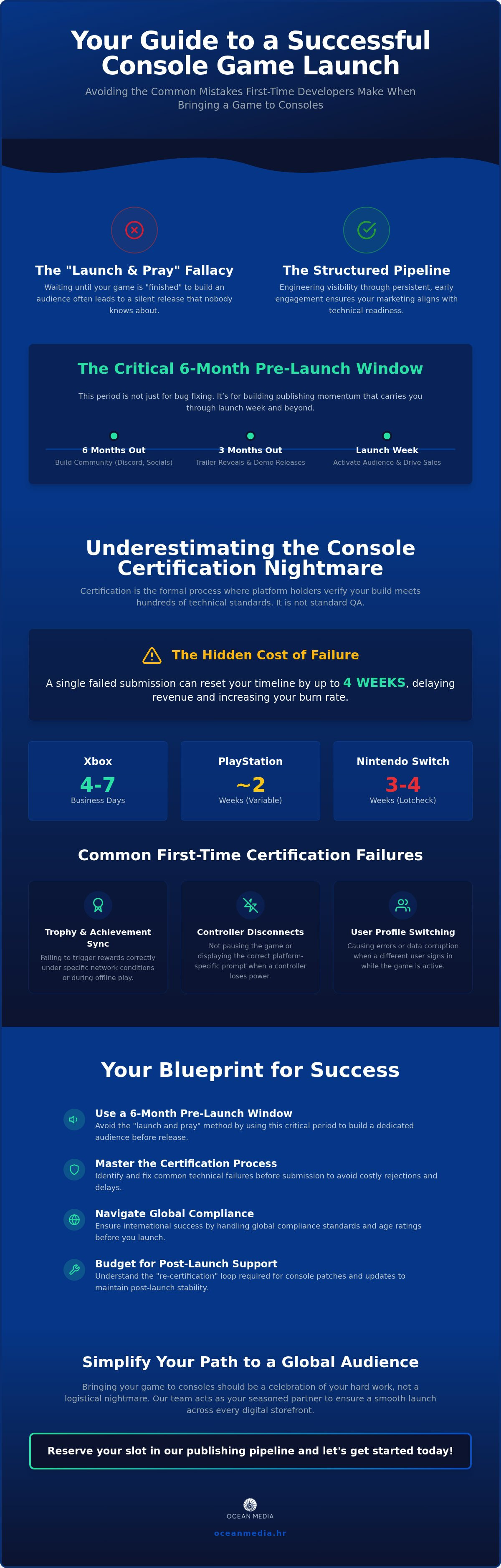
- Learn why the "launch and pray" method fails and how to effectively use a 6-month pre-launch window to build a dedicated audience.
- Master the console certification process by identifying the common mistakes first-time game developers make when publishing that often lead to technical rejection.
- Ensure international success by navigating global compliance standards and age ratings before your build hits the digital storefront.
- Budget for post-launch stability by understanding the technical "re-certification" loop required for console patches and updates.
- Simplify the process of bringing your game to consoles with a professional partner; reserve your slot in our publishing pipeline and let's get started today!
The "Launch and Pray" Fallacy: Why Marketing Starts Early
You've spent years polishing your mechanics and perfecting your art. It's tempting to think the hard work is over once the code is locked. One of the most common mistakes first-time game developers make when publishing is waiting until the game is "finished" to start building an audience. This "launch and pray" approach often results in a quiet release where nobody knows your title exists. We specialize in bringing your game to consoles by ensuring your marketing strategy aligns with your technical readiness. In the high-stakes 2026 market, visibility isn't accidental; it's engineered through persistent, early engagement.
First-time developers often underestimate the critical 6-month pre-launch window. This period isn't just for final bug fixing. It's for building publishing momentum that carries you through the launch week. Avoiding the common mistakes first-time game developers make when publishing requires a shift in mindset from "creator" to "publisher." While development visibility focuses on your internal code progress, publishing momentum focuses on external market desire. A structured publishing pipeline helps you hit critical milestones like trailer reveals, demo releases, and platform-specific announcements that keep your project in the public eye.
The Trap of the Silent Developer
Believing your game will "speak for itself" is a dangerous gamble. Without an active community on platforms like Discord before your console storefront page goes live, you're starting from zero. Engaging early allows you to leverage player feedback to refine your assets. If your community loves a specific mechanic, that should be your marketing focal point. This collaborative approach turns your project into a product players are already waiting to buy. It builds a foundation of trust that can significantly boost your day-one downloads.
Creating Storefront Assets That Convert
Your storefront is your digital window, and first impressions happen in seconds. Common errors include trailers that take too long to show gameplay or screenshots that hide the UI. Platform-specific metadata acts as a discovery tool, placing your game in front of the right audience. We help you craft evocative descriptors that build emotional connections rather than just listing features. Don't leave your success to chance; reserve your slot in our publishing pipeline and let's get started today!
Underestimating the Console Certification Nightmare
Certification is the gatekeeper of the console ecosystem. It is the formal process where platform holders like Sony, Microsoft, and Nintendo verify that your build meets hundreds of specific technical standards. One of the common mistakes first-time game developers make when publishing is viewing this as a standard QA pass. It isn't. While your internal QA team looks for gameplay bugs, certification testers look for compliance failures. If your game crashes when a controller is unplugged, or if a trophy fails to sync within a specific window, your submission will be rejected.
Failing certification carries heavy hidden costs. Industry data from 2026 suggests that while a clean build on Xbox might take 4 to 7 business days, Nintendo Switch Lotcheck realistically takes 3 to 4 weeks. If you fail, the clock resets. Planning for 4 to 8 weeks per submission round is a safer minimum. Every failed attempt delays your revenue and extends your burn rate. You can learn what console game publishers do to mitigate these risks and keep your project on track.
TRCs, XRs, and Lotcheck Explained
Each platform has its own rulebook. Sony uses Technical Requirements (TRCs), Microsoft uses Xbox Requirements (XRs), and Nintendo uses Lotcheck. These documents are massive. They cover everything from how your game handles save data to the exact wording of system messages. We often see first-time developers struggle with specific compliance issues:
- Trophy and Achievement Sync: Failing to trigger rewards under specific network conditions or during offline play.
- Controller Disconnects: Not pausing the game or displaying the correct platform-specific prompt when a controller loses power.
- User Profile Switching: Errors occurring when a different user signs in while the game is active.
A dedicated QA phase for certification only is mandatory. It's about meeting the platform holder's rigid expectations, not just your players'.
The Administrative Submission Gap
The technical build is only half the battle. You must also face the dev-portal maze. This includes managing SDK versions, configuring storefront metadata, and completing complex tax and legal forms. These administrative tasks often delay launches by weeks if handled incorrectly. If you want to bypass the stress of the technical submission lifecycle, our team provides the expertise needed to turn your build into a retail-ready product. To secure your launch date,
Ignoring Global Compliance and Localization
Clicking the "global" checkbox on a developer portal doesn't actually make your game a worldwide success. One of the common mistakes first-time game developers make when publishing is assuming digital storefronts handle regional legalities automatically. They don't. While the infrastructure exists to sell your game in 150 countries, each region has its own gatekeepers. We see many creators hit a wall when they realize their launch is blocked in major markets because they missed a specific legal filing or age rating requirement. Bringing your game to consoles requires a proactive approach to these international barriers.
Localization is often treated as an afterthought, but it's a massive revenue multiplier. In 2026, the global game localization market is projected to reach nearly $9.12 billion, reflecting how critical regionalized content has become. For a 40,000-word RPG, the estimated text-only localization cost for eight languages is about $57,600. While that's a significant investment, the return in player engagement and storefront visibility is worth the cost. Professional console releases require more than just "machine translation." They require cultural nuance and linguistic quality assurance (LQA) to pass the high standards of platform holders.
The Age Rating Hurdle
Your game can be removed from a storefront overnight if it lacks the correct regional ratings. You need to understand the difference between ESRB for North America, PEGI for Europe, and the various systems used in Asia. While the IARC (International Age Rating Coalition) process has simplified things for digital releases, it isn't a universal "get out of jail free" card. Some regions still require separate, manual submissions that involve specific fees and lead times. You can see our guide to age rating systems to understand how these requirements impact your timeline.
Strategic Localization for Console Markets
Don't try to translate your game into every language at once. We help you choose the right languages based on your genre and target platforms. For example, some genres perform exceptionally well in the Brazilian or German markets. Beyond the in-game text, your UI and storefront assets must be localized to convert browsing players into buyers. This includes trailers with translated captions and screenshots that feature localized text. If you want to ensure your game reaches a truly global audience without the administrative headache,
The Post-Launch Support and Patching Gap
Many creators view the release date as the finish line. In reality, it's just the beginning of a new phase. One of the common mistakes first-time game developers make when publishing is failing to budget time and resources for the "Day 1" patch. Industry standards in 2026 show that software maintenance can account for 50% to 80% of a product's total lifetime cost. If you haven't set aside 15% to 25% of your original development budget for annual maintenance, you're setting yourself up for a financial shock. You can avoid indie game publishing deal pitfalls by ensuring your strategy accounts for these long-term technical needs.
Bringing your game to consoles requires a commitment to quality that extends far beyond the launch trailer. Managing community expectations during that critical first week is vital for your long-term storefront ranking. We act as your partner in this journey, providing the seasoned authority needed to handle technical hurdles while maintaining a positive relationship with your players. A smooth post-launch experience is what separates a one-hit wonder from a sustainable studio.
The Technical Reality of Console Updates
Patching on consoles is significantly more complex than on PC. On platforms like Steam, you can push a hotfix in minutes. On PlayStation, Xbox, or Switch, every update must go through the "re-certification" loop. This means a simple bug fix can take days or even weeks to reach your audience. Planning a stable development roadmap is essential to avoid constant submission failures. We help you manage this lifecycle so your game remains functional and relevant long after the initial buzz fades.
Community Management as a Publishing Pillar
Your first week live is a high-pressure environment. Players will find bugs you missed, and their feedback will be public. Community management is a core publishing pillar, not just a social media task. Responding to storefront reviews with transparency can turn a rocky launch into a "redemption arc." A professional publisher acts as a shield, managing player feedback at scale while you focus on the code. This collaboration ensures that technical complaints don't derail your global visibility. If you want to ensure your post-launch support is handled with professional precision, our team is ready to assist.
Securing Your Future: Why a Professional Pipeline Matters
Attempting to manage every technical and administrative thread solo is the final entry in our list of common mistakes first-time game developers make when publishing. While the tools for game creation have become more accessible, the barriers to professional distribution have never been higher. A professional publishing partner bridges the gap between a "project" and a "product." It's about taking your creative vision and wrapping it in a layer of commercial stability that platform holders and players respect. With over 20 years of industry experience, we understand that bringing your game to consoles requires a focused strategy to avoid being buried in a crowded digital marketplace.
When you work with a seasoned guide, you gain access to a legacy of technical knowledge. We've seen the evolution of digital storefronts and know exactly how to position your title for maximum impact. This isn't just about passing a test; it's about building a sustainable future for your studio. One of the common mistakes first-time game developers make when publishing is underestimating how much professional reputation still matters in a digital-first world. Our established relationships with platform holders provide a layer of security that solo developers simply cannot replicate.
Navigating the 2026 Console Landscape
The storefront algorithms of 2026 are more sophisticated than ever. They favor titles with clean metadata, high performance, and consistent update cycles. Professional certification help is no longer optional for small studios; it's a prerequisite for survival. You can connect with our developers page to see how we streamline this process for our partners. We ensure your title doesn't just exist on a server but thrives in the spotlight. By focusing strictly on digital distribution, we keep our expertise sharp and our strategies current.
Start Your Professional Journey Today
Transitioning from a finished build to a global release shouldn't feel like a leap into the unknown. Ocean Media is the approachable creative partner you need to handle the heavy lifting. We value longevity and consistency, providing a reliable path through the complexities of digital media. Our collaborative spirit means we care about your individual success as much as you do. We aim to simplify the transition into a professional environment, allowing you to focus on what you do best: making great games. Don't let your hard work go unnoticed.
Launch Your Vision with Confidence
Success in the 2026 console market requires more than just a great game; it requires a bulletproof strategy. We've explored how early marketing, rigorous certification testing, and global compliance are the pillars of a professional release. By avoiding the common mistakes first-time game developers make when publishing, you protect your studio's reputation and your project's financial future. Bringing your game to consoles is a significant milestone, and you don't have to face the administrative maze alone.
Our team provides 20+ years of console publishing experience and global digital distribution expertise to ensure your launch is seamless. We offer dedicated technical certification support to help you navigate TRCs, XRs, and regional requirements without the stress of repeated rejections. We're here to act as your approachable creative partner, turning your finished build into a retail-ready product that thrives on every major platform. We're excited to help you share your creative vision with the world.
Frequently Asked Questions
What is the most common reason games fail console certification?
Technical compliance failures regarding platform-specific standards are the leading cause of rejection. This often involves errors in save data management, trophy synchronization, or how the game handles controller disconnects. These requirements are rigid and non-negotiable. One of the common mistakes first-time game developers make when publishing is treating these tests as simple bug checks. Our expertise helps you clear these technical hurdles on the first attempt.
How long does the console publishing process take for first-time developers?
In 2026, Microsoft Xbox typically requires 4 to 7 business days for a clean build, though 1 to 2 weeks is realistic with feedback. Sony PlayStation takes around 2 to 3 weeks, while Nintendo Switch Lotcheck can require 3 to 4 weeks. You should plan for a minimum of 4 to 8 weeks per submission round to account for potential failures. We manage this timeline to keep your release on schedule.
Can I self-publish on consoles without a professional partner?
Self-publishing is possible but requires managing every technical and administrative hurdle independently. You'll need to purchase specialized devkits, which typically cost between $5,000 and $10,000 per platform. Navigating the dev-portal maze and certification requirements without a seasoned guide is one of the common mistakes first-time game developers make when publishing. We simplify this transition into a professional environment by handling the technical and administrative heavy lifting.
What are TRCs and XRs in game publishing?
TRCs (Technical Requirements) for Sony and XRs (Xbox Requirements) for Microsoft are the specific rulebooks for console builds. These documents detail exactly how a game must behave during system-level events like user profile switching or network loss. Failing to meet even one of these hundreds of requirements results in an immediate rejection. We use our 20 years of industry experience to ensure your build is compliant before submission.
Do I need different age ratings for PlayStation, Xbox, and Switch?
You need regional ratings that apply to all platforms in those territories rather than platform-specific ones. While the IARC process has simplified digital storefront submissions, some regions still require manual filings with the ESRB or PEGI. Missing these legal requirements can block your launch in entire global markets. We guide you through the age rating maze to ensure your game achieves maximum visibility on every digital storefront.
What storefront assets are most important for a successful launch?
High-quality trailers and localized metadata are your most powerful conversion tools. Your trailer must capture attention within the first five seconds, focusing on gameplay rather than logos. Screenshots should clearly display the user interface to manage player expectations. We help you refine these assets to ensure they meet the specific standards of each digital storefront.
How much does it cost to get a game through certification?
Costs primarily involve hardware and internal resources rather than flat submission fees. Devkits for console development in 2026 generally range from $5,000 to $10,000 per platform. However, the true cost lies in the time lost during failed submission rounds. Each failure resets your timeline and increases your burn rate. We provide a structured path to avoid these expensive delays and secure your studio's financial future.
What happens if my game fails the platform submission process?
If a build fails, the platform holder provides a report detailing the specific compliance violations. You must fix every identified issue and resubmit the entire package for another full review. This process resets the submission clock, which can delay your launch by several weeks. Our team acts as a bridge between creators and the global market, helping you interpret feedback and resolve technical failures quickly.


