

Did you know the console gaming market generated $45.9 billion in revenue in 2025? It is a massive opportunity for any studio, but the gap between a finished build and a global success story often comes down to how you handle the technical hurdles of the storefronts. You've poured your heart into development, yet the thought of failing a Sony TRC or Microsoft certification because of a regional language error is enough to keep any dev up at night. Preparing your game for global console launch requires more than just translating text; it demands a strategic approach to cultural relevance and technical compliance.
We understand that the transition into a professional publishing environment can feel daunting. It's perfectly normal to feel overwhelmed by the technical requirements of multi-region publishing, but you don't have to navigate it alone. This guide provides a clear roadmap to help you master the strategic and technical steps required to conquer major storefronts on your first try. We'll explore the updated 2026 PEGI requirements for monetization, the nuances of IARC ratings, and how to maximize your international revenue. Our goal is to act as your seasoned guide through every stage of the process. Reserve your slot in our publishing pipeline and let's get started today!
Key Takeaways
- Master the strategic steps for preparing game for global console launch to ensure your title stands out on every digital storefront.
- Identify high-priority markets using the FIGS framework and evaluate the massive growth potential in regions like Brazil and Simplified Chinese.
- You'll learn how to clear console certification on your first try while addressing the updated 2026 PEGI age-rating requirements for interactive elements.
- We'll help you build a sustainable localization pipeline using externalized strings and internationalization best practices to avoid the technical debt of hard-coded text.
- Leverage Ocean Media's 20 years of industry expertise to streamline your release; reserve your slot in our publishing pipeline and let's get started today!
What Does Preparing a Game for a Global Console Launch Involve?
Preparing game for global console launch is a multi-dimensional challenge that extends far beyond simple text translation. It requires a synchronized effort across linguistic, cultural, and technical disciplines to ensure your title feels native to every player, regardless of their region. This comprehensive process, often referred to as video game localization, is the foundation of a successful international release. It ensures that your creative vision remains intact while meeting the rigorous standards of global digital storefronts.
Storefront discovery is a critical factor in your success. Algorithms on the Nintendo eShop and PlayStation Store rely heavily on localized metadata to rank your game in search results. If your keywords, descriptions, and taglines aren't optimized for local languages, you're effectively invisible to millions of potential players. By 2026, the bar for quality has shifted. Players now expect deep cultural immersion rather than just basic subtitles. Meeting this demand directly correlates with higher user review scores in non-English regions, as players reward studios that respect their language and culture.
Beyond Translation: Cultural Adaptation
Adapting your game for a global audience means looking closely at your UI/UX design. Technical preparation must account for text expansion; for instance, German translations often require significantly more screen real estate than English. If your menus aren't flexible, your UI will break. Cultural sensitivity is equally vital. We help you identify and avoid regional taboos that could lead to storefront bans or age-rating spikes. Beyond compliance, we focus on the creative soul of your project. Humor, idioms, and wordplay must be carefully reimagined so your game's personality shines through in every territory.
The Business Case for Global Reach
Expanding your Total Addressable Market (TAM) is the most direct path to scaling your studio's success. Global preparation is a strategic lever for indie revenue growth. When you are preparing game for global console launch, you are doing more than just opening new markets; you are building a global community. By making your title available in multiple regions simultaneously, you mitigate the risk of a soft launch in a single territory. This global availability creates a surge of momentum that storefront algorithms love. We specialize in bringing your game to consoles with a focus on maximizing your international footprint. Our team acts as your expert partner through every stage of the publishing pipeline. Reserve your slot in our publishing pipeline and let's get started today!
Strategic Market Selection: Where to Launch First?
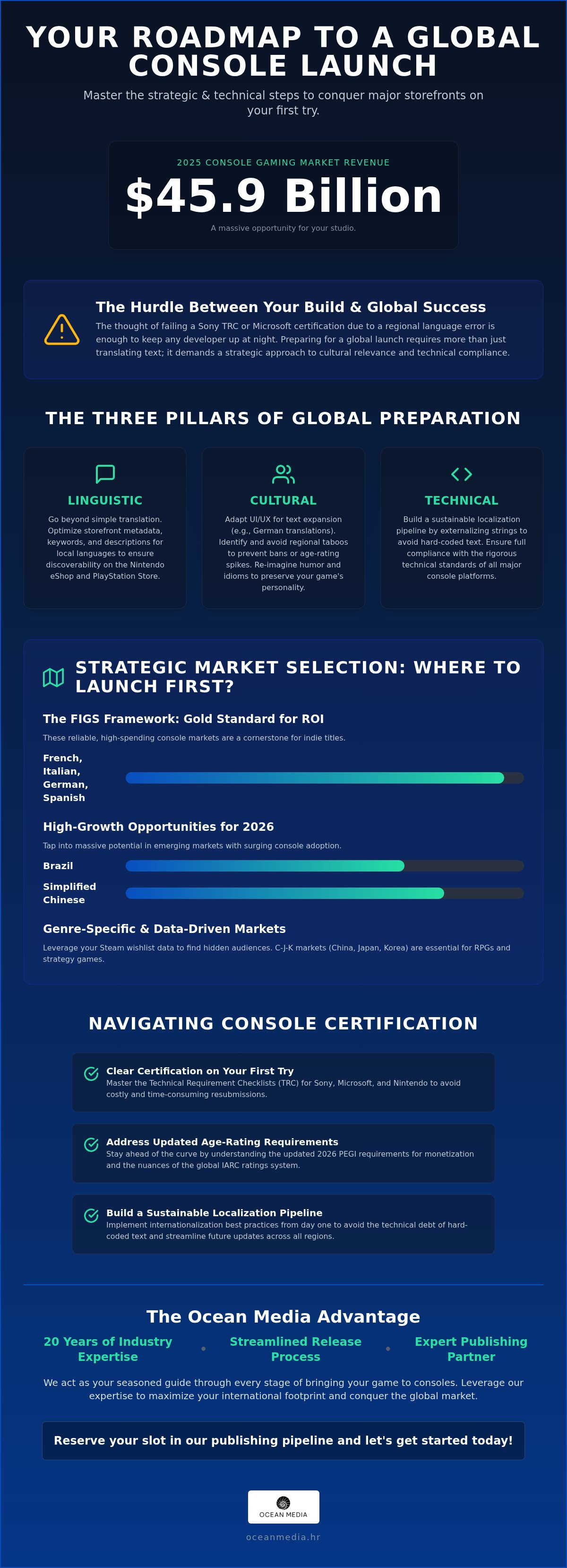
Selecting your launch territories is a high-stakes decision. You can't just guess where your players live. When you're preparing game for global console launch, you need a data-backed plan. The FIGS framework remains the gold standard for ROI. French, Italian, German, and Spanish territories are reliable, high-spending console markets. However, the 2026 landscape shows massive growth elsewhere. Brazil and Simplified Chinese markets offer huge potential for studios willing to adapt. Brazil, in particular, has seen a surge in console adoption, while Simplified Chinese remains a massive market for narrative-heavy titles.
Use your existing analytics to find "hidden" audiences. Look at your console dashboard and Steam wishlist data. If you see a spike in interest from Poland or Turkey, pay attention. Balancing the cost of professional translation against your projected sales is the key to a sustainable release. The International Trade Administration highlights the importance of understanding these global trade dynamics to maximize your export potential. We've spent 20 years observing these shifts, helping our partners decide exactly where to focus their resources for the best results.
Prioritising the FIGS+ Strategy
Western Europe is a cornerstone for console indie titles. Players there have high disposable income and a long history of supporting independent creators. But don't ignore the C-J-K markets. China, Japan, and Korea are essential if your game fits specific genres like RPGs or strategy titles. You can validate these priorities by looking at your Early Access data. If your game is already gaining traction on PC in certain regions, it's a strong indicator for your console performance. A localized build in these territories can often be the difference between a niche release and a global hit.
Budgeting for Localization Excellence
Professional localization is an investment. In 2026, you'll encounter various per-word rates and project-based fees. Don't forget the hidden costs. Linguistic Quality Assurance (LQA) and UI re-designs are often overlooked but critical for success. Community translation might seem cheap, but it's a major risk. Linguistic errors can cause you to fail console certification, leading to costly delays. This is where our expertise in platform certification becomes invaluable.
We help you navigate these financial decisions by providing a clear publishing roadmap. Our experience ensures your budget is spent where it will have the most impact. It's about working smarter, not just harder. Reserve your slot in our publishing pipeline and let's get started today!
Navigating Console Certification and Technical Requirements
Certification is the final, most demanding hurdle in your publishing journey. For many developers, the technical side is clear, but the linguistic requirements often cause unexpected delays. When you are preparing game for global console launch, a single mistranslated system message can trigger an immediate rejection. Platform holders like Sony, Microsoft, and Nintendo require absolute consistency in how you refer to their hardware. If your game tells a player to "Press the Start Button" on a modern controller that no longer uses that label, you'll fail certification. We ensure every string matches the official terminology for every region and every controller type.
Managing digital storefront assets is another logistical challenge. You'll need to coordinate descriptions, taglines, and legal disclaimers in 10 or more languages simultaneously. This metadata is vital for the discovery factor we discussed in previous sections. Accuracy here isn't just about professional pride; it's about passing the platform's internal checks. Our team manages these complex submissions daily, ensuring your localized builds meet the strict standards required for a synchronized global release. We specialize in bringing your game to consoles by handling the heavy lifting of storefront management.
Platform Submission Expertise
Each platform has its own set of rules, often called Technical Requirement Checklists (TRCs) or Lotcheck requirements. These documents are massive. They vary significantly between North America, Europe, and Asia. Navigating these regional linguistic requirements requires a partner who understands the nuances of each storefront. We help you audit your build before submission to catch the errors that typically lead to failure. For a deeper dive into the technical milestones, see How to Publish a Game on Console: The Complete Developer Roadmap for 2026.
Global Compliance and Age Ratings
Age ratings are a critical part of your global timeline. Effective June 2026, PEGI has updated its framework to include stricter criteria for interactive elements like paid random items. These changes can push your game into a higher age bracket, affecting your marketability. Fortunately, the International Age Rating Coalition (IARC) system simplifies this for digital-only releases, providing ratings for multiple regions through a single questionnaire. If you're planning a physical release, remember that an ESRB rating for games with budgets under $1 million costs approximately $3,000. You can explore the full details in our Global Console Game Age Rating Guide for Developers 2026.
Success in certification requires meticulous planning and a deep understanding of platform expectations. We take the stress out of this process, acting as your guide through the entire publishing pipeline. Don't let a technicality stall your success; reserve your slot in our publishing pipeline and let's get started today!
Building a Sustainable Localization Pipeline
Establishing a robust pipeline early in development is the best way to avoid technical debt. When you're preparing game for global console launch, your workflow must be systematic and scalable. A professional pipeline moves through five critical stages to ensure your game is ready for every market simultaneously. It begins with code-level preparation and ends with the final submission of localized metadata to digital storefronts.
- Step 1: Internationalisation (i18n). You must design your code to handle multiple languages from the very first line.
- Step 2: Externalising strings. Move all text into manageable formats like .JSON or .CSV. This prevents the need for developers to touch the code during the translation phase.
- Step 3: Creating a Localization Kit (LocKit). This document provides essential context, character lore, and screenshots for translators to ensure the tone remains consistent.
- Step 4: Implementing LQA. This stage involves testing the localized build in-engine to catch text overflows and context errors.
- Step 5: Storefront optimization. The final step is submitting localized descriptions and tags to maximize your visibility on the eShop or PlayStation Store.
Internationalisation (i18n) Best Practices
Your UI design needs to be flexible. German text, for example, often requires 30% more space than English. If your menus are static, they'll break. You also need to consider font support for Asian, Cyrillic, and right-to-left languages early on. Hard-coding strings is the most common reason for launch delays because it forces you to rebuild the game every time a typo is found. By keeping text separate from your logic, you ensure a smoother path to certification.
Managing Localization Quality Assurance (LQA)
LQA is mandatory if you want your game to feel native in every region. It isn't just about catching typos; it's about verifying that cultural nuances are respected. A 2026 survey found that 75.7% of localization buyers still consider human proofreading or LQA mandatory despite the rise of AI tools. We work with native speakers to track linguistic bugs and inconsistencies directly in your development environment. This collaborative approach ensures that your creative vision isn't lost in translation.
We specialize in helping studios build a professional publishing pipeline that eliminates the guesswork. Our team acts as your partner to streamline every technical and creative hurdle. To ensure your title meets the highest global standards, reserve your slot in our publishing pipeline and let's get started today!
Bringing Your Game to Consoles: The Ocean Media Advantage
Ocean Media isn't just a service provider; we're your partner in navigating the intricate world of digital distribution. While a standalone translation agency might handle your text, they won't help you navigate a Sony TRC failure or manage your Microsoft storefront assets. Preparing game for global console launch requires a holistic approach that a simple translation firm cannot offer. We leverage our 20+ years of console industry experience to streamline every technical and administrative hurdle, ensuring your title reaches its full international potential.
We take on the heavy lifting of platform submissions. This reduces your administrative burden, allowing your team to stay focused on the creative work that makes your game unique. By acting as a bridge between your indie vision and the global digital market, we ensure that nothing is lost in translation, neither culturally nor technically. Our expertise in platform certification means we catch the small errors that lead to big delays, giving you the best chance of passing on your first attempt.
Our Collaborative Publishing Process
Our approach is built on transparency and collaboration. We assist with the technical complexities of PlayStation, Xbox, and Nintendo Switch, ensuring your build is compliant before it ever hits the certification desk. We understand the nuances of global storefronts and how to position your game for maximum visibility. Visit our developers page to see how we help studios succeed by providing a structured, reliable path to market. We don't just publish your game; we advocate for its success across every major territory.
Your Next Step to Global Success
Success on consoles is rarely a one-time event. We value long-term partnerships that extend beyond a single release. Whether you're looking at future ports, seasonal updates, or full-blown sequels, we provide the consistency and expertise needed to grow your brand globally. As a reliable leader in the digital landscape, we offer the stability you need to navigate changing regulations and market shifts. Don't let the complexities of international distribution hold your studio back. Preparing game for global console launch is a journey we are ready to take with you. Now is the time to secure your future in the global market. To lock in your launch window and benefit from our two decades of expertise, reserve your slot in our publishing pipeline and let's get started today!
Secure Your Place on the Global Storefront
Mastering the complexities of international markets is what separates a local release from a global phenomenon. You've seen how localized metadata drives discovery and how technical compliance ensures you clear certification without the stress of rejection. Preparing game for global console launch is a strategic evolution that requires precision; it's also the most rewarding step your studio will ever take. By focusing on cultural immersion and a sustainable technical pipeline, you ensure your title resonates with players from Berlin to Beijing.
Our team brings over 20 years of console publishing expertise to your project, specializing in global digital distribution and providing dedicated support for platform certification. We act as your seasoned guide, simplifying the transition from development to a professional publishing environment. Let's work together to bring your creative vision to players in every corner of the world. Reserve your slot in our publishing pipeline and let's get started today! Your game deserves a global stage, and we're ready to help you build it. We are excited to see what we can achieve together.
Frequently Asked Questions
When should I start the localization process for my indie game?
Start as early as possible, ideally during the pre-production phase of development. This allows you to handle internationalization (i18n) from the first line of code, ensuring your UI can scale for different languages. Waiting until the end often leads to hard-coded text issues that delay your release. Early planning allows for seamless integration into our publishing pipeline, saving weeks of work during the final certification push.
Which languages provide the best ROI for indie console games in 2026?
The FIGS group (French, Italian, German, Spanish) remains a high-spending cornerstone for Western markets. However, 2026 trends highlight Simplified Chinese and Brazilian Portuguese as high-growth territories for digital storefronts. Analyzing your specific genre's performance in these regions is crucial. We help you use data-driven insights to prioritize markets that align with your game's mechanics and narrative style for maximum revenue. Every region offers unique opportunities for growth.
How much does indie game localization typically cost for a global launch?
Costs vary based on word count and the complexity of your title. Industry rates for text translation generally range from $0.07 to $0.18 per word, while Linguistic Quality Assurance (LQA) is often billed hourly. Narrative-heavy RPGs naturally command higher budgets than arcade titles. While we don't set these translation rates, we help you budget effectively to ensure your investment translates into successful console certification and global sales results.
Can I use AI or machine translation for my console game localization?
AI can be a tool for initial drafts, but human oversight is essential for professional quality. A 2026 survey indicates that 75.7% of localization buyers still consider human proofreading or LQA mandatory. Machine translation often misses cultural nuances and platform-specific terminology required by Sony or Nintendo. To avoid certification failure, you should always have native experts review your strings before submitting your build to the storefronts.
What is the difference between internationalization and localization?
Internationalization (i18n) is the technical process of designing your game's code to support multiple languages without engineering changes. Localization (l10n) is the actual process of adapting the content, such as text and cultural references, for a specific region. You must master both when preparing game for global console launch. Think of i18n as building the foundation and localization as the creative finishing work that makes the game feel native.
What happens if my game fails console certification due to localization errors?
A certification failure usually results in a rejection notice and a list of bugs to fix. You'll need to correct the linguistic errors, rebuild the game, and resubmit for a new review cycle. This can delay your launch by several weeks and may involve additional submission fees. Our expertise in platform certification helps you catch these errors early, ensuring you pass on your first attempt and stay on schedule.
Do I need to localize my game’s voice-over or just the text?
Localizing voice-over depends on your budget and target audience expectations. For many indie titles, high-quality localized text and subtitles are sufficient to reach a global audience. However, narrative-driven experiences often benefit from full voice localization in high-ROI markets like Germany or Japan. We analyze your game's scope to recommend whether text-only or full audio localization is the right move for your specific digital distribution strategy.
How do I handle global updates and DLC for a localized game?
You should treat updates and DLC as part of your ongoing localization pipeline. Every new piece of content must go through the same translation and LQA steps as the base game. Storefront metadata also needs updating in every supported language to maintain search visibility. We help you manage these post-launch requirements so your community receives a consistent experience. To lock in your release schedule, reserve your slot in our publishing pipeline and let's get started today!


