

What if the "Grant of Rights" clause in your contract is actually a hidden exit ramp for your studio's most valuable assets? Protecting your creative work isn't just about filing a copyright; it requires surgical precision when mastering video game IP law for developers. We know the anxiety that comes with signing over your world. You've poured your soul into these characters, and the thought of losing them or being locked out of your own sequels is enough to stall any deal. The industry is shifting quickly, especially with Sony's move toward a digital-only model by 2028.
We believe your studio deserves a partner that respects your ownership. This guide breaks down the complexities of bringing your game to consoles, helping you distinguish between licensing and assigning rights with ease. You'll learn exactly what you should control versus what a publisher needs to manage. We've prepared a comprehensive checklist to use during negotiations so you can sign with total confidence. Let's ensure your studio's long-term value remains in your hands. Reserve your slot in our publishing pipeline and let's get started today!
Key Takeaways
- Identify the critical differences between copyrights, trademarks, and patents to protect your studio's creative assets from the ground up.
- Prepare for the unique IP requirements of major platforms like Sony, Microsoft, and Nintendo to ensure your game passes certification without delays.
- Master the complexities of video game IP law for developers by learning why licensing your rights is far superior to assigning them away.
- Use our comprehensive checklist to verify that your publishing agreement preserves your ownership and limits platform exclusivity.
- Access a structured path for bringing your game to consoles with a partner that values your IP; reserve your slot in our publishing pipeline and let's get started today!
Understanding Video Game IP Law: Why Developers Need a Strategy
Intellectual property (IP) is the lifeblood of your studio. It's more than just a legal concept; it's the tangible value of your creative output. Understanding video game IP law for developers is the difference between building a long-term legacy and watching your hard work slip away during a contract dispute. IP isn't a monolith. It's a bundle of rights that dictates who can sell, modify, or profit from your game. Without a strategy, you're essentially building a house on land you don't own.
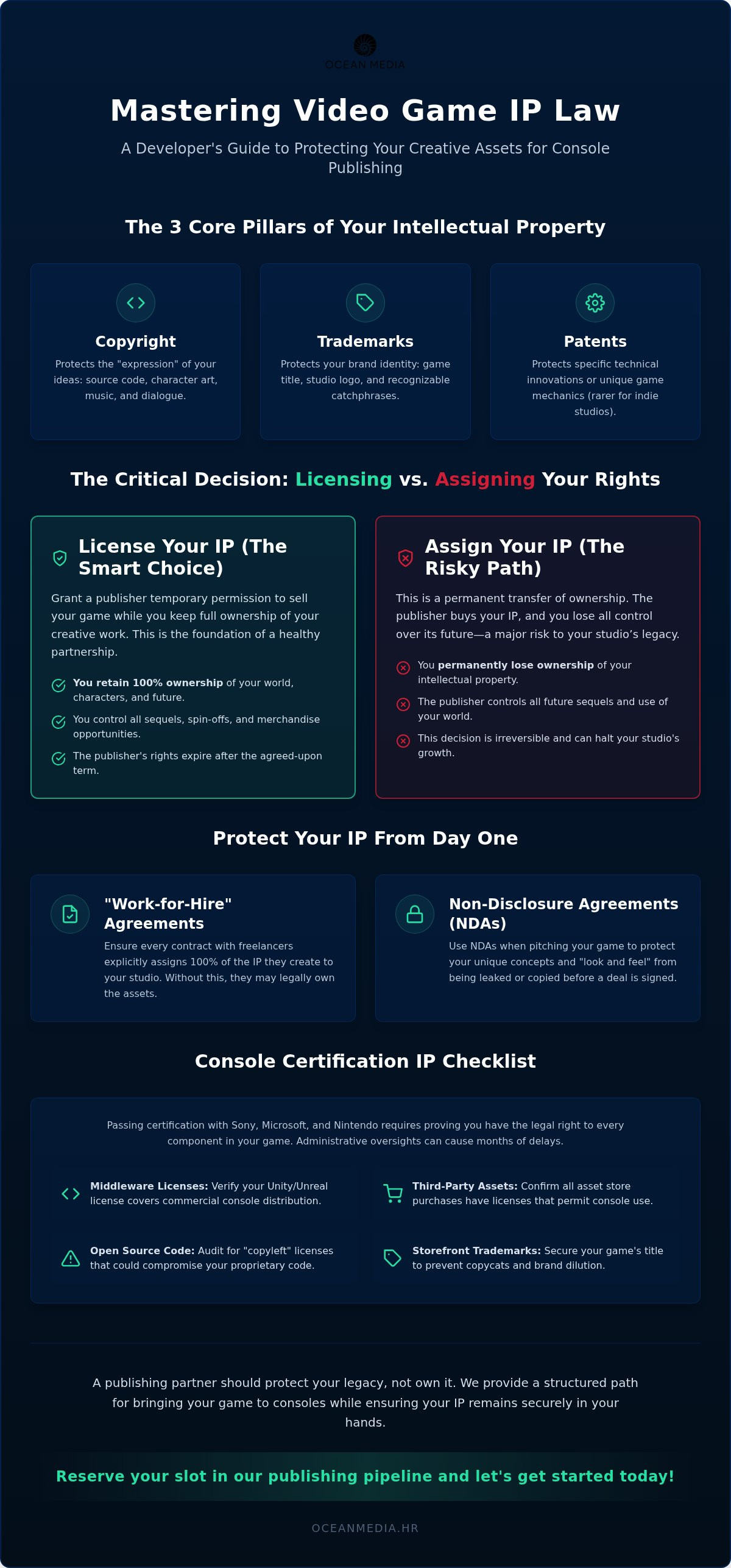
To protect your studio, you must distinguish between three core pillars:
- Copyright: Protects the "expression" of your ideas, including your source code, character art, music, and dialogue.
- Trademarks: Protects your brand identity, such as your game's title, studio logo, and recognizable catchphrases.
- Patents: Protects specific technical innovations or unique hardware mechanics, though these are rarer in indie development.
"Cloning" remains a frustrating reality because basic game mechanics (like jumping or health bars) aren't usually copyrightable. However, a robust IP strategy protects the unique way those mechanics are presented. Beyond protection, your IP is the primary asset on your balance sheet. If you ever seek funding or a future acquisition, investors aren't just buying your talent; they're buying the exclusive right to your world.
Copyright vs. Trademark in Gaming
Copyright is your first line of defense. In most jurisdictions, it attaches the moment you write a line of code or sketch a character. While automatic, formal registration is vital before bringing your game to consoles on a global scale. Trademarks, conversely, are about market clarity. They stop "copycat" listings from using a similar name to siphon off your players. Without a registered trademark, you're vulnerable to brand dilution and confusion in crowded digital storefronts.
The Risk of IP "Leakage" in Early Development
Your IP is most vulnerable during the early stages of development. If you hire a freelance artist or contractor without a clear "Work-for-Hire" agreement, they might technically own the rights to the assets they created for you. You must ensure every contributor signs a contract that explicitly assigns ownership to your studio. Similarly, protect your "look and feel" during the pitching process by using Non-Disclosure Agreements (NDAs) until you've secured a reliable partner.
Navigating these legal hurdles early sets the stage for a professional launch. If you're ready to secure your studio's future, reserve your slot in our publishing pipeline and let's get started today!
Console-Specific IP Hurdles: Digital Storefronts and Certification
Moving your game from a local build to a major console storefront involves more than just a technical port. Sony, Microsoft, and Nintendo maintain strict gatekeeping standards. Certification (or "cert") serves as a final audit of your legal right to the technology inside your game. Platform holders need to know you aren't just using the code, but that you have the explicit permission to distribute it commercially on their hardware. This is a critical stage in video game IP law for developers where administrative oversights can stall a launch for months.
For a broader look at the submission process and how it fits into your development cycle, check out our How to Publish a Game on Console: The Complete Developer Roadmap for 2026.
Middleware and Third-Party Licenses
Your game engine is the foundation of your IP, but it comes with strings attached. Whether you use Unity or Unreal, your license must specifically cover console distribution. Some developers discover too late that their tier doesn't grant the necessary seats for console SDK access. You must also audit your "Open Source" components. Using a library under a restrictive "copyleft" license could legally "poison" your proprietary code, potentially forcing you to reveal your source code. Always verify that your asset store purchases include "commercial use" rights for console platforms to avoid post-launch takedowns.
Storefront Trademarks and Metadata
Digital storefronts are under increasing scrutiny. California's Assembly Bill 2426, effective January 1, 2026, requires clear disclosure that players are obtaining a revocable license rather than "buying" a permanent asset. This transparency extends to your metadata. You must ensure your game title is trademarked in all target territories to prevent competitors from filing infringement claims. Managing your global presence also means securing age ratings. Consult our Global Console Game Age Rating Guide for Developers 2026 to navigate the requirements of the ESRB and PEGI. Regional IP laws, particularly in the EU, are also evolving regarding game preservation, making it essential to have a clear strategy for your digital titles.
If these technical and legal layers feel overwhelming, remember you don't have to navigate them alone. Our team specializes in bringing your game to consoles with two decades of expertise. We handle the administrative heavy lifting so you can focus on the creative process. Reserve your slot in our publishing pipeline and let's get started today!
Negotiating the Publishing Deal: The Grant of Rights
The "Grant of Rights" is the most critical clause in any contract involving video game IP law for developers. It defines exactly what you are allowing a publisher to do with your creation. You'll encounter two primary paths: assigning and licensing. Assigning IP means a total, permanent transfer of ownership; once you sign, the characters and world no longer belong to you. Licensing, however, is essentially "renting" your IP. We believe developers should almost always retain 100% ownership, granting only the specific permissions needed for a successful launch.
Precision matters when defining the "Scope of Use." You need to specify which platforms, territories, and timeframes are included. In a fast-moving market where digital storefronts are the primary revenue driver, "perpetual" licenses are dangerous. They can lock your game into a stagnant deal for decades. Instead, aim for limited terms that allow rights to revert to your studio if certain conditions aren't met. This ensures your studio remains agile as technology evolves, especially as major players like Sony move toward digital-only models by 2028.
Sequel, Port, and Merchandising Rights
If your game becomes a breakout hit, who owns the rights to "Game 2"? Many agreements include a Right of First Refusal (ROFR), giving the publisher the first chance to sign a sequel. This is standard, but you must ensure it doesn't become a "Right of First Negotiation" that traps you in a legal loop. You should also protect your rights for transmedia adaptations, like film or TV. Keeping these rights separate from the console publishing agreement preserves your studio's long-term value and creative freedom.
Ownership of New Material (DLC and Updates)
Post-launch content like DLC, patches, and expansions are technically "Derivative Works." Your contract must explicitly state that you own these additions. This is particularly vital for modern "Live Service" models where the game is constantly evolving. Without clear language, a publisher might claim ownership of the new code or assets created after the initial launch. We advocate for contracts where the developer maintains the IP for every update and expansion. If you want a partner that respects your creative legacy, reserve your slot in our publishing pipeline and let's get started today!
The Video Game Publishing Agreement Checklist
Your publishing agreement shouldn't be a mystery. It's a set of rules that governs your studio's future. When diving into video game IP law for developers, you need a structured way to evaluate every page. A professional-grade checklist ensures you don't miss the clauses that could cost you your autonomy. Use the following points as your baseline during negotiations to ensure your interests are protected.
- IP Ownership: Does the contract explicitly state that the developer retains all rights, title, and interest in the IP?
- Grant of Rights: Is the license strictly limited to specific platforms, such as digital console only, rather than a "catch-all" grant?
- Reversion Clause: Do the rights automatically return to you if the publisher fails to launch the game within a set window or if sales fall below a specific floor?
- Termination Rights: Is there a clear, bilateral path to exit the deal if the publisher commits a material breach of contract?
- Indemnification: Is there a fair split of responsibility? The publisher should pay if a third party sues over the publisher's specific marketing materials or platform-level errors.
Financial and Royalty IP Terms
Ownership is only half the battle; how that ownership translates into revenue is what keeps your studio running. Your contract should grant you clear audit rights. This allows you to verify the publisher's sales data independently. You must also watch out for cross-collateralization. This practice allows a publisher to recoup losses from one of your games using the profits from another. Every project should stand on its own financial merits to protect your studio's cash flow.
Marketing and Trademark Usage
Your characters are your brand. While a publisher needs to use your IP for promotion, that right should be limited and subject to your approval. Quality control clauses are essential here. They ensure that any trailers, social media posts, or store descriptions maintain your studio's brand integrity. You should always have the final say on how your world is presented to the public. If you're looking for a partner that respects these boundaries, we're here to help you navigate the console publishing pipeline with professional care. Reserve your slot in our publishing pipeline and let's get started today!
Securing Your Legacy: How a Publishing Partner Protects Your IP
Experience is the ultimate shield in the volatile landscape of video game IP law for developers. At Ocean Media, we've spent 20 years acting as a bridge between independent creators and the global market. Our role is to navigate the technical red tape and administrative hurdles that often trap smaller studios. By focusing exclusively on digital console distribution, we minimize the complex IP risks and legal liabilities associated with physical retail manufacturing. This digital-first strategy is more relevant than ever, especially with Sony's confirmed shift to an all-digital model by 2028. We protect your legacy by ensuring your game meets every platform-specific requirement without compromising your ownership.
We don't view our relationships as cold, transactional deals. Instead, we operate as a collaborative partner (a seasoned guide with a massive portfolio) dedicated to growing your IP alongside you. Our approach ensures you retain the creative freedom to expand your world while we handle the logistical heavy lifting. We believe that a successful launch shouldn't come at the cost of your studio's long-term value. Our 20-year history in the industry provides the stability you need to sign a deal with total confidence.
Navigating the Publishing Pipeline
Our publishing pipeline offers a structured, reliable path from a finished build to a global storefront listing. We specialize in the nuances of platform-specific certification for PlayStation, Xbox, and Nintendo Switch. This includes a deep dive into IP compliance, ensuring every third-party library and middleware license is correctly documented for commercial use. We simplify these technical complexities so you don't have to become a legal expert just to see your game on a console dashboard. Our team manages the submission process from start to finish, acting as your advocate with platform holders.
Ready to Bring Your Game to Consoles?
The right partner does more than just upload a file; they secure your studio's future. Mastering video game IP law for developers is a career-long journey, but you don't have to walk it alone. We provide the expertise and the infrastructure to ensure your characters and worlds remain yours forever. Bringing your game to consoles is a major milestone, and we've refined our process to make it as smooth and professional as possible. If you're ready to take the next step without losing control of your creation, we're ready to help. Reserve your slot in our publishing pipeline and let’s get started today!
Secure Your Studio's Future on Global Storefronts
Your creative vision is the most valuable asset your studio possesses. Protecting it requires a firm grasp of video game IP law for developers, especially as the industry shifts toward a digital-only landscape by 2028. We've explored the critical difference between licensing and assigning rights, and how a precise "Grant of Rights" clause keeps you in the driver's seat. A successful launch on PlayStation, Xbox, or Nintendo Switch isn't just about the code. It's about navigating the technical certification red tape with total confidence so your characters and worlds stay under your control.
With over 20 years of console publishing experience, we've built a proven track record of helping indie developers globally secure their legacies. We act as your seasoned guide, providing the administrative shield you need to thrive without ever taking ownership of your world. Let's turn your hard work into a long-term success story on the global stage. We're ready to help you navigate the complexities of the digital market while ensuring your studio maintains its long-term value. Reserve your slot in our publishing pipeline and let’s get started today!
Frequently Asked Questions
Do I lose my IP if I sign with a video game publisher?
You don't lose your IP unless you explicitly sign an "Assignment of Rights" clause. With our 20 years of experience, we've seen how professional console publishing agreements are structured as licenses, meaning you "rent" the rights to the publisher for a set period. We believe developers should always retain 100% ownership. If you want a partner that respects your creative legacy, reserve your slot in our publishing pipeline and let's get started today!
What is a "reversion of rights" clause and why is it important?
A reversion clause is your legal safety net. It ensures that all rights to your game return to you if the publisher fails to meet specific milestones, such as a launch date or a minimum sales floor. This prevents your IP from being trapped in "legal limbo" if a partnership sours. It's a fundamental part of video game IP law for developers that protects your studio's long-term agility.
Should I trademark my game title before pitching to a publisher?
You should ideally register your trademark as early as possible. Having a registered title or studio logo provides immediate leverage during negotiations and prevents "copycat" listings on digital storefronts. While some publishers assist with this during the video game IP law for developers phase, owning the trademark yourself from day one ensures you maintain control over your brand's identity regardless of who you sign with.
Does a publishing agreement cover sequel rights automatically?
Sequel rights aren't automatic; they must be explicitly defined in your contract. Most publishers include a "Right of First Refusal" (ROFR), which gives them the first opportunity to publish subsequent titles in the series. However, you should ensure this doesn't prevent you from taking a sequel elsewhere if the publisher declines. Clear language here is essential for protecting your characters' potential for future transmedia adaptations or follow-up games.
What happens to my IP if the publishing company goes bankrupt?
If your contract includes a strong reversion clause, the rights should return to you upon the publisher's insolvency. Without this protection, your IP could technically be treated as a business asset during bankruptcy proceedings, potentially being sold to satisfy creditors. This is why we emphasize the importance of "bankruptcy-proof" language in every agreement. It ensures your creative work remains your property even if the publisher faces financial failure.
How does IP law work for games with multiple developers or freelancers?
Ownership is determined by the contracts you have with your contributors. Without a "Work-for-Hire" agreement, a freelance artist or coder may technically own the rights to the specific assets they created for your game. You must ensure every team member signs a document that assigns all IP to your studio. This creates a "clean chain of title," which is a mandatory requirement for passing certification and bringing your game to consoles.
Can a publisher own the code but not the art assets?
Yes, intellectual property is modular. A contract can be structured where the publisher owns specific technical implementations (like a proprietary porting wrapper) while you retain full ownership of the art, music, and characters. However, this "split" ownership can complicate future ports or sequels. We generally recommend that developers keep the entire bundle of rights together under their studio's control to avoid logistical headaches during the publishing pipeline.
What is the difference between a work-for-hire and a publishing deal?
In a work-for-hire arrangement, you are paid to create a game that the client owns entirely. You are a service provider, not an owner. A publishing deal is a partnership where you own the game and license the distribution rights to a third party. While we don't offer work-for-hire services, we specialize in console publishing deals that respect your autonomy. Reserve your slot in our publishing pipeline and let's get started today!


