

A single administrative oversight in your metadata is now enough to delay your global launch by weeks, effectively killing the vital momentum of your release window. You've likely spent years refining your game's mechanics and narrative, so it's frustrating to realize that the technical "certification wall" is often higher than the development process itself. Many developers find that common console publishing mistakes, such as misinterpreting the latest Xbox XR 16.3 requirements or the June 2026 PEGI rating updates regarding interactive risks, can lead to immediate rejection and costly rescheduling.
We understand that the transition from a finished build to a live storefront is daunting. This article will help you avoid the pitfalls that derail indie launches by highlighting the critical differences between struggling through self-publishing and leveraging a professional partnership. We'll preview the shifting landscape of 2026, from the new PEGI 16 defaults for games with paid random items to the nuances of PlayStation system stability. Our goal is to ensure your title achieves maximum visibility on PlayStation, Xbox, and Switch without the stress of a "fail" result. If you're ready to bypass the technical minefield, reserve your slot in our publishing pipeline and let's get started today!
Key Takeaways
- Master the technical requirements of the certification wall to ensure your build meets the latest platform standards without the risk of rejection.
- Navigate the updated 2026 PEGI rating system and global compliance standards to secure a smooth digital launch across all major territories.
- Identify and avoid common console publishing mistakes in metadata and storefront optimization that can limit your game's visibility.
- Understand why a professional partnership provides a better ROI by significantly reducing your time-to-market and administrative burden.
- Take the first step toward a successful release; reserve your slot in our publishing pipeline and let's get started today!
Common Console Publishing Mistakes vs. The Self-Publishing Reality
Self-publishing an independent video game on PC often feels like a straightforward path to your audience. You upload a build, set a price, and hit launch. However, consoles operate under an entirely different set of rules. The "self-publishing" myth suggests that because tools are accessible, the process is simple. It isn't. Consoles are gated ecosystems where platform holders act as strict guardians of quality and stability. They expect a level of professional polish that goes far beyond the game's code.
One of the most common console publishing mistakes is treating a console release like a Steam launch. On PC, a minor bug might result in a quick patch. On consoles, that same bug can trigger the "certification loop." This is a cycle where a build is rejected for a technical violation, leading to weeks of delays. You suddenly shift from being a creative developer to an exhausted administrator, drowning in documentation and regional compliance forms. We've seen talented teams lose their launch momentum because they underestimated the administrative weight of the console publishing pipeline. Avoiding common console publishing mistakes requires a fundamental shift in how you view the release process.
The Hidden Complexity of Digital Distribution
Just being "live" on a storefront doesn't guarantee sales. Digital storefronts like the PlayStation Store or Nintendo eShop use complex algorithms that favor games with optimized metadata and proven engagement metrics. If your store page isn't localized for every region or your launch timing ignores global time zones, you'll vanish into the "new releases" abyss within hours. Visibility is a science, not a byproduct of showing up. You need a strategy that addresses how storefronts prioritize content in 2026.
Why Experience Matters in 2026
At Ocean Media, we've spent over 20 years observing how these digital storefronts evolve. We act as your seasoned guide, helping you transition from a creative mindset to a professional publishing environment. Our established relationships with platform holders allow us to anticipate shifts in requirements before they become roadblocks. We've managed global launches for dozens of titles, ensuring that every administrative detail is handled with precision. Bringing your game to consoles shouldn't feel like a battle against bureaucracy. It should be the pinnacle of your career. By partnering with experts, you can focus on what you do best: making great games. If you're ready to see your vision on the big screen, reserve your slot in our publishing pipeline and let's get started today!
Technical Pitfalls: Navigating the Certification Wall
Getting your game running on a PC is a major milestone, but getting it through console certification is a different gauntlet entirely. Many developers fall into common console publishing mistakes by assuming their Steam-ready build will pass on PlayStation or Xbox without significant modification. It won't. Consoles are closed environments that require specialized build optimization to handle hardware constraints and system-level interactions that simply don't exist in the open PC market. A "finished" PC build is often just the starting line for a console port.
TRCs are the mandatory technical standards set by console manufacturers. These checklists, along with Xbox Requirements (XR), which reached version 16.3 in July 2026, serve as the gatekeepers of your launch. Failing to meet even one minor requirement, such as how your game handles a controller being disconnected or how it displays system-level messages, results in an immediate rejection. This isn't just a technical setback; it often leads to Global Compliance Errors and missed marketing windows that can't be recovered. The "certification tax" is paid in lost time and fractured momentum.
Platform-Specific Submission Requirements
Each platform has its own set of demands. PlayStation 5, currently running system version 26.04-13.42.00, requires rigorous performance stability and specific trophy integration. Xbox demands deep ecosystem compliance. Nintendo Switch presents unique hurdles for indie devs, particularly regarding handheld-to-docked transitions and specific memory management. While Nintendo's developer portal registration is free as of October 2025, the hardware costs and engine licensing fees remain significant hurdles for teams unprepared for the investment.
The Certification Loop and How to Break It
The "certification loop" occurs when you fix one bug only to trigger a new compliance failure. Common triggers include UI elements overlapping with system overlays or non-standard controller mapping that violates platform conventions. Breaking this loop requires more than standard QA. It requires pre-vetting your build against the exact criteria platform holders use. We help developers navigate these technical nuances before the official submission happens. Ensuring your build is console-ready from day one avoids the trap of wasted developer hours. To secure your release window, reserve your slot in our publishing pipeline and let's get started today!
Administrative and Global Compliance Errors
Administrative hurdles are often the silent killers of a promising indie project. You might have the technical certification under control, but a single error in tax documentation or a missed regional age rating can halt your storefront activation entirely. One of the most common console publishing mistakes involves underestimating the legal and logistical complexity of selling a digital product in over 100 countries simultaneously. Transitioning from a developer to a global administrator requires a shift in mindset that many teams aren't prepared for (and shouldn't have to be).
Operating as an individual is rarely an option; most platform holders require you to have a registered legal entity to even begin the submission process. Beyond the corporate structure, you must navigate the labyrinth of global tax treaties and VAT compliance for digital sales. These administrative tasks take hundreds of hours that your team should be spending on your next project. Navigating common publishing agreement pitfalls is just as critical as writing clean code if you want to see a return on your investment.
Global Age Ratings and Regional Restrictions
The rating landscape shifted significantly in June 2026. PEGI now mandates a default PEGI 16 for games with "paid random items" and a PEGI 18 for any title utilizing blockchain technology or unrestricted online communication. Missing these nuances doesn't just mean a wrong icon on your store page. It can lead to your game being blocked in specific territories like Germany (USK) or Australia (OFLC) where standards are notoriously strict. For a deeper dive into these requirements, check out our Global Console Game Age Rating Guide.
Storefront Presence and Asset Management
Your metadata is your storefront's DNA. If your keywords are poorly chosen or your descriptions are machine-translated without cultural context, the platform algorithms will bury you. Trailers also require region-specific edits to meet local advertising laws, which often dictate the format and length allowed for promotional content. Managing "Coming Soon" pages effectively is vital to build pre-launch momentum, yet many developers fail to set these up early enough to capture wishlist data. We help you manage these assets with precision, ensuring your game is visible and enticing to players everywhere. To secure your global reach, reserve your slot in our publishing pipeline and let's get started today!
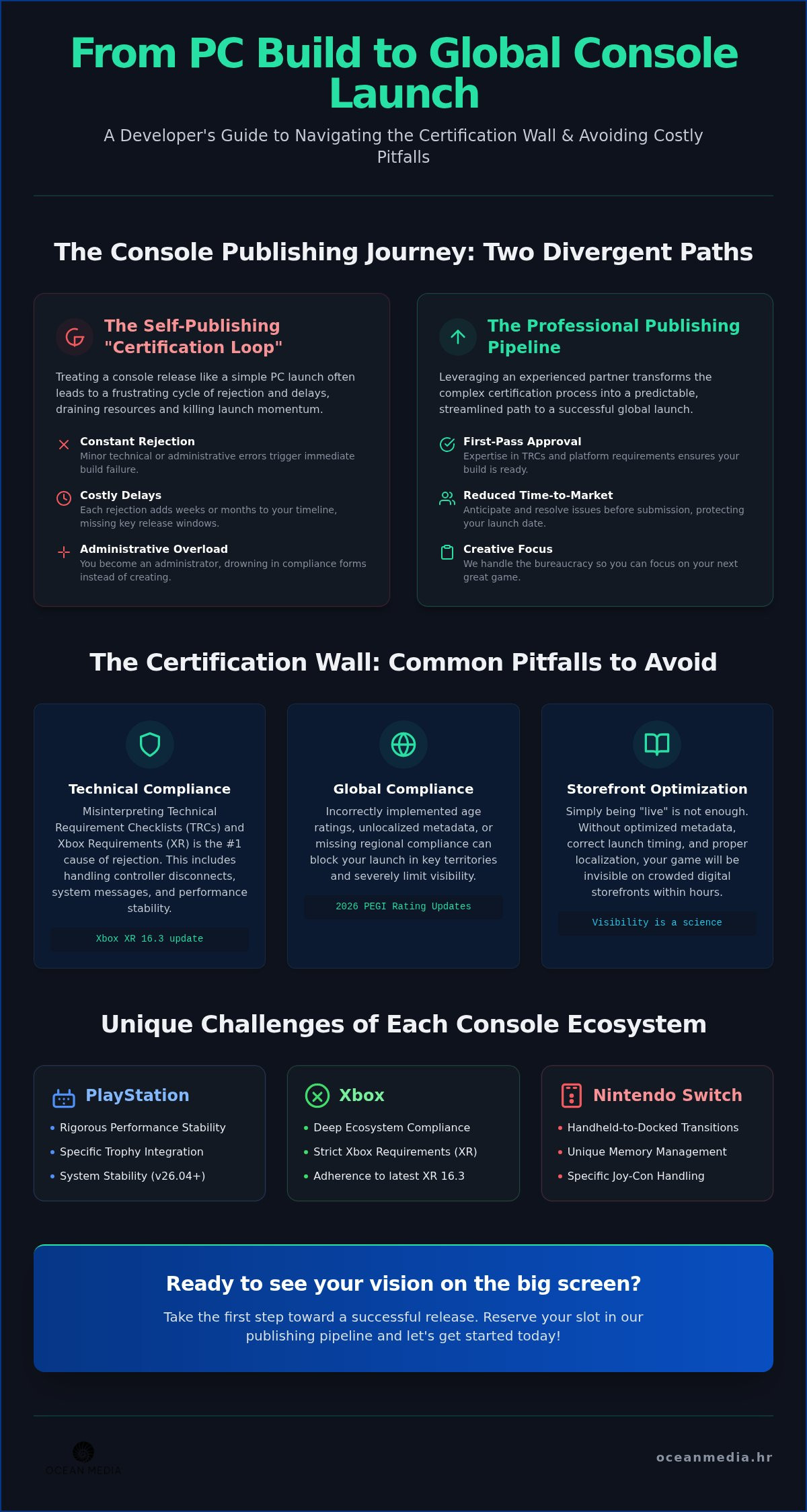
Indie Game Publishing Without Self-Publishing: A Comparison
Choosing between self-publishing and partnering with a professional often comes down to a misunderstanding of ROI. While the allure of keeping 100% of your revenue, after the platform's standard 30% commission, is strong, the hidden costs of "going it alone" are frequently devastating. If your team spends three months stuck in a certification loop, those are three months of lost sales and developer salaries that can never be recovered. One of the most common console publishing mistakes is failing to calculate the opportunity cost of your time. When you act as your own publisher, you aren't just a developer anymore; you're a full-time compliance officer.
Risk mitigation is the invisible benefit of a publishing partnership. When a submission fails, a partner handles the fallout, technical debugging, and re-submission logistics. We take the hit so your creative flow remains uninterrupted. Tapping into 20 years of console history means we already know the shortcuts through the certification wall that would take an independent team years to discover. We focus on the digital-only future. Digital game sales accounted for 95.4% of all revenue in 2025, making storefront optimization more critical than ever. We ensure your title doesn't just exist on a store but thrives there.
Self-Publishing vs. Partner Publishing Framework
- Administrative Burden: In a self-publishing model, the developer carries 100% of the weight, from tax forms to metadata. A partner absorbs this entirely, allowing you to focus on your next title.
- Platform Access: Individual developers must negotiate directly with platform holders. Established partners leverage existing relationships to secure better visibility and faster communication.
Deciding which path fits your studio requires an honest look at your internal resources. You can read more about the revenue logic in our guide on Game Publisher vs Self-Publishing: Which Wins?. Most studios find that the time saved by offloading logistics far outweighs the royalty split.
The Value of a Collaborative Partner
Maintaining creative control is non-negotiable for most developers. We act as a seasoned guide, providing the technical infrastructure while you keep the keys to your vision. We don't offer work-for-hire development; we offer a bridge to the global market. Our focus remains on digital distribution across PlayStation, Xbox, and Switch, ensuring your game reaches the widest possible audience without the risks of common console publishing mistakes. If you're ready to bring your game to consoles with a partner who values your creative independence, reserve your slot in our publishing pipeline and let's get started today!
Securing Your Global Launch with Ocean Media
The transition from a completed build to a globally recognized digital release is the most critical phase of your game's lifecycle. You have seen how technical hurdles, administrative burdens, and common console publishing mistakes can stall even the most promising titles. We believe your primary focus should remain on the creative process while we handle the logistical complexities. Our goal is to act as your seasoned guide, ensuring that the years you spent developing your vision result in a smooth, high-visibility launch on the world's most competitive storefronts.
Our approach simplifies the professional environment for indie studios. We don't just submit your game; we manage the entire publishing pipeline with a methodical, purposeful rhythm. From initial technical pre-checks to final storefront activation, we provide the infrastructure needed to succeed in 2026. This includes navigating the latest platform updates and compliance standards that we've analyzed in previous sections. By offloading the heavy lifting to us, you avoid the "certification loop" and ensure your marketing window is utilized to its full potential.
Bringing Your Game to Consoles the Right Way
Our 20+ years of experience in the gaming industry is your biggest asset when bringing your game to consoles. We've built deep roots in this field, allowing us to anticipate platform-specific demands before they become roadblocks. Our step-by-step approach to platform submission ensures that your build is optimized for PlayStation, Xbox, and Nintendo Switch storefronts from day one. We collaborate with you to maximize global reach, handling the regional nuances and localization requirements that often trip up independent teams. This professional partnership is designed to be inclusive and enthusiastic, reflecting our genuine passion for the medium.
Reserve Your Slot in Our Publishing Pipeline
Success on digital storefronts requires more than just a great game; it requires a reliable and knowledgeable leader to navigate the digital landscape. If you are ready to avoid common console publishing mistakes and secure a professional path to market, we are here to help. Our structured path is designed to be easily accessible for busy professionals who value consistency and growth. Visit our Ocean Media Developers Page to learn more about how we can collaborate on your next release. Don't let administrative errors or technical pitfalls derail your vision. Take the next step toward a global digital launch, reserve your slot in our publishing pipeline and let's get started today!
Launch Your Vision with Confidence
The journey from a final build to a live global storefront is the ultimate test of your studio's resilience. You now understand how common console publishing mistakes, from technical metadata oversights to certification failures, can jeopardize years of hard work. By prioritizing storefront optimization and technical compliance, you ensure your game stands out in an increasingly crowded digital market. Our team brings 20+ years of console publishing expertise to your project, acting as a bridge between your creative vision and a global audience.
We specialize in navigating the intricate requirements of PlayStation, Xbox, and Nintendo Switch storefronts, focusing exclusively on digital distribution to maximize your title's reach. Let's simplify the transition together and turn your creative milestone into a lasting commercial success. Our collaborative approach ensures you maintain control while we handle the logistical heavy lifting. Your game deserves a launch that is as polished as its mechanics. Reserve your slot in our publishing pipeline and let's get started today!
Frequently Asked Questions
What are the most common technical reasons a game fails console certification?
Handling controller disconnections and performance drops below platform stability targets are the most common technical reasons for certification failure. In 2026, many rejections stem from the updated Xbox XR 16.3 requirements or PlayStation 5 system software version 26.04-13.42.00 standards. These technical hurdles are common console publishing mistakes that delay launches. Pre-vetting your build against TRCs is the only way to ensure a first-time pass.
Is indie game publishing without self-publishing more expensive in the long run?
Partnership is often more cost-effective when you factor in the opportunity cost of your developer hours. While self-publishing avoids royalty shares, it forces your team to spend hundreds of hours on administrative tasks and global compliance. For indie developers working with a publisher in 2026, the average revenue share is 67.9% without a development advance. This investment shaves months off your timeline and prevents costly marketing delays.
How long does the console certification process usually take in 2026?
Console certification usually takes between two and four weeks for an initial review in 2026. This timeline depends on the specific platform and the technical complexity of your build. Working with a seasoned guide helps you navigate these windows efficiently by preventing the fail results that trigger a total loop restart. To secure your release date, reserve your slot in our publishing pipeline and let's get started today!
Can I still have creative control if I work with a console publisher?
You maintain 100% creative control over your game's mechanics, narrative, and art style when partnering with our team. We act as a bridge to the global market, handling the technical and administrative heavy lifting so you can focus on your vision. Our role is to provide the infrastructure for bringing your game to consoles without interfering with your creative process. We do not offer work-for-hire development services.
What is the IARC system and why is it important for indie console games?
The International Age Rating Coalition (IARC) system streamlines age ratings across multiple territories through a single questionnaire. It is vital for indie titles because it covers regions like North America and Europe simultaneously. However, as of June 2026, IARC results are heavily scrutinized. Games with paid random items now default to PEGI 16, and unrestricted online communication triggers a PEGI 18. We ensure your submission accurately reflects these regulatory changes.
Does Ocean Media handle physical retail distribution for indie titles?
Ocean Media focuses strictly on digital distribution and does not offer physical retail distribution services. We specialize in maximizing your visibility on digital storefronts like the PlayStation Store, Xbox Marketplace, and Nintendo eShop. Given that digital sales accounted for 95.4% of all revenue in 2025, our strategy prioritizes the most profitable and accessible channel for independent creators. We believe digital-first is the most effective way of reaching a global audience.
What information do I need to provide for a console storefront submission?
You must provide high-quality localized trailers, screenshots, metadata keywords, and a registered legal entity. Platform holders also require specific documentation regarding tax compliance and regional age ratings. Incomplete metadata is one of the common console publishing mistakes that can hide your game from search results. We help you organize these assets into a professional package that meets the specific format and length requirements of each console manufacturer.
How does a publisher help with global age ratings like PEGI and ESRB?
We act as your compliance officer, navigating the complex June 2026 updates to the PEGI framework. This includes identifying interactive risk features, such as loot boxes or daily quest rewards, which now trigger specific age classifications. We manage the submission process for ESRB, USK, and OFLC to ensure your game isn't blocked in major markets. Our expertise prevents the global compliance errors that often derail self-published titles during their final release.


