

Did you know that digital software downloads now account for up to 85% of all console game sales? This massive shift has made console game digital distribution the definitive path to commercial success for modern developers. You've likely spent years perfecting your mechanics and art, only to find that the final mile (getting through the gates of the PlayStation Store, Xbox Store, and Nintendo eShop) is a minefield of technical requirements. It's a daunting reality where a single certification error can delay your launch by weeks and drain your remaining budget.
We understand the pressure of bringing your game to consoles while managing strict platform compliance and global age ratings. You shouldn't have to choose between creative excellence and administrative exhaustion. This guide provides a clear roadmap to mastering these storefronts, showing you how a strategic publishing partner can handle the heavy lifting. We'll explore the nuances of 2026 certification standards and how our structured publishing pipeline ensures a smooth, global release. Let's turn your vision into a worldwide digital reality; reserve your slot in our publishing pipeline and let's get started today!
Key Takeaways
- Grasp how console game digital distribution has become the primary revenue driver and learn to capitalize on digital storefront dominance.
- You don't have to face technical hurdles alone; master the nuances of TRCs, XRs, and Lotcheck to clear certification without expensive delays.
- Streamline your journey by understanding how a professional publishing pipeline manages global age ratings and complex storefront metadata.
- Compare the realities of self-publishing against the benefits of a strategic partnership to maximize your game's global visibility.
- Find out how to simplify the task of bringing your game to consoles; reserve your slot in our publishing pipeline and let's get started today!
What is Console Game Digital Distribution in 2026?
Console game digital distribution is the specialized process of delivering your creative work directly to players through platform-specific storefronts like the PlayStation Store, Xbox Games Store, and Nintendo eShop. By 2026, the industry has moved decisively past the era of physical retail for most independent creators. While PC platforms often feel like an open market, consoles operate as curated ecosystems. These platform holders act as technical gatekeepers, ensuring every title meets rigorous standards before it reaches a global audience. Understanding the history of the digital distribution of video games highlights how we've arrived at this point of total digital market saturation.
For a developer, this means your "publishing pipeline" is no longer just about logistics. It's about compliance, relationship management, and visibility. You're not just uploading a file; you're entering a professional partnership with a platform holder. To see how we simplify this transition, explore our developer resources and see how our experience can work for you.
The Dominance of Digital Storefronts
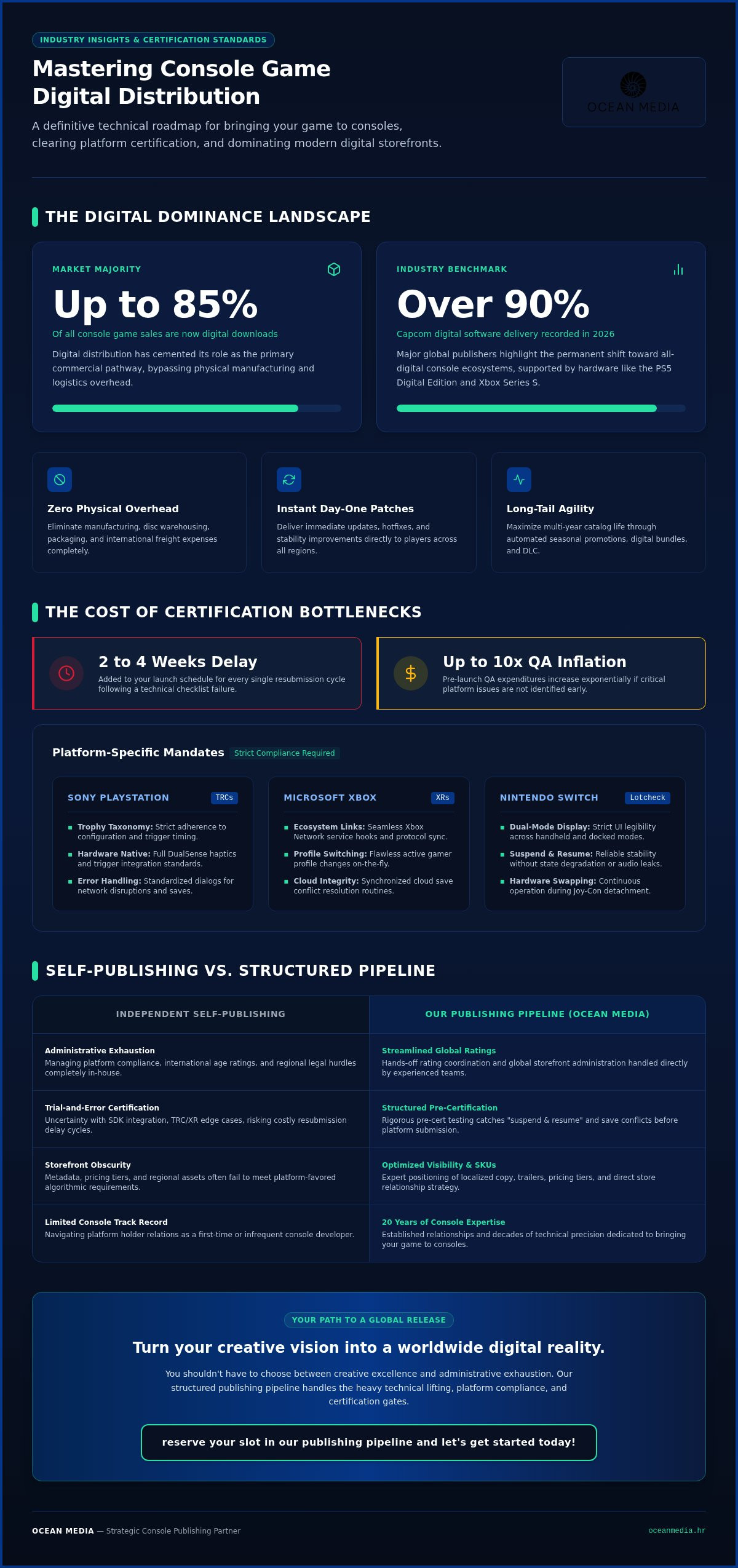
Digital-first isn't just a trend anymore. It's the standard. With major global publishers like Capcom recording over 90% digital software delivery in 2026, the infrastructure for physical indie releases has all but vanished. Digital distribution allows you to bypass the massive overhead costs of manufacturing, warehousing, and shipping physical discs or cartridges. This agility is vital. It lets you push day-one patches instantly and manage long-tail revenue through seasonal sales or DLC without worrying about inventory shelf life. The rise of all-digital console SKUs, like the PS5 Digital Edition and Xbox Series S, has cemented this shift. If you aren't optimized for digital, you're missing the vast majority of the market.
Key Players in the Console Ecosystem
Sony, Microsoft, and Nintendo each have distinct philosophies and technical mandates that you must respect. Sony focuses heavily on high-fidelity compliance and DualSense integration. Microsoft prioritizes Xbox Network ecosystem features and cloud save integrity. Nintendo emphasizes UI legibility and stability across handheld and docked modes. Their algorithms dictate your visibility. Without a strategic approach to these relationships, your game might get buried under the thousands of other titles. You need a professional approach to ensure your metadata, store assets, and regional pricing are optimized for these specific storefronts.
Don't let the administrative weight of these storefronts crush your creative spirit. We've spent 20 years perfecting the art of bringing your game to consoles. Our team acts as your seasoned guide through every technical requirement. If you're ready to scale your reach, reserve your slot in our publishing pipeline and let's get started today!
Navigating the Technical Hurdles of Console Certification
Certification is the final boss of game development. In the ecosystem of console game digital distribution, failing a Technical Requirements Checklist (TRC) or Xbox Requirement (XR) is a costly setback. A single rejection often results in a 2 to 4 week launch delay per resubmission cycle and can inflate pre-launch QA expenditures by up to 10x if issues aren't caught early. This is why mastering the Software Development Kit (SDK) is vital. You've got to ensure your build integrates seamlessly with the console's native features, from controller haptics to network protocols.
Mastering the Platform Submission Requirements
Every platform holder has its own set of mandatory rules. Sony's TRCs require strict adherence to trophy taxonomy and error handling. Microsoft's XRs focus on Xbox Network integration and profile switching. Nintendo's Lotcheck tests UI legibility in both handheld and docked modes. These requirements are non-negotiable. Investing in console pre-certification and platform compliance is the best way to catch bugs like "suspend and resume" errors or cloud save conflicts before they cause a rejection. We've seen many studios struggle with these platform-specific features, but they are essential for a professional release.
Managing Storefront Metadata and Assets
The administrative side of a launch is just as demanding as the code. You'll need to prepare high-impact trailers, localized descriptions, and high-resolution icons for every digital storefront. Managing SKUs, pricing tiers, and release dates across different time zones requires meticulous attention to detail. You must also navigate the International Age Rating Coalition (IARC) system to secure age ratings for North America, Europe, and beyond. While digital-only releases use IARC at no cost, any discrepancy between your game's content and its rating can lead to an immediate storefront ban.
Handling these technical and administrative burdens alone is overwhelming for most independent studios. We act as your seasoned guide, using our 20 years of experience to manage the complexities of platform submissions. If you're looking for a partner to simplify your path to console storefronts, we're ready to step in and take that weight off your shoulders.
Let's get your game over the finish line. We've built a structured path that takes the guesswork out of certification and storefront management. Don't let technical hurdles delay your success; reserve your slot in our publishing pipeline and let's get started today!
Digital Distribution vs. Self-Publishing: Making the Right Choice
You face a pivotal decision as you near the finish line: do you handle the release yourself or seek a partner? While the idea of total independence is tempting, the reality of console game digital distribution involves a mountain of administrative labor that can derail even the most organized studio. It's not just about the code. It's about managing the "invisible" tasks that keep your game on the storefront and compliant with international law. You're effectively choosing between being a developer and being a full-time administrator.
The True Cost of Going It Alone
Self-publishing requires you to become an expert in several non-development areas. These include:
- Global tax compliance and financial reporting.
- Regional age rating certificates and IARC submissions.
- Storefront metadata localization and asset management.
- Direct communication with platform account managers.
Calculating the hours you'll spend on paperwork versus actual development often reveals a hidden deficit. If your team spends three weeks wrestling with metadata instead of polishing gameplay, you've already lost momentum. For indie developers, the return on investment for digital publishing is often found in the time saved. A single missed launch window because of a certification delay doesn't just hurt your pride; it damages your revenue. When you weigh the cost of a royalty split against the cost of a failed launch, the value of a seasoned guide becomes clear.
The Partner Advantage
A strategic partner provides more than just a name on a store page. We offer 20 years of established relationships with platform holders, giving you access to submission priority and direct lines of communication that independent studios rarely possess. We handle the entire publishing lifecycle, from strategic advice on launch timing to the professional management of post-launch updates. This allows you to focus on what you do best: creating great games. By integrating your work into our established publishing pipeline, you bypass the learning curve and head straight for a global audience.
Deciding which path to take is a critical step in bringing your game to consoles successfully. To help you weigh your options, we've put together a guide on Choosing the Right Indie Game Publishing Partner. It breaks down the specific questions you should ask before signing any agreement.
Let's simplify your journey to the global market. We're here to manage the technical and administrative heavy lifting so your creative vision remains the priority. If you're ready to see your game on every major storefront, reserve your slot in our publishing pipeline and let's get started today!
Executing a Global Digital Release Strategy
You've polished the mechanics and perfected the art. Now comes the technical sprint. Executing a global release through console game digital distribution requires a disciplined, four-step approach to avoid last-minute disasters. We start by finalizing your build and entering a pre-certification phase. This involves checking every platform requirement, from trophy taxonomy to network stability, before the platform holders even see the code. Once we pass these internal checks, we move toward "gold" status on the console servers, marking the point where your game is officially ready for public consumption.
Global Reach and Localization
Localization is your most powerful tool for expanding your audience. It's about more than just text. You need to adapt your entire storefront presence to resonate with players in different cultures. This includes trailers, screenshots, and even your pricing strategy. Regional pricing is vital. You should adjust your costs to reflect local purchasing power in markets like Brazil or Indonesia to ensure your game remains competitive. To learn more about this process, read our 2026 Global Console Launch: Indie Game Localization Guide.
Age Ratings and Compliance
Securing the right ratings is a legal necessity for bringing your game to consoles. Digital storefronts have streamlined this through the IARC system, which provides ratings for the ESRB, PEGI, and others at no cost. This is a significant advantage over physical releases, which still require paid evaluations from individual boards. You still need to be careful with specific markets like Germany (USK) or Australia, where compliance rules are particularly strict. Our Global Console Game Age Rating Guide for Developers 2026 covers everything you need to know to avoid a storefront ban.
The final submission is the culmination of your hard work. We manage this entire transition, handling the metadata and the administrative hurdles that often trip up smaller studios. Our goal is to make the process of releasing your game globally as seamless as possible. We've spent 20 years refining our publishing pipeline to ensure every release is handled with professional precision. Don't leave your global success to chance; reserve your slot in our publishing pipeline and let's get started today!
Ocean Media: Your Strategic Partner in the Console Publishing Pipeline
Choosing a partner is about finding a team that respects your vision while possessing the technical muscle to execute it. At Ocean Media, we've spent over 20 years focusing exclusively on the nuances of console game digital distribution. We don't get distracted by the fading logistics of physical retail. Instead, we channel every bit of our expertise into ensuring your digital release is flawless across PlayStation, Xbox, and Nintendo storefronts. Our role is to act as your seasoned guide, navigating the complexities we've discussed so you can remain focused on your craft.
The Ocean Media difference lies in our blend of approachable creative partnership and professional authority. We aren't just a service provider; we're a collaborator invested in your long-term growth. We simplify the transition from developer to published console studio by providing a reliable framework that handles the administrative and technical burdens. This specialized focus ensures your game reaches the widest possible audience without the friction of platform-specific hurdles.
Our Expertise, Your Vision
We bridge the gap between your creative milestones and global commercial success. With more than 350 commercial console releases under our belt, our history is one of international collaboration and steady growth. We understand that every studio has unique needs, whether you're a solo developer or a mid-sized team. By specializing in digital-only publishing, we maximize your game's visibility in a market where digital downloads now dominate the landscape. If you're looking for specific regional insights, our article on Console Game Publishing in Europe: The Developer’s Guide to 2026 offers a deeper dive into one of the world's most vibrant markets.
Get Started with Ocean Media
Our onboarding process is designed to be as efficient as the games we publish. We've stripped away the corporate red tape to offer a structured, transparent path forward. When you join our publishing pipeline, you gain immediate access to our technical expertise, platform relationships, and administrative support. We handle the heavy lifting of certification and storefront management, providing a clear roadmap from your final build to a global launch. You can visit our Developers Page to learn more about our submission process and how we handle the technical side of bringing your game to consoles.
The journey from a dev kit to a global digital audience doesn't have to be a solo struggle. We're ready to put our two decades of experience to work for you, ensuring your game receives the professional release it deserves. Let's turn your hard work into a worldwide success story. Don't wait for the market to move without you; reserve your slot in our publishing pipeline and let's get started today!
Ready to Launch Your Vision on the Global Stage?
Mastering console game digital distribution in 2026 is about more than just a great build. It requires navigating the precise technical mandates of Sony, Microsoft, and Nintendo while executing a localization strategy that resonates across borders. You've seen the data; digital storefronts are now the primary heartbeat of the industry. Success means moving beyond development and into a professional publishing pipeline that guarantees your work actually reaches the players who want it.
We've spent over 20 years perfecting this journey. Our dedicated focus on digital-first distribution means we understand exactly how to clear certification hurdles and optimize your storefront presence without the distractions of physical retail. We're here to act as your seasoned guide, handling the administrative heavy lifting so you can stay focused on your creative passion. Let's work together to turn your game into a global digital success story. It's time to take the next step and see your hard work on every major console storefront. Reserve your slot in our publishing pipeline and let's get started today!
Frequently Asked Questions
What is the difference between console digital distribution and self-publishing?
Digital distribution is the delivery method; self-publishing means you handle the technical and administrative weight alone. While anyone can attempt to self-publish, using a partner means you plug into an existing publishing pipeline. This offloads the burden of managing platform relationships and metadata, allowing you to focus on development while experts handle the global storefront logistics. It's the most efficient way to ensure a professional launch.
How long does the console certification process typically take in 2026?
Microsoft's official Service Level Agreement for digital base games is currently 4 business days. Content updates are often faster, averaging about 2 business days. Sony and Nintendo timelines vary based on the complexity of the build and current submission volume. It's best to plan for several weeks to account for potential rejections and the necessary resubmission cycles that often follow initial testing.
Do I need a publisher to get my game on the PlayStation Store or Xbox Store?
You aren't strictly required to have a publisher, but the barriers to entry are significant. Sony requires a verified legal corporate entity and strict NDAs through their Partners Portal. Microsoft increased Xbox Dev Kit prices to $2,000 in 2025, adding upfront financial pressure. A partner simplifies this by providing the hardware, managing the portal access, and ensuring your game meets every technical mandate for a successful launch.
What are the most common reasons games fail console certification?
Technical rejections often stem from failures in suspend and resume states or improper cloud save handling. Other frequent pitfalls include UI text legibility issues in handheld mode for Nintendo Switch and trophy or achievement taxonomy errors on PlayStation and Xbox. These compliance issues are why pre-certification testing is a non-negotiable step in our publishing pipeline to avoid costly launch delays and resubmission fees that drain your budget.
How do global age ratings like PEGI and ESRB work for digital-only games?
Digital-only releases utilize the International Age Rating Coalition (IARC) system at zero cost. This allows you to secure ESRB, PEGI, USK, and other regional ratings simultaneously through a single questionnaire. This is a massive advantage over physical releases, which require separate, paid evaluations from each board. We help you navigate this questionnaire to ensure your content is accurately represented and compliant with every platform holder's rules.
Can a publisher help with storefront visibility and algorithms?
Yes, we specialize in optimizing storefront metadata to improve your visibility. Platform algorithms favor games with localized descriptions, high-quality trailers, and professional asset kits. We also leverage our 20 years of industry experience to manage relationships with platform account managers. This can lead to better featuring opportunities and placement on the storefront, which are critical for successful console game digital distribution on a global scale.
Does Ocean Media offer physical retail distribution for indie games?
No, we focus exclusively on digital distribution. By avoiding the distractions and overhead of physical retail, we can dedicate our full attention to your game's success on digital storefronts. This specialization is a core strength in 2026, as digital downloads now account for up to 85% of all console game sales. Our expertise is entirely centered on console game digital distribution through digital channels.
What platforms does Ocean Media support for digital distribution?
We provide comprehensive support for all major console platforms, including PlayStation 4 and 5, Xbox One, Xbox Series X|S, and the Nintendo Switch. Our team handles the specific technical requirements for each ecosystem, from Sony's TRCs to Microsoft's XRs. If you're ready to reach a global audience across these storefronts, reserve your slot in our publishing pipeline and let's get started today!


