

A single failed certification cycle can add four to eight weeks of brutal delays to your release schedule while inflating engineering costs by over 15%. Figuring out how to get game approved on console storefronts often feels like entering an opaque maze. You've spent years polishing gameplay mechanics and squashing bugs, yet platform-specific compliance criteria like Sony TRCs, Microsoft XRs, and Nintendo Lotcheck can trigger instant rejections over an unhandled controller disconnect or an outdated branding glyph.
You don't have to gamble your target launch date on trial-and-error submissions. We designed this guide to help you master the technical standards, platform checklists, and audit procedures needed to pass certification on your first attempt. Bringing your game to consoles becomes entirely manageable once you know what platform testers actually evaluate behind closed doors. Here is our clear roadmap covering edge-case system states, regional requirements, and setting up an internal publishing pipeline that secures your green light on time.
Key Takeaways
- Understand why console certification evaluates strict operating system compliance rather than general gameplay bugs.
- Discover the proven criteria for how to get game approved on console by mastering system-state transitions, profile switches, and controller disconnects.
- Learn why testing your builds on native devkits within retail-equivalent sandbox environments prevents costly late-stage rejections.
- Prepare regional storefront assets and automated IARC age ratings early to ensure your digital store page launches in sync with your game binary.
- Leverage a dedicated publishing pipeline to audit your build against platform standards and secure first-pass approval without release delays.
Understanding Console Certification: TRC, XR, and Lotcheck Requirements
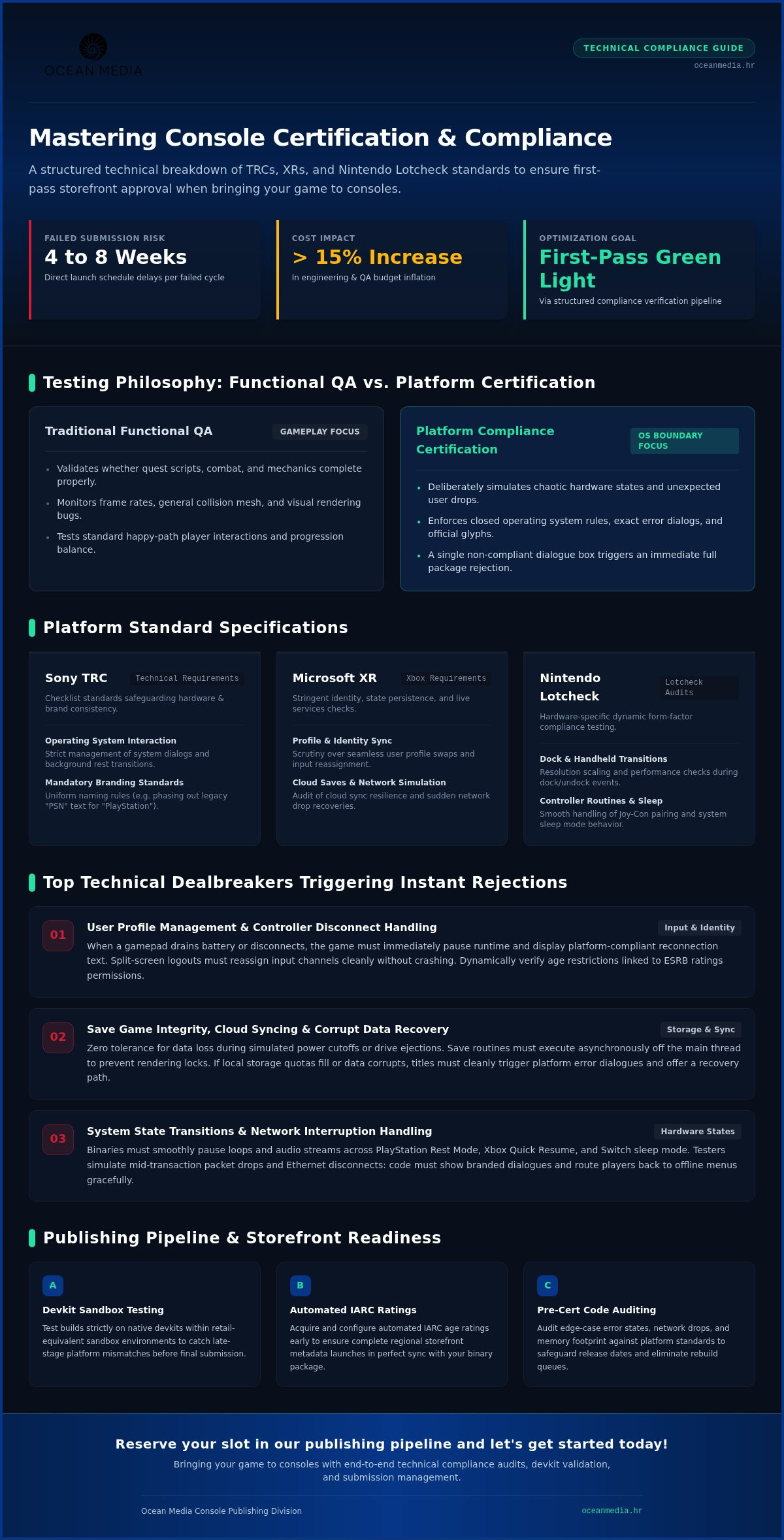
Console certification isn't about whether your combat feels responsive or your lighting looks stunning. It represents an inflexible gating mechanism enforced by Sony, Microsoft, and Nintendo to safeguard their hardware ecosystems. When learning how to get game approved on console platforms, you have to separate standard bug hunting from platform compliance. Passing requires strict adherence to closed operating system rules, where a single non-compliant dialogue box will instantly derail your launch.
Deconstructing Platform Standards: TRC, XR, and Lotcheck
Each platform operator maintains proprietary compliance benchmarks. Sony enforces Technical Requirements Checklists (TRCs), prioritizing smooth operating system interaction and mandatory branding standards, such as phasing out legacy "PSN" text in favor of uniform "PlayStation" terminology. Microsoft requires strict adherence to Xbox Requirements (XRs), heavily scrutinizing profile management, cloud saves, and network drops under real-time simulation tools. Meanwhile, Nintendo Lotcheck audits handheld-to-dock transitions, sleep mode behavior, and Joy-Con controller pairing routines. Bringing your game to consoles demands balancing these divergent rules across a unified codebase without compromising stability.
Certification Testing vs. Traditional Game QA
Traditional functional QA checks whether quests complete, collision holds, and frame rates remain steady. Platform certifiers operate differently. Testers conduct rigorous game compliance testing designed to break your title at the operating system boundary. They trigger abrupt interruptions. They disconnect controllers during active disk writes, yank network cables during microtransactions, and toggle system sleep modes mid-cinematic.
A completely crash-free game will fail instantly if an error message displays an incorrect button glyph, or if save data corrupts when swapping user profiles. These missteps force a full package rejection, burning precious engineering hours in queue rebuilds. Mastering these platform criteria early protects your release window and keeps your production budget intact.
Top Technical Dealbreakers That Trigger Instant Certification Rejection
First-time submissions routinely stumble over edge cases rather than core gameplay bugs. Platform certification teams rarely play your title as intended; instead, they deliberately simulate chaotic hardware environments. Learning how to get game approved on console storefronts requires engineering robust safeguards against user errors, unexpected system interruptions, and sudden hardware drops.
User Profile Management and Controller Disconnect Handling
Controller disconnects represent a frequent failure point. If a wireless gamepad drains its battery or drops connection mid-action, your game must immediately suspend active play and prompt the user with platform-compliant reconnection text. Multi-profile handling is equally tricky. When a player logs out from a local split-screen session or swaps controller ports, your systems must reassign input channels cleanly without crashing. Builds must also verify age permissions dynamically, respecting parental restrictions linked to content thresholds from the ESRB ratings process.
Save Game Integrity, Cloud Syncing, and Corrupt Data Recovery
Console gatekeepers show zero tolerance for data loss. Platform testers simulate power cutoffs, drive ejections, and cloud sync failures during active write routines. Your save operations must execute asynchronously off the main thread so rendering never locks up. If local drive quotas fill up or save data corrupts, your title cannot freeze on a black screen. It must cleanly trigger platform error dialogues and offer players a straightforward recovery path.
System State Transitions and Network Interruption Behavior
Modern hardware depends heavily on background suspension modes like PlayStation Rest Mode, Xbox Quick Resume, and Nintendo Switch sleep mode. Your binary must pause runtime loops smoothly, park audio streams, and cleanly re-authenticate network connections upon waking. Testers will pull Ethernet cables mid-transaction to see if your software crashes. If sudden packet loss occurs, your code must display branded error dialogues and return players to offline menus gracefully.
Isolating these asynchronous platform edge cases requires extensive internal stress testing. If you want to simplify bringing your game to consoles, our experienced crew can audit your release candidates through a proven console publishing pipeline that neutralizes compliance traps before platform teams ever touch your code.
The Console Submission Lifecycle: From Devkit Validation to FQA
Securing platform approval is a phased marathon rather than a single file upload. Understanding how to get game approved on console storefronts means mapping your development milestones against first-party turnaround windows. Microsoft generally clears clean builds in 4 to 7 business days, Sony TRC testing spans 5 to 10 business days, while Nintendo Lotcheck requires 2 to 4 weeks depending on seasonal queue congestion. Missing a target window throws off your entire marketing calendar, making milestone planning critical.
Phase 1: Devkit Provisioning and Engine Target Optimization
Securing hardware begins inside closed developer networks. You must sign platform agreements, such as Sony's Global Developer and Publisher Agreement, to access the PlayStation SDK and request devkits, or enroll in ID@Xbox to acquire GDK hardware. Optimizing early on these units ensures stable frame rates under real thermal loads. Microsoft strictly enforces XR-130 parity, demanding identical gameplay features between Xbox Series S and Series X. For a deeper breakdown of this preliminary operational setup, check out our guide on how to publish a game on console.
Phase 2: Internal Pre-Cert Audits and Submission Candidate Builds
Uploading an untested build directly to first-party evaluators invites immediate failure. Seasoned teams mandate an internal console pre-certification phase to stress-test candidate binaries against platform-specific scripts. Your engineers must purge debug menus, eliminate developer cheats, and scrub local test telemetry. Xbox cert testing now executes on retail hardware inside the CERT sandbox rather than developer mode, making retail-equivalent sandbox validation essential before packaging your master binary.
Phase 3: Formal Platform QA and Waiver Requests
Once you trigger formal submission, platform QA logs issues across tiered severity levels:
- Showstoppers: Critical compliance breaches that halt testing instantly, such as unhandled crashes or profile-switching corruption.
- Major Defects: Violations of mandatory system requirements that prevent greenlight approval unless resolved via hotfix.
- Minor Bugs: Low-risk issues, such as minor visual clipping or non-critical text truncation, that may qualify for formal launch waivers.
When an edge-case bug cannot be resolved before submission deadlines, your producer can submit a waiver request to your platform account lead. Approvals depend on demonstrating that the issue poses no risk to player hardware, cloud data, or first-party services.
Storefront Readiness: Metadata, Age Ratings, and Regional Compliance
Clearing technical code checks is only half the battle. Your game binary cannot go live without an approved storefront configuration. When evaluating how to get game approved on console storefronts, platform teams run independent audits on your product pages, regional age certifications, promotional artwork, and localized descriptive text. Failing a store-level compliance audit will freeze your launch just as quickly as a fatal crash.
Securing Mandatory Global Age Ratings via IARC and Regional Boards
Digital storefront submissions rely on the International Age Rating Coalition (IARC), which has issued over 19 million digital ratings worldwide. The automated questionnaire is free for digital-only storefront distribution across the PlayStation Store, Xbox Store, and Nintendo eShop. It instantly generates certificates for ESRB, PEGI, USK, ClassInd, and ACB.
Territory pitfalls still exist. In South Korea, GRAC enforces an age-19 rating standard, meaning titles rated IARC 19+ require manual board submissions to prevent automatic delisting. In Japan, Xbox prohibits free demos rated CERO Z or IARC 18+. To review these jurisdictional requirements in depth, check our global console game age rating guide.
Storefront Asset Guidelines and Localization Standards
First-party storefront teams enforce strict visual safe zones across hero banners, square icons, and store trailers. Cropping a required platform logo or violating UI text padding triggers instant metadata rejection. Storefront listings must also mirror your game's actual localization status:
- Language Parity: If store copy lists French, Italian, German, Spanish, or Japanese, in-game menus and subtitles must fully reflect those options without untranslated string errors.
- Asset Clearances: Screenshots and gameplay trailers cannot feature developer debug metrics, mouse cursors, or unapproved peripheral references.
- Regional Text Compliance: Store descriptions must match regional legal mandates, including mandatory health warnings and consumer return notices.
For a detailed breakdown on coordinating multi-region storefront assets, read our 2026 global console launch guide. Coordinating these assets alongside binary certification takes time and precision. When you are ready to remove the friction of bringing your game to consoles across global digital storefronts, submit your project to our publishing team so we can handle compliance and keep your release on schedule.
How a Console Publishing Partner Streamlines Your Path to Approval
Navigating certification alone often forces independent studios to split focus between creative game development and technical compliance bureaucracy. Partnering with a dedicated publisher transforms this unpredictable gauntlet into a structured release roadmap. Instead of treating platform rules as an eleventh-hour scramble, an experienced partner integrates compliance testing across your production cycles, ensuring your team knows exactly how to get game approved on console ecosystems without burning development cycles.
The Advantage of Seasoned Platform Relationships and Pre-Cert QA
Direct communication channels with first-party platform managers change everything. When technical criteria produce ambiguous edge cases, an established publisher quickly clarifies requirements with platform leads or negotiates formal waiver requests. As detailed in our breakdown of what console game publishers do, dedicated partners maintain internal QA suites specifically calibrated to simulate Sony TRC, Microsoft XR, and Nintendo Lotcheck stress cases on native devkits. Uncovering suspend-state bugs and profile conflicts before official submission prevents expensive failed testing loops.
Securing Your Console Release with Ocean Media
Bringing your game to consoles should mark the triumphant culmination of your hard work, not an administrative headache. With over 20 years of console game publishing experience, Ocean Media bridges the gap between your game build and successful platform storefront greenlights. We manage technical compliance audits, coordinate multi-region digital age ratings, configure digital storefront metadata, and execute end-to-end digital submissions across PlayStation, Xbox, and Nintendo.
Our structured approach takes the guesswork out of console certification, safeguarding your target launch window and protecting your release momentum. Ready to launch smoothly across global digital storefronts? Take the next step: reserve your slot in our publishing pipeline and let's get started today!
Launch Your Title Across Console Storefronts with Confidence
Mastering how to get game approved on console comes down to thorough preparation, technical discipline, and understanding platform boundaries. When you anticipate edge-case hardware states, validate candidate builds early, and align regional storefront metadata with your master binary, you turn an intimidating compliance audit into a predictable milestone.
You don't have to tackle this technical marathon alone. Backed by over 20 years of continuous console publishing and platform submission expertise, Ocean Media provides dedicated end-to-end lifecycle management across PlayStation, Xbox, and Nintendo Switch. We manage compliance audits, platform communications, and global digital storefront configurations so you can focus entirely on creating memorable gameplay. Bringing your game to consoles should be a triumphant leap forward for your studio. Take the clear route to launch: reserve your slot in our publishing pipeline and let's get started today!
Frequently Asked Questions
What happens if my game fails its initial console certification test?
The platform provides a detailed defect report categorizing issues by severity, and you must address all showstoppers before rebuilding and resubmitting. This failure resets the review queue, typically adding four to eight weeks to your release timeline while inflating engineering costs by roughly 15%. Minor defects can sometimes receive conditional waivers, but major compliance failures demand immediate code remediation and complete regression testing on native hardware.
Can indie developers submit games directly to console storefronts without a publisher?
Yes, independent developers can apply directly through self-publishing portals like ID@Xbox, PlayStation Partners, and the Nintendo Developer Portal. However, managing binary compliance, regional storefront metadata, and age rating boards requires substantial administrative and QA bandwidth. Navigating how to get game approved on console platforms independently often pulls core developers away from game production, leading many studios to partner with seasoned publishers.
How long does the console certification process typically take in 2026?
Turnaround times vary significantly across each first-party platform holder. Clean builds submitted to Microsoft Xbox generally clear certification in 4 to 7 business days. Sony PlayStation TRC evaluations typically run between 5 and 10 business days. Nintendo Lotcheck reviews require 2 to 4 weeks, depending on seasonal submission volume. You should always allocate a buffer for potential bug triage before locking your official launch date.
What are the most common reasons games fail Sony TRC or Xbox XR testing?
Edge cases surrounding system-state interruptions cause the overwhelming majority of first-pass rejections. Frequent dealbreakers include game crashes during background suspension or Quick Resume, missing pause prompts when a wireless controller disconnects, and save corruption during mid-session profile switches. Platform testers also reject binaries for displaying outdated branding, such as referencing legacy PSN nomenclature instead of PlayStation, or using mismatched button glyphs.
Is an IARC rating sufficient to release a game globally across all console stores?
An IARC rating covers standard digital storefront releases across most Western territories for free, but notable regional exceptions exist. South Korea's GRAC enforces an age-19 threshold, requiring traditional board submissions for titles rated IARC 19+ to avoid digital store delisting. Additionally, Japan restricts free downloadable demos rated CERO Z or IARC 18+ on Xbox. Factoring in these regional rules is vital when mastering how to get game approved on console marketplaces globally.
How much devkit hardware do I need to test compliance in-house?
You need at least one dedicated devkit per target ecosystem, configured to run in retail-equivalent sandbox modes. Relying solely on PC engine emulators or running builds with active debug privileges masks critical operating system bugs. For Xbox releases, testing must validate strict feature parity across both Xbox Series S and Series X hardware. Multi-platform launches require parallel compliance sweeps on PlayStation, Xbox, and Nintendo devkits.


